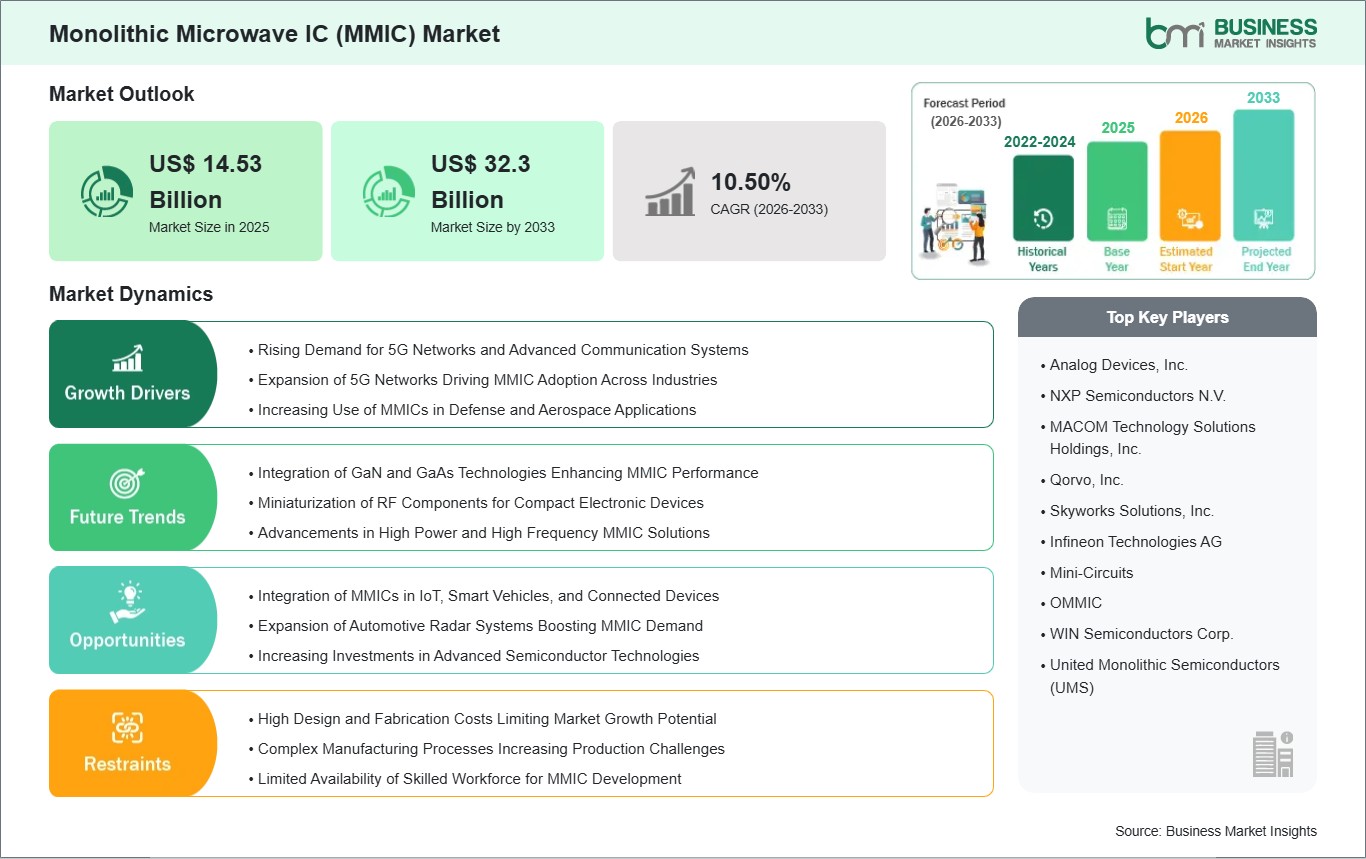
The Monolithic Microwave IC (MMIC) Market size is expected to reach US$ 32.3 Billion by 2033 from US$ 14.53 Billion in 2025. The market is estimated to record a CAGR of 10.50% from 2026 to 2033.
The global monolithic microwave IC market is expanding rapidly due to increased usage of high-frequency electronic devices in defense, aerospace, communication, and automotive applications. Monolithic microwave ICs are required for designing high-performance and compact high-frequency RF and microwave circuits and are therefore required in radar systems, satellite communication systems, and development of next-generation 5G communication systems. With advancements in semiconductor technologies such as GaAs, GaN, and SiGe, power efficiency and thermal stability have increased in monolithic microwave ICs, allowing them to operate efficiently in harsh and high-stress environments. The increased usage of IoT devices and development of next-generation automotive and aerospace technologies have increased the requirement for monolithic microwave ICs that offer high precision and high-frequency operations and have therefore become a cornerstone in modern electronic systems.
However, the monolithic microwave IC market faces various challenges. This is because high production costs, which result from the intricacy of semiconductor manufacturing processes, may impede growth, especially for smaller companies or emerging markets. There is also a technical challenge associated with integrating these devices with older technologies, especially in defense and industrial environments, where reliability is essential. In addition, the dynamics of technology trends demand continuous innovation, thus creating pressure on research and development activities. Nevertheless, continuous efforts towards miniaturization, multi-band, and high-frequency performance have created new growth opportunities. Emerging markets, such as automotive radar, satellite broadband connectivity, and next-generation communications, continue to expand the scope of growth potential for the MMIC market, creating a promising future, not only for established companies but also new market entrants.

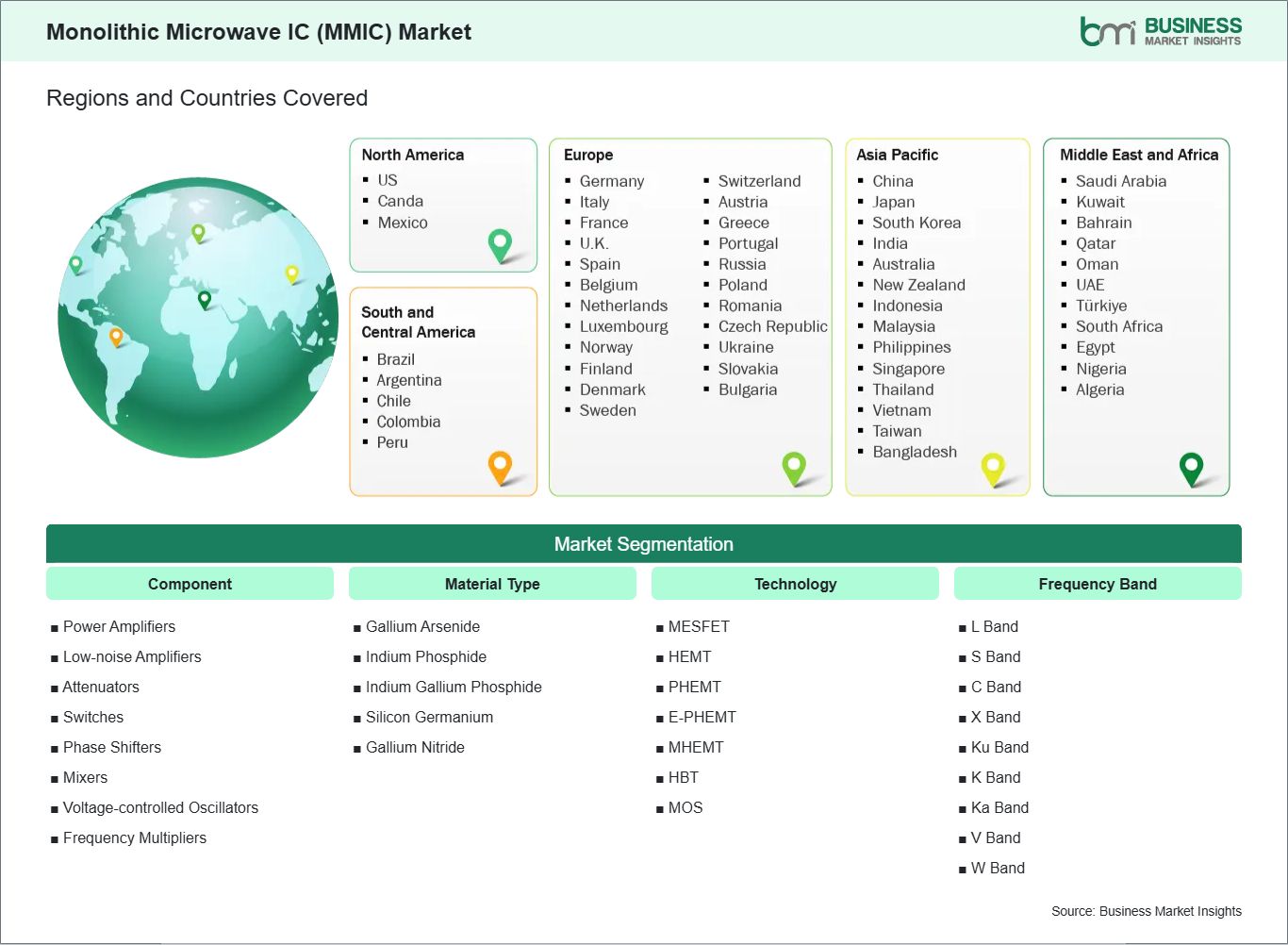
Key segments that contributed to the derivation of the monolithic microwave IC market analysis are component, material type, technology, frequency band and application.
The global market for MMIC is greatly benefiting from the widespread deployment of 5G networks, which is creating a high demand for sophisticated communication infrastructure. MMICs play a vital role in base stations, small cells, and mmWave transceivers, where high-frequency signal amplification is required, accompanied by low noise performance, which is essential for ultra-fast data communication. North America, European, and Asian countries are actively deploying 5G networks, creating a high demand for sophisticated MMICs, which can operate effectively at high frequencies and high bandwidths. Telecommunication service providers are actively investing in upgrading their networks to accommodate 5G and future networks, where high-performance MMICs are required to operate effectively at multiple bands and high power levels. These components have greatly improved telecommunication networks, enabling faster data communication, increasing network reliability, and facilitating the growth of connected devices, smart cities, and industry automation. Due to their importance, MMICs have become essential components, especially with the increasing focus on low-latency communications, where 5G networks have greatly benefited, thus propelling global growth. In addition, defense and aerospace requirements support 5G growth.
The increasing number of IoT devices and smart vehicle technologies is fueling the growth of the global MMIC market. MMICs are critical for the development of miniaturized RF circuits for wireless connectivity and vehicle radar. With the increasing number of vehicles equipped with radar-based safety features by automobile companies in the US, Europe, and Asia, MMICs are the go-to solution for reliable high-frequency amplification with the benefits of miniaturized size, low power consumption, and high thermal stability. Smart home and industrial IoT solutions also heavily depend on MMICs for efficient data transmission and communication. Devices such as environmental sensors, smart home meters, and wearable technology require MMIC-enabled RF modules for efficient transmission and accurate communication with the help of RF modules. The increasing number of connected devices around the world is fueling the growth of the global MMIC market.
The monolithic microwave IC market demonstrates steady growth, with size and share analysis highlighting evolving trends and competitive dynamics among key players. The report examines subsegments categorized within component, material type, technology, frequency band and application, offering insights into their contribution to overall market performance.
By component, the power amplifiers subsegment dominated the market in 2025, driven by their critical role in boosting signal strength for wireless communication, radar, and satellite systems, making them essential for high-frequency applications.
Based on material type, the gallium arsenide (GaAs) subsegment dominated the market in 2025, driven by its superior high-frequency performance, low noise, and reliability in RF and microwave applications across telecom and defense sectors.
In terms of technology, the HEMT subsegment dominated the market in 2025, driven by its high gain, low noise, and high efficiency, making it ideal for high-frequency and high-power applications.
On the basis of frequency band, the Ka Band subsegment dominated the market in 2025, driven by its extensive use in satellite communications and next-generation broadband networks due to wider bandwidth and higher data transmission rates.
In terms of application, the consumer/enterprise electronics subsegment dominated the market in 2025, driven by the growing demand for high-performance communication devices that integrate MMICs for efficient signal processing and connectivity
| Report Attribute | Details |
|---|---|
| Market size in 2025 | US$ 14.53 Billion |
| Market Size by 2033 | US$ 32.3 Billion |
| Global CAGR (2026 - 2033) | 10.50% |
| Historical Data | 2022-2024 |
| Forecast period | 2026-2033 |
| Segments Covered | By Component
|
|
Regions and Countries Covered
| |
| North America | US, Canada, Mexico |
| Europe | Belgium, Austria, Finland, Denmark, Greece, Poland, Romania, Russia, Ukraine, Czech Republic, Slovakia, Bulgaria, Italy, Luxembourg, Germany, Switzerland, France, Netherlands, Norway, Portugal, Spain, Sweden, United Kingdom |
| Asia-Pacific | Australia, China, India, Japan, South Korea, Indonesia, Malaysia, Philippines, Singapore, Thailand, Vietnam, Bangladesh, New Zealand, Taiwan |
| South and Central America | Brazil, Argentina, Peru, Chile, Colombia |
| Middle East and Africa | Bahrain, Kuwait, Oman, Qatar, Saudi Arabia, United Arab Emirates, Turkiye, South Africa, Egypt, Algeria, Nigeria |
| Market leaders and key company profiles |
|
The "Monolithic Microwave IC Market Size and Forecast (2022 - 2033)" report provides a detailed analysis of the market covering below areas:
The geographical scope of the Monolithic Microwave IC Market report is divided into North America, Asia Pacific, Europe, Middle East & Africa, and South & Central America. North America held the largest share in 2025.
The market for Monolithic Microwave ICs shows strong geographical differences, with North America clearly in the lead in the global market, driven by its advanced semiconductor technology, established electronics industry, and early adoption of high-frequency communication systems. The United States is the main driver in the North American region, with the widespread adoption of defense radar systems, satellite communications, and the latest technology in 5G communications, in which Monolithic Microwave ICs are the key components for the amplification of signals, operation with minimal noise, and integration of these systems with minimal space requirements. The region is driven by strong R&D efforts, cooperation between defense organizations and semiconductor manufacturers, and the presence of technology giants as well as innovative start-ups, establishing the North American region as the global hub for the development of Monolithic Microwave ICs.
The Asia Pacific region is showing strong growth in the market, driven by the acceleration of 5G deployments, expansion of telecommunication systems, and increased investment in defense electronics in countries such as China, Japan, South Korea, and India. The growth of consumer electronics, automotive radar, and IoT technologies is also boosting the demand for cost-effective and high-performance MMIC products. Furthermore, government-funded semiconductor development programs and smart infrastructure development projects in the region are also boosting market growth and encouraging local production.
Europe is another mature market for MMIC products, with a high level of innovation and adoption of MMIC products, driven by defense modernization, automotive radar, and telecom network upgrade projects in countries such as Germany, France, and the United Kingdom. Research activities in high-frequency electronics, eco-friendly production, and precision applications are also adding market relevance.
In the Middle East & Africa region, the MMIC market is gradually increasing through defense modernization programs, satellite communications, and radar technologies. Aerospace, borders, and smart infrastructure initiatives are contributing to the growth in this region.
On the other hand, the South & Central America region is a developing market for MMICs, driven by Brazil and Mexico. Telecom infrastructure growth, industrial automation, and defense electronics programs are contributing to the growth in this region.

The Monolithic Microwave IC Market is evaluated by gathering qualitative and quantitative data post primary and secondary research, which includes important corporate publications, association data, and databases. A few of the key developments in the monolithic microwave IC market are:
The Monolithic Microwave IC (MMIC) Market is valued at US$ 14.53 Billion in 2025, it is projected to reach US$ 32.3 Billion by 2033.
As per our report Monolithic Microwave IC (MMIC) Market, the market size is valued at US$ 14.53 Billion in 2025, projecting it to reach US$ 32.3 Billion by 2033. This translates to a CAGR of approximately 10.50% during the forecast period.
The Monolithic Microwave IC (MMIC) Market report typically cover these key segments-
The historic period, base year, and forecast period can vary slightly depending on the specific market research report. However, for the Monolithic Microwave IC (MMIC) Market report:
The Monolithic Microwave IC (MMIC) Market is populated by several key players, each contributing to its growth and innovation. Some of the major players include:
The Monolithic Microwave IC (MMIC) Market report is valuable for diverse stakeholders, including:
Essentially, anyone involved in or considering involvement in the Monolithic Microwave IC (MMIC) Market value chain can benefit from the information contained in a comprehensive market report.
Please tell us your area of interest
(Market Segments/ Regions and Countries/ Companies)