Market Summary
Executive Summary and Global Market Analysis
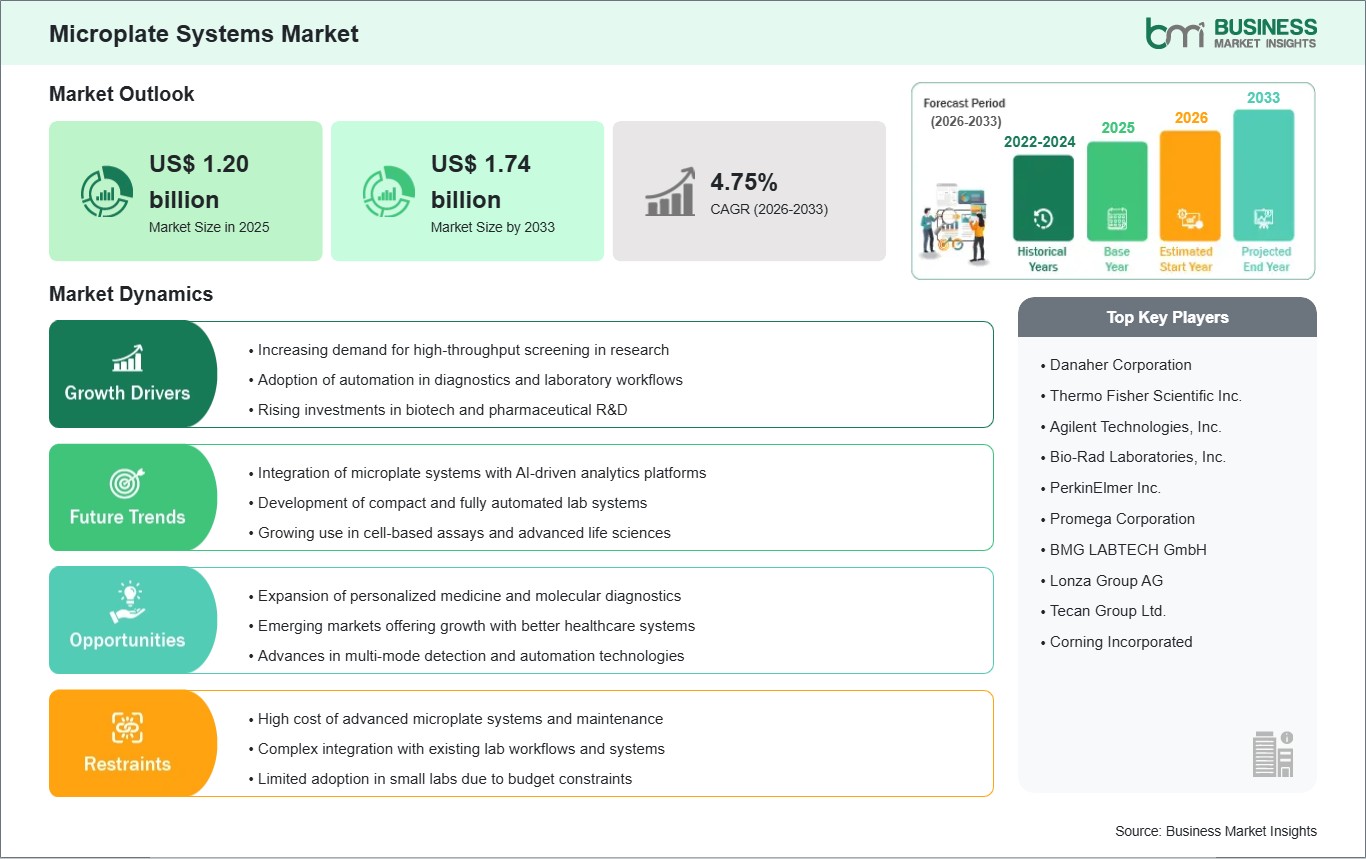
Microplate systems refer to an integrated category of laboratory instruments and consumables designed to handle, process, and analyze samples contained within standardized multi-well plates. Market expansion is fundamentally driven by the global surge in drug discovery and development activities, alongside an increasing emphasis on genomics and proteomics research. Furthermore, the shift toward laboratory automation is allowing facilities to enhance their throughput while significantly reducing human error and the consumption of expensive reagents. The rising demand for personalized medicine, which requires extensive biomarker identification and molecular profiling, is further propelling the adoption of advanced multimode detection platforms.
However, several factors can restrain market growth. The high initial capital expenditure required for fully automated workstations and multi-detection readers remains a barrier for smaller, budget-constrained research laboratories. Technical complexities regarding data integration and the lack of interoperability between legacy hardware and modern laboratory information management systems (LIMS) can complicate workflow optimization. Additionally, the industry faces constraints due to a shortage of specialized personnel proficient in managing sophisticated automated systems and interpreting the vast amounts of data generated by high-throughput assays.
Despite these hurdles, the market holds significant opportunities in the integration of artificial intelligence (AI) for predictive maintenance and real-time assay optimization. The rise of cloud-connected laboratory ecosystems, which facilitate remote monitoring and protocol sharing, and the expansion of point-of-care testing applications for portable microplate readers are expected to support long-term development within the sector. Manufacturers are also finding growth potential in the development of contactless liquid handling technologies, which minimize cross-contamination risks and enable the precise dispensing of picoliter-scale volumes.
Segment Analysis
Microplate Systems Market Segmentation
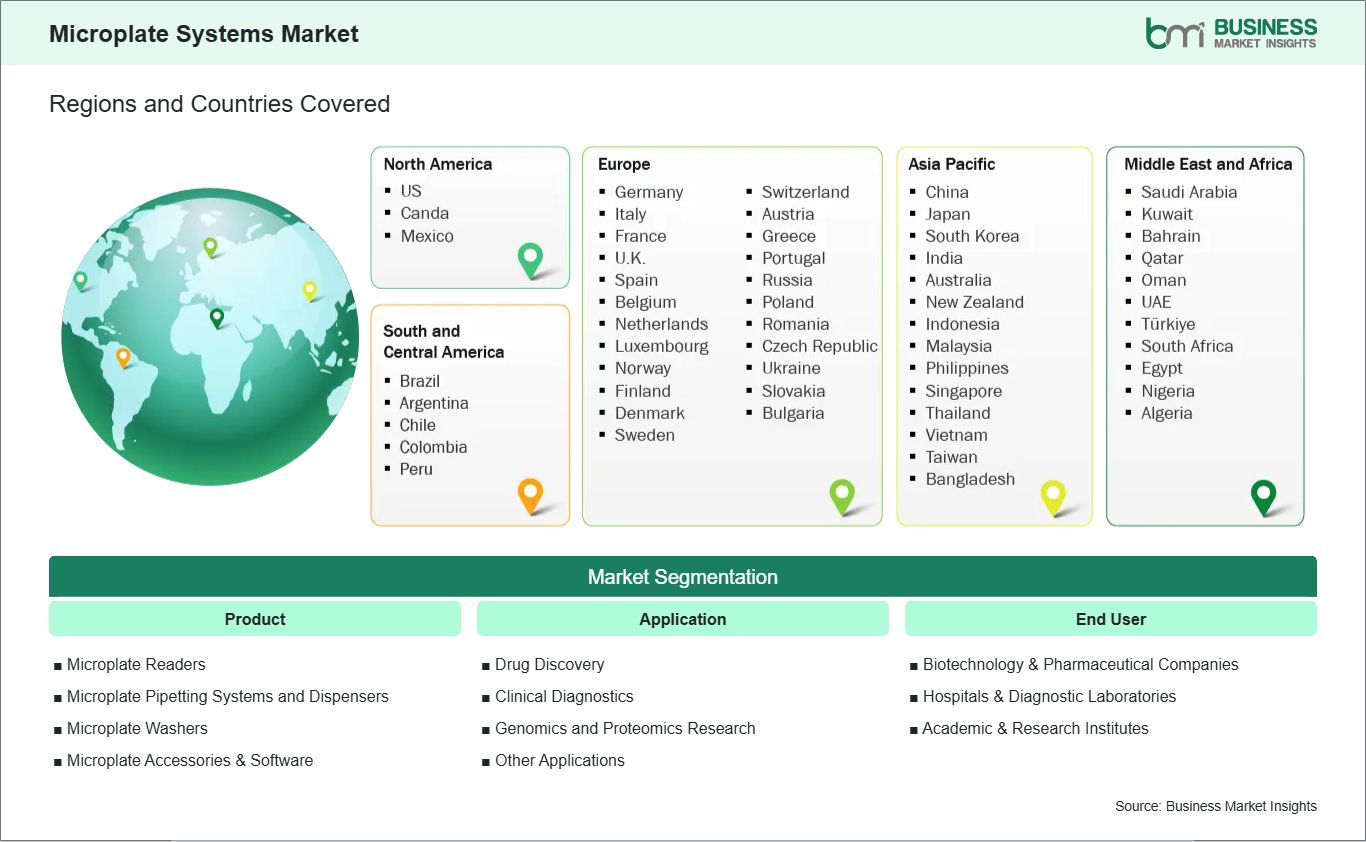
Key segments that contributed to the derivation of the Microplate Systems market analysis are product, application, and end user.
- By Product, the market is segmented into Microplate Readers, Microplate Pipetting Systems and Dispensers, Microplate Washers, and Microplate Accessories & Software.
- By Application, the market is divided into Drug Discovery, Clinical Diagnostics, Genomics and Proteomics Research, and Other Applications.
- By End User, the market is categorized into Biotechnology & Pharmaceutical Companies, Hospitals & Diagnostic Laboratories, and Academic & Research Institutes.
Market Forces
Microplate Systems Market Drivers and Opportunities
Escalating R&D Investment and the Rise of Personalized Medicine
The primary driver for the Microplate Systems Market is the systemic global increase in biopharmaceutical research and development expenditure. The Rising Demand for High-Throughput Screening (HTS) in Drug Discovery acts as a foundational catalyst, as pharmaceutical firms seek to expedite hit identification and reduce time-to-market for novel therapeutic candidates. This momentum is further propelled by the Growing Prevalence of Chronic and Infectious Diseases; the urgent need for advanced diagnostic testing and vaccine development has intensified the reliance on automated microplate assays for rapid, large-scale screening. In the technology sphere, the Rapid Adoption of Laboratory Automation and Robotics serves as a critical driver, addressing the need for higher precision, reproducibility, and the reduction of human error in complex laboratory workflows. Furthermore, the Increasing Focus on Personalized Medicine and Biomarker Research is expanding the use of specialized cell-based assays, which require the high-sensitivity detection capabilities provided by modern microplate systems. Together, these factors, robust R&D funding, public health imperatives, and the automation revolution, ensure a sophisticated and non-discretionary growth path for the global life sciences infrastructure.
AI-Native Data Analytics and Decentralized High-Throughput Labs Expansion
A significant high-value opportunity lies in the convergence of Microplate Systems with Artificial Intelligence (AI) and Machine Learning. Next-generation smart readers are being developed to utilize AI for real-time analysis of complex datasets, allowing for predictive maintenance and the automated identification of biological hits without manual intervention. There is also a major growth frontier in the development of Highly Oxygen-Permeable Cell Culture Microplates for 3D Biology; as the industry moves toward more physiologically relevant models, systems that support long-term live-cell imaging and organoid analysis represent a lucrative and expanding niche. Furthermore, the expansion of Portable and Cloud-Connected Microplate Readers presents a unique opportunity for point-of-care diagnostics and environmental testing in field settings, where immediate data transmission to centralized LIMS is required. Beyond hardware, the rise of Digital Self-Service and Remote Validation Platforms offers a significant frontier, allowing manufacturers to provide automated calibration and compliance reporting as a subscription-based service. Manufacturers who focus on Miniaturized Benchtop Multi-Mode Platforms and those pioneering Label-Free Detection Technologies are positioned to lead the most innovative and high-margin segments of the global Microplate Systems Market.
Size and Share Analysis
Microplate Systems Market Size and Share Analysis
The Microplate Systems market demonstrates steady growth, with size and share analysis revealing evolving trends and competitive positioning among key players. The report examines subsegments categorized within product, application, and end user, offering insights into their contribution to overall market performance.
Based on the product, the Microplate Readers subsegment holds the primary market presence, acting as the indispensable analytical core of the modern laboratory. These systems maintain the largest market share because their ability to measure absorbance, fluorescence, and luminescence across hundreds of samples simultaneously makes them the essential gateway for biological and chemical quantification. While Microplate Pipetting Systems and Dispensers and Microplate Washers provide critical procedural support, they hold secondary positions compared to the high-value detection platforms. However, a notable trend is the surge in the Microplate Accessories & Software subsegment, which is registering a higher pace of adoption. These digital solutions are becoming essential for Data Integrity and Regulatory Compliance, as laboratories strategically invest in robust audit trails and cloud-based analytics to manage the massive datasets generated by high-throughput screening.
Report Coverage
Microplate Systems Market Report Coverage and Deliverables
The "Microplate Systems Market Size and Forecast (2022–2033)" report provides a detailed analysis of the market covering below areas:
- Microplate Systems market size and forecast at global, regional, and country levels for all market segments covered under the scope
- Microplate Systems market trends, as well as drivers, restraints, and opportunities
- Microplate Systems market analysis covering key trends, global and regional framework, major players, regulations, and recent developments
- Industry landscape and competition analysis covering market concentration, heat map analysis, prominent players, and recent developments for the Microplate Systems market
- Detailed company profiles, including SWOT analysis
Geographic Insights
Microplate Systems Market Geographic Insights
The geographical scope of the Microplate Systems market report is divided into five regions: North America, Asia Pacific, Europe, Middle East & Africa, and South & Central America.
North America maintains the leading market position, supported by substantial investments in biopharmaceutical research and a high density of biotechnology clusters. The region benefits from a robust regulatory environment and the rapid adoption of automated, high-throughput screening technologies. Europe represents a mature and technologically sophisticated market, where growth is driven by collaborative multinational research initiatives and a strong institutional focus on personalized medicine and biomarker discovery. Asia Pacific is identified as the most rapidly advancing region, propelled by significant government funding for life sciences, the expansion of contract research organizations (CROs), and a burgeoning pharmaceutical manufacturing base in emerging economies.
The Asia-Pacific Microplate Systems Market is segmented into China, Japan, South Korea, India, Australia, and the Rest of Asia Pacific. China serves as a central hub for regional expansion, supported by government initiatives to modernize laboratory infrastructure and an increasing emphasis on indigenous biotechnology innovation. India is witnessing a notable transition as domestic pharmaceutical players and clinical diagnostic centers adopt advanced microplate readers and washers to manage rising testing volumes for chronic and infectious diseases. Japan continues to prioritize high-precision instrumentation, focusing on the integration of artificial intelligence and robotics to optimize drug discovery workflows for its aging population.
Industry Activity
Recent Developments
The Microplate Systems market is evaluated by gathering qualitative and quantitative data post primary and secondary research, which includes important corporate publications, association data, and databases. A few of the key developments in the Microplate Systems market are:
- In July 2025, Molecular Devices launched the next-generation SpectraMax® iD5e and iD3s Multi-Mode Microplate Readers, offering enhanced flexibility, advanced detection capabilities, and improved workflow efficiency for diverse assays. This launch represents a significant positive development for the Microplate Systems market, reflecting innovation and expanding options for life science research laboratories.
- In September 2025, Cerillo launched the Rayo multiwavelength microplate reader, featuring compact, automation-ready design and versatile assay capabilities for ELISA, protein quantification, and microbial growth monitoring. This launch represents a positive development for the Microplate Systems market, highlighting innovation and expanding laboratory research capabilities.
Trust & Transparency
Research Methodology
The market analysis combines proprietary research with secondary data from government agencies, company disclosures, regulatory filings, industry databases and expert interviews. Market estimates are validated through data triangulation, cross-market benchmarking and analyst
review.
View Full Research Methodology
Key Sources Referred:
World Bank – Global Trade IndicatorsWorld Trade Organization (WTO)(International Monetary Fund )IMFInternational Trade Administration (ITA)Company websiteCompany annual reportsCompany investor presentations