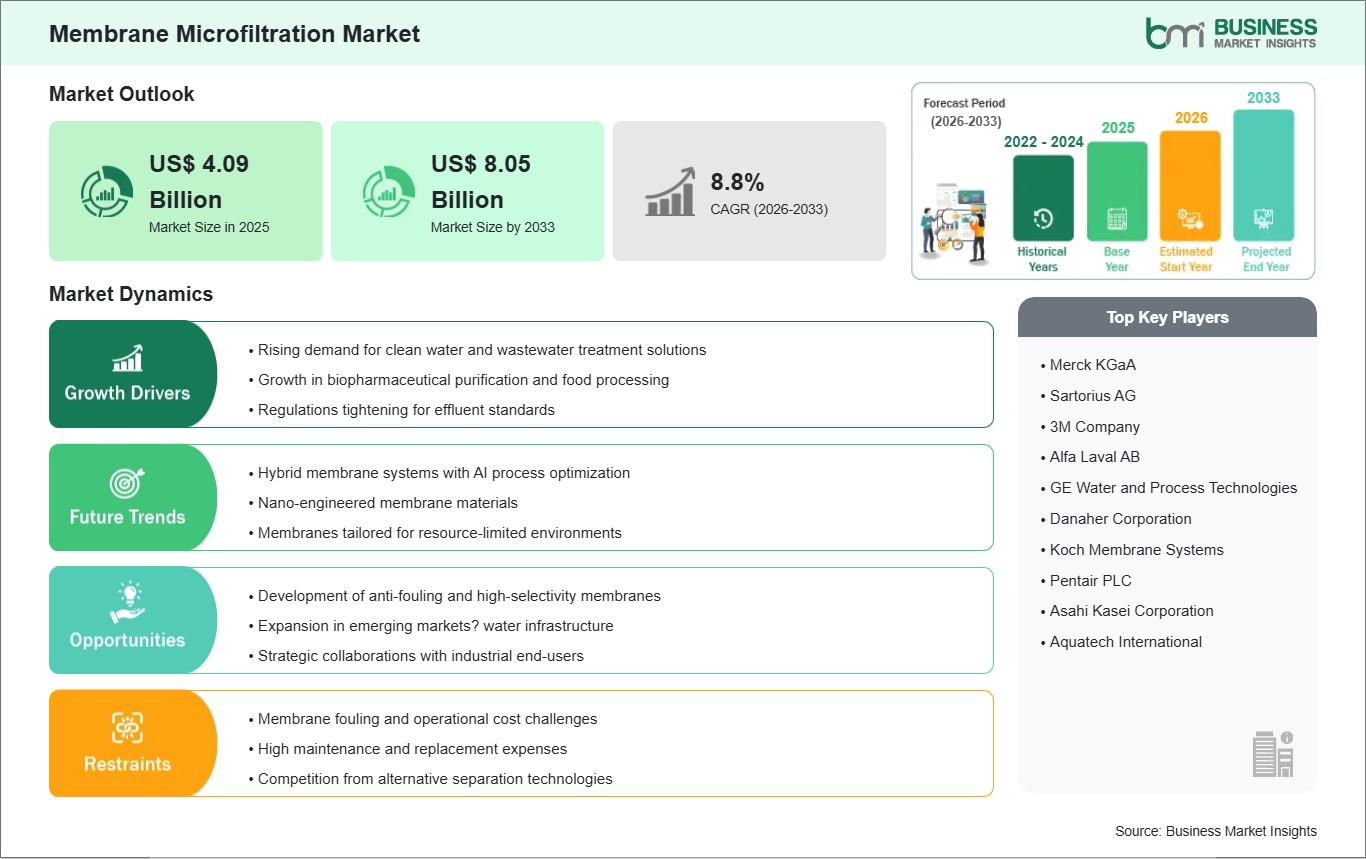
The Membrane Microfiltration Market size is expected to reach US$ 8.05 billion by 2033 from US$ 4.09 billion in 2025. The market is estimated to record a CAGR of 8.80% from 2026 to 2033.
Membrane microfiltration is one of the methods for separating substances that is driven by pressure and where the liquid flows through a porous membrane with wells that have the largest diameter of 0.1 to 10 micrometers. Among others, water, smaller molecules, and ions are allowed to pass through while the suspended solids, bacteria, and particulates are held back. The method is the most common one for the purification of the aforementioned sources of water and many other industrial uses where the method meets the energy efficiency requirements, the output purity standards, and the drinking water and contamination-free production area regulations.
The membrane microfiltration market is growing strongly worldwide, and the main factors contributing to this growth are the need for clean water, the regulatory requirements concerning discharge and effluent quality, and the fast-paced industrialization that needs advanced purification technologies. Municipalities are swapping traditional media filters for microfiltration systems more and more often to remove pathogens and comply with reuse rules; the pharmaceutical sectors and food & beverage are opting for microfiltration to improve product safety and quality. Innovations like hollow-fiber and ceramic membrane materials are improving performance and life cycle, even when the technology is facing challenges such as fouling and high initial costs. Asia-Pacific is the biggest region in terms of adoption, thanks to the investments in infrastructure and strict environmental regulations; however, North America and Europe are also significant demand sources as a result of infrastructure upgrades and sustainability initiatives. The competition in the industry is characterized by innovations and different areas of application, thereby positioning microfiltration as a basic technology in the global water and process purification markets.

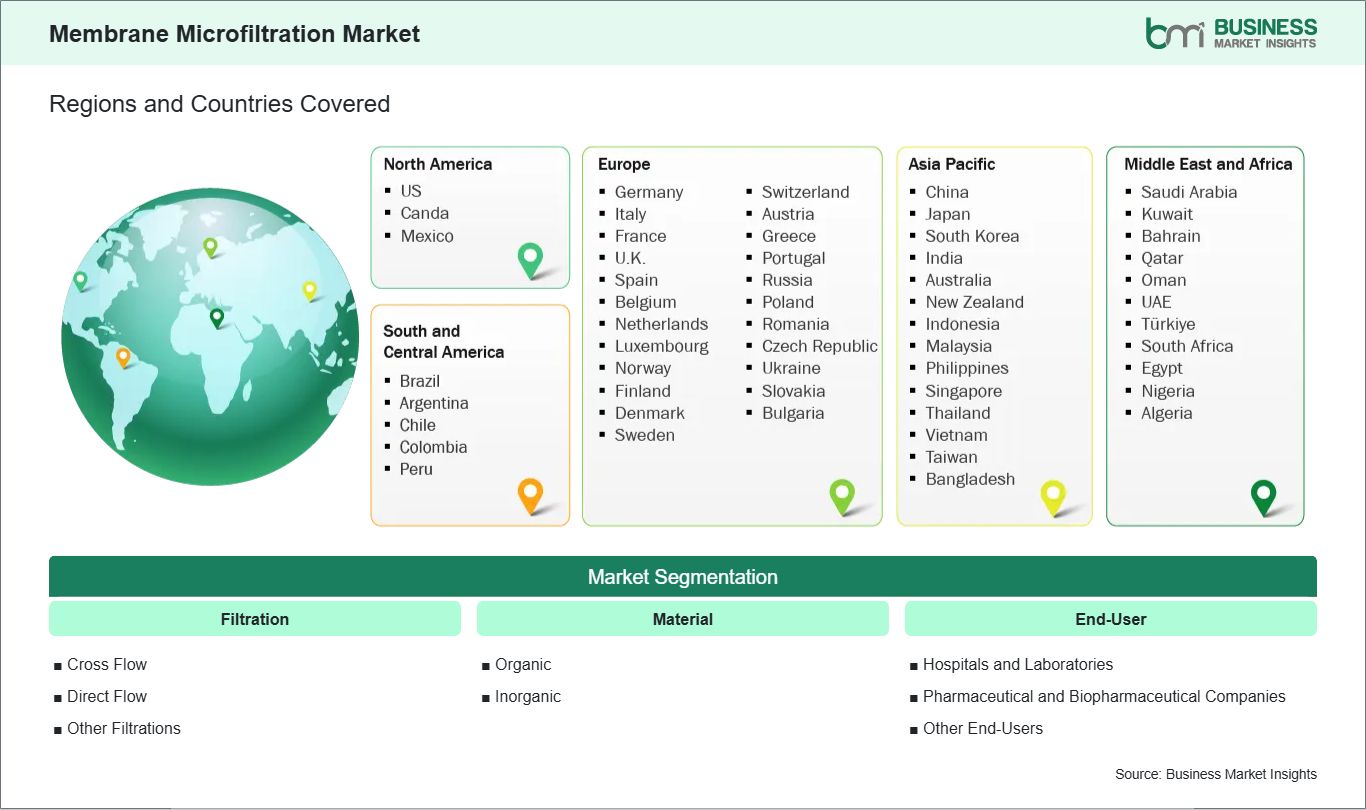
Key segments that contributed to the derivation of the membrane microfiltration market analysis are filtration, material, and end-user.
The major factor influencing the global membrane microfiltration market is the increasing demand for pure and safe water, which is a result of population growth, urban migration, and more environmental concerns. More than 2 billion people around the world do not have access to safe drinking water; hence, the governments and industries are putting water treatment infrastructure projects on their priority list, thereby hastening the installation of advanced filtration technologies such as microfiltration, which is able to get rid of suspended solids, bacteria, and other impurities. Furthermore, strict environmental regulations regarding water discharge and quality in North America, Europe, and Asia-Pacific are pushing both municipal and industrial users to adopt microfiltration systems to be compliant, lower public health risk and consequently, the awareness of regulatory scrutiny has even led to the deployment of microfiltration modules in both municipal treatment plants and industrial facilities thereby proving the technology's essential role in freshwater security and regulatory mandate achievement.
The membrane microfiltration market presents a significant opportunity due to its increasing use cases in industrial wastewater recycling projects and the different sectors. Industries are turning to microfiltration more and more as a substitute for the old methods, such as centrifugation or chemical treatment, since it can maintain the quality of the product and, at the same time, ensure microbial safety. On the other hand, water shortage and stringent discharge regulations are leading industries to put up wastewater recycling systems that would incorporate microfiltration, which allows them to use the water for their production processes as well as cut down on the overall demand for fresh water. These factors, along with the growing sustainability requirements, provide a great chance for the membrane manufacturers to develop solutions for the particular industrial applications and help with the circular water economy strategies, thereby positioning microfiltration technologies for wider adoption in sectors beyond just the traditional water treatment.
By filtration, the membrane microfiltration market is categorized into cross flow, direct flow, other filtrations. The cross flow segment dominated the market in 2025. The segment leads the membrane microfiltration market because it significantly reduces membrane fouling by sweeping particulates parallel to the membrane surface, increasing both flux and membrane life. This makes it highly effective for large-scale, continuous operations like municipal water treatment, industrial wastewater recycling, and food & beverage processing. Its broader industrial applicability and lower long-term maintenance costs compared to Direct Flow underpin its dominant market share.
By material, the market is bifurcated into organic, inorganic. The organic segment held a larger share of the market in 2025. The segment dominates due to its cost-effectiveness, flexibility, ease of fabrication, and strong performance in applications like water treatment, biopharma, and dairy processing. Organic polymer membranes (e.g., PVDF, PES) can be produced in diverse forms (hollow fiber, flat sheet), offer high throughput, and are widely adopted across sectors prioritizing throughput and affordability. Their versatility and compatibility in mainstream industries sustain their leading position.
By end-user, the membrane microfiltration market is segmented into hospitals and laboratories, pharmaceutical and biopharmaceutical companies, other end-users. The pharmaceutical and biopharmaceutical companies segment dominated the market in 2025. Pharmaceutical and biopharmaceutical companies are leading because microfiltration is critical for sterile drug production, cell culture clarification, and ensuring product purity in regulated manufacturing workflows. The increasing global demand for biologics, vaccines, personalized medicines, and stringent regulatory compliance fuels heavy microfiltration usage at scale in this sector. As a result, the pharmaceutical/biopharma segment captures a major share of market volume and value.
| Report Attribute | Details |
|---|---|
| Market size in 2025 | US$ 4.09 Billion |
| Market Size by 2033 | US$ 8.05 Billion |
| Global CAGR (2026 - 2033) | 8.8% |
| Historical Data | 2022 - 2024 |
| Forecast period | 2026-2033 |
| Segments Covered | By Filtration
|
| Regions and Countries Covered | North America
|
| Market leaders and key company profiles |
|
The " Membrane Microfiltration Market Size and Forecast (2022–2033)" report provides a detailed analysis of the market covering below areas:
The geographical scope of the membrane microfiltration market report is divided into five regions: North America, Asia Pacific, Europe, Middle East & Africa, and South & Central America. The membrane microfiltration market in Asia Pacific is expected to grow significantly during the forecast period.
The Asia-Pacific membrane microfiltration market is segmented into China, Japan, South Korea, India, Australia, New Zealand, Indonesia, Malaysia, the Philippines, Singapore, Thailand, Vietnam, Taiwan, Bangladesh, and the Rest of Asia. The Asia-Pacific membrane microfiltration market is experiencing robust growth due to factors like rapid industrialization, urbanization, and increased population needing clean water and state-of-the-art purification technologies. China and India, for instance, are making substantial investments in water treatment infrastructure to provide safe drinking water to their growing cities.
Moreover, the pharmaceutical, food and beverage, and chemical industries are using microfiltration systems as a means of compliance with strict regulations regarding quality and safety, especially in sterile processing and waste management. Besides, the increasing concern about the environment and government measures to control the discharge of wastewater have further led to the installation of microfiltration technologies in factories, hospitals, and laboratories. To give an example, China is conducting large-scale microfiltration projects for wastewater recycling in industrial parks, while India is gradually replacing the traditional water supply systems with hollow fiber and ceramic microfiltration membranes. The technological advancements, like new membrane materials, which are more durable and resistant to fouling, thus cutting down the operational cost, besides increasing adoption, are the main reasons that support the growth. As a whole, these factors make Asia-Pacific a region with potential for growth in the application of membrane microfiltration technology in both municipal and industrial sectors.

The membrane microfiltration market is evaluated by gathering qualitative and quantitative data post primary and secondary research, which includes important corporate publications, association data, and databases. A few of the key developments in the membrane microfiltration market are:
The Membrane Microfiltration Market is valued at US$ 4.09 Billion in 2025, it is projected to reach US$ 8.05 Billion by 2033.
As per our report Membrane Microfiltration Market, the market size is valued at US$ 4.09 Billion in 2025, projecting it to reach US$ 8.05 Billion by 2033. This translates to a CAGR of approximately 8.8% during the forecast period.
The Membrane Microfiltration Market report typically cover these key segments-
The historic period, base year, and forecast period can vary slightly depending on the specific market research report. However, for the Membrane Microfiltration Market report:
The Membrane Microfiltration Market is populated by several key players, each contributing to its growth and innovation. Some of the major players include:
The Membrane Microfiltration Market report is valuable for diverse stakeholders, including:
Essentially, anyone involved in or considering involvement in the Membrane Microfiltration Market value chain can benefit from the information contained in a comprehensive market report.
Please tell us your area of interest
(Market Segments/ Regions and Countries/ Companies)