
Luxury Electronic Watches Market Outlook: Size, Share, Trends, Growth Analysis, Competitive Landscape & Forecast, 2026-2033

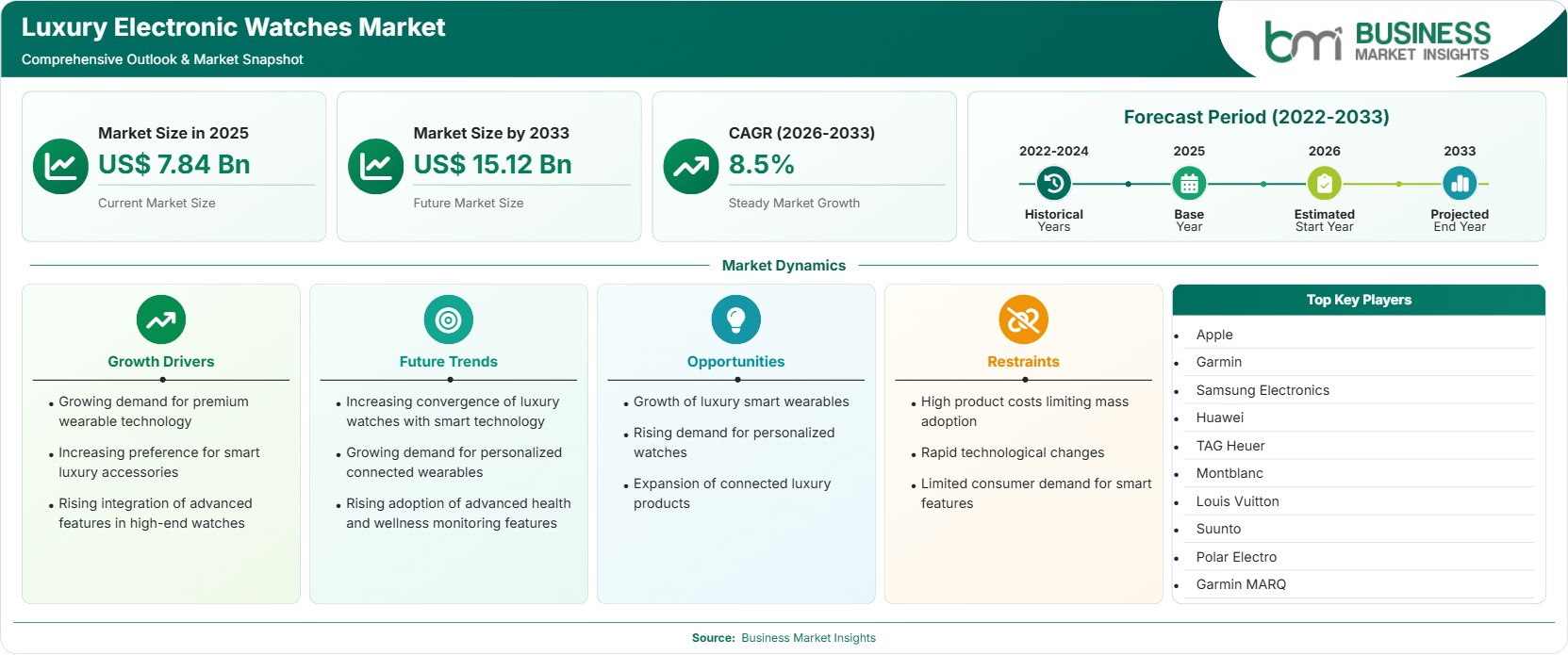
The Luxury Electronic Watches Market size was valued at US$ 7.84 Billion in 2025 and is projected to reach US$ 15.12 Billion by 2033, growing at a CAGR of 8.5% during 2026–2033, driven by rising premium wearable adoption, increasing demand for connected luxury accessories, advanced health monitoring features, and personalization capabilities among affluent consumers. The market size reflects the growing convergence of traditional luxury watchmaking and digital technology, as premium brands integrate smart connectivity, fitness tracking, and personalized experiences. Manufacturers are investing in advanced sensors, premium materials, and software ecosystems to attract consumers seeking both craftsmanship and intelligent functionality.

Report Coverage
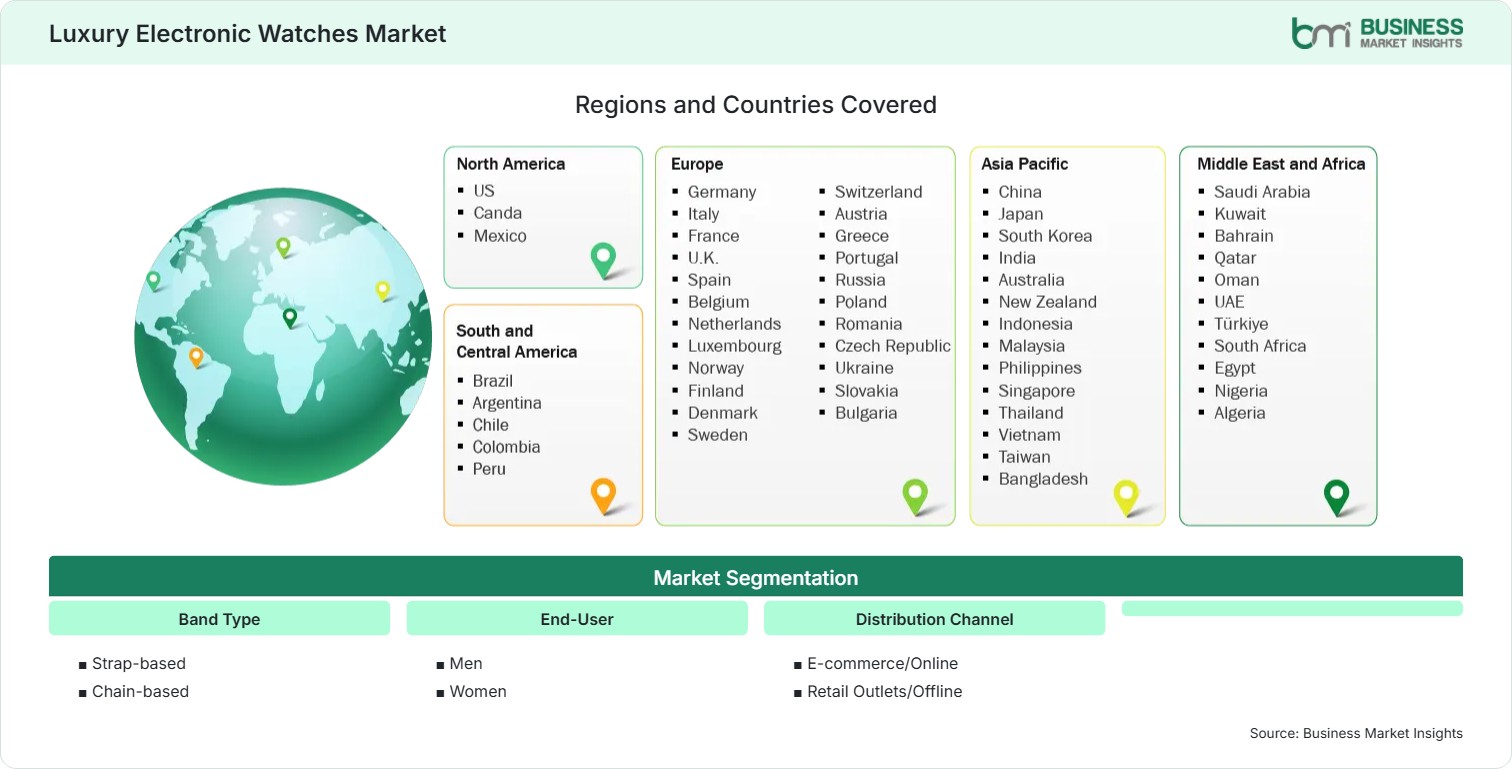
  • Band Type: Strap-based, Chain-based
  • End-User: Men, Women
  • Distribution Channel: E-commerce/Online, Retail Outlets/Offline
US$ 7.84 Bn Market size in 2025
US$ 15.12 Bn Market Size by 2033
8.5% CAGR, 2026 - 2033
2026-2033 Forecast Period

AI Overview

Luxury Electronic Watches Market Summary

  • North America Region: North America holds a 35%–38% share in 2025 and is projected to grow at a CAGR of 7.8%–8.5% during 2026–2033, supported by premium wearable adoption, high purchasing power, connected lifestyle trends, and technology innovation. The US market is expected to expand at a 8.0%–8.7% CAGR, driven by affluent consumers, luxury brand partnerships, and demand for advanced smart features.
  • Fastest Growing Region: Asia Pacific represents a 27%–30% share in 2025 and is forecast to record the fastest CAGR of 9.2%–10.0%, supported by rising disposable income, expanding luxury markets, growing digital adoption, and increasing preference for premium connected accessories.
  • Leading Segment: Chain-based watches account for a 52%–55% share in 2025 and are expected to grow at a CAGR of 8.0%–8.7%, supported by premium aesthetics, traditional luxury appeal, durable construction, and demand among consumers seeking sophisticated wearable designs.
  • High Growth Segment: E-commerce/Online distribution is projected to expand at a CAGR of 10.0%–11.0%, driven by digital luxury retail expansion, direct-to-consumer strategies, online customization options, and wider access to premium electronic watch collections.
  • Key Market Opportunity: Growth opportunities are emerging through personalized luxury wearables, connected ecosystems, AI-powered features, and integration of advanced wellness technologies that enhance user engagement and premium product differentiation.
  • Major Market Players: Apple, Garmin, Samsung Electronics, Huawei, TAG Heuer, Montblanc, Louis Vuitton, Suunto, Polar Electro, Garmin MARQ.
Strategic Insights

Luxury Electronic Watches Market: Strategic Insights

Luxury Electronic Watches Market Strategic Framework
FREE PDF
Request your free sample
Request free sample
Stakeholder View

Key Takeaways

  • The value chain is shifting from hardware-focused watch manufacturing toward integrated ecosystems combining premium design, software platforms, connected services, and customer engagement technologies.
  • Smart luxury accessories with advanced wellness tracking, personalized interfaces, and premium materials represent significant opportunities as consumers increasingly combine lifestyle products with digital functionality.
  • Artificial intelligence, biometric sensors, enhanced connectivity, and improved battery technologies are shaping the next generation of luxury electronic watch development.
  • Asia Pacific provides strong investment potential due to expanding luxury consumption, increasing technology adoption, and rising demand among younger affluent consumers in China, India, Japan, and Southeast Asia.
  • Strategic collaborations between technology firms and luxury brands are increasing as companies seek to combine digital capabilities with established brand prestige and customer networks.
  • Competition is intensifying through product launches, ecosystem development, personalization services, and premium subscription-based digital experiences.
Geographic Outlook

Luxury Electronic Watches Market Regional Highlights

North America Luxury Electronic Watches Market

North America accounted for a 35%–38% of the Luxury Electronic Watches Market share in 2025 and is projected to grow at a CAGR of 7.8%–8.5% from 2026 to 2033. The region maintains leadership due to strong luxury spending, high technology adoption, mature wearable markets, and consumer demand for premium connected devices. The United States remains the largest contributor with increasing interest in health-focused and lifestyle-oriented electronic watches.

  • Premium consumers are adopting advanced electronic watches offering luxury designs combined with fitness and wellness capabilities.
  • Technology companies are expanding premium wearable ecosystems through software updates and connected services.
  • Luxury brands are introducing smart collections targeting affluent consumers seeking hybrid functionality.
  • Online luxury retail platforms are improving access to premium electronic watch products.
  • Health monitoring features are increasing consumer interest in high-end wearable devices.

US Luxury Electronic Watches Market

The US accounted for 30%–33% in 2025 and is forecast to grow at a CAGR of 8.0%–8.7% in the Luxury Electronic Watches Market forecasts. Strong purchasing power, technology adoption, and established luxury retail networks support market expansion. Consumers increasingly prefer premium wearables that combine advanced digital functions with exclusive designs and brand recognition.

  • Luxury technology buyers are showing increased interest in personalized and connected wearable products.
  • Healthcare and wellness awareness are supporting the adoption of advanced monitoring features.
  • Brand collaborations are strengthening premium electronic watch positioning.
  • E-commerce channels are improving the availability of luxury wearable collections.

Europe Luxury Electronic Watches Market

Europe held a 25%–28% share in 2025 and is expected to grow at a CAGR of 7.5%–8.2% during 2026–2033. The region benefits from a strong watchmaking heritage, premium consumer markets, and established luxury brands. Switzerland, Germany, France, and the United Kingdom remain important markets due to strong demand for sophisticated wearable products combining craftsmanship and technology.

  • Swiss luxury watch expertise is influencing the development of premium electronic watch designs.
  • France is supporting luxury technology adoption through strong fashion and lifestyle markets.
  • Germany is witnessing demand for advanced wearable technologies among premium consumers.
  • The United Kingdom is experiencing growth through online luxury retail expansion.
  • European brands are focusing on sustainability and personalization strategies.

Asia Pacific Luxury Electronic Watches Market

Asia Pacific accounted for 27%–30% in 2025 and is projected to achieve the fastest CAGR of 9.2%–10.0% through 2033. Increasing disposable income, expanding luxury markets, digital adoption, and younger consumer demographics are driving regional growth. China, Japan, South Korea, and India are key markets supporting premium wearable expansion.

  • China continues driving demand through expanding luxury consumption and technology adoption.
  • Japan combines traditional watch appreciation with growing interest in smart functionality.
  • India is experiencing increasing demand from digitally connected premium consumers.
  • South Korea supports adoption through strong electronics and technology ecosystems.
  • Southeast Asia offers growth opportunities through expanding luxury retail markets.

Rest of World Luxury Electronic Watches Market

The rest of the world accounted for 7%–10% of the market in 2025 and is expected to grow at a CAGR of 8.5%–9.3% between 2026 and 2033. Latin America, the Middle East, and Africa are gradually adopting premium electronic watches due to rising luxury spending, digital transformation, and increasing availability through online channels. Affluent consumer segments are creating new opportunities for global brands.

  • Middle Eastern markets are expanding luxury technology adoption through premium lifestyle consumption.
  • Latin America is witnessing increased interest in connected premium accessories.
  • African urban markets are gradually adopting digital wearable technologies.
  • Tourism-driven luxury retail supports premium watch sales in selected regions.
  • Online distribution is improving accessibility across emerging markets.
Global Market Geography
FREE PDF
Request your free sample
Request free sample
Segment Analysis

Luxury Electronic Watches Market Segmentation

Band Type

The band type segment influences consumer purchasing decisions through design preferences, comfort, durability, and luxury appeal. The segment accounted for a significant share of demand in 2025, with chain-based designs maintaining higher adoption rates due to their premium aesthetics and traditional watch appeal. The Luxury Electronic Watches Market scope is expanding as manufacturers introduce interchangeable bands, advanced materials, and customized designs to attract diverse consumer groups. Band innovation is supporting product differentiation across luxury and technology-focused brands.

  • Strap-based: Strap-based electronic watches offer lightweight designs, customization options, and enhanced comfort. They are gaining adoption among consumers seeking sporty luxury aesthetics and interchangeable wearable configurations.
  • Chain-based: Chain-based electronic watches maintain strong demand due to premium appearance, durability, and association with traditional luxury watch designs combined with modern electronic functionality.

End-User

The end-user segment is shaped by lifestyle preferences, purchasing power, fashion trends, and demand for connected personal technology. Men currently represent a larger consumer base due to stronger adoption of premium watches and technology accessories. However, women’s adoption is increasing due to personalized designs, wellness features, and fashion-oriented smartwatch collections. Manufacturers are expanding their product portfolios to address gender-specific preferences and broader luxury-lifestyle applications.

  • Men: Men represent a major customer segment due to strong interest in premium technology products, fitness tracking features, and luxury accessories, combining performance with sophisticated design.
  • Women: Women’s adoption is increasing through customized designs, health monitoring features, elegant aesthetics, and wearable products aligned with fashion and lifestyle preferences.

Distribution Channel

The distribution channel segment is transforming as luxury brands combine traditional retail experiences with digital commerce platforms. Offline retail outlets continue providing personalized experiences, brand engagement, and product demonstrations. However, online channels are expanding rapidly due to convenience, wider product availability, and direct-to-consumer strategies. Digital luxury retail platforms are enabling brands to reach younger technology-oriented consumers while maintaining premium positioning.

  • E-commerce/Online: Online channels are expanding through digital luxury platforms, brand websites, virtual consultations, customization tools, and convenient purchasing experiences for premium consumers.
  • Retail Outlets/Offline: Offline retail remains important for luxury electronic watches through personalized services, physical product experiences, exclusive collections, and strong customer relationships.
Market Forces

Luxury Electronic Watches Market Dynamics

Key Market Drivers

Growing Demand for Premium Wearable Technology

The Luxury Electronic Watches Market growth is being supported by increasing consumer interest in premium wearable technology that combines advanced digital capabilities with luxury craftsmanship. Consumers are seeking products that provide health monitoring, connectivity, and lifestyle benefits without compromising design quality. Manufacturers are responding by integrating sophisticated sensors, premium materials, and enhanced software ecosystems.

Rising awareness of fitness tracking, wellness monitoring, and connected lifestyles is encouraging adoption among affluent customers. The Luxury Electronic Watches Market trends indicate that premium wearables are becoming lifestyle statements rather than only functional devices, allowing brands to increase value through innovation, personalization, and exclusive ownership experiences.

Increasing Preference for Smart Luxury Accessories

Consumers are increasingly adopting smart luxury accessories that combine traditional aesthetics with digital functionality. High-income customers are showing a preference for electronic watches offering communication features, activity tracking, and personalized experiences alongside premium designs. Luxury brands are investing in collaborations, exclusive collections, and the integration of advanced technology to attract consumers who value both heritage and innovation.

The shift toward connected lifestyles is encouraging manufacturers to develop products that fit seamlessly into daily routines. Increasing demand among younger affluent consumers is also influencing product strategies, with brands focusing on customization, digital services, and ecosystem-based experiences.

Rising Integration of Advanced Features in High-End Watches

Luxury electronic watch manufacturers are integrating advanced features such as biometric sensors, AI-driven insights, GPS, and enhanced connectivity to improve product differentiation. Consumers increasingly expect premium devices to provide comprehensive wellness, communication, and performance capabilities. Companies are investing in research and development to make batteries more efficient, software more functional, and to provide a better user experience.

 With the help of advanced technology, luxury companies can keep up with mainstream smart-wearable manufacturers without compromising their luxury status. It is increasingly important to continually enhance product features due to rapidly evolving technology cycles.

Key Market Opportunities

Growth of Luxury Smart Wearables

The expansion of luxury smart wearables presents significant opportunities for manufacturers combining premium design with advanced digital capabilities. With the growing demand for devices that enable a connected life, companies are making advanced watches with advanced electronics for high-end customers. There is a growing opportunity for the companies that can capitalize on premium material usage, unique designs, and a digital ecosystem to make more profits.

Luxury customers see wearables as an essential component of their lifestyles, and companies that are innovating and improving software and customer experience can capitalize on rising demand for connected products.

Rising Demand for Personalized Watches

Personalization is becoming an important opportunity area as consumers seek unique luxury products reflecting individual preferences. Customizable watch faces, interchangeable bands, high-quality materials, engraving services, and personalized digital interfaces are being offered by manufacturers. Advanced customization technology can help companies foster customer engagement and create valuable products.

 Increasing demands from young luxury customers are pushing firms to offer flexibility in designs and a unique ownership experience. Customized electronic watches could help companies develop customer loyalty and use premium pricing strategies.

Expansion of Connected Luxury Products

The expansion of connected luxury products creates opportunities for brands to develop integrated ecosystems across watches, smartphones, health platforms, and digital services. Customers are now looking for gadgets that ensure connectivity and personalized user experience across multiple platforms. In the luxury electronic watches market, the possibility of generating income via software products, high-end apps, and connected solutions exists.

Collaborations between tech companies and luxury brands have made way for innovation in that these organizations integrate tech skills with reputation. The future success will depend on creating complete connection experiences beyond hardware products.

Market Restraints and Challenges

High Product Costs Limiting Mass Adoption

Factor: Luxury electronic watches involve premium components, advanced technology integration, specialized materials, and high-end manufacturing processes that increase production and retail costs.

Impact: The high cost of products restricts their use by a wider array of consumers and limits market growth, mostly for rich people. The high costs of components, software development, and premium branding make it difficult to manage compared with ordinary smartwatches. There should be a balance between innovation and cost management to make the product more affordable. It can affect the penetration of the brand in developing markets.

Rapid Technological Changes

Factor: Constant technological changes create an endless drive for manufacturers to improve hardware, software, and connectivity.

Impact: The fast pace of innovation can shorten the lifespan of products and make research and development more costly. Buyers might hold off on making purchases as they wait for newer models with enhanced features. High-end brands need to constantly develop software upgrades and technological partnerships to compete. Balancing innovation speed with retaining the essence of luxury is one of the toughest tasks in the market environment.

Company Analysis

Competitive Landscape

The Luxury Electronic Watches Market analysis highlights a competitive environment where technology companies and luxury watchmakers are developing premium connected products through innovation, ecosystem integration, and personalized consumer experiences. Companies are focusing on advanced health features, software capabilities, premium materials, and strategic collaborations to strengthen their positions in the luxury wearable segment.

Company Name

Overview

Products and Services Relevant to this Market

Apple

Technology company offering premium connected wearable products.

Apple Watch, health tracking, smart connectivity services.

Garmin

Wearable technology company specializing in advanced devices.

Premium smartwatches, fitness tracking, and GPS technologies.

Samsung Electronics

An electronics company is developing connected consumer devices.

Galaxy Watch, health monitoring, wearable ecosystems.

Huawei

Technology company offering smart wearable solutions.

Premium smartwatches, health tracking, connectivity features.

TAG Heuer

Luxury watchmaker integrating digital technology.

Connected luxury watches, premium smartwatch collections.

Montblanc

Luxury brand offering sophisticated wearable products.

Summit smartwatches, premium digital watch designs.

Louis Vuitton

Luxury fashion company developing connected accessories.

Tambour Horizon smartwatches are luxury wearable products.

Suunto

Outdoor technology company producing premium watches.

Sports smartwatches, navigation, and performance tracking.

Polar Electro

Wearable technology specialist focused on fitness.

Smartwatches, heart rate monitoring, training solutions.

Garmin MARQ

Premium Garmin luxury smartwatch collection.

Luxury performance watches, advanced activity tracking.

Industry Activity

Recent Developments

October 2025

TAG Heuer and New Balance introduced the TAG Heuer Connected Caliber E5 40MM x New Balance Edition, a limited-edition luxury smartwatch collaboration combining TAG Heuer’s connected watch technology with New Balance’s performance-focused design approach. The model included running-focused features, dual-band GPS, and a titanium case with a sport-oriented design.

September 2025

Apple launched the Apple Watch Ultra 3, its premium titanium smartwatch, featuring satellite connectivity, 5G cellular support, advanced health monitoring features, a larger OLED display, and improved battery performance. The launch strengthened Apple’s position in the high-end electronic watch segment, targeting luxury, adventure, and professional users.

September 2025

Garmin introduced the fēnix 8 Pro series, including a MicroLED display model and inReach satellite/cellular connectivity. The premium GPS smartwatch range expanded Garmin’s luxury outdoor wearable portfolio, offering advanced navigation, health, and communication capabilities for high-end consumers and athletes.

January 2024

TAG Heuer expanded its Connected Caliber E4 luxury smartwatch portfolio with new dial designs and limited-edition variants unveiled during LVMH Watch Week 2024. The update focused on combining traditional Swiss watch aesthetics with connected watch functionality.

Trust & Transparency

Research Methodology

The market analysis combines proprietary research with secondary data from government agencies, company disclosures, regulatory filings, industry databases and expert interviews. Market estimates are validated through data triangulation, cross-market benchmarking and analyst review.

View Full Research Methodology

Questions Answered

Frequently Asked Questions

What challenges affect the adoption of luxury electronic watches?

Major challenges include high product prices, rapid technology changes, shorter replacement cycles, software compatibility concerns, and competition from established technology companies offering advanced wearable ecosystems at lower price points.

What role does artificial intelligence play in luxury electronic watches?

Artificial intelligence supports personalized health insights, activity recommendations, predictive analytics, voice assistance, and improved user experiences. AI integration is helping manufacturers enhance functionality while maintaining premium product positioning.

How are luxury brands differentiating electronic watches?

Luxury brands are focusing on exclusive materials, customized designs, premium software experiences, advanced wellness features, limited editions, and partnerships with technology companies to create differentiated connected products.

Which segment dominates the Luxury Electronic Watches Market?

Chain-based electronic watches hold a leading position due to consumer preference for premium aesthetics, durability, traditional luxury appeal, and the ability to combine classic watch designs with modern electronic features.

What factors are supporting the Luxury Electronic Watches Market Report growth?

The report highlights the increasing adoption of premium wearable technology, rising demand for connected luxury accessories, advanced health-monitoring features, personalization options, and the integration of luxury craftsmanship with digital innovation.

Access the Full Luxury Electronic Watches Market Report

Get segment-level forecasts, regional estimates, competitive benchmarking, company profiles and downloadable Excel datasets.

Access the full Luxury Electronic Watches Market Report
350 pages PDF & Excel | 2026-07-28