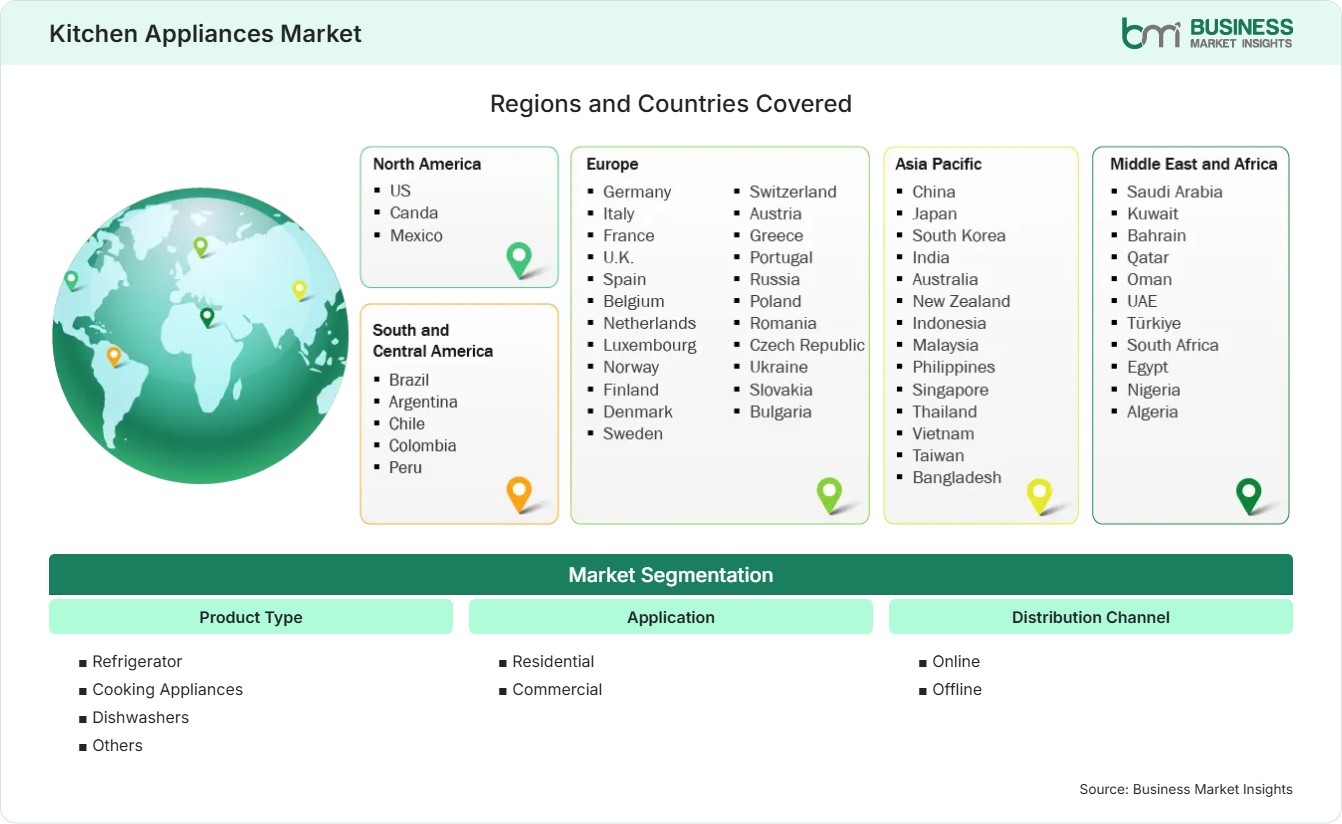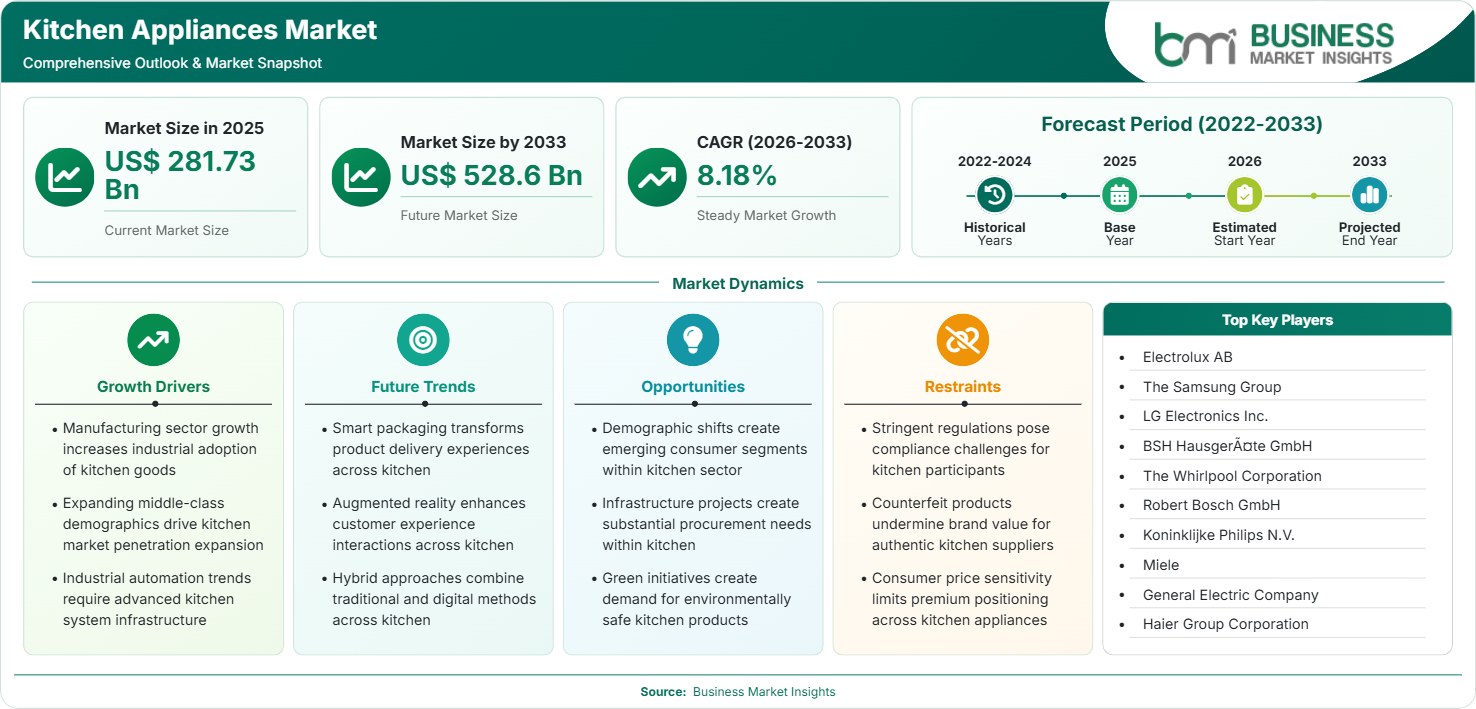
Kitchen Appliances Market Regional Highlights
North America Kitchen Appliances Market
North America accounted for 31%–34% of global revenue in 2025 and is projected to register a CAGR of 7.5%–8.0% during 2026–2033. High consumer purchasing power, widespread adoption of smart home technologies, and strong replacement demand continue supporting regional expansion. Growing investments in energy-efficient appliances, premium kitchen remodeling, and connected household ecosystems further strengthen market performance. The Kitchen Appliances Market share remains the highest in North America due to established brands, advanced retail infrastructure, and consistent consumer spending.
- Smart refrigerators, connected cooking appliances, and voice-enabled kitchen devices continue gaining popularity as consumers increasingly prioritize convenience, automation, energy efficiency, and seamless integration with broader smart home ecosystems.
- Growing residential renovation activity across the United States and Canada supports replacement sales of premium appliances featuring inverter technology, advanced sensors, and intelligent energy management capabilities.
- Sustainability regulations and consumer awareness encourage manufacturers to introduce appliances with improved energy ratings, environmentally friendly refrigerants, and recyclable materials, supporting long-term product innovation.
- Strong omnichannel retail strategies combining physical stores with e-commerce platforms improve product accessibility, customer engagement, financing options, and after-sales support across the region.
US Kitchen Appliances Market
The United States contributes approximately 79%–82% of North American Kitchen Appliances Market revenue and is anticipated to grow at a CAGR of 7.6%–8.1% through 2033. High household replacement demand, increasing home improvement projects, and widespread adoption of premium smart appliances continue driving sales. Innovation in connected kitchens, expanding online retail channels, and strong purchasing power reinforce the country's leadership in the regional industry.
- Premium refrigerators, induction cooktops, built-in ovens, and smart dishwashers remain the fastest-growing categories due to rising consumer preference for connected living.
- Major retailers and digital marketplaces continue expanding product portfolios, financing options, and installation services, improving customer convenience and purchasing confidence.
- Rising demand for energy-efficient appliances is encouraging manufacturers to invest in advanced compressor technologies, intelligent controls, and environmentally sustainable product designs.
Europe Kitchen Appliances Market
Europe represented 24%–27% of global revenue in 2025 and is expected to expand at a CAGR of 7.7%–8.3% during the Kitchen Appliances Market period. Demand is supported by stringent energy efficiency regulations, premium kitchen renovations, and increasing consumer preference for sustainable household appliances. Germany and the United Kingdom remain the largest regional markets, while Poland, Spain, and Italy are witnessing comparatively faster growth driven by residential construction and modernization.
- European consumers increasingly prefer compact, energy-efficient, and multifunctional appliances that complement modern urban lifestyles while reducing household electricity consumption.
- Regulatory standards promoting energy labeling and environmentally friendly manufacturing continue accelerating innovation in refrigeration, cooking, and dishwashing technologies.
- Germany and the United Kingdom lead regional revenue, while Poland, Spain, and Italy benefit from growing disposable incomes and expanding housing development.
- Premium built-in kitchen appliances continue gaining popularity across residential projects, supporting higher-value product sales throughout the region.
Asia Pacific Kitchen Appliances Market
Asia Pacific accounted for 29%–32% of global revenue in 2025 and is forecast to register the fastest CAGR of 9.3%–9.9% through 2033. Rising urbanization, increasing middle-class income, expanding residential construction, and strong e-commerce penetration continue driving appliance demand. China, India, Japan, and South Korea remain key manufacturing and consumption hubs. The Kitchen Appliances Market growth across Asia Pacific is supported by rapid smart home adoption and increasing consumer spending on modern household products.
- China maintains regional leadership through large-scale manufacturing capabilities, strong domestic demand, and continuous innovation in connected household appliances.
- India is emerging as one of the fastest-growing markets due to urban housing expansion, rising disposable income, and increasing penetration of organized retail.
- Japan and South Korea continue driving premium appliance innovation through smart technologies, compact product designs, and energy-efficient engineering.
- Online sales channels and digital payment adoption continue improving product accessibility across emerging economies throughout the region.
Rest of World Kitchen Appliances Market
The Rest of World region held 10%–12% of global Kitchen Appliances Market revenue in 2025 and is projected to expand at a CAGR of 8.4%–8.9% during 2026–2033. South & Central America and the Middle East & Africa continue experiencing rising demand due to urbanization, residential development, expanding retail infrastructure, and growing consumer awareness of energy-efficient appliances. International manufacturers are strengthening regional distribution networks to capture emerging growth opportunities.
- Brazil and Mexico remain the largest South & Central American markets, supported by growing middle-class populations, housing development, and expanding organized retail.
- Saudi Arabia and the United Arab Emirates continue investing in premium residential developments, increasing demand for modern built-in kitchen appliances.
- South Africa leads appliance demand across Africa through improving retail infrastructure, urbanization, and growing adoption of energy-efficient household products.
- Expanding e-commerce platforms, localized manufacturing, and strategic distributor partnerships continue improving product availability and supporting long-term regional market expansion.