Market Summary
Executive Summary and Global Market Analysis
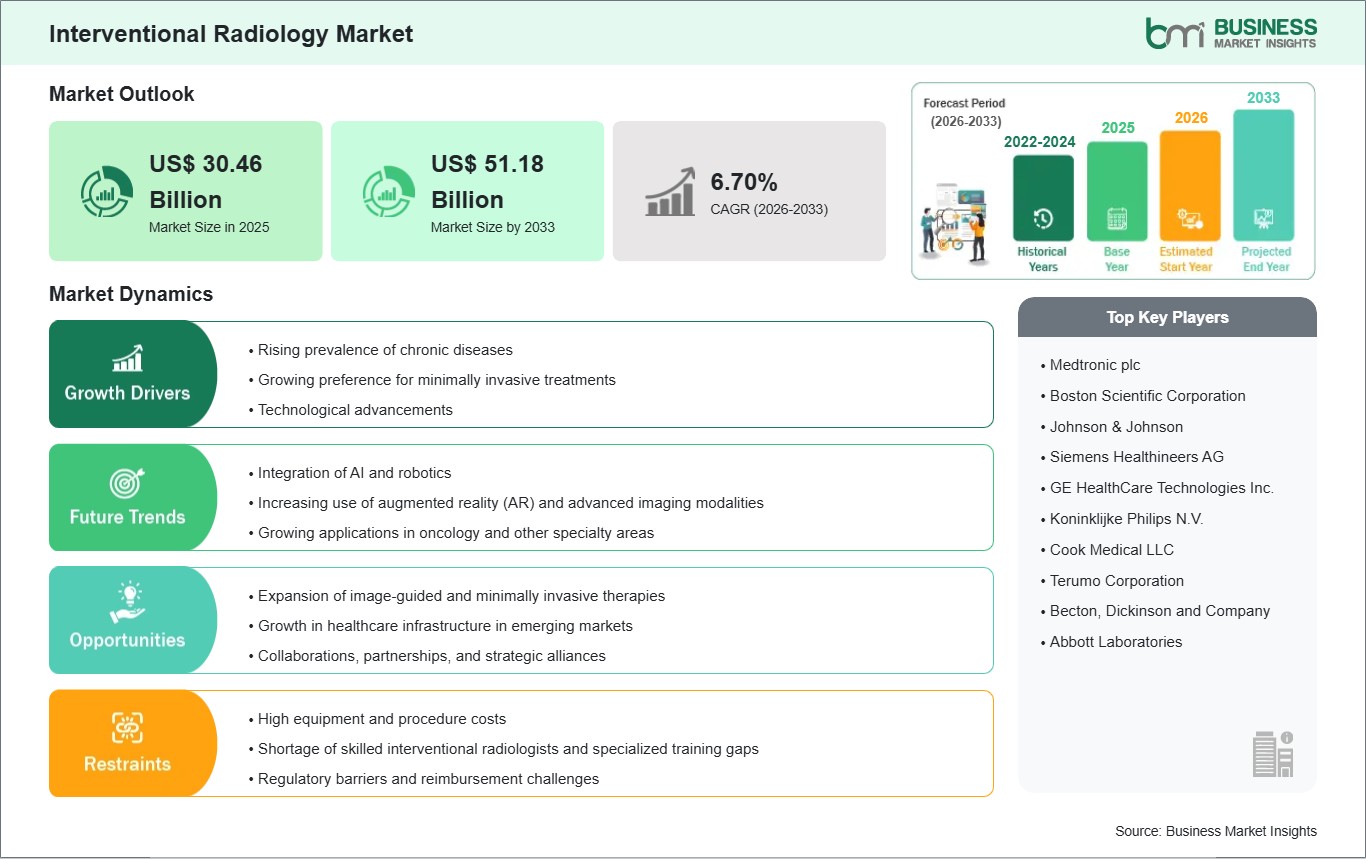
Interventional radiology is a medical sub-specialty that utilizes minimally invasive, image-guided procedures to diagnose and treat diseases in nearly every organ system. These technologies provide immense strategic value by enabling precision-guided treatments for chronic conditions such as cardiovascular diseases, cancer, and neurological disorders. Market expansion is fundamentally driven by the global transition toward minimally invasive therapies and the increasing clinical adoption of image-guided interventions in oncology and urology. Furthermore, the shift toward outpatient endovascular centers and ambulatory surgical centers is improving patient throughput and reducing the total cost of care for healthcare systems.
However, several factors can restrain market growth. The high capital investment required for sophisticated hybrid operating rooms and high-end imaging suites can be a barrier for hospitals in emerging regions. Stringent regulatory approval cycles for new robotic-assisted systems and complex reimbursement landscapes often delay the commercialization of innovative technologies. Additionally, the industry faces constraints due to a global shortage of trained interventional radiologists and specialized staff, which can limit the volume of procedures performed in certain geographies.
Despite these hurdles, the market holds significant opportunities in the integration of artificial intelligence for real-time procedural guidance and dose monitoring. The rise of robotic-assisted catheter systems and the expansion of personalized interventional oncology are expected to support long-term development within the sector.
Segment Analysis
Interventional Radiology Market Segmentation
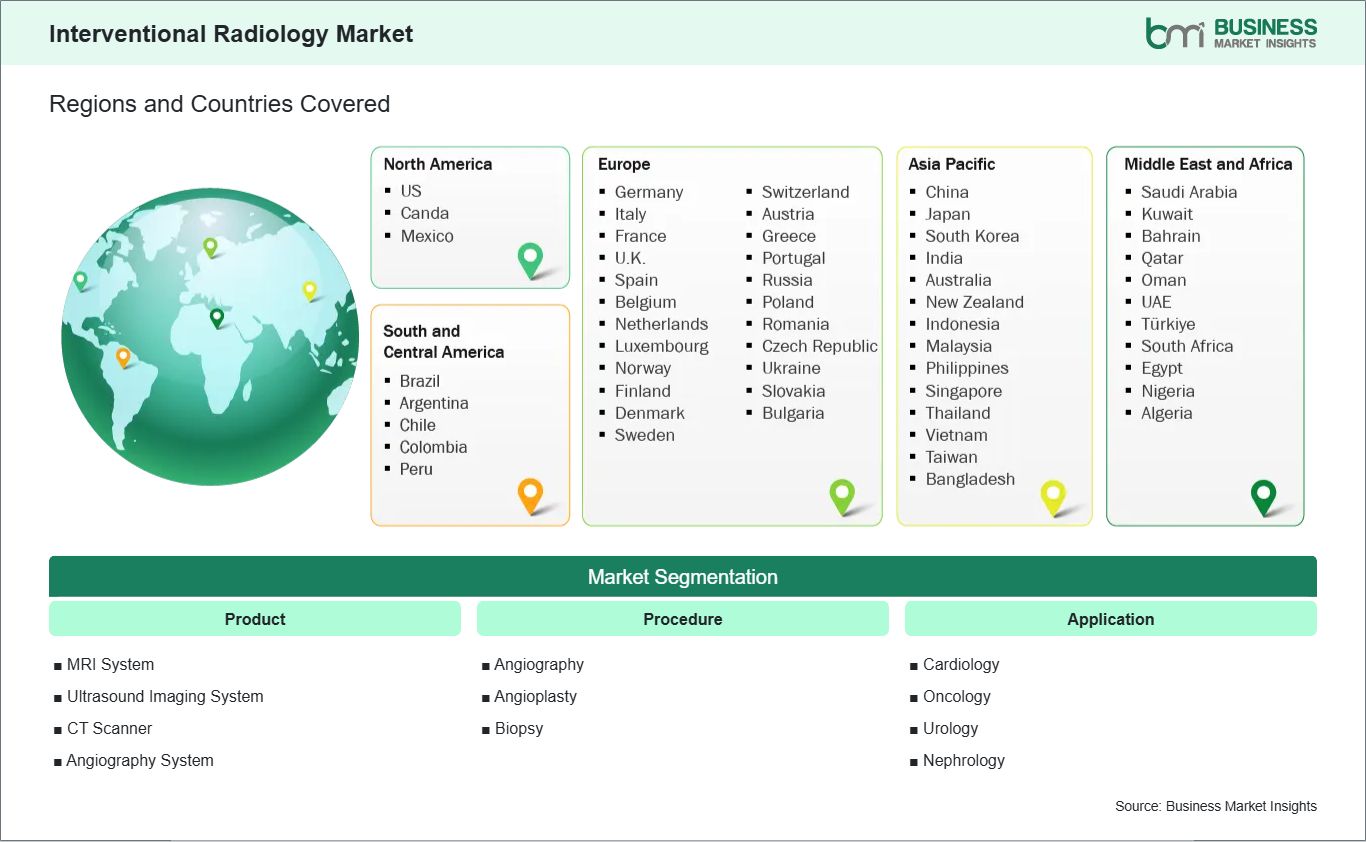
Key segments that contributed to the derivation of the Interventional Radiology market analysis are product, procedures, and application.
- By Product, the market is segmented into MRI System, Ultrasound Imaging System, CT Scanner, and Angiography System.
- By Procedure, the market is divided into Angiography, Angioplasty, and Biopsy.
- By Application, the market is categorized into Cardiology, Oncology, Urology, and Nephrology.
Market Forces
Interventional Radiology Market Drivers and Opportunities
Chronic Disease Proliferation and the Mainstreaming of Precision Oncology
The primary driver for the Interventional Radiology Market is the systemic global increase in chronic conditions such as cardiovascular disease, peripheral artery disease, and various malignancies. The Rising Incidence of Cancer and the Shift Toward Targeted Therapies act as a dominant catalyst, as interventional oncology procedures, including tumor ablation and transarterial chemoembolization (TACE)- offer localized treatment with fewer systemic side effects than traditional chemotherapy. This momentum is further propelled by the Global Aging Population and the Demand for Lower-Risk Interventions; elderly patients with multiple comorbidities are increasingly steered toward IR procedures because they involve minimal anesthesia, reduced blood loss, and shorter hospital stays.
In the technological sphere, the Rapid Adoption of AI-Enhanced Image Guidance serves as a critical driver, with algorithms now capable of automating catheter navigation and identifying ideal ablation zones in real-time. Furthermore, the Expansion of Office-Based Labs (OBLs) and Ambulatory Surgical Centers (ASCs) is decentralizing care, allowing for high-volume, cost-effective interventional procedures to be performed outside the traditional hospital setting. Together, these factors, disease prevalence, precision oncology, and outpatient migration, ensure a robust and essential growth path for the global interventional radiology market.
Robotic-Assisted Interventions and Smart Wearable Navigation
A significant high-value opportunity lies in the convergence of Interventional Radiology with Robotic-Assisted Operation Systems. Next-generation robotic platforms are being developed to enhance the stability and repeatability of catheter manipulation, which not only improves procedural success rates but also significantly reduces radiation exposure for the clinical team. There is also a major growth frontier in the development of Extended Reality (XR) and Augmented Reality (AR) Overlay Systems; by projecting 3D holographic anatomical maps directly onto the patient during surgery, these tools provide interventionalists with X-ray vision, allowing for more accurate needle placement in complex anatomical regions. Furthermore, the expansion of Spectral CT and Molecular Imaging in the IR Suite presents a lucrative opportunity, as these technologies allow for better tissue characterization and real-time assessment of treatment efficacy during the procedure itself.
Beyond hardware, the rise of Predictive Analytics for Patient Selection offers a unique frontier, where AI models analyze longitudinal data to predict which patients will respond best to specific interventional therapies, moving the field toward a personalized interventional model. Manufacturers who focus on Radiation-Free Imaging Alternatives and those pioneering Hybrid Pharmacomechanical Devices are positioned to lead the most innovative and high-margin segments of the global interventional radiology market.
Size and Share Analysis
Interventional Radiology Market Size and Share Analysis
The Interventional Radiology market demonstrates steady growth, with size and share analysis revealing evolving trends and competitive positioning among key players. The report examines subsegments categorized within product, procedures, and application, offering insights into their contribution to overall market performance.
Based on product, the Angiography Systems subsegment holds the primary market presence, serving as the technological foundation and primary revenue driver. These systems are indispensable for the market, holding a significant market share as they serve as the essential workhorse for high-volume vascular and cardiac interventions, providing the superior real-time visualization of blood flow required for life-saving procedures. While MRI Systems, CT Scanners, and Ultrasound Imaging Systems are critical components of the interventional suite, they hold secondary market positions compared to the high-utilization angiography platforms.
However, a notable trend is the surge in the MRI and CT-Guided subsegments, which are registering the highest pace of adoption. MRI Systems are becoming essential for Neurovascular and Oncological Interventions due to their unmatched soft-tissue contrast without ionizing radiation, while CT Scanners are increasingly favored for complex biopsy guidance where high-resolution anatomical cross-sections are vital for navigating around critical structures.
Report Coverage
Interventional Radiology Market Report Coverage and Deliverables
The "Interventional Radiology Market Size and Forecast (2022 - 2033)" report provides a detailed analysis of the market covering below areas:
- Interventional Radiology market size and forecast at global, regional, and country levels for all market segments covered under the scope
- Interventional Radiology market trends, as well as drivers, restraints, and opportunities
- Interventional Radiology market analysis covering key trends, global and regional framework, major players, regulations, and recent developments
- Industry landscape and competition analysis covering market concentration, heat map analysis, prominent players, and recent developments for the Interventional Radiology market
- Detailed company profiles, including SWOT analysis
Geographic Insights
Interventional Radiology Market Geographic Insights
The geographical scope of the Interventional Radiology market report is divided into five regions: North America, Asia Pacific, Europe, Middle East and Africa, and South and Central America.
North America maintains the primary market position, underpinned by an extensive infrastructure of specialized imaging centers and the early adoption of advanced guidance technologies such as augmented reality and robotic-assisted navigation. Europe represents a mature and highly regulated market segment, where demand is sustained by a robust framework of clinical research and the integration of hybrid operating rooms across major healthcare networks. Asia Pacific is identified as the most rapidly advancing region, propelled by significant capital investments in diagnostic imaging infrastructure, rising healthcare expenditures, and an expanding patient demographic requiring minimally invasive oncological and cardiovascular interventions.
The Asia-Pacific Interventional Radiology Market is segmented into China, Japan, South Korea, India, Australia, and the Rest of Asia Pacific. China serves as a central hub for market expansion, characterized by a substantial volume of neurovascular procedures and government initiatives to modernize regional hospital facilities. India is experiencing notable growth in demand as private healthcare providers invest in high-end angiography and CT suites to address the increasing prevalence of lifestyle-related chronic conditions. Japan and South Korea continue to prioritize high-precision interventional equipment, focusing on technological integration and specialized micro-catheter systems tailored for complex anatomical access in geriatric populations.
Industry Activity
Recent Developments
The Interventional Radiology market is evaluated by gathering qualitative and quantitative data post primary and secondary research, which includes important corporate publications, association data, and databases. A few of the key developments in the Interventional Radiology market are:
- In February 2026, Bracco and ACIST Medical Systems announced the European launch of the ACIST Pro™ Diagnostic System, a next-generation variable-rate contrast management solution for image-guided cardiovascular procedures. CE-marked under MDR, the system enhances precision, safety, and efficiency in interventional radiology and cardiology workflows.
- In November 2025, Canon announced the global commercial launch of the Alphenix 4D CT with Aquilion ONE / INSIGHT Edition, following FDA clearance. This next-generation hybrid Angio-CT system integrates advanced angiography and CT imaging in a single suite, enhancing workflow efficiency and precision in interventional radiology procedures.
Trust & Transparency
Research Methodology
The market analysis combines proprietary research with secondary data from government agencies, company disclosures, regulatory filings, industry databases and expert interviews. Market estimates are validated through data triangulation, cross-market benchmarking and analyst
review.
View Full Research Methodology
Key Sources Referred:
World Bank - Global Trade Indicators World Trade Organization (WTO) International Monetary Fund (IMF) International Trade Administration (ITA) Company website Company annual reports Company investor presentations