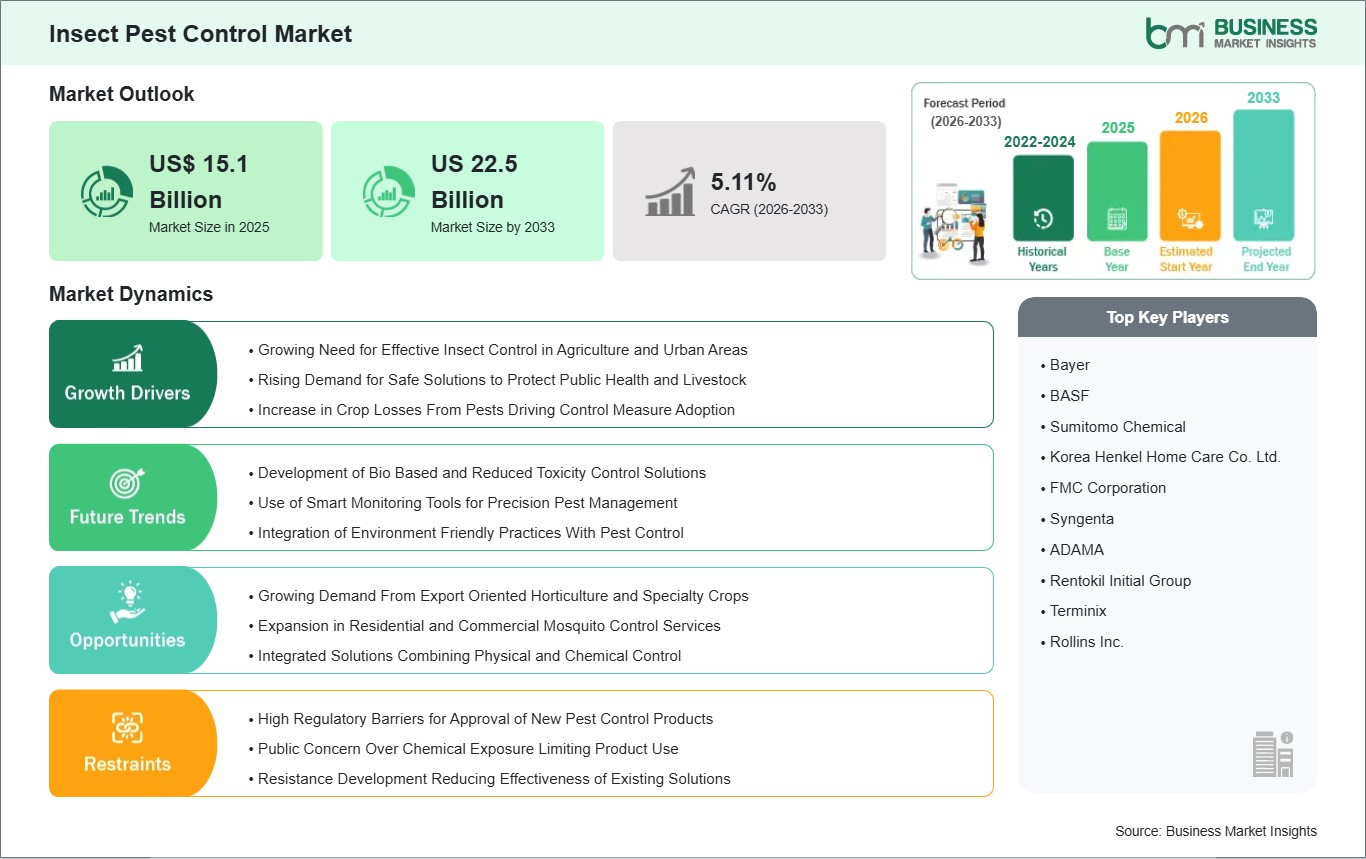
The Insect Pest Control Market size is expected to reach US$ 22.5 Billion by 2033 from US$ 15.1 Billion in 2025. The market is estimated to record a CAGR of 5.11% from 2026 to 2033.
The global insect pest control market is a significant segment in the public health, agricultural, and household safety arenas, covering a broad spectrum of chemicals, biologicals, and mechanical control agents intended for the control and mitigation of insect pest populations. The market extends to various insect pest control agents, including mosquitoes, flies, termites, cockroaches, and other nuisance and vector species, which are essential in the protection of crops, livestock, infrastructure, and human health. The market is characterized by a broad spectrum of product offerings in the market, including insecticides, insect bait, repellents, traps, integrated pest management, etc., which highlight the importance of the market in providing the required insect pest control agents in response to the growth in urban populations and the intensity of agricultural practices.
Key factors driving the market include heightened awareness of insect-borne diseases, such as those transmitted by mosquitoes, and the growing need to protect high-value crops from pest-related losses. Urbanization and climate variability have also influenced insect behavior and breeding patterns, amplifying the requirement for innovative and adaptive pest control strategies. At the same time, the market faces restraints such as regulatory restrictions on certain chemical insecticides, public concerns about environmental impact, and the emergence of insect resistance to conventional treatments. These challenges are prompting the development of safer, more targeted solutions, including biopesticides, pheromone-based traps, and insect growth regulators. The combination of evolving pest dynamics, sustainability imperatives, and technological innovation continues to shape the global insect pest control market, reinforcing its relevance across multiple sectors.

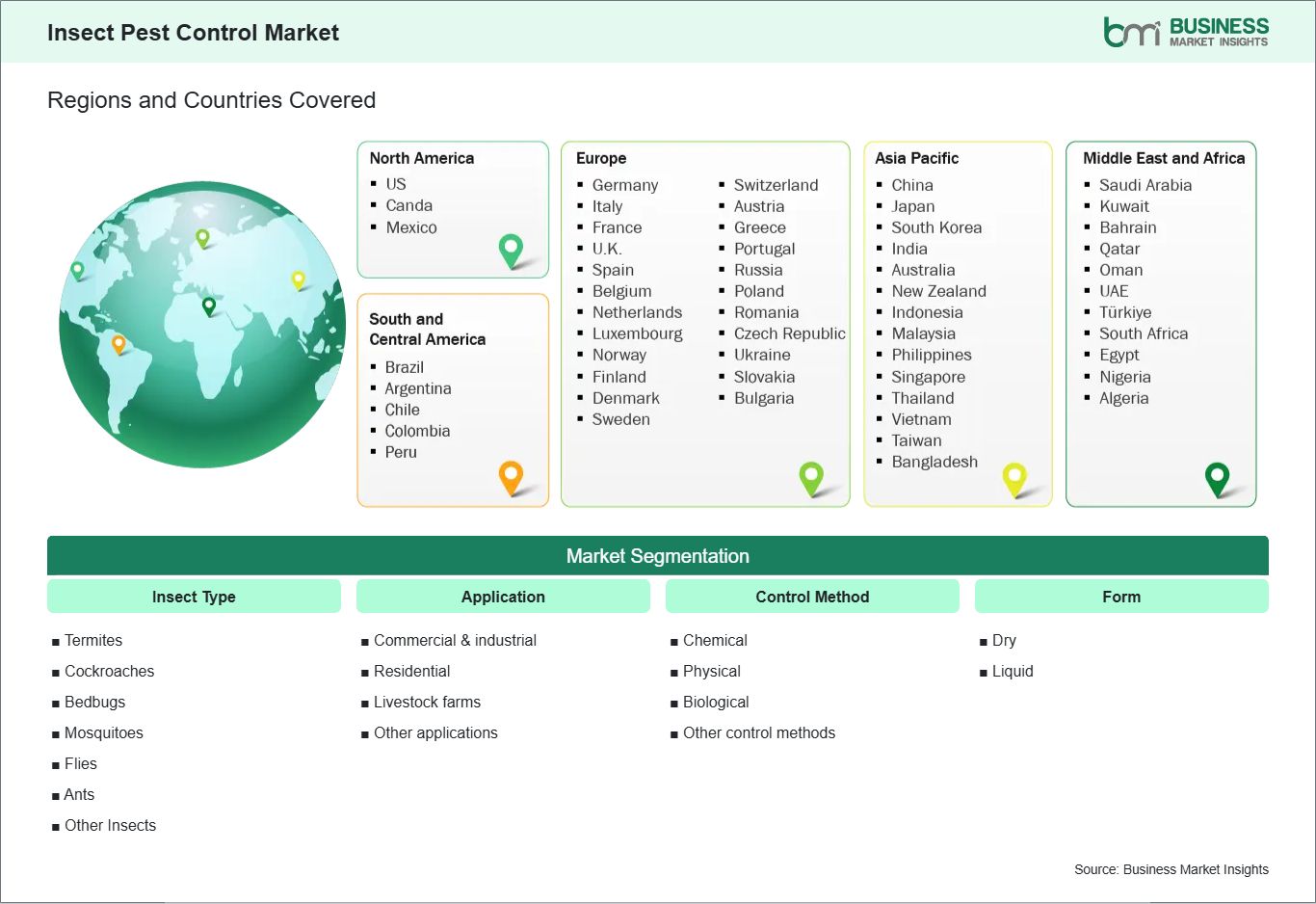
Key segments that contributed to the derivation of the insect pest control market analysis are insect type, application, control method, and form.
The global insect pest control market is expanding significantly, driven by a rise in demand for pest management solutions in both agricultural and non-agricultural areas. In agriculture, for instance, crop damage by insects is a major concern, and it has always been a significant challenge for farmers. Crop damage by insects is a major concern, and it has always been a significant challenge for farmers. Farmers are increasingly using advanced pest control solutions to protect crops such as cereals, vegetables, fruits, and other high-value crops from insect pests, including aphids, beetles, and caterpillars. Proper insect pest control is crucial for enhancing crop quality, which is necessary for meeting international standards.
Urban centers are also contributing to the growth of the market for insect pest control solutions. Insects such as mosquitoes, flies, cockroaches, and termites are responsible for posing health and sanitation risks. These insects are responsible for spreading diseases and damaging properties. Therefore, urban centers, commercial centers, and residential homes are using preventive and control measures to reduce the menace associated with these insects. Integrated pest management solutions are being used to ensure that control is efficient and environmentally friendly. Solutions that are targeted, have a residual effect, and minimal environmental impact are being used in urban centers.
Furthermore, global awareness of sustainable pest management is influencing the development and adoption of next-generation insect control products. Companies are introducing formulations with lower toxicity, reduced residues, and improved specificity to target pests while minimizing harm to beneficial organisms. Advances in application technologies, including automated spraying systems, drones, and smart monitoring, are enabling precise and efficient pest management on a global scale. As agriculture and urban development continue to expand worldwide, the demand for reliable and effective insect pest control solutions is expected to rise steadily, solidifying their role as an essential component of food safety, urban hygiene, and public health strategies.
Export-oriented horticulture crops, as well as specialty crops, are being seen as one of the emerging areas driving the global insect pest control market. High-value fruits, vegetables, ornamental crops, as well as greenhouse crops, require stringent control measures to ensure the quality, appearance and shelf life of the crops during transportation to export markets. Exporters are looking for options to ensure the export market receives the crops in the best condition, without any damage, as well as ensuring the export market regulations are met. Hence, the market for insecticides as well as pest control products is in high demand, which not only ensures the quality of the crops but also ensures the safety of the crops.
Specialty crops such as berries, grapes, and exotic vegetables present unique pest challenges, including susceptibility to localized infestations and the need for delicate handling. In these sectors, integrated pest management strategies that combine chemical, biological, and cultural control methods are increasingly favored to preserve crop integrity and maximize profitability. Advanced insect control solutions, including systemic insecticides, pheromone traps, and biopesticides, enable farmers to manage pests proactively without compromising fruit quality or export eligibility. This precision-driven approach is becoming standard practice in modern horticulture and specialty crop production.
Moreover, the growth of global trade and the expansion of greenhouse and high-density cultivation systems have further accelerated the adoption of advanced insect pest control solutions. Export-oriented growers require reliable and consistent pest management to prevent losses during long supply chains and maintain product consistency. Coupled with sustainability requirements and the reduction of chemical residues, this trend is encouraging innovation in targeted insect control products and application methods. As global horticulture and specialty crop markets continue to expand, the demand for effective, safe, and high-performance insect pest control solutions is expected to grow, supporting both agricultural productivity and international trade standards.

The insect pest control market is experiencing steady growth, with market size and share analysis reflecting evolving treatment preferences and competitive dynamics among key players. The report evaluates important subsegments categorized within insect type, application, control method, and form, highlighting their respective contributions to overall market performance.
By insect type, the Mosquitoes subsegment dominated the Insect Pest Control market in 2025. Mosquito control is critical due to public health concerns, driving high demand for effective and targeted pest control solutions.
Based on application, the Residential subsegment dominated the Insect Pest Control market in 2025. Residential settings require reliable and safe insect control methods, supporting strong adoption of pest control products for homes.
In terms of control method, the Chemical subsegment dominated the Insect Pest Control market in 2025. Chemical methods offer rapid and effective insect elimination, reinforcing the dominance of this segment in both residential and commercial applications.
On the basis of form, the Liquid subsegment dominated the Insect Pest Control market in 2025. Liquid formulations provide uniform coverage, ease of application, and fast action, driving their widespread use across various settings.
| Report Attribute | Details |
|---|---|
| Market size in 2025 | US$ 15.1 Billion |
| Market Size by 2033 | US 22.5 Billion |
| Global CAGR (2026 - 2033) | 5.11% |
| Historical Data | 2022-2024 |
| Forecast period | 2026-2033 |
| Segments Covered | By Insect Type
|
|
Regions and Countries Covered
| |
| North America | US, Canada, Mexico |
| Europe | Belgium, Austria, Finland, Denmark, Greece, Poland, Romania, Russia, Ukraine, Czech Republic, Slovakia, Bulgaria, Italy, Luxembourg, Germany, Switzerland, France, Netherlands, Norway, Portugal, Spain, Sweden, United Kingdom |
| Asia-Pacific | Australia, China, India, Japan, South Korea, Indonesia, Malaysia, Philippines, Singapore, Thailand, Vietnam, Bangladesh, New Zealand, Taiwan |
| South and Central America | Brazil, Argentina, Peru, Chile, Colombia |
| Middle East and Africa | Bahrain, Kuwait, Oman, Qatar, Saudi Arabia, United Arab Emirates, Turkiye, South Africa, Egypt, Algeria, Nigeria |
| Market leaders and key company profiles |
|
The "Insect Pest Control Market Size and Forecast (2022 - 2033)" report provides a detailed analysis of the market covering below areas:
The geographical scope of the Insect Pest Control market report is divided into five regions: North America, Asia Pacific, Europe, Middle East & Africa, and South & Central America. The Insect Pest Control market in North America is expected to grow during the forecast period.
North America has the largest market share in the market for controlling insect pests. This is attributed to the fact that the region has the best in terms of agricultural practices, urban development, and health initiatives. In the region’s agricultural sector, there is the use of preventive and curative methods of controlling pests. This is because the region has crops such as fruits and grains that are of high value and can be greatly affected by the presence of insects. In the urban and residential sector, the market is driven by the control of pests such as mosquitoes, termites, and cockroaches. This is particularly in areas with a large population and climatic conditions that are conducive to breeding. In the region of North America, there is a good regulatory environment and awareness of the environmental and health impacts of pests. This has prompted the region to ensure that it uses safe and sustainable approaches in controlling pests, including the use of biological agents and integrated pest management approaches.
In addition, the aspect of technology has also played a crucial role in the dominance of the North American region, where manufacturers are increasingly introducing intelligent traps, monitoring devices, and application technology that ensures the efficacy of the product while minimizing exposure to the environment. Furthermore, the region has also witnessed the influence of public health initiatives, including insect pest control campaigns, resulting in the increased adoption of innovative insect pest control products in the region. The aforementioned aspects have collectively contributed to the dominance of the North American region in the insect pest control market, thereby setting the benchmark for the efficiency, safety, and innovative products used in the region while effectively addressing the changing needs of the pest control industry in the region.

The insect pest control market is evaluated by gathering qualitative and quantitative data post primary and secondary research, which includes important corporate publications, association data, and databases. A few of the key developments in the insect pest control market are:
The Insect Pest Control Market is valued at US$ 15.1 Billion in 2025, it is projected to reach US 22.5 Billion by 2033.
As per our report Insect Pest Control Market, the market size is valued at US$ 15.1 Billion in 2025, projecting it to reach US 22.5 Billion by 2033. This translates to a CAGR of approximately 5.11% during the forecast period.
The Insect Pest Control Market report typically cover these key segments-
The historic period, base year, and forecast period can vary slightly depending on the specific market research report. However, for the Insect Pest Control Market report:
The Insect Pest Control Market is populated by several key players, each contributing to its growth and innovation. Some of the major players include:
The Insect Pest Control Market report is valuable for diverse stakeholders, including:
Essentially, anyone involved in or considering involvement in the Insect Pest Control Market value chain can benefit from the information contained in a comprehensive market report.
Please tell us your area of interest
(Market Segments/ Regions and Countries/ Companies)