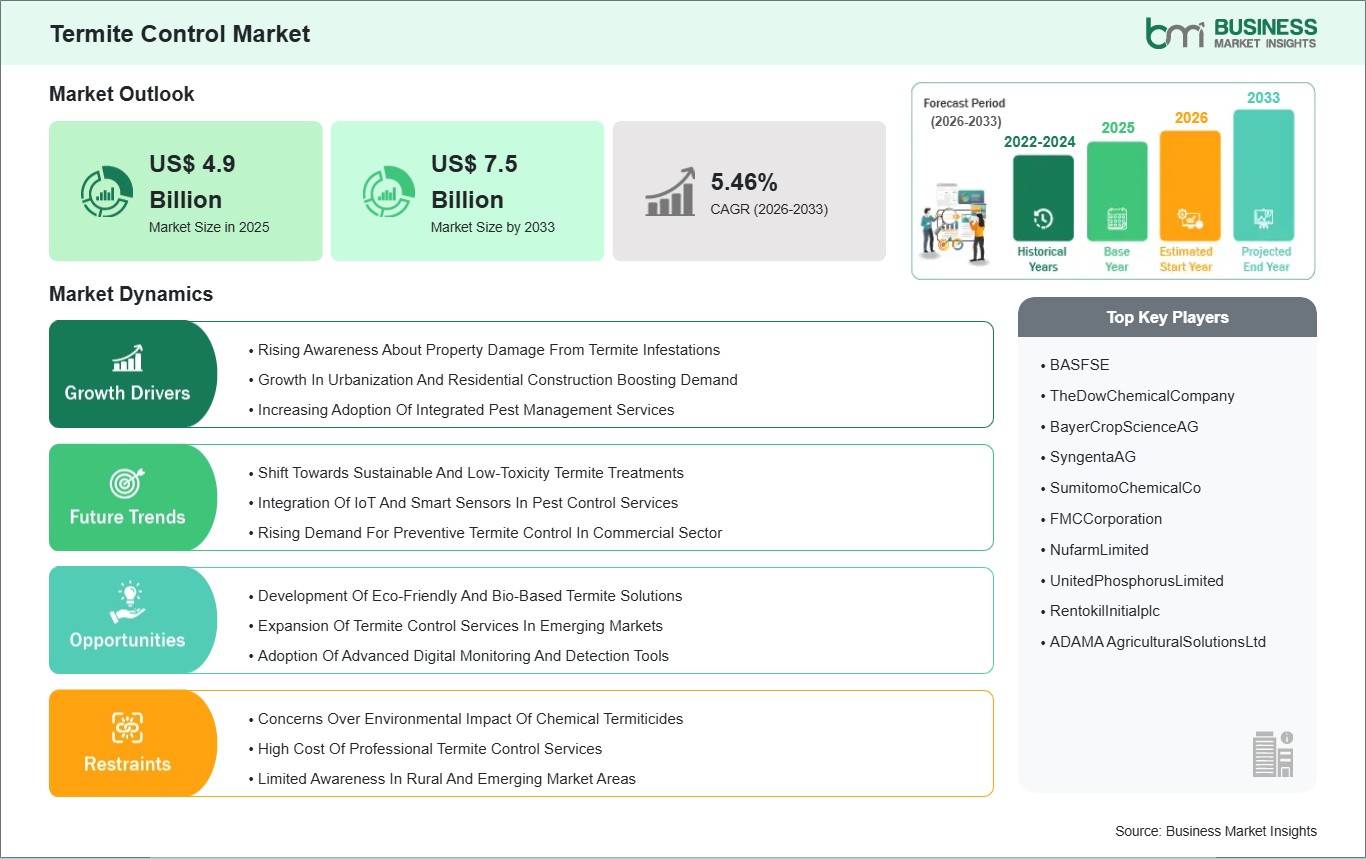
The Termite Control Market size is expected to reach US$ 7.5 billion by 2033 from US$ 4.9 billion in 2025. The market is estimated to record a CAGR of 5.46% from 2026 to 2033.
The international termite control industry exists because there is an increasing requirement to safeguard residential, commercial, and agricultural properties from structural harm that termites create. The worldwide wooden infrastructure and agricultural and ornamental vegetation face severe destruction from termite attacks, which has resulted in higher spending for both prevention and solution development. The market provides numerous products and services, which include chemical solutions, baiting systems, monitoring devices, biological products and integrated pest management (IPM) methods.
The professional pest control companies, termiticide manufacturers and technology-based inspection companies provide these solutions to their customers in order to protect their customers from economic losses and environmental damage caused by termite infestations. The United States and Canada lead the global termite control industry because their residents have strong property protection awareness, their building codes enforce secure construction standards, and their people trust professional pest control services. The region experiences an increasing demand from homeowners and business owners who want permanent termite protection solutions that use advanced monitoring systems and environmentally friendly treatment options. The urban development regulations of the United States and Canada require property owners to implement certified termite examination and extermination methods throughout their building activities and property ownership transfers. The global market experiences fundamental growth from three main factors, which include urbanization, increased real estate investments and the growing understanding of hidden expenses linked to termite destruction that go beyond direct repair costs to affect both insurance costs and property resale value.
The changing climate patterns of several regions have enabled termites to spread into new territories, thus increasing the need for effective control methods in areas that experienced minimal termite activity. The market encounters multiple constraints, including two main factors that create problems for businesses to deliver uniform service quality across different local areas, because of their environmental worries about chemical termiticides and their operational difficulties.
The field of innovation opens many opportunities for researchers to explore through biological control agents, digital monitoring platforms and eco-friendly formulations that achieve effective control while protecting the environment. The market will develop through joint efforts between technology developers, pest control experts and regulatory authorities, which will create termite control methods that achieve international standards for both efficiency and environmental protection.

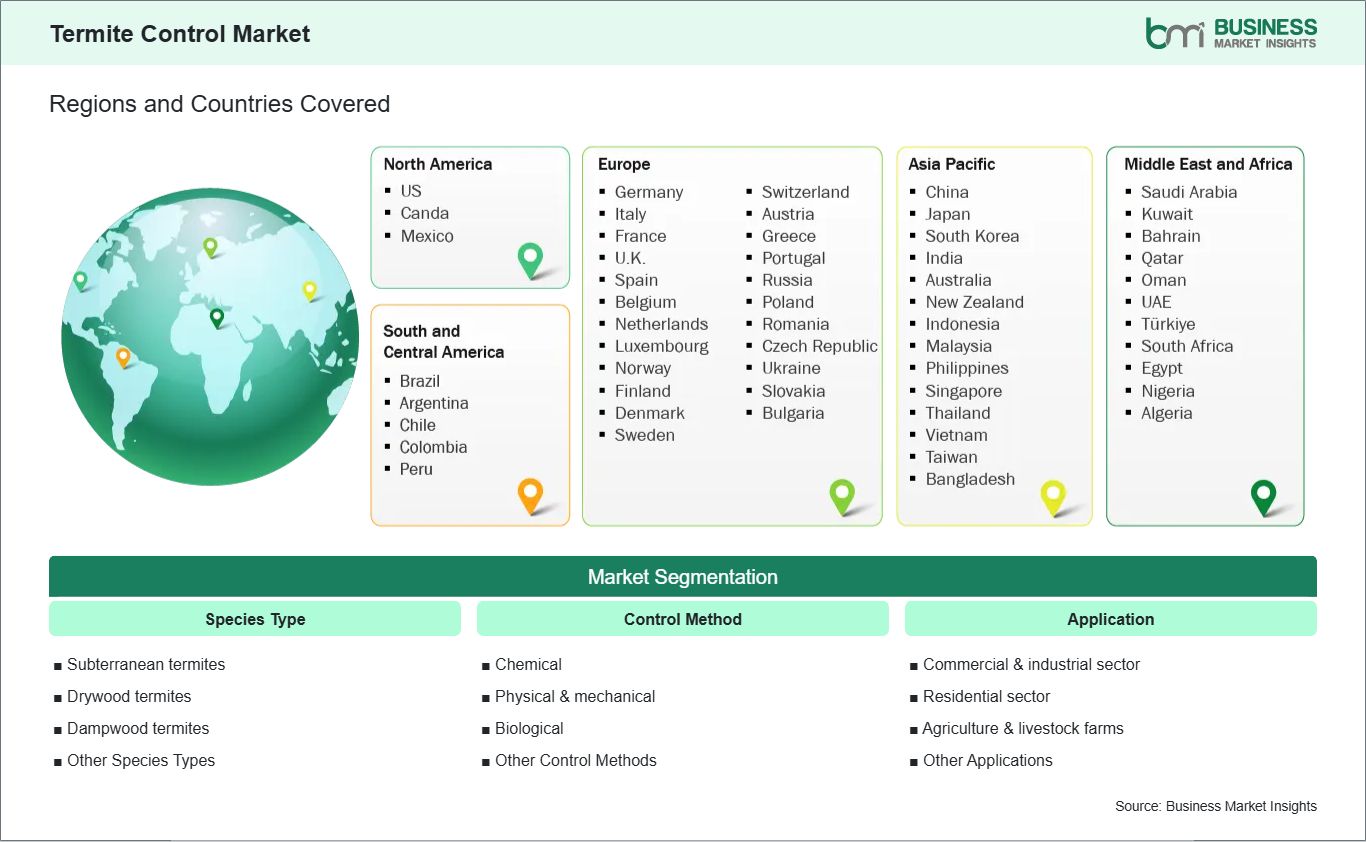
Key segments that contributed to the derivation of the termite control market analysis are type, control method and application.
Termites are increasingly recognized worldwide as one of the most destructive pests for built environments. In many regions, homeowners and commercial property owners are more informed about the hidden and progressive nature of termite damage, which often undermines structural integrity long before visible signs appear. This heightened awareness has been driven by public safety campaigns, media coverage of costly infestations, and insurance industry recommendations that highlight the financial and safety implications of untreated termite problems.
In developed markets such as North America and Europe, property investors are incorporating regular termite inspections into maintenance routines, especially for aging buildings and timber‑rich constructions. The broad understanding that early detection can significantly reduce repair expenses has made professional termite control services a routine part of property care. Real estate transactions increasingly include termite reports as a standard requirement, further embedding termite awareness in property market practices.
Emerging economies in Asia Pacific and Latin America are also seeing a rise in awareness, particularly in urbanizing regions where wood and composite materials are widely used in new developments. Local pest control firms are educating consumers about seasonal termite activity and preventive treatments, reinforcing the notion that treating termite risks proactively is more cost‑effective than reacting to advanced infestations. This global shift toward preventive maintenance is a core driver of sustained demand for termite control services and products across diverse markets.
Global concern over environmental health and human safety has spurred innovation in eco‑friendly termite control solutions. Traditional chemical termiticides, while effective, raise issues related to soil contamination, toxicity to non‑target organisms, and long‑term environmental impact. As a result, manufacturers and pest management professionals are exploring biological control agents, botanical extracts, and reduced‑toxicity formulations that can provide effective termite suppression while aligning with sustainability objectives.
In regions with strong environmental regulations, such as the European Union and parts of North America, adoption of bio‑based termiticides and natural repellents has gained momentum. These markets push suppliers to develop products that meet strict registration standards and minimize ecological footprints without sacrificing performance. For example, botanical oils and microbial agents are being integrated into baiting systems and soil barriers that target termite colonies more precisely and with reduced chemical persistence.
Meanwhile, Asia Pacific, Latin America, and Africa present unique opportunities for eco‑friendly solutions due to both regulatory evolution and growing consumer demand for safer pest control options in densely populated communities. Local pest control companies are increasingly trained to apply integrated pest management (IPM) techniques that emphasize habitat modification, moisture control, and biological products over heavy chemical use. This shift not only supports environmental goals but also helps service providers differentiate their offerings in competitive markets, establishing eco‑friendly termite control as a key growth area globally.
The termite control market demonstrates steady growth, with size and share analysis highlighting evolving trends and competitive dynamics among key players. The report examines subsegments categorized within type, control method and application, offering insights into their contribution to overall market performance.
By species type, the subterranean termites subsegment dominated the market in 2025, driven by their widespread presence and high potential to cause structural damage.
Based on control method, the chemical subsegment dominated the market in 2025, driven by its high effectiveness, ease of application, and rapid termite elimination.
In terms of application, the commercial & industrial sector subsegment dominated the market in 2025, driven by strict regulatory requirements and high demand for termite management in large facilities.
| Report Attribute | Details |
|---|---|
| Market size in 2025 | US$ 4.9 Billion |
| Market Size by 2033 | US$ 7.5 Billion |
| Global CAGR (2026 - 2033) | 5.46% |
| Historical Data | 2022-2024 |
| Forecast period | 2026-2033 |
| Segments Covered | By Species Type
|
|
Regions and Countries Covered
| |
| North America | US, Canada, Mexico |
| Europe | Belgium, Austria, Finland, Denmark, Greece, Poland, Romania, Russia, Ukraine, Czech Republic, Slovakia, Bulgaria, Italy, Luxembourg, Germany, Switzerland, France, Netherlands, Norway, Portugal, Spain, Sweden, United Kingdom |
| Asia-Pacific | Australia, China, India, Japan, South Korea, Indonesia, Malaysia, Philippines, Singapore, Thailand, Vietnam, Bangladesh, New Zealand, Taiwan |
| South and Central America | Brazil, Argentina, Peru, Chile, Colombia |
| Middle East and Africa | Bahrain, Kuwait, Oman, Qatar, Saudi Arabia, United Arab Emirates, Turkiye, South Africa, Egypt, Algeria, Nigeria |
| Market leaders and key company profiles |
|
The "Termite Control Market Size and Forecast (2022 - 2033)" report provides a detailed analysis of the market covering below areas:
The geographical scope of the Termite Control Market report is divided into North America, Asia Pacific, Europe, Middle East & Africa, and South & Central America. North America held the largest share in 2025.
North America dominates the worldwide termite control industry because people understand property protection better while pest control experts operate through established networks, and building safety regulations function as structural restrictions.
The United States and Canada both treat termite infestations as a dangerous threat that requires property owners to conduct preventive inspections and use chemical treatments, baiting systems and integrated pest management systems. Service providers use digital monitoring and sensor-based detection technologies to deliver exact solutions that remain effective for extended periods.
The European market has reached maturity, but businesses now focus on developing environmentally sustainable termite control methods. Germany, France, and the UK require their pest control operations to adopt environmentally valid methods that use chemical treatments together with biological agents and preventive structural measures.
The Asia Pacific region experiences exceptional growth because people move to cities, construction and infrastructure development continue to increase, and people learn more about how termites damage properties. The countries of China, India, Japan, and Australia now experience increased demand for termite inspections and preventive treatments and professional pest management services, which particularly target areas with humid and tropical climates.
The Middle East and Africa market is growing because termite infestations affect both residential and agricultural properties. Nations like Saudi Arabia, UAE, and South Africa are increasingly adopting modern termite control methods, though their professional services and public understanding of these methods still remain at moderate levels. The South and Central American region experiences ongoing expansion as Brazil, Mexico, and Argentina develop preventive termite treatments that protect their wooden structures and commercial properties. The presence of limited regulatory enforcement, together with inconsistent service standards, creates various difficulties to overcome.
The global demand for sustainable, safe, and effective termite control solutions shows a unified pattern across all regions, while North America establishes the standard through its professional service adoption, technological implementation, and regulatory adherence, which other regions modify to suit their particular environmental and socio-economic circumstances.

The Termite Control Market is evaluated by gathering qualitative and quantitative data post primary and secondary research, which includes important corporate publications, association data, and databases. A few of the key developments in the termite control market are:
The Termite Control Market is valued at US$ 4.9 Billion in 2025, it is projected to reach US$ 7.5 Billion by 2033.
As per our report Termite Control Market, the market size is valued at US$ 4.9 Billion in 2025, projecting it to reach US$ 7.5 Billion by 2033. This translates to a CAGR of approximately 5.46% during the forecast period.
The Termite Control Market report typically cover these key segments-
The historic period, base year, and forecast period can vary slightly depending on the specific market research report. However, for the Termite Control Market report:
The Termite Control Market is populated by several key players, each contributing to its growth and innovation. Some of the major players include:
The Termite Control Market report is valuable for diverse stakeholders, including:
Essentially, anyone involved in or considering involvement in the Termite Control Market value chain can benefit from the information contained in a comprehensive market report.
Please tell us your area of interest
(Market Segments/ Regions and Countries/ Companies)