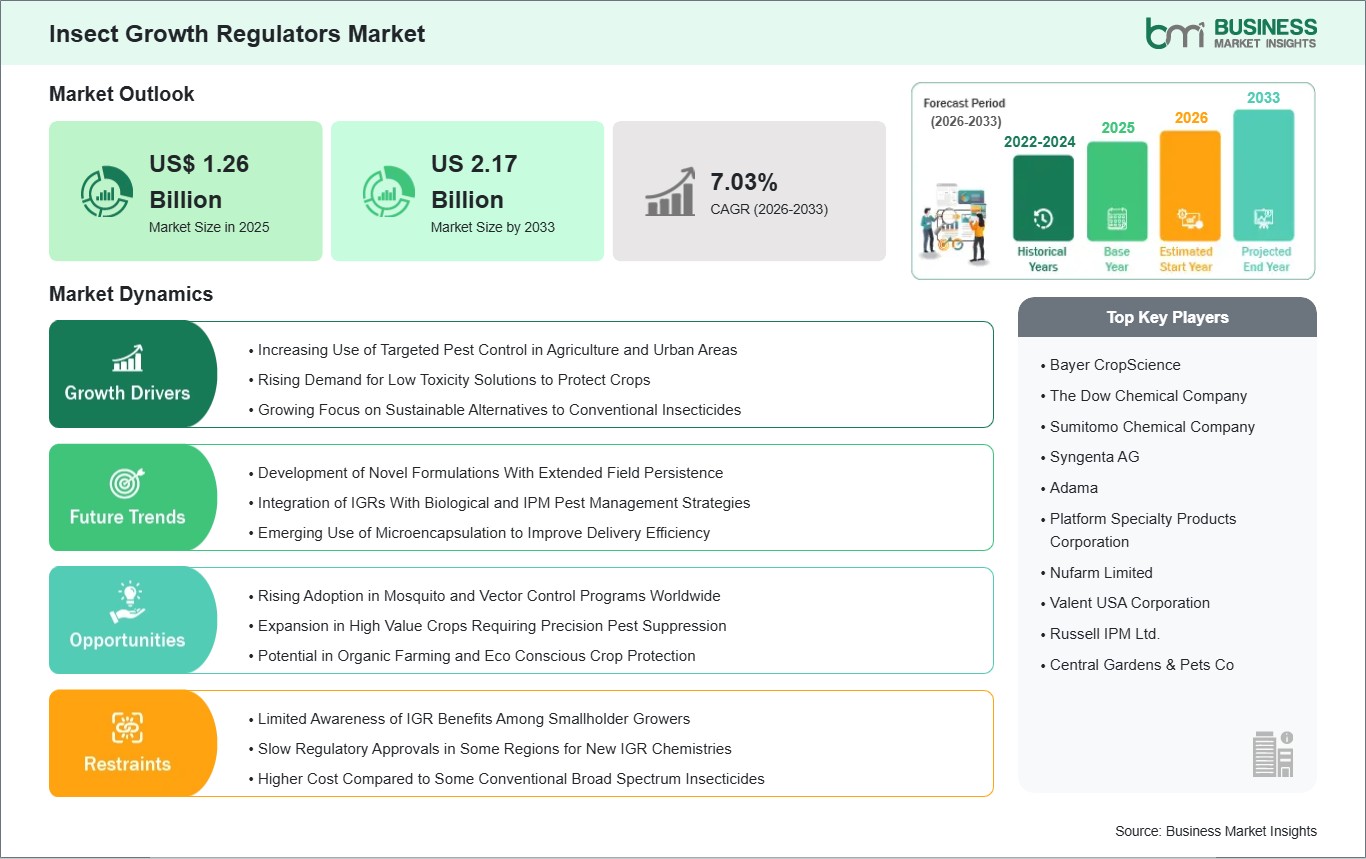
The Insect Growth Regulators Market size is expected to reach US$ 2.17 Billion by 2033 from US$ 1.26 Billion in 2025. The market is estimated to record a CAGR of 7.03% from 2026 to 2033.
The global insect growth regulators market is a segment of pest control that deals specifically in insect growth regulators, a class of pest control agents that specifically interfere with insect growth, development, and reproduction by mimicking or interfering with insect hormones that are required for insect development. IGRs are used in a variety of pest control areas, including agriculture, urban pest control, and animal health. IGRs are used for pest control in a manner that is non-toxic to non-target organisms, thus protecting the environment from contamination by insecticides, a factor that has seen IGRs gain prominence in integrated pest management. Some of the major factors that are influencing the overall market for IGR globally include the increased focus on sustainable agriculture, the rising concerns over chemical residues, and the need for safer pest management options in urban and livestock areas.
In this context, the overall market for IGR is being driven by the adoption of such products owing to their ability to support the use of conventional insecticides and minimize the development of resistance while offering long-term control of pest populations. However, some of the factors that are acting as restraints for the overall market include the limited spectrum of activity against some pest species, the issues faced in the registration of new chemicals, and the higher production costs of such products. Nevertheless, the overall market for IGR is being driven by the increasing research efforts in the development of new active compounds and the formulation of environmentally acceptable systems.

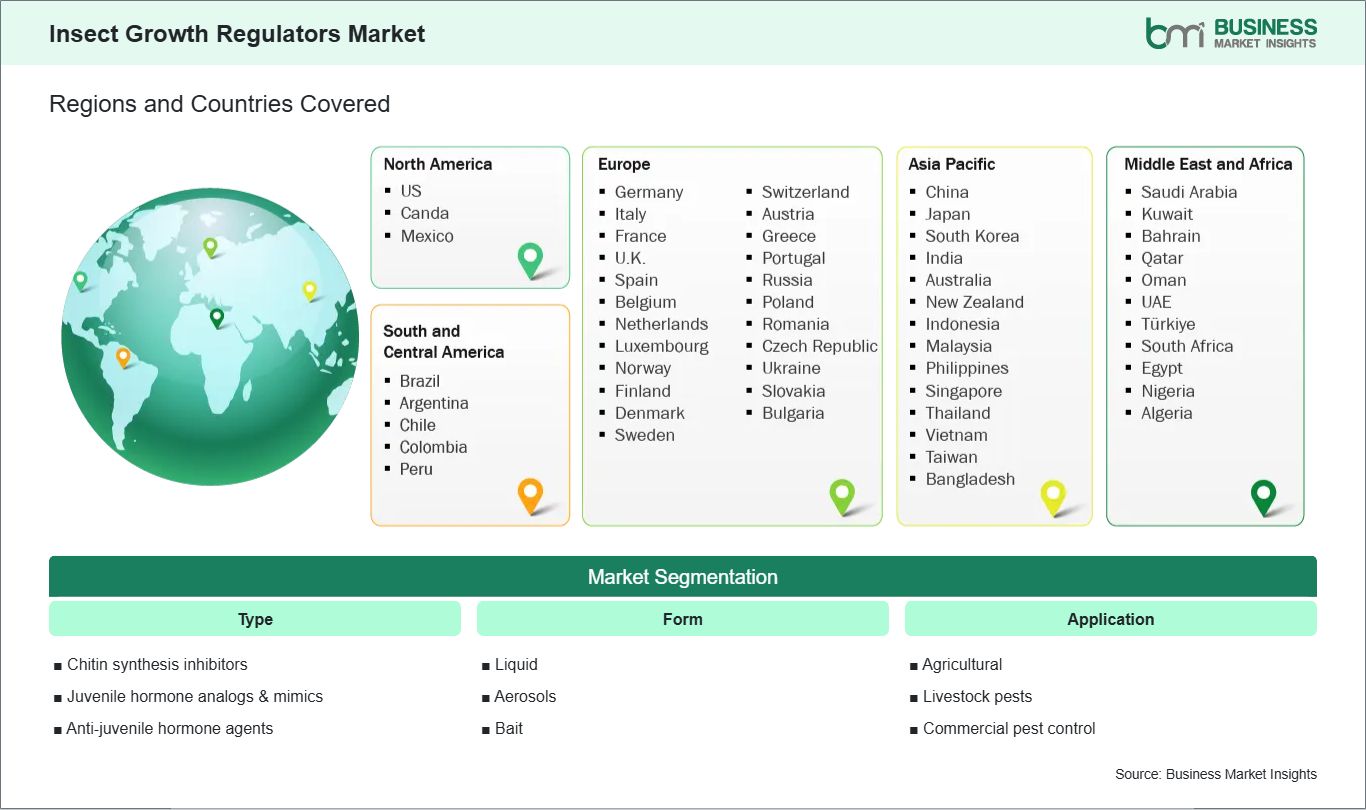
Key segments that contributed to the derivation of the insect growth regulators market analysis are type, form, and application.
The global insect growth regulators market is experiencing steady growth due to the increasing demand for targeted pest control in both agricultural and urban environments. IGRs are designed to disrupt the life cycles of pests, preventing them from reaching maturity or reproducing, which offers a highly specific and environmentally conscious alternative to broad-spectrum insecticides. In agriculture, these compounds are widely used to manage populations of aphids, whiteflies, and other crop-damaging insects without adversely affecting beneficial pollinators or natural predators. Their precision ensures that crops remain protected while minimizing ecological disruption, making IGRs a preferred tool for integrated pest management strategies worldwide.
Urban pest control has also benefited significantly from the use of IGRs. Mosquitoes, cockroaches, and termites are some of the pests that are a nuisance in densely populated areas. Unlike conventional insect control measures that rely on reactive control methods, using IGRs is a more proactive approach to controlling pests. They are used to control pests in water systems and at the perimeter of buildings to limit their reproduction. It is this emphasis on adopting more sustainable and safer pest control measures that has increased the use of IGRs in different parts of the world.
Furthermore, the specificity and long-lasting effects of IGRs provide economic and operational advantages for both farmers and city managers. By controlling pest populations over time without repeated high-dose applications, IGRs reduce labor, maintenance, and chemical costs. Their compatibility with other pest management tools, such as biological agents and environmentally friendly repellents, enables integrated strategies that align with global regulatory requirements and consumer demand for sustainable agriculture and urban living. As global awareness of environmental protection and food safety rises, the use of insect growth regulators in agriculture and urban pest management continues to expand steadily, establishing them as a crucial component of modern pest control programs.
The insect growth regulators market is also being driven by increasing adoption in mosquito and vector control programs on a global scale. Mosquito-borne diseases such as malaria, dengue, Zika, and chikungunya remain persistent public health challenges in many regions. IGRs play a key role in controlling vector populations by disrupting the development of larvae and pupae in breeding habitats. This targeted approach is particularly valuable in areas where mosquitoes have developed resistance to traditional insecticides, allowing public health agencies to maintain control of disease-carrying populations without increasing environmental toxicity.
IGRs are increasingly incorporated into national and international vector control programs, in which the compounds are used in water bodies, drains as well as stagnant ponds to prevent the emergence of adult mosquitoes. The fact that IGRs are able to target mosquito larvae without affecting the populations of fish, amphibians, and other non-target species makes them very suitable for use in the environment. The use of IGRs, in conjunction with adulticidal compounds as well as community-based mosquito control programs, plays a crucial role in the management of vector-borne diseases in the environment in the most efficient way.
Furthermore, the application of IGRs in vector control is in concert with the overall global health initiatives aimed at reducing the incidence of mosquito-borne diseases while maintaining the integrity of the environment. In this way, the compounds offer a long-term solution in the management of mosquito control initiatives and provide overall benefits to the integrity of the health infrastructure. In this context, the application of IGRs is widespread in the management of sustainable vector populations in areas with high incidence of mosquito-borne diseases. As the awareness of the importance of resistance management and vector-borne diseases increases, the application of insect growth regulators in public health initiatives is likely to continue and further solidify the importance of the compound in the management of the environment.

The insect growth regulators market is experiencing steady growth, with market size and share analysis reflecting evolving treatment preferences and competitive dynamics among key players. The report evaluates important subsegments categorized within are type, form, and application, highlighting their respective contributions to overall market performance.
By type, the Chitin Synthesis Inhibitors subsegment dominated the Insect Growth Regulator market in 2025. Chitin synthesis inhibitors disrupt insect development effectively, offering targeted pest control and high efficiency, driving their widespread adoption in agriculture and pest management.
Based on form, the Liquid subsegment dominated the Insect Growth Regulator market in 2025. Liquid formulations provide ease of application, uniform coverage, and rapid action, supporting strong demand across agricultural and commercial pest control uses.
In terms of application, the Agricultural subsegment dominated the Insect Growth Regulator market in 2025. Agricultural applications require effective, safe, and environmentally compatible pest control solutions, reinforcing the dominance of this segment in the market.
| Report Attribute | Details |
|---|---|
| Market size in 2025 | US$ 1.26 Billion |
| Market Size by 2033 | US 2.17 Billion |
| Global CAGR (2026 - 2033) | 7.03% |
| Historical Data | 2022-2024 |
| Forecast period | 2026-2033 |
| Segments Covered | By Type
|
|
Regions and Countries Covered
| |
| North America | US, Canada, Mexico |
| Europe | Belgium, Austria, Finland, Denmark, Greece, Poland, Romania, Russia, Ukraine, Czech Republic, Slovakia, Bulgaria, Italy, Luxembourg, Germany, Switzerland, France, Netherlands, Norway, Portugal, Spain, Sweden, United Kingdom |
| Asia-Pacific | Australia, China, India, Japan, South Korea, Indonesia, Malaysia, Philippines, Singapore, Thailand, Vietnam, Bangladesh, New Zealand, Taiwan |
| South and Central America | Brazil, Argentina, Peru, Chile, Colombia |
| Middle East and Africa | Bahrain, Kuwait, Oman, Qatar, Saudi Arabia, United Arab Emirates, Turkiye, South Africa, Egypt, Algeria, Nigeria |
| Market leaders and key company profiles |
|
The "Insect Growth Regulators Market Size and Forecast (2022 - 2033)" report provides a detailed analysis of the market covering below areas:
The geographical scope of the Insect Growth Regulators market report is divided into five regions: North America, Asia Pacific, Europe, Middle East & Africa, and South & Central America. The Insect Growth Regulators market in North America is expected to grow during the forecast period.
North America has the largest market share in the market for insect growth regulators, owing to the well-established agricultural sector, residential sector, and public health sector in the region. This region is the largest market for insect growth regulators in the world and is likely to remain so in the coming years. This is because the agricultural sector in this region is heavily dependent on the use of insect growth regulators in the cultivation of fruits, vegetables and grains. In the residential sector, the region is the largest market for the use of insect growth regulators in controlling the population of mosquitoes and termites in a way that is safe for the environment. The most significant factor in the sustainability of North America's position as a leader in the market is the emphasis on the integration of IGRs in the development of comprehensive pest management practices.
As such, companies are making significant strides in the development of long-lasting, slow-release formulations, as well as targeted applications for specific pest species. Moreover, the emphasis on public education programs as well as regulatory encouragement for the use of alternative pest control practices has significantly contributed to the adoption of IGR-based pest control practices. Finally, the availability of robust supply chains, as well as partnerships between manufacturers, research institutions, and extension services, ensures the optimized use of IGRs. In essence, the aforementioned factors position North America as the leader in the global insect growth regulators market.

The insect growth regulators market is evaluated by gathering qualitative and quantitative data post primary and secondary research, which includes important corporate publications, association data, and databases. A few of the key developments in the insect growth regulators market are:
The Insect Growth Regulators Market is valued at US$ 1.26 Billion in 2025, it is projected to reach US 2.17 Billion by 2033.
As per our report Insect Growth Regulators Market, the market size is valued at US$ 1.26 Billion in 2025, projecting it to reach US 2.17 Billion by 2033. This translates to a CAGR of approximately 7.03% during the forecast period.
The Insect Growth Regulators Market report typically cover these key segments-
The historic period, base year, and forecast period can vary slightly depending on the specific market research report. However, for the Insect Growth Regulators Market report:
The Insect Growth Regulators Market is populated by several key players, each contributing to its growth and innovation. Some of the major players include:
The Insect Growth Regulators Market report is valuable for diverse stakeholders, including:
Essentially, anyone involved in or considering involvement in the Insect Growth Regulators Market value chain can benefit from the information contained in a comprehensive market report.
Please tell us your area of interest
(Market Segments/ Regions and Countries/ Companies)