Market Summary
Executive Summary and Global Market Analysis
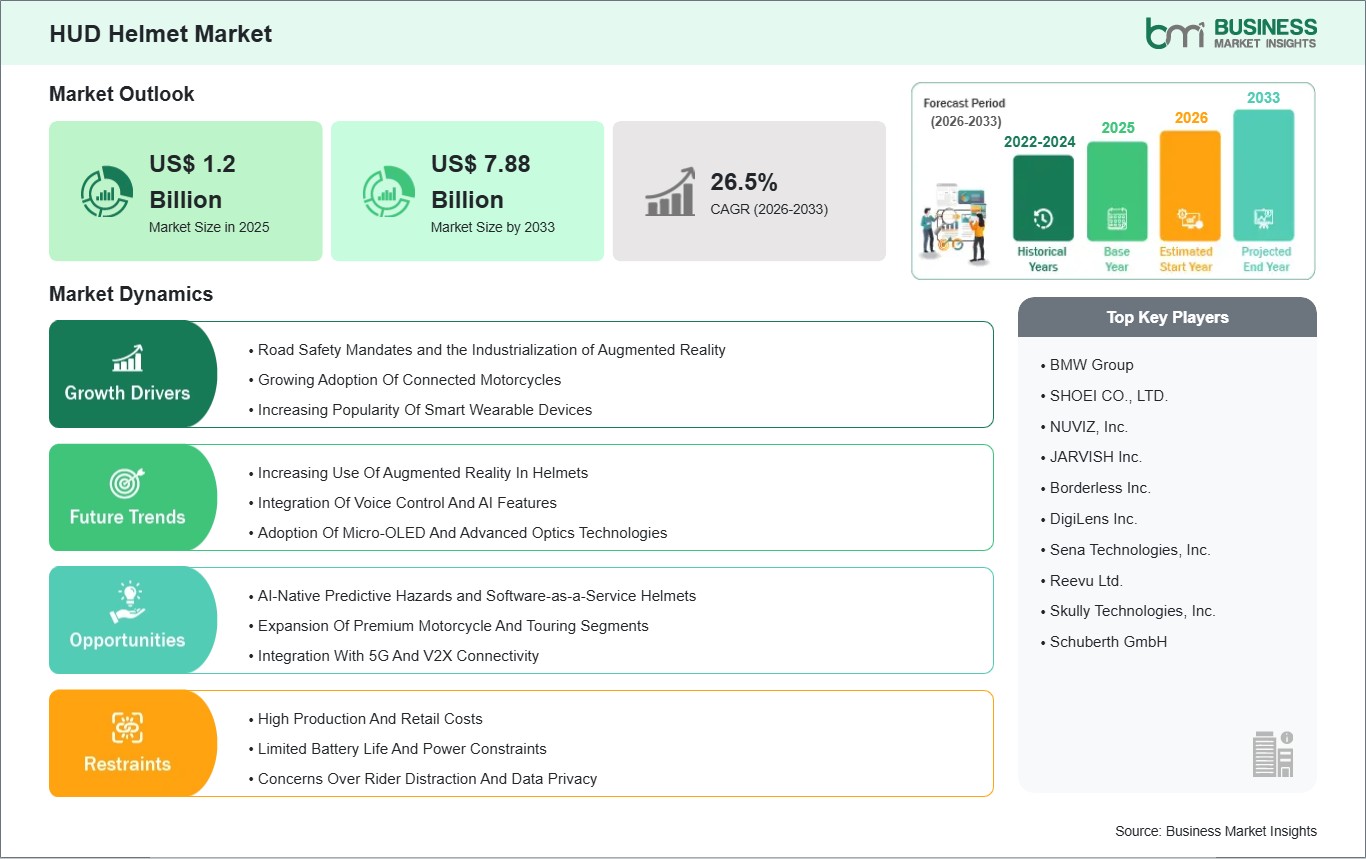
HUD (Heads-Up Display) helmets are advanced protective headgear integrated with transparent display technology that projects critical data directly into the user`s primary field of vision. This allows the wearer to access real-time information, such as navigation, airspeed, thermal imaging, or tactical overlays, without looking away from their environment. Market progression is fundamentally propelled by the modernization of defense forces, where augmented reality (AR) HUDs are becoming standard for enhancing pilot and infantry situational awareness. Furthermore, the rising consumer demand for connected motorcycle safety gear and the integration of biometric sensors in industrial headgear serve as primary catalysts for sustained demand.
However, several factors may restrain market progression. The high cost of development and procurement remains a significant barrier for wide-scale civilian adoption, as high-fidelity optical systems require specialized manufacturing. Technical complexity, specifically regarding battery longevity and thermal management of on-helmet processors, can affect device reliability in extreme conditions. Additionally, the industry faces challenges related to stringent regulatory standards for impact protection, where the inclusion of electronic components must not compromise the primary structural integrity of the helmet.
Despite these hurdles, the market holds significant opportunities in the expansion of AI-driven predictive alerts, which anticipate road hazards or mechanical failures before they occur. The rise of 5G connectivity for real-time data streaming and the development of modular HUD units, which can be retrofitted onto existing helmets, are expected to support long-term development. Manufacturers are also finding growth potential in the industrial and construction sectors, where smart hard hats provide hands-free access to blueprints and remote expert assistance.
Segment Analysis
HUD Helmet Market Segmentation
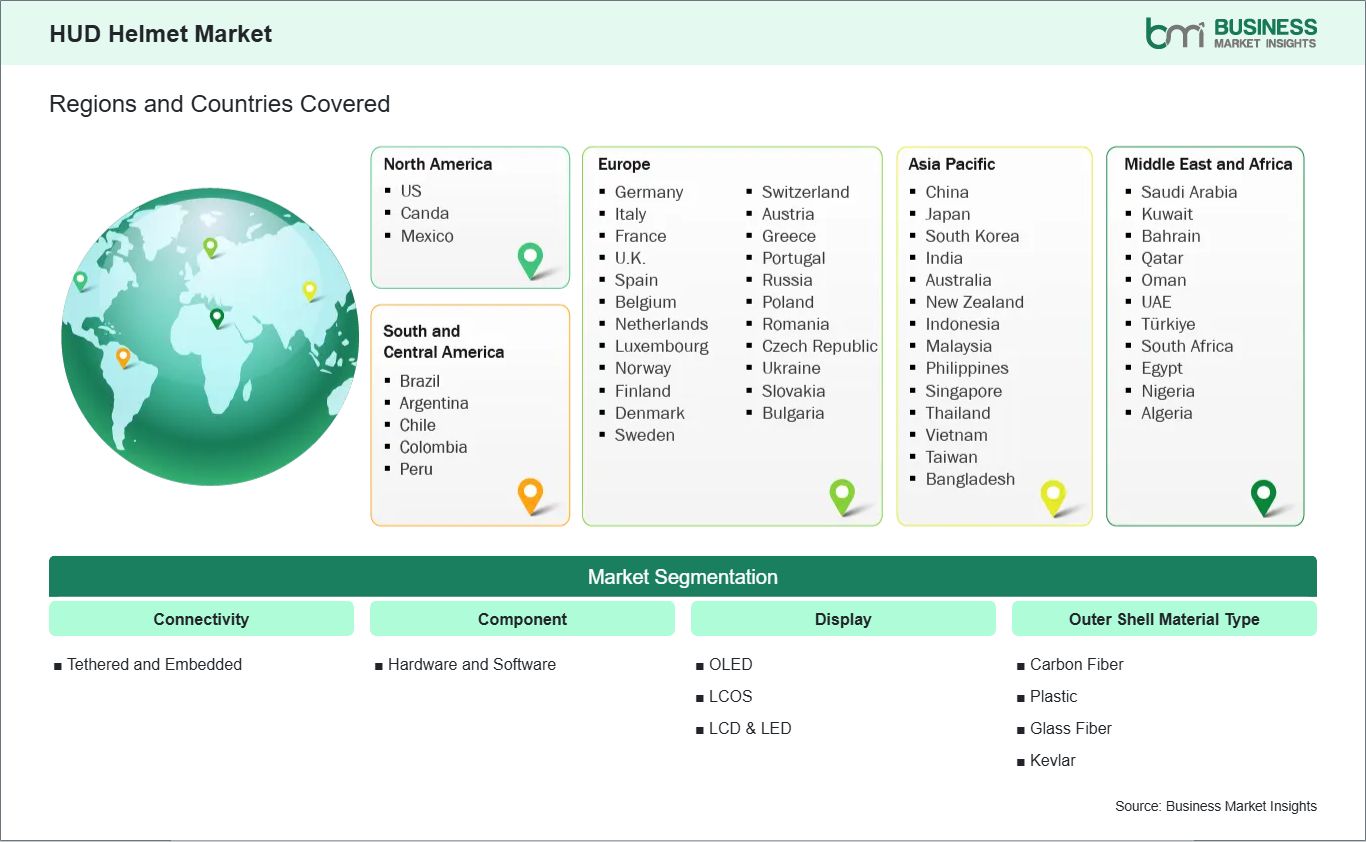
Key segments that contributed to the derivation of the HUD Helmet market analysis are connectivity, component, display, outer shell material type, technology, end‑user, and function.
- By Connectivity, the market is segmented into Tethered and Embedded.
- By Component, the market is divided into Hardware and Software.
- By Display, the market is categorized into OLED, LCOS, and LCD & LED.
- By Outer Shell Material Type, the market is divided into Carbon Fiber, Plastic, Glass Fiber, and Kevlar.
- By Technology, the market is categorized into Conventional HUD and AR HUD.
- By End‑User, the market is segmented into Racing Professionals and Personal Use.
- By Function, the market is divided into Navigation, Communication, and Performance Monitoring.
Market Forces
HUD Helmet Market Drivers and Opportunities
Road Safety Mandates and the Industrialization of Augmented Reality
The primary driver for the HUD Helmet Market is the systemic global effort to reduce fatalities in high-risk environments through digital intervention. The Urgent Requirement to Mitigate Rider Distraction acts as a foundational catalyst; by projecting turn-by-turn navigation and vehicle telemetry directly onto the visor, HUD systems can reduce hazard reaction times by as much as 25% compared to traditional head-down instrument checks. This momentum is further propelled by Stringent Workplace Safety Regulations and Industry 4.0 Mandates; in sectors such as mining and construction, smart hard hats with HUDs are being adopted to provide workers with real-time hazard alerts and remote expert guidance, significantly reducing downtime and liability. In the technological sphere, the Rapid Miniaturization of Optical Waveguides and Micro-Displays serves as a vital driver, as lighter and more energy-efficient components finally enable the production of sleek, comfortable helmets that do not compromise aerodynamic performance. Furthermore, Increased Defense Spending on Battlefield Digitization, particularly in North America, is driving the development of ruggedized, high-fidelity HUDs for ground forces and aviators, with these military-grade innovations rapidly trickling down to high-end consumer racing and touring products. Together, these factors, safety efficacy, industrial digitization, and hardware miniaturization, ensure a robust and essential growth path for the global HUD Helmet Market.
AI-Native Predictive Hazards and Software-as-a-Service Helmets
A significant high-value opportunity lies in the convergence of HUD Helmets with Edge-AI and Predictive Analytics. Next-generation helmets are being developed to utilize AI algorithms that process real-time sensor data to anticipate road hazards or industrial equipment failures before they occur, providing the user with preemptive visual warnings. There is also a major growth frontier in the development of Subscription-Based Software and Feature-on-Demand Models; manufacturers are beginning to offer base hardware with the opportunity for users to unlock premium features, such as advanced thermal imaging overlays or multi-user V2X communication, via over-the-air (OTA) updates. Furthermore, the expansion of Remote Medical Support and Tele-Surgical Guidance presents a lucrative opportunity, where HUD helmets allow field practitioners to receive real-time, hands-free instructions from remote specialists during complex emergencies. Beyond the consumer market, the rise of Integrated Fleet Management Solutions for Logistics and Delivery Services offers a unique frontier, as companies equip riders with HUDs to optimize delivery routes and track biometric fatigue levels in real time. Manufacturers who focus on Interoperable, Modular Display Modules and those pioneering Sustainable, 3D-Printed Protective Shells are positioned to lead the global HUD Helmet Market.
Size and Share Analysis
HUD Helmet Market Size and Share Analysis
Based on the display, the OLED subsegment holds the primary market presence, serving as the preferred technology for high-end HUD helmets due to its exceptional contrast ratios and energy efficiency. While LCOS and LCD & LED displays provide critical high-resolution and cost-effective alternatives for entry-level and industrial models, they hold secondary positions in terms of technological prestige. A notable trend is the surge in the Micro-LED and Waveguide subsegments, which are registering significant expansion. In these technologies, HUD helmets are becoming essential for Transparent AR Visualization, where the strategic use of ultra-compact light engines allows for the projection of vibrant graphics directly onto the visor with minimal obstruction of the natural field of vision
Report Coverage
HUD Helmet Market Report Coverage and Deliverables
The "HUD Helmet Market Size and Forecast (2022 - 2033)" report provides a detailed analysis of the market covering below areas:
- Market size and forecast at global, regional, and country levels for all market segments covered under the scope
- Market trends, as well as drivers, restraints, and opportunities
- Market analysis covering key trends, global and regional framework, major players, and recent developments
- Market concentration, heat map analysis, prominent players, and recent developments
- Detailed company profiles, including SWOT analysis
Geographic Insights
HUD Helmet Market Geographic Insights
The geographical scope of the HUD Helmet market report is divided into five regions: North America, Asia Pacific, Europe, Middle East & Africa, and South & Central America.
North America maintains the preeminent market position, supported by early adoption of advanced wearable technologies and a robust motorsports culture. Asia Pacific is identified as the most rapidly advancing region, propelled by high motorcycle penetration and increasing consumer interest in smart safety gear across emerging economies. Europe represents a sophisticated market where growth is sustained by rigorous road safety mandates and a strong presence of premium automotive and aerospace manufacturers.
The Asia-Pacific HUD Helmet Market serves as a central engine for global expansion, driven by urbanization and the modernization of personal transportation. China and Japan are leading contributors to regional growth, characterized by significant manufacturing capabilities and the integration of artificial intelligence into consumer safety products. India is witnessing a notable transition, marked by a surge in motorcycle ownership and a heightened focus on reducing road fatalities through technologically advanced protective equipment. The region benefits from a maturing ecosystem of electronics suppliers and a tech-savvy demographic seeking integrated navigation and communication features.
Industry Activity
Recent Developments
The HUD Helmet market is evaluated by gathering qualitative and quantitative data post primary and secondary research, which includes important corporate publications, association data, and databases. A few of the key developments in the HUD Helmet market are:
- In November 2025, TVS Motor Company unveiled AR-based Heads-Up Display (HUD) helmets at EICMA 2025 in collaboration with Swiss startup Aegis Rider. The helmets feature advanced AR technology for real-time navigation, hazard alerts, and smart connectivity. This launch marks a significant innovation, boosting safety and enhancing the HUD helmet market globally.
- In September 2025, Visteon Corporation and China-based FUTURUS officially partnered to co-develop next-generation AR, Windshield, and Panoramic Head-Up Display (HUD) systems for global automakers. The collaboration will project real-time driving data and ADAS alerts directly in the driver`s line of sight, enhancing safety and in-cabin experience. This strategic partnership represents a major positive development for the global HUD market, accelerating AR HUD commercialization.
Trust & Transparency
Research Methodology
The market analysis combines proprietary research with secondary data from government agencies, company disclosures, regulatory filings, industry databases and expert interviews. Market estimates are validated through data triangulation, cross-market benchmarking and analyst
review.
View Full Research Methodology
Key Sources Referred:
World Bank & Global Trade Indicators World Trade Organization (WTO) (International Monetary Fund )IMF International Trade Administration (ITA) Company website Company annual reports Company investor presentations