Market Summary
Executive Summary and Global Market Analysis
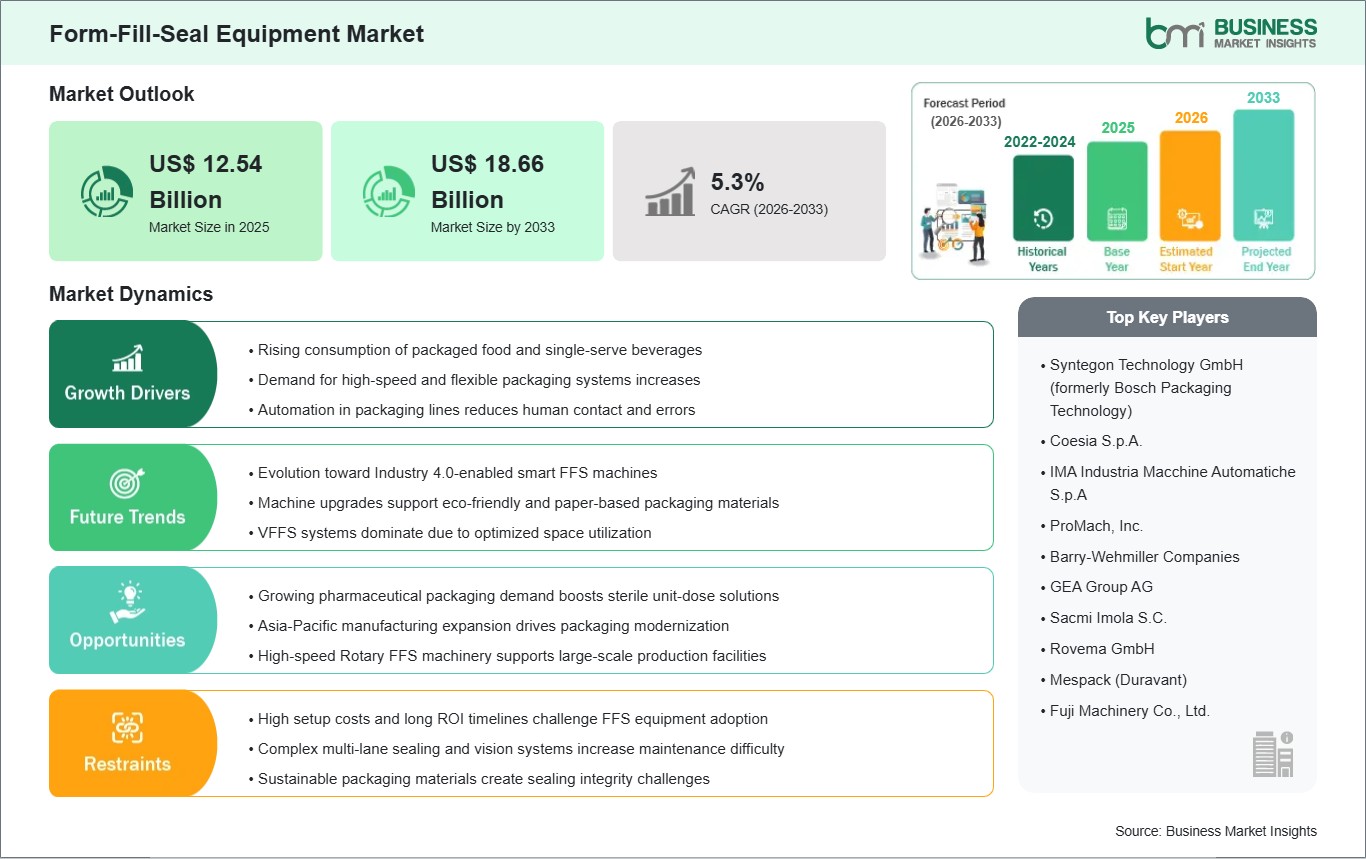
Form-fill-seal (FFS) equipment refers to the integrated application of packaging machinery engineered to form a container, fill it with a predetermined volume of product, and seal it in a single continuous operation. By utilizing specialized configurations, primarily Vertical Form-Fill-Seal (VFFS) for liquids and granules and Horizontal Form-Fill-Seal (HFFS) for solid items, these systems streamline production by replacing multiple standalone machines with a unified workflow. This technology is fundamental to the operational architecture of the food and beverage industry, pharmaceutical manufacturing, and the personal care sector. Market expansion is being propelled by the rising global demand for ready-to-eat (RTE) packaged goods, the rapid transition toward flexible pouch formats to reduce material weight, and the increasing institutional adoption of smart automation to enhance throughput and hygiene standards.
However, several factors may restrain market progression. The high capital intensity associated with the procurement of advanced, multi-format FFS lines, which often require significant upfront investment in servo-driven controls and precision dosing units, remains a primary hurdle for small and medium-sized enterprises (SMEs). The industry also faces persistent technical challenges regarding material compatibility, as transitioning from traditional plastics to sustainable, paper-based, or mono-material substrates often necessitates costly machine retrofitting to manage narrower sealing temperature windows. Additionally, the shortage of skilled technical expertise to operate and maintain highly automated Industry 4.0-compliant systems can lead to suboptimal equipment utilization. These hurdles, compounded by global supply chain volatility for critical electronic components and stringent regulatory mandates regarding aseptic packaging in the healthcare sector, increase the total cost of ownership and may lengthen the ROI period for legacy-dependent manufacturers.
Despite these hurdles, the market outlook remains highly favorable as the sector transitions toward autonomous and sustainable packaging ecosystems. Opportunities are emerging through the adoption of AI-driven predictive maintenance; as of March 2026, the market is witnessing a surge in systems that utilize real-time sensor data to identify mechanical wear before failure, reducing unplanned downtime by up to 40%. The expansion of Hybrid FFS units is gaining significant traction, allowing manufacturers to switch between plastic and biodegradable films in under 30 minutes to meet shifting consumer preferences for eco-friendly packaging. Furthermore, the growth of modular automation, where machines are built in sections for easy hardware upgrades, aligns with global goals for operational agility and long-term asset future-proofing. Collectively, these innovations position the form-fill-seal equipment industry for sustained long-term development as a cornerstone of the modern, efficient, and circular global packaging landscape.
Segment Analysis
Form-Fill-Seal Equipment Market Segmentation
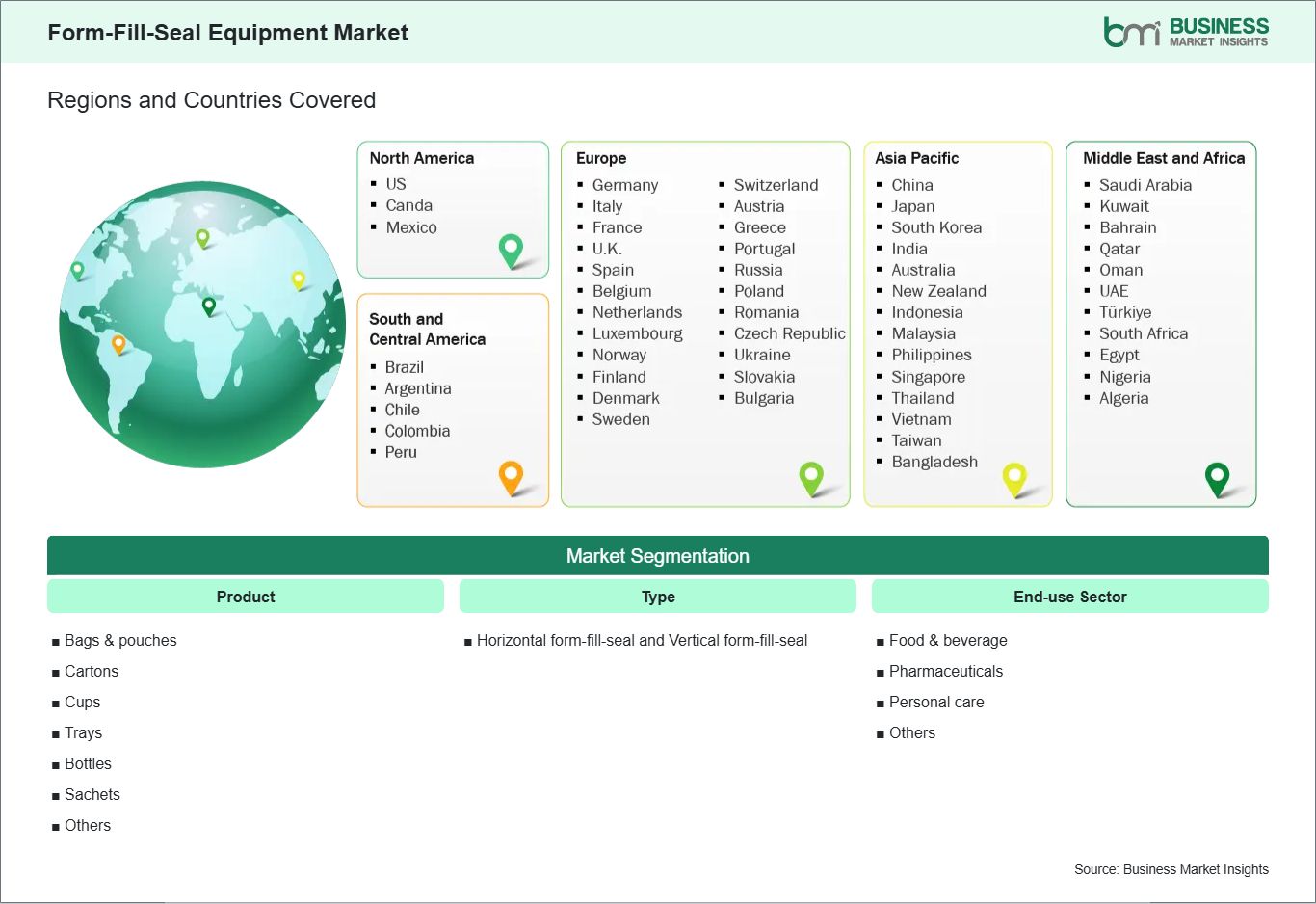
Key segments that contributed to the derivation of the Form-Fill-Seal Equipment market analysis are product, type, and end-use sector.
- By Product, the market is segmented into Bags & pouches, Cartons, Cups, Trays, Bottles, Sachets, and Others.
- By Type, the market is divided into Horizontal form-fill-seal and Vertical form-fill-seal.
- By End-use Sector, the market is categorized into Food & beverage, Pharmaceuticals, Personal care, and Others.
Market Forces
Form-Fill-Seal Equipment Market Drivers and Opportunities
Rising Demand for Automation, Efficiency, and Hygiene
The form‑fill‑seal equipment market is being driven by the growing need for automation, production efficiency, and hygiene across food & beverage, pharmaceuticals, chemicals, and consumer goods industries. FFS machines streamline packaging by forming, filling, and sealing products in a single integrated process, reducing labor costs and minimizing errors. Rising demand for packaged food and ready‑to‑eat products is amplifying adoption, as manufacturers seek faster, more reliable packaging solutions to meet consumer expectations. In pharmaceuticals, strict regulatory standards for sterile packaging are reinforcing growth, with FFS equipment ensuring compliance and product safety. Sustainability initiatives are also propelling investment, as modern FFS systems reduce material waste and support eco‑friendly packaging formats. Additionally, the expansion of e‑commerce and global supply chains is driving demand for durable, tamper‑proof packaging solutions. Collectively, automation needs, hygiene priorities, and efficiency goals are fueling sustained growth in the global form‑fill‑seal equipment market.
Rising Integration of Smart Technology, Customization, and Emerging Applications
Opportunities in the form‑fill‑seal equipment market are expanding through the integration of smart technology, customization capabilities, and emerging cross‑industry applications. IoT‑enabled FFS systems are opening lucrative opportunities by offering real‑time monitoring, predictive maintenance, and adaptive production control. AI‑driven platforms are gaining traction, enabling manufacturers to optimize packaging speed, reduce downtime, and improve quality consistency. The growing emphasis on personalized and flexible packaging is fueling demand for FFS equipment that can handle diverse product sizes, shapes, and materials. Emerging applications in nutraceuticals, cosmetics, and specialty chemicals are driving innovation, as these industries require precise, contamination‑free packaging solutions. Additionally, sustainability trends are encouraging deployment of FFS machines compatible with biodegradable films and recyclable materials, aligning with global environmental goals. The expansion of modular and high‑speed FFS systems is creating new pathways for adoption, offering scalability and adaptability to evolving production needs. Vendors who focus on smart, customizable, and eco‑friendly FFS solutions are well‑positioned to capture growth. The convergence of automation, IoT, and sustainable packaging underscores a transformative trajectory for the global form‑fill‑seal equipment market.
Size and Share Analysis
Form-Fill-Seal Equipment Market Size and Share Analysis
The Form-Fill-Seal Equipment market demonstrates steady growth, with size and share analysis revealing evolving trends and competitive positioning among key players. The report examines subsegments categorized within product, type, and end-use sector, offering insights into their contribution to overall market performance.
Based on Product, the Bags & Pouches subsegment holds the primary market presence, as they are widely used in food, beverage, and pharmaceutical packaging for their flexibility, cost‑effectiveness, and convenience. The Cartons subsegment is essential for retail and consumer goods, offering durability and branding opportunities. The Cups and Trays subsegments anchor demand in ready‑to‑eat meals and dairy products, supporting portion control and hygiene. The Bottles subsegment is critical for beverages and liquid pharmaceuticals, ensuring safety and extended shelf life. The Sachets subsegment dominates small‑volume packaging in personal care and food products. The Others category includes niche formats, highlighting versatility across industries.
Report Coverage
Form-Fill-Seal Equipment Market Report Coverage and Deliverables
The “Form-Fill-Seal Equipment Market Size and Forecast (2022–2033)” report provides a detailed analysis of the market covering below areas:
- Market size and forecast at global, regional, and country levels for all market segments covered under the scope
- Market trends, as well as drivers, restraints, and opportunities
- Market analysis covering key trends, global and regional framework, major players, and recent developments
- Market concentration, heat map analysis, prominent players, and recent developments
- Detailed company profiles, including SWOT analysis
Geographic Insights
Form-Fill-Seal Equipment Market Geographic Insights
The geographical scope of the Form-Fill-Seal Equipment market report is divided into five regions: North America, Asia Pacific, Europe, Middle East & Africa, and South & Central America.
North America maintains a preeminent position within the global industry, a status reinforced by the region's advanced manufacturing landscape and the rapid adoption of high-speed, integrated packaging lines. The regional landscape is characterized by significant investments in the United States and Canada, where the United States stands as the largest national market for these systems. This leadership is supported by a robust ecosystem of technology pioneers, including ProMach, Duravant, and Barry-Wehmiller, who drive the commercialization of sophisticated vertical and horizontal systems that combine forming, filling, and sealing into a single, uninterrupted process.
Industrial and consumer trends in the region reflect a decisive shift toward Modular Automation and Flexible Packaging Formats. As manufacturers face persistent labor shortages, there is an escalating demand for fully automated systems that minimize manual handling and reduce human error. Furthermore, the region is witnessing a rapid expansion in the use of Pouches and Stick Packs for the food, beverage, and pharmaceutical sectors. This focus on Convenience Engineering allows brands to meet growing consumer preferences for single-serve, on-the-go products and ready-to-eat meals, while simultaneously optimizing floor space through the use of compact, multi-format machinery.
Industry Activity
Recent Developments
The Form-Fill-Seal Equipment market is evaluated by gathering qualitative and quantitative data post primary and secondary research, which includes important corporate publications, association data, and databases. A few of the key developments in the Form-Fill-Seal Equipment market are:
- In March 2026, ROVEMA launched the BV Core 260, a new generation vertical form-fill-seal machine offering up to 160 bags per minute, robust sealing, and compatibility with both paper and film structures. Designed for cost-efficiency and flexibility, the BV Core 260 features intuitive HMI controls, ergonomic access, and advanced sensor integration, enabling high-quality, sustainable, and reliable packaging operations.
- In November 2025, Zydus Lifesciences and SIG announced a collaboration to launch single-serve spouted pouches for liquid cough and cold medication, utilizing SIG’s Motion Servo 3.2 horizontal form-fill-seal machine. The solution enables precise dosing, reduces contamination risk, and minimizes product waste, showcasing advanced FFS technology in pharmaceutical packaging. This development highlights innovation and efficiency in the form-fill-seal equipment market, strengthening its growth potential.
Trust & Transparency
Research Methodology
The market analysis combines proprietary research with secondary data from government agencies, company disclosures, regulatory filings, industry databases and expert interviews. Market estimates are validated through data triangulation, cross-market benchmarking and analyst
review.
View Full Research Methodology
Key Sources Referred:
World Bank & Global Trade Indicators World Trade Organization (WTO) International Monetary Fund (IMF) International Trade Administration (ITA) Company Websites Company Annual Reports Company Investor Presentations