
Field Programmable Gate Array Market Outlook: Size, Share, Trends, Growth Analysis, Competitive Landscape & Forecast, 2026-2033

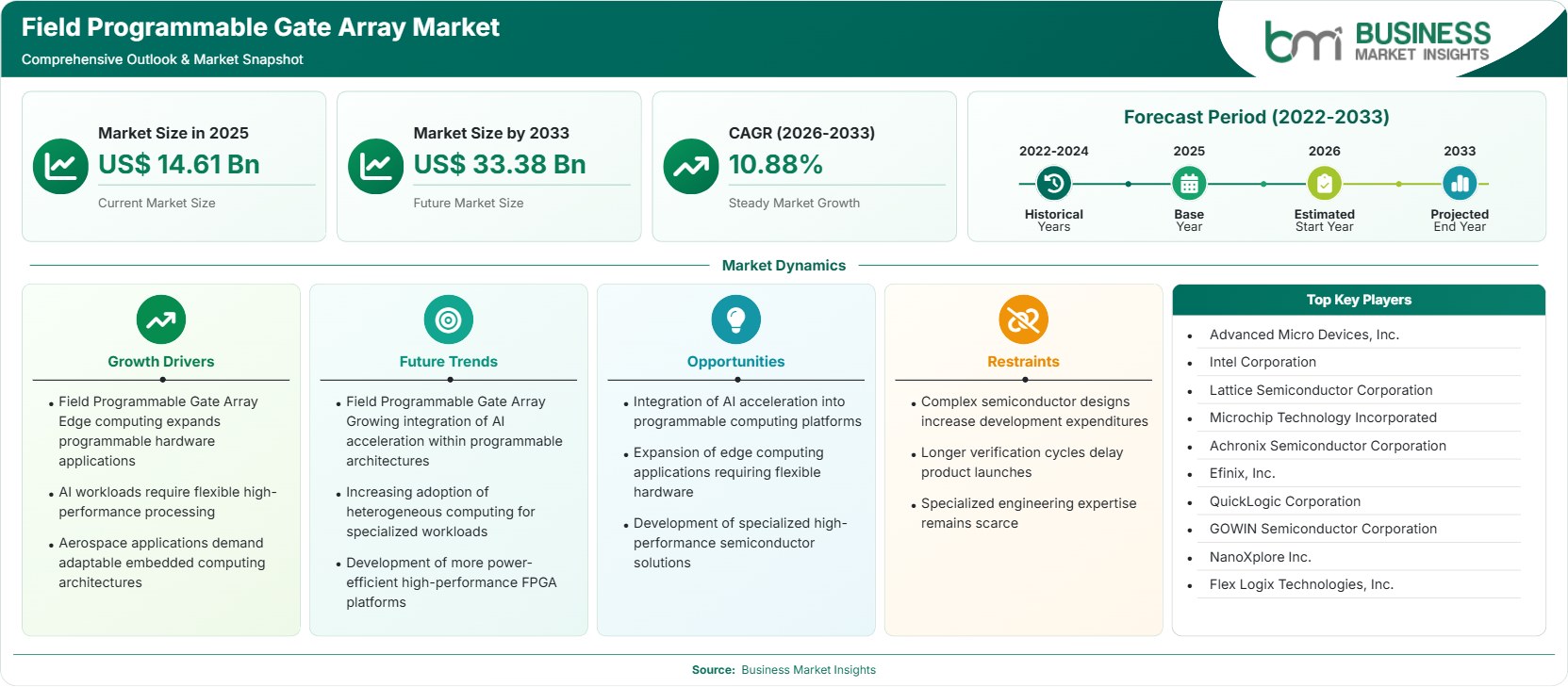
The Field Programmable Gate Array Market size was valued at US$ 14.61 Billion in 2025 and is projected to reach US$ 33.38 Billion by 2033, growing at a CAGR of 10.88% during 2026–2033, supported by AI acceleration, advanced networking, edge computing, automotive electronics, industrial automation, and defense modernization.

Report Coverage
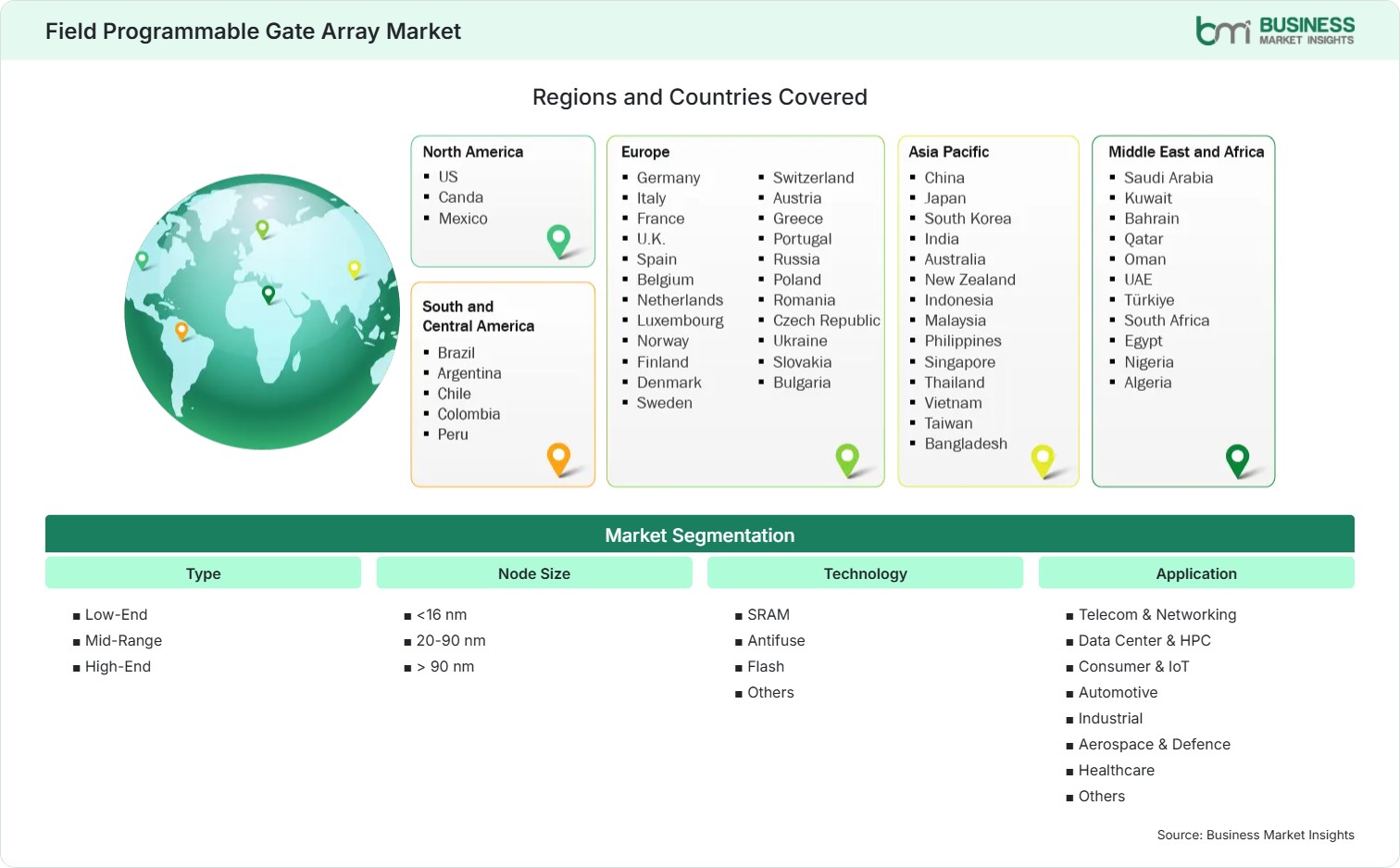
  • Type: Low-End, Mid-Range, High-End
  • Node Size: <16 nm, 20-90 nm, > 90 nm
  • Technology: SRAM, Antifuse, Flash, Others
  • Application: Telecom & Networking, Data Center & HPC, Consumer & IoT, Automotive, Industrial, Aerospace & Defence, Healthcare, Others
US$ 14.61 Bn Market size in 2025
US$ 33.38 Bn Market Size by 2033
10.88% CAGR, 2026 - 2033
2026-2033 Forecast Period

AI Overview

Field Programmable Gate Array Market Summary

  • North America Region: North America held 31%–34% share in 2025, with a 9.7%–10.2% CAGR during 2026–2033, driven by AI infrastructure, aerospace, defense, cloud computing, networking, and semiconductor investment. The US market is supported by hyperscale computing, defense electronics, advanced chip design, and adaptive computing, producing a 9.8%–10.3% CAGR through 2033.
  • Fastest Growing Region: Asia Pacific held 34%–38% share in 2025, expanding at a 12.0%–12.7% CAGR during 2026–2033, supported by electronics manufacturing, telecom infrastructure, automotive production, industrial automation, semiconductor localization, AI deployment, and data center investment.
  • Leading Segment: High-End devices held 43%–47% Field Programmable Gate Array Market share in 2025, growing at an 11.0%–11.7% CAGR during 2026–2033, supported by AI acceleration, high-speed networking, data centers, radar, aerospace, defense, and compute-intensive signal processing.
  • High Growth Segment: Devices using ≤ 16 nm held 32%–36% share in 2025, growing at a 12.0%–12.8% CAGR during 2026–2033, driven by higher logic density, energy efficiency, AI workloads, high-speed interfaces, compact designs, and advanced embedded processing.
  • Key Market Opportunity: AI inference, edge analytics, secure networking, industrial vision, robotics, and automotive processing create opportunities for adaptable hardware delivering low latency, application flexibility, energy efficiency, and extended product lifecycles.
  • Major Market Players: Advanced Micro Devices, Inc.; Intel Corporation; Lattice Semiconductor Corporation; Microchip Technology Incorporated; Achronix Semiconductor Corporation; Efinix, Inc.; QuickLogic Corporation; GOWIN Semiconductor Corporation; NanoXplore Inc.; and Flex Logix Technologies, Inc.
Strategic Insights

Field Programmable Gate Array Market: Strategic Insights

Field Programmable Gate Array Market Strategic Framework
FREE PDF
Request your free sample
Request free sample
Stakeholder View

Key Takeaways

  • The value chain is now bringing together FPGA architecture, foundry capacity, advanced packaging, intellectual property, development tools, software, boards, distributors, and system integration.
  • Opportunities for applications are heading in the direction of AI inference, data center acceleration, machine vision, robotics, advanced driver assistance, radar, secure communications, and high-speed networking.
  • The focus of product innovation is now on adaptive SoCs, AI-enabled programmable fabric, chiplets, advanced memory interfaces, hardware security, and more efficient edge processing.
  • Asia Pacific represents a significant investment opportunity since semiconductor manufacturing, electronics assembly, telecom infrastructure, automotive production, and industrial automation all contribute to increasing demand at the same time.
  • Increasingly, competitive investment is being directed towards specialized acceleration, different kinds of programmable architectures, development software, IP, accelerator cards, security, and system-level solutions.
Geographic Outlook

Field Programmable Gate Array Market Regional Highlights

North America Field Programmable Gate Array Market

North America represented 31%–34% share in 2025, with a 9.7%–10.2% CAGR during 2026–2033. The region benefits from established semiconductor design capabilities, hyperscale computing, defense electronics, aerospace programs, advanced networking, and cloud infrastructure. The United States remains the principal national contributor, while Canada adds specialized opportunities in communications, aerospace, and embedded electronics. The Field Programmable Gate Array Market share is supported by AI acceleration, secure computing, and demand for adaptable hardware across critical infrastructure.

  • The demand for programmable acceleration in AI infrastructure is growing because these workloads need parallel processing, low latency, and adaptable data paths.
  • In the aerospace and defense fields, deterministic processing, secure system architectures, long-term availability, and programmable signal processing for radar and communications are all given priority.
  • Investing in networking opens up possibilities in the areas of packet processing, security acceleration, protocol adaptation, and infrastructure modernization.

US Field Programmable Gate Array Market

The United States represented approximately 82%–86% of the North American share in 2025, with a 9.8%–10.3% CAGR during 2026–2033. Demand is anchored by cloud computing, AI infrastructure, defense, aerospace, telecommunications, industrial systems, and automotive electronics. Semiconductor policy is also encouraging domestic ecosystem development and supply-chain resilience. The Field Programmable Gate Array Market growth outlook is strengthened by demand for adaptable computing, where application requirements evolve faster than fixed-function semiconductor development cycles.

  • The defense procurement program includes the use of programmable architectures in radar, secure communications, electronic sensing, signal processing, and mission computing.
  • The huge scale of infrastructure leads to a need for acceleration platforms that support networking, storage, compression, security, and AI workloads.
  • Increasingly, people involved in the automotive and industrial sectors are using programmable hardware for sensor processing, machine vision, functional safety, and edge acceleration.

Europe Field Programmable Gate Array Market

Europe Field Programmable Gate Array Market held 22%–25% share in 2025, with a 9.9%–10.5% CAGR during 2026–2033. Germany, France, the United Kingdom, Italy, and the Netherlands remain important markets because of automotive electronics, industrial automation, aerospace, defense, and communications. Germany provides substantial automotive and industrial demand, while France and the United Kingdom contribute to aerospace and defense opportunities. Germany and France represent higher-growth markets, with country-level growth generally around 10.2%–11.0% CAGR as automation and secure computing requirements increase.

  • Automotive electrification increases the need for sensor processing, communications management, control functions, and flexible electronic designs.
  • The use of FPGAs is being extended by industrial automation into the fields of robotics, machine vision, motion control, factory networking, and deterministic processing.
  • The modernization of the defense sector includes the use of programmable processing in radar, communications, surveillance, and electronic systems.

Asia Pacific Field Programmable Gate Array Market

Asia Pacific held 34%–38% share in 2025, with a 12.0%–12.7% CAGR during 2026–2033. China, Japan, South Korea, Taiwan, India, and Southeast Asia provide manufacturing depth and expanding electronics demand. Taiwan and South Korea benefit from advanced semiconductor ecosystems, while India and Southeast Asia offer high-growth opportunities through electronics manufacturing, telecom expansion, automotive production, industrial automation, and semiconductor investment. The Field Programmable Gate Array Market share is reinforced by broad electronics production and infrastructure development.

  • The telecommunications infrastructure provides the capability for programmable processing in the areas of protocol conversion, signal processing, traffic management, and network acceleration.
  • The automotive manufacturing industry has the opportunity to benefit from electrification, advanced driver assistance, in-vehicle networking, battery systems, and sensor processing.
  • The fact that semiconductor production is localized promotes investment in design capabilities, packaging, testing, and in the electronic supply chains that support them.

Rest of World Field Programmable Gate Array Market

The South and Central America Field Programmable Gate Array Market provides opportunities through telecommunications, industrial automation, energy systems, and automotive electronics, with Brazil and Mexico serving as important markets. The Middle East and Africa are developing through telecom infrastructure, defense systems, energy modernization, and data center investment. RoW represented 7%–10% share in 2025, with a 9.1%–9.7% CAGR during 2026–2033. Mexico benefits from North American manufacturing integration, while Gulf economies provide opportunities in digital infrastructure and secure computing.

  • Mexico benefits from electronics manufacturing, automotive production, industrial automation, and cross-border supply chains.
  • Brazil offers possibilities in the fields of telecommunications, industrial controls, energy infrastructure, healthcare equipment, and embedded electronics.
  • Investment in data centers, digital infrastructure, secure communications, and automation is being made by markets in the Gulf.
Global Market Geography
FREE PDF
Request your free sample
Request free sample
Segment Analysis

Field Programmable Gate Array Market Segmentation

Type

High-End devices represented 43%–47% share in 2025 and are projected to grow at 11.0%–11.7% CAGR during 2026–2033. The Field Programmable Gate Array Market scope is expanding as data centers, AI systems, networking, aerospace, and defense require greater programmable resources, memory bandwidth, connectivity, and parallel processing capabilities.

  • Low-End: Low-end devices serve cost-sensitive control, monitoring, consumer electronics, and embedded applications, supported by compact packaging, low power consumption, simplified designs, and high-volume production.
  • Mid-Range: Mid-range devices address industrial automation, communications, automotive electronics, and edge computing while balancing programmable resources, connectivity, power efficiency, security, and development cost.
  • High-End: High-end devices support AI acceleration, networking, data centers, radar, aerospace, and defense workloads requiring extensive programmable resources and advanced interfaces.

Node Size

The ≤ 16 nm category represented 32%–36% Field Programmable Gate Array Market share in 2025 and is projected to achieve 12.0%–12.8% CAGR during 2026–2033. Advanced nodes improve logic density and energy efficiency, supporting AI acceleration, networking, edge processing, and compact high-performance designs.

  • ≤ 16 nm: Advanced nodes enable higher logic density, improved performance-per-watt, sophisticated interfaces, and compact designs for AI, networking, data centers, and automotive systems.
  • 20-90 nm: Mature nodes remain important for industrial, automotive, communications, and control applications requiring long lifecycles, established qualification, predictable supply, and cost discipline.
  • > 90 nm: Legacy nodes continue serving specialized industrial, defense, and replacement markets where established qualification, availability, and design stability remain important.

Technology

SRAM remains central to reprogrammable architectures because it supports flexibility and advanced scaling. Antifuse and flash technologies retain application-specific positions where non-volatility, security, reliability, or instant-on operation are priorities. The Field Programmable Gate Array Market trends therefore reflect a technology mix rather than a single architecture.

  • SRAM: SRAM supports reprogrammable architectures across AI acceleration, networking, data centers, industrial processing, and advanced embedded systems.
  • Antifuse: Antifuse devices provide permanent configuration and strong resistance to unauthorized modification, supporting aerospace, defense, security-sensitive, and specialized systems.
  • Flash: Flash-based devices combine non-volatile configuration with programmable logic for embedded applications requiring instant-on behavior, low power, security, and simplified architectures.

Application

Telecom and networking remain important applications, while data centers, HPC, automotive, industrial automation, aerospace, defense, healthcare, consumer electronics, and IoT broaden demand through real-time processing and adaptable acceleration.

  • Telecom & Networking: Programmable devices support packet processing, protocol adaptation, optical networking, traffic management, security acceleration, and infrastructure upgrades.
  • Data Center & HPC: FPGAs provide adaptable acceleration for networking, storage, compression, security, AI inference, and specialized workloads requiring deterministic latency.
  • Consumer & IoT: Compact programmable devices support sensor processing, connectivity, imaging, display functions, and product differentiation in connected devices.
  • Automotive: Automotive systems use programmable hardware for sensor fusion, driver assistance, communications, control, safety, and evolving electronic architectures.
  • Industrial: Industrial applications emphasize deterministic processing, robotics, machine vision, motor control, factory networking, and flexible automation.
  • Aerospace & Defense: Programmable logic supports radar, secure communications, signal processing, electronic warfare, navigation, and mission computing.
  • Healthcare: Medical imaging, diagnostics, monitoring systems, surgical platforms, and laboratory equipment use programmable processing for specialized real-time workloads.
Market Forces

Field Programmable Gate Array Market Dynamics

Key Market Drivers

AI Acceleration Expands Programmable Computing

AI inference is increasing the demand for adaptable hardware because workloads require parallel processing, low latency, and efficient data movement. Intel's Agilex 5 architecture integrates AI tensor blocks into FPGA fabric, while its AI Suite supports model conversion and optimization. Achronix is also positioning Speedster7t platforms for AI and HPC acceleration. These developments are shifting demand toward programmable acceleration rather than conventional logic alone. The Field Programmable Gate Array Market trends increasingly emphasize AI inference, memory bandwidth, energy efficiency, and software tools that simplify deployment. Demand therefore spans cloud infrastructure, telecom networks, industrial edge systems, and embedded platforms.

Advanced Networking Raises Performance Requirements

Network infrastructure requires programmable processing for packet handling, security, protocol adaptation, and workload acceleration. High-speed programmable architectures increasingly combine fabric, processors, memory, hardened interfaces, and security functions. This expands the addressable role of FPGAs in data center interconnects, optical systems, storage, communications infrastructure, and edge networking. The Field Programmable Gate Array Market growth outlook is consequently linked to increasing data movement and infrastructure complexity. Suppliers that combine high-speed connectivity with strong development environments can address system-level requirements more effectively. Programmable networking also provides flexibility as protocols and workloads evolve, reducing the need for complete hardware redesigns during infrastructure refresh cycles.

Industrial and Automotive Electronics Increase Adoption

Industrial automation and automotive systems need deterministic processing, flexible interfaces, sensor management, and long product lifecycles. The fact that they have these features makes use of programmable hardware possible since the systems can take on new protocols and algorithms without having to completely redesign the silicon. Intel has identified edge, embedded, automotive, vision, and medical applications as suitable for its Agilex series. Lattice as well aims its small, low-power devices at industrial, communications, server, and automotive applications. As a result, acceptance is now being spread across the fields of machine vision, robotics, sensor fusion, factory networking, vehicle electronics, and edge AI.

Key Market Opportunities

Edge AI Creates New Acceleration Architectures

Edge AI offers the possibility of bringing together programmable logic, embedded processors, and specialized AI resources all within strict power limits. Since latency, bandwidth, privacy, or reliability can prevent cloud-only systems from being viable, industrial cameras, robotics, medical equipment, autonomous systems, and intelligent infrastructure are increasingly relying on local inference. Intel's Agilex range shows this trend by incorporating AI tensor blocks and providing AI development tools. Companies can take advantage of this opportunity by using compact devices, optimizing their software, offering reference designs, ensuring secure deployment, and improving performance per watt. It is especially important to simplify the conversion of AI models since this can reduce the need for specialized hardware engineering and allow a wider range of customers to be served.

Security and Post-Quantum Protection Create Demand

As security continues to be a stronger factor in product differentiation, the growing cyber risks facing connected infrastructure are driving this trend. In October 2025, Lattice launched the MachXO5-NX TDQ family featuring CNSA 2.0-compliant post-quantum cryptography, crypto-agility, and a hardware root of trust. Opportunities now exist in the areas of communications, industrial equipment, automotive systems, servers, and government infrastructure. Programmable devices are able to incorporate secure boot, authenticated configuration, cryptographic acceleration, and updatable security functions. For equipment with a long lifespan, security agility can lessen the need to replace such assets when cryptographic requirements change. Vendors who combine the flexibility of programmable devices with built-in security, thus being able to meet the security needs of infrastructure that requires protection to evolve over the entire equipment lifecycle.

Cost-Optimized Devices Broaden Addressable Applications

Cost optimization can expand FPGA adoption among applications that do not require high-end transceivers or maximum logic resources. This illustrates a strategy of matching feature sets to application requirements. Industrial controls, medical equipment, embedded communications, automotive subsystems, and volume-sensitive products can benefit from such architectures. Pin compatibility, long availability, mature tools, low power consumption, and predictable supply can further reduce migration barriers, strengthening the Field Programmable Gate Array Market forecast as cost-efficient programmable solutions broaden adoption across diverse applications.

Market Restraints and Challenges

Advanced Manufacturing and Packaging Costs

The use of advanced-node wafers, intricate packaging, high-speed interfaces, and complex design processes leads to higher development and manufacturing costs. This results in greater device prices, which in turn may limit their use in applications where cost is a major concern and raises the level of investment needed to move from products based on mature nodes. When programmable devices switch to smaller nodes, suppliers have to strike a balance among performance, energy efficiency, packaging complexity, qualification cost, capacity access, and inventory exposure. Because of these economic considerations, there remains a continued demand for differentiated mid-range and mature-node devices in cases where the highest possible density is not required.

Development Complexity Limits Broader Adoption

The need for specialized hardware design knowledge, verification, timing closure, integration of intellectual property, and hardware-software co-design arises in FPGA development. This increased complexity may lead to longer project timelines and may discourage companies that are used to working with processor-based programming. To meet this challenge, vendors are providing higher-level tools, AI frameworks, reference designs, development kits, reusable IP, and automated optimization options. For instance, Intel's FPGA AI Suite enables the conversion of pretrained models into inference IP and includes optimization features. However, efficient deployment still requires expertise in architecture-specific design. Simplified software environments, therefore, continue to be important if adoption is to be expanded across industrial, automotive, AI, networking, and embedded applications.

Company Analysis

Competitive Landscape

The Field Programmable Gate Array Market analysis indicates competition across high-end adaptive computing, low-power programmable logic, secure embedded devices, accelerator cards, space electronics, and specialized AI acceleration.

Company Name

Overview

Products and Services relevant to this market

Advanced Micro Devices, Inc.

Major adaptive computing supplier serving data center, networking, embedded, AI, and communications applications.

Versal adaptive SoCs, FPGA architectures, AI engines, networking acceleration, IP, and development tools.

Intel Corporation

Global semiconductor supplier with programmable products spanning edge, embedded, communications, and computing.

Agilex FPGA families, SoC FPGAs, AI tools, development kits, IP, and acceleration platforms.

Lattice Semiconductor Corporation

Specialist in low-power, compact, secure programmable solutions for edge and embedded markets.

Certus-NX, MachXO5-NX, Nexus platforms, sensAI solutions, security features, and software.

Microchip Technology Incorporated

Diversified semiconductor supplier serving industrial, aerospace, defense, automotive, communications, and embedded markets.

PolarFire, PolarFire SoC, RTG4, radiation-tolerant FPGAs, development tools, and security solutions.

Achronix Semiconductor Corporation

Specialist supplier focused on high-performance programmable acceleration for networking, AI, and data-intensive workloads.

Speedster FPGAs, VectorPath accelerator cards, embedded FPGA IP, and AI acceleration.

Efinix, Inc.

Programmable logic developer emphasizing efficient architectures and embedded computing applications.

Titanium and Trion FPGA families, RISC-V solutions, development tools, and AI acceleration.

QuickLogic Corporation

Supplier focused on low-power programmable logic and embedded FPGA technology.

EOS S3, eFPGA technology, sensor processing, low-power logic, and embedded acceleration.

GOWIN Semiconductor Corporation

FPGA supplier serving consumer, industrial, communications, and embedded applications.

Arora FPGA families, LittleBee devices, development software, IP, and evaluation platforms.

NanoXplore Inc.

European programmable semiconductor company focused on radiation-tolerant space and embedded applications.

NG FPGA families, space-grade devices, development tools, and radiation-tolerant solutions.

Flex Logix Technologies, Inc.

Semiconductor IP supplier specializing in embedded FPGA and hardware acceleration technology.

InferX AI acceleration, embedded FPGA IP, configurable logic, and SoC integration technologies.

Trust & Transparency

Research Methodology

The market analysis combines proprietary research with secondary data from government agencies, company disclosures, regulatory filings, industry databases and expert interviews. Market estimates are validated through data triangulation, cross-market benchmarking and analyst review.

View Full Research Methodology

Questions Answered

Frequently Asked Questions

How is security influencing FPGA development?

Security is increasingly integrated through secure boot, configuration authentication, hardware roots of trust, encryption, cryptographic acceleration, tamper protection, and post-quantum capabilities. These features are particularly relevant to long-lived connected infrastructure.

Which applications benefit from low-power programmable logic?

Industrial controllers, machine vision, automotive subsystems, communications equipment, portable medical devices, consumer electronics, and edge AI systems can benefit when local processing must operate within strict thermal, power, size, or latency constraints.

Why is FPGA software important?

Development tools influence engineering time, verification effort, IP integration, model deployment, and hardware optimization. Software ecosystems supporting AI frameworks, reusable IP, simulation, debugging, and automated optimization can reduce adoption barriers.

Why do mature-node FPGAs remain relevant?

Mature-node devices can provide cost advantages, established qualification, long availability, and predictable supply. Industrial, automotive, aerospace, and infrastructure applications may prioritize lifecycle stability over maximum logic density.

How do FPGAs differ from GPUs for AI workloads?

FPGAs provide configurable parallel processing and application-specific data paths, while GPUs offer highly parallel architectures optimized for broad computational workloads. The Field Programmable Gate Array Market Report examines these architectural differences alongside application demand, technology developments, regional dynamics, and competitive positioning.

Access the Full Field Programmable Gate Array Market Report

Get segment-level forecasts, regional estimates, competitive benchmarking, company profiles and downloadable Excel datasets.

Access the full Field Programmable Gate Array Market Report
350 pages PDF & Excel | 2026-10-05
Similar Research

Related Market Reports