
Facial Recognition Market Size, Share, Trends & Forecast Report, 2026–2033

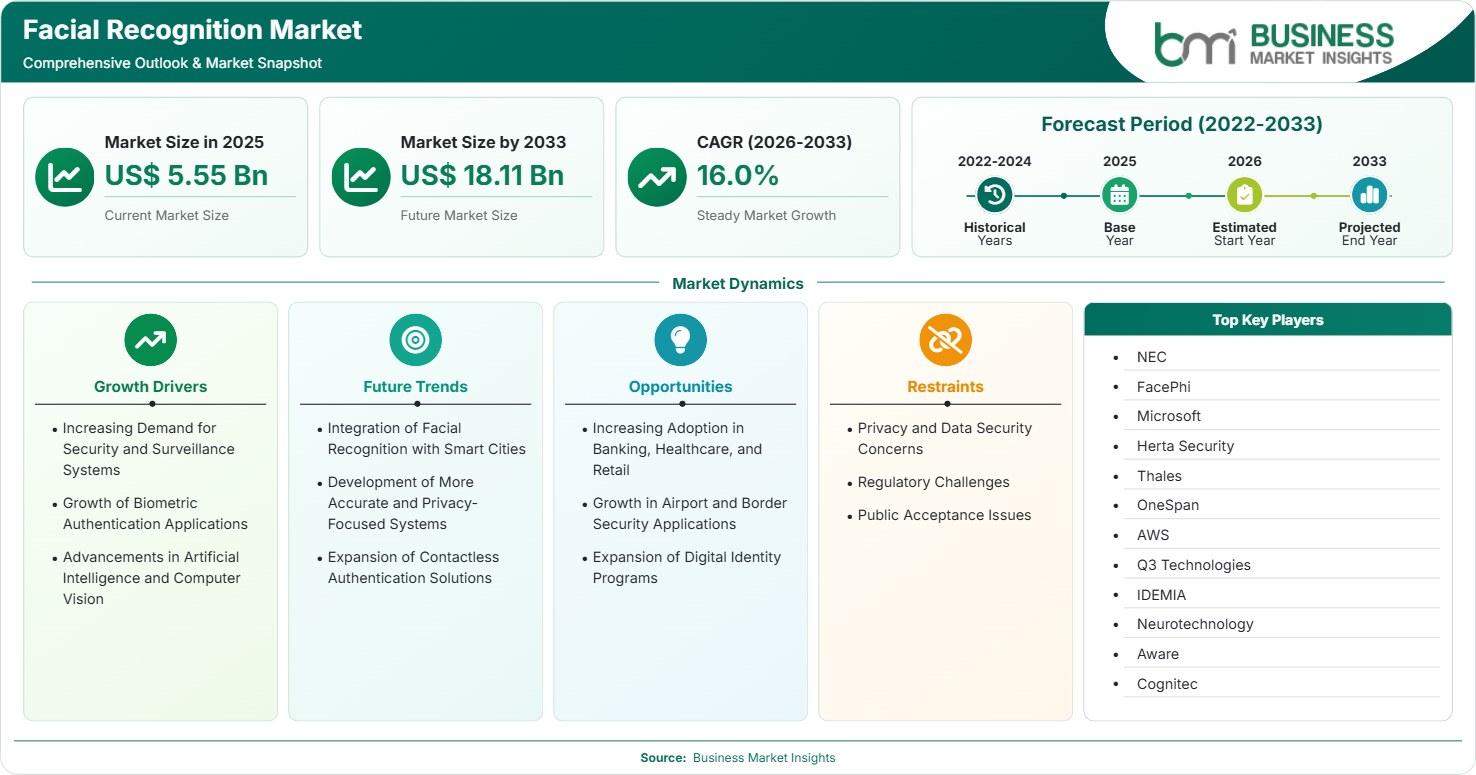
The Facial Recognition Market size was valued at US$ 5.55 Billion in 2025 and expected to grow up to US$ 18.11 Billion by 2033, registering an annual growth rate of US$ 16.0% between 2026 and 2033, due to increasing demand for AI-powered identity solutions, growing security needs, and digital transformation programs.

Report Coverage
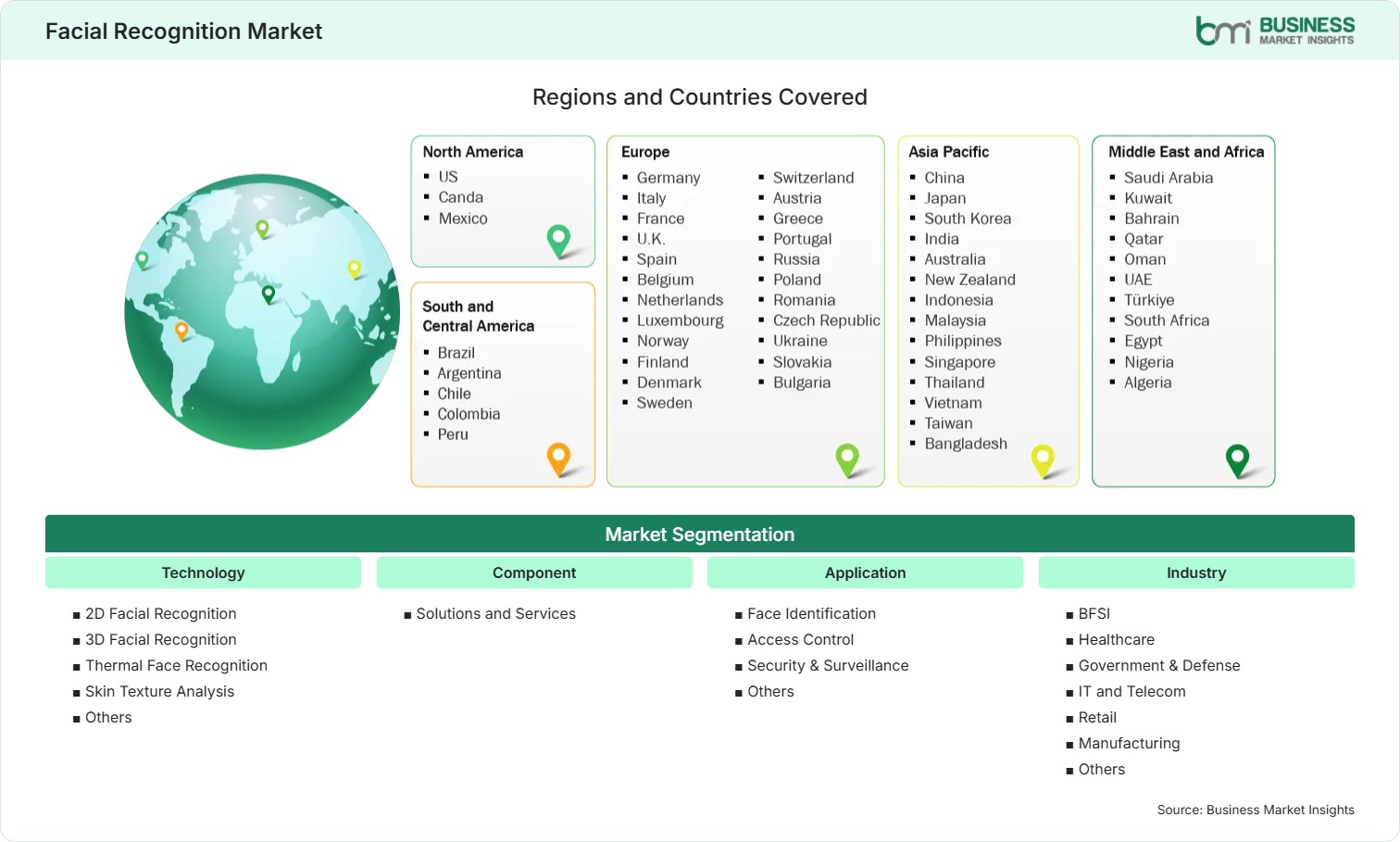
  • Technology: 2D Facial Recognition, 3D Facial Recognition, Thermal Face Recognition, Skin Texture Analysis, and Others
  • Component: Solutions and Services
  • Application: Face Identification, Access Control, Security & Surveillance, and Others
  • Industry: BFSI, Healthcare, Government & Defense, IT and Telecom, Retail, Manufacturing, and Others
US$ 5.55 Bn Market size in 2025
US$ 18.11 Bn Market Size by 2033
16.0% CAGR, 2026 - 2033
2026-2033 Forecast Period

01 AI Overview

Facial Recognition Market Summary

  • North America Region: North America holds a market share of 35%–38% in 2025, growing with a CAGR of 14%–16% due to advanced security infrastructure, government modernization, and enterprise adoption. The US market expands through AI investments and identity verification applications with a CAGR of 15%–17%.
  • Fastest Growing Region: Asia Pacific accounts for a market share of 28%–31% in 2025, growing with a CAGR of 18%–20% supported by smart city programs, digital identity initiatives, expanding surveillance networks, and increasing biometric deployment across developing economies.
  • Leading Segment: Solutions maintain a market share of 62%–65% in 2025, growing with a CAGR of 15%–17% due to integrated platforms, AI analytics capabilities, enterprise security demand, and government investments in automated identification systems.
  • High Growth Segment: 3D Facial Recognition captures a market share of 22%–25% in 2025, growing with a CAGR of 19%–21% driven by accuracy improvements, anti-spoofing capabilities, smartphone authentication, and advanced access control applications.
  • Key Market Opportunity: Expansion of digital identity frameworks, automated border control systems, and cloud-based biometric platforms creates investment opportunities by enabling secure authentication, improving operational efficiency, and supporting large-scale identity management deployments globally.
  • Major Market Players: NEC, FacePhi, Microsoft, Herta Security, Thales, OneSpan, Amazon Web Services, Q3 Technologies, IDEMIA, Neurotechnology, Aware, Cognitec, Daon, Ayonix, and Megvii.
02 Strategic Insights

Facial Recognition Market: Strategic Insights

Facial Recognition Market Strategic Framework
FREE PDF
Request your free sample
Request free sample
03 Stakeholder View

Key Takeaways

  • The ecosystem is evolving from standalone recognition software toward integrated biometric platforms combining cameras, cloud infrastructure, AI models, cybersecurity layers, and identity management capabilities.
  • Enterprise demand is shifting toward secure authentication applications, with banking, healthcare, retail, and transportation sectors representing high-value opportunities for scalable deployments.
  • Innovation priorities are centered on improving algorithm accuracy, reducing bias, strengthening anti-spoofing mechanisms, and enabling faster edge-based processing for real-time recognition.
  • Asia Pacific presents a strong investment case due to smart city expansion, government-backed digital identity programs, and rising adoption of automated security systems.
  • Strategic investments and partnerships are increasing as technology companies expand biometric portfolios through acquisitions, platform integration, and collaborations with public and private organizations.
  • Market participants are prioritizing privacy-preserving technologies, including encrypted biometric processing and decentralized identity approaches, to address regulatory expectations and user trust requirements.
04 Geographic Outlook

Facial Recognition Market Regional Highlights

North America Facial Recognition Market

North America accounted for a market share of 35%–38% in 2025 and is forecasted to grow at a CAGR of 14%–16% from 2026 to 2033. The region dominates because of high adoption by enterprises, cybersecurity framework, and government spending on biometric security systems. Market share of Facial Recognition Market stays high in the US and Canada because of application growth in finance, transport, and defense sectors.

  • Government agencies are deploying advanced identity verification platforms for border management, law enforcement operations, and secure citizen service delivery across multiple jurisdictions.
  • Financial institutions are integrating biometric authentication solutions to strengthen fraud prevention, improve customer onboarding processes, and enable secure digital banking experiences.
  • Technology companies are advancing cloud-based recognition platforms with artificial intelligence capabilities, supporting scalable deployments across commercial and public sector environments.
  • Healthcare organizations are adopting biometric identification systems to improve patient authentication, protect medical records, and streamline administrative workflows.

US Facial Recognition Market

The US represented a market share of 29%-32% in 2025 and is projected to register growth at a rate of 15%-17% between 2026 and 2033. There is high demand from federal organizations, tech vendors, banks and airports, aiding in the development of the Facial Recognition market. This nation continues to be an important center for innovation, due to artificial intelligence research and enterprise security needs.

  • Federal security programs are increasing biometric adoption for border screening, identity verification, and national security applications requiring accurate recognition capabilities.
  • Retail companies are implementing facial analytics solutions to understand customer behavior, improve security monitoring, and optimize personalized shopping experiences.
  • Cloud service providers are expanding biometric computing capabilities through scalable platforms that support enterprise authentication and application development.

Europe Facial Recognition Market

The market share of Europe stood at 20% to 23% in 2025, and the region is anticipated to report a CAGR of 13% to 15% between 2026 and 2033. The adoption is driven by factors such as upgrades in airports, digitized identities, and security in the leading economies. Some nations which include Germany, France, and the UK are implementing such solutions.

  • Germany is expanding biometric applications across industrial facilities, transportation networks, and enterprise security systems with a focus on reliable authentication.
  • France is increasing investments in secure identity platforms for public services, airports, and large-scale event security management applications.
  • The UK market is developing through retail analytics, law enforcement modernization, and commercial security implementations requiring advanced recognition technologies.
  • European technology providers are focusing on privacy-enhancing architectures to align biometric innovation with regional data protection requirements.

Asia Pacific Facial Recognition Market

Asia Pacific captured a Facial Recognition Market share of 28%–31% in 2025 and is forecast to grow at a CAGR of 18%–20% through 2033. The region represents the fastest-growing Facial Recognition market due to smart city development, digital identity programs, and expanding surveillance infrastructure. China, India, Japan, and South Korea are leading adoption through government and commercial deployments.

  • China continues large-scale biometric implementation across transportation, public security, and commercial environments supported by advanced artificial intelligence ecosystems.
  • India is expanding digital identity applications through technology modernization, financial inclusion programs, and increasing demand for secure authentication solutions.
  • Japan is investing in biometric technologies for airports, retail automation, and enterprise access control systems requiring higher accuracy.
  • South Korea is adopting recognition platforms across smart infrastructure projects, healthcare facilities, and public safety applications.

Rest of World Facial Recognition Market

Rest of World accounted for a market share of 10%–13% in 2025 and is expected to grow at a CAGR of 16%–18% during 2026–2033. South and Central America, along with Middle East and Africa markets, are increasing adoption through security modernization, banking digitization, and infrastructure development. Brazil, UAE, and Saudi Arabia represent important growth countries.

  • Brazil is deploying biometric solutions in banking, government services, and transportation networks to improve identity verification capabilities.
  • Middle Eastern countries are investing in smart airports, security infrastructure, and digital government platforms requiring advanced recognition technologies.
  • Saudi Arabia and UAE are expanding biometric applications through smart city initiatives and automated border management programs.
  • African markets are adopting mobile-based identity solutions to support financial access, government services, and secure authentication requirements.
  • Latin American enterprises are increasing technology investments as digital transformation initiatives create demand for reliable security solutions.
Global Market Geography
FREE PDF
Request your free sample
Request free sample
05 Segment Analysis

Facial Recognition Market Segmentation

Technology

Technology segment accounted for a market share of 55%–58% in 2025 and is expected to expand at a CAGR of 16%–18% between 2026–2034. Facial Recognition Market scope within the technology segment is rising because of advancements in artificial intelligence, sensors, and biometrics. Organizations are deploying facial recognition techniques in order to secure, verify, and identify people.

  • 2D Facial Recognition: Provides cost-effective identification capabilities through conventional camera systems, supporting widespread deployment in retail, access control, and enterprise security applications.
  • 3D Facial Recognition: Enhances accuracy using depth mapping technologies, enabling secure authentication, anti-spoofing capabilities, and improved performance in complex environments.
  • Thermal Face Recognition: Uses infrared imaging to identify individuals under challenging conditions, supporting security applications requiring visibility in low-light or temperature-variable environments.
  • Skin Texture Analysis: Improves biometric verification by analyzing facial surface patterns, helping strengthen authentication reliability and reduce impersonation risks.

Component

Component segment represented a market share of 42%–45% in 2025 and is projected to grow at a CAGR of 15%–17% from 2026–2034. Facial Recognition Market trends include the growing demand for comprehensive platforms that offer software and hardware integration, as well as analytics and managed services.

  • Solutions: Includes recognition platforms, analytical software, and integrated systems designed for identity verification, surveillance, security, and automated authentication workflows.
  • Services: Covers implementation, consulting, maintenance, integration, and support services that help organizations deploy and manage biometric technology efficiently.

Application

Application segment generated a market share of 65%–68% in 2025 and is estimated to record a CAGR of 17%–19% through 2026–2034. Growth in applications is driven by the growing need for quick identity authentication, higher security, and automation of operations. Increasing use of applications in public safety, financial institutions, transport, and customer interaction is boosting demand for biometrics.

  • Face Identification: Supports identity matching applications across government databases, security operations, and enterprise authentication environments requiring accurate recognition.
  • Access Control: Enables secure entry management for workplaces, facilities, and restricted areas by replacing traditional authentication methods.
  • Security & Surveillance: Provides real-time monitoring capabilities for public spaces, transportation hubs, and critical infrastructure protection.

Industry

Industry segment accounted for a market share of 70%–73% in 2025 and is projected to grow at a CAGR of 16%–18% through 2034. Industry adoption continues expanding as organizations prioritize automated security, identity protection, and operational efficiency. The Facial Recognition Market trends demonstrate increasing implementation across regulated industries and technology-driven business environments.

  • BFSI: Banks and financial institutions utilize biometric authentication for secure transactions, customer onboarding, fraud reduction, and digital banking verification.
  • Healthcare: Providers deploy recognition technologies for patient identification, medical record security, and streamlined healthcare administration processes.
  • Government & Defense: Agencies use biometric platforms for national security, border management, law enforcement, and public service authentication.
  • IT and Telecom: Technology providers integrate recognition systems into digital platforms, cybersecurity solutions, and customer identity management services.
  • Retail: Retailers apply facial analytics for customer insights, loss prevention, personalized experiences, and store security enhancement.
  • Manufacturing: Industrial facilities implement biometric access systems to improve workforce management, safety compliance, and restricted-area monitoring.
06 Market Forces

Facial Recognition Market Dynamics

Key Market Drivers

Increasing Demand for Security and Surveillance Systems

The rise in security needs in various places like airports, governmental institutions, transportation systems, and commercial centers is making more people embrace biometric identification systems. The market growth will be boosted by greater spending on surveillance and threat detection systems. Security analysis in the industry suggests that countries all over the world have focused on digital identities and border management solutions. Facial Recognition Market trends indicate stronger demand for systems that integrate artificial intelligence, video analytics, and cloud platforms. The expansion of smart city projects and critical infrastructure protection programs is further supporting deployments across public and private environments.

Growth of Biometric Authentication Applications

Biometric authentication is becoming a preferred alternative to passwords and physical identification methods because of improved convenience and security performance. Financial services firms, hospitals and medical facilities, and technology businesses are using facial verification systems in their customer onboarding process and for transaction authorizations and digital access controls. The rising use of smartphones and mobile payments is leading to more consumer-facing uses of facial recognition technology. The capability of offering contactless authentication is making the use of biometrics more attractive in many industries. Better encryption techniques and identity management systems along with cloud computing are contributing towards improved reliability and scalability of implementations.

Advancements in Artificial Intelligence and Computer Vision

AI advancements and computer vision improvements have improved recognition accuracy, speed, and adaptability to the environment. Deep learning algorithms enable the identification of people under various lighting conditions, angles, and scenarios. Corporations are researching developments in algorithm optimization, edge computing, and privacy protection in biometric processing. These developments are facilitating the implementation of recognition technology in security systems, retail analytics, and enterprise authentication services. Combining deep learning algorithms with hardware enables the implementation of fast and effective recognition systems.

Key Market Opportunities

Increasing Adoption in Banking, Healthcare, and Retail

Opportunities in Banking, Healthcare, and Retail industries arise due to the demand of the companies for secure and user-friendly identity verification tools. Financial enterprises use facial recognition technology for online banking services. In healthcare organizations, biometric identification is used for better patient management and confidentiality. Facial analytics are implemented in the retail industry to enhance customer experience and security. According to Facial Recognition Market Forecast, there is an increased opportunity for investment due to incorporation of biometric technologies into overall digital transformations. Cloud-based systems allow small companies to implement biometric recognition technology through subscriptions.

Growth in Airport and Border Security Applications

Airport modernization programs and border security initiatives are creating strong demand for biometric identification technologies. Aviation authorities are adopting automated passenger processing systems to reduce waiting times and improve identity verification accuracy. Facial recognition-enabled checkpoints, self-service boarding solutions, and immigration controls are becoming important components of next-generation travel infrastructure. International travel trends and the need for security solutions are driving the development of biometric solutions. Technology companies are designing systems that can offer recognition accuracy, cybersecurity elements, and compliance solutions.

Expansion of Digital Identity Programs

There is an increasing demand in emerging economies and advanced nations for innovative identity solutions. There are increasing efforts by governments to establish an identity framework which enables better access to public services and other facilities like the financial system. Facial recognition systems can be utilized for such purposes. There are increasing alliances between public sector agencies and tech companies in order to develop infrastructure for identity systems. In future, adoption would depend on privacy-conscious design and effective governance of such technology.

Market Restraints and Challenges

Privacy and Data Security Concerns

Factor: Growing concerns regarding biometric data collection, storage, and unauthorized usage create challenges for widespread adoption. Impact: The deployment of recognition systems comes with a higher level of compliance, costs of implementation, and the issue of public trust. There are privacy regulations in various locations that need businesses to improve their encryption, consent management, and data protection. Issues related to surveillance and abuse of personal information may lead to the postponement of implementation in some regions. The solution is for technology vendors to develop privacy-based tools and other governance systems.

Regulatory Challenges

Factor: Diverse regulatory approaches across countries create uncertainty for technology providers and end users implementing biometric systems. Impact: Longer deployment times, higher compliance costs, and constraints on certain uses may be experienced by businesses. Regulatory bodies and governments are putting frameworks together that deal with the issues of transparency, accountability of algorithms, and permissible use. Regional differences in policies could pose difficulties for the deployment of such systems globally. Solution providers will have to continue adapting their products according to changing legal requirements.

07 Company Analysis

Competitive Landscape

The Facial Recognition Market analysis highlights a competitive ecosystem consisting of technology companies, biometric specialists, cloud providers, and security solution developers. Market participants are focusing on artificial intelligence integration, improved recognition accuracy, privacy-focused solutions, and industry-specific platforms to strengthen their positions across government, enterprise, and consumer applications.

Company Name

Overview

Products and Services relevant to this market

NEC Corporation

Global technology provider specializing in biometric identification, security, and digital transformation solutions.

Facial recognition platforms, identity verification systems, biometric authentication, and public safety solutions.

FacePhi Biometria, S.L.

Spanish biometric technology company focused on digital identity verification and secure authentication.

Facial biometrics, remote onboarding, identity verification, and financial authentication solutions.

Microsoft Corporation

Global software and cloud technology company offering AI-powered enterprise solutions.

Azure AI Vision, facial analysis capabilities, cloud-based identity and security applications.

Herta Security S.L.

Spanish company developing advanced video intelligence and facial recognition technologies.

Real-time facial recognition, surveillance analytics, security monitoring, and investigation platforms.

Thales S.A.

Technology and security company providing digital identity and aerospace security solutions.

Biometric identification, airport security systems, identity management, and authentication technologies.

OneSpan Inc.

Digital security company focused on authentication and fraud prevention solutions.

Identity verification, secure authentication, transaction security, and biometric access solutions.

Amazon Web Services, Inc.

Cloud computing provider delivering artificial intelligence infrastructure and developer services.

Cloud AI services, machine learning tools, computer vision applications, and scalable biometric processing.

Q3 Technologies, Inc.

Technology solutions provider supporting software development and digital transformation projects.

AI development, computer vision solutions, enterprise applications, and biometric technology integration.

IDEMIA Identity & Security France SAS

Global identity technology provider specializing in secure identification systems.

Facial recognition, biometric identity solutions, border control systems, and digital identity platforms.

Neurotechnology UAB

Lithuanian technology company developing biometric algorithms and recognition software.

Facial recognition engines, biometric SDKs, identity management, and authentication applications.

Aware, Inc.

US-based biometric technology provider serving identity verification markets.

Biometric software platforms, enrollment solutions, authentication systems, and identity management tools.

Cognitec Systems GmbH

German company specializing in facial recognition technology and biometric research.

Face recognition software, video analytics, access control, and forensic identification solutions.

Daon, Inc.

Digital identity company providing authentication and identity verification technologies.

Facial biometrics, digital identity platforms, fraud prevention, and customer verification services.

Ayonix Corporation

Japanese technology company developing artificial intelligence and recognition solutions.

Facial recognition software, AI analytics, authentication systems, and security applications.

Megvii Technology Limited

Chinese artificial intelligence company focused on computer vision technologies.

Facial recognition algorithms, AI platforms, smart security systems, and enterprise vision solutions.

08 Industry Activity

Recent Developments

July 2026

Parsons Corporation launched AresNXT, a next-generation biometrics platform designed for secure identity management across critical infrastructure, national security operations, and large-scale events. The platform supports biometric verification, including facial recognition, fingerprint, and iris technologies, expanding Parsons’ presence in identity and security solutions.

November 2025

IDEMIA Public Security expanded its collaboration with Microsoft as a launch partner for Microsoft Entra Verified ID, enabling identity verification workflows using IDEMIA’s biometric-based identity technologies. The partnership strengthens the adoption of secure digital identity solutions across enterprise and public-sector applications.

August 2025

Incode Technologies, Inc. entered the Experian Partner Ecosystem to integrate its AI-powered identity verification technology into the Experian Ascend Platform. The collaboration enables Experian customers to use Incode’s facial recognition, liveness detection, and identity validation capabilities for fraud prevention and digital onboarding applications.

January 2025

Entrust Corporation added AI-powered facial biometric authentication capabilities to its Identity as a Service (IDaaS) platform. The enhancement enables organizations to verify users through encrypted biometric identifiers stored on devices, supporting secure digital identity and fraud protection use cases.

10 Trust & Transparency

Research Methodology

The market analysis combines proprietary research with secondary data from government agencies, company disclosures, regulatory filings, industry databases and expert interviews. Market estimates are validated through data triangulation, cross-market benchmarking and analyst review.

View Full Research Methodology

11 Questions Answered

Frequently Asked Questions

What are the major challenges affecting adoption?

Privacy concerns, regulatory differences, data security requirements, and public acceptance issues remain important challenges requiring responsible deployment strategies and transparent governance frameworks.

What is covered in the Facial Recognition Market Report?

The report covers market size, regional trends, segmentation analysis, competitive landscape, industry developments, growth factors, challenges, and future opportunities across major applications and industries.

How is artificial intelligence improving facial recognition technology?

AI improves recognition accuracy, processing speed, environmental adaptability, and fraud detection capabilities through advanced machine learning models, deep neural networks, and real-time computer vision processing.

Which industries are adopting facial recognition solutions most actively?

Banking, healthcare, government, defense, retail, transportation, and IT sectors are actively implementing facial recognition for identity verification, security monitoring, customer services, and operational automation.

What factors are influencing the Facial Recognition Market growth?

Increasing demand for secure authentication, AI advancements, smart infrastructure investments, and digital identity programs are key factors influencing adoption across government, enterprise, transportation, and consumer applications.

Access the Full Facial Recognition Market Report

Get segment-level forecasts, regional estimates, competitive benchmarking, company profiles and downloadable Excel datasets.

Access the full Facial Recognition Market Report
350 pages PDF & Excel | 2026-07-27