
Ethyl Acetate Market Outlook: Size, Share, Trends, Growth Analysis, Competitive Landscape & Forecast, 2026-2033

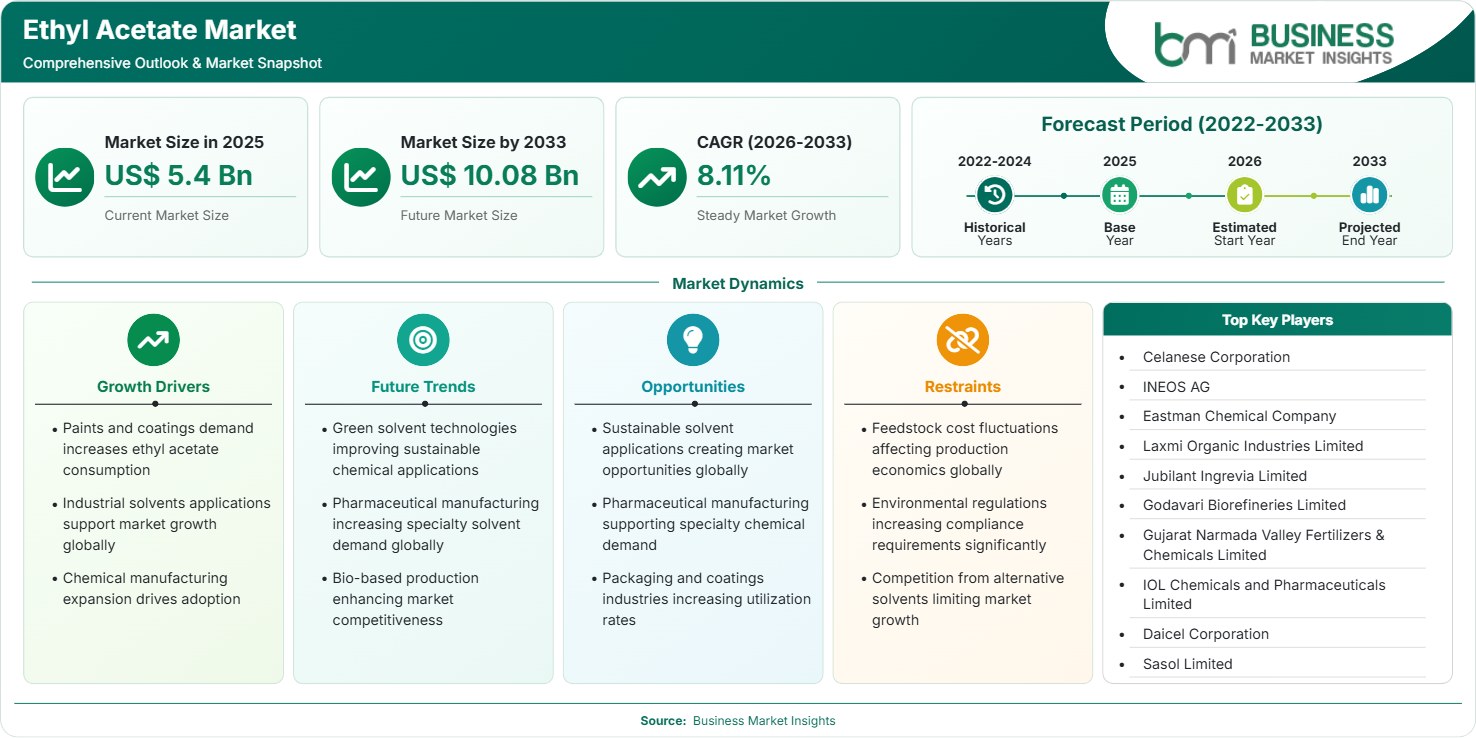
The Ethyl Acetate Market size was valued at US$ 5.4 Billion in 2025 and is projected to reach US$ 10.08 Billion by 2033, growing at a CAGR of 8.11% during 2026–2033, supported by demand for coatings, flexible packaging, printing inks, pharmaceutical processing, and lower-impact solvent solutions.

Report Coverage
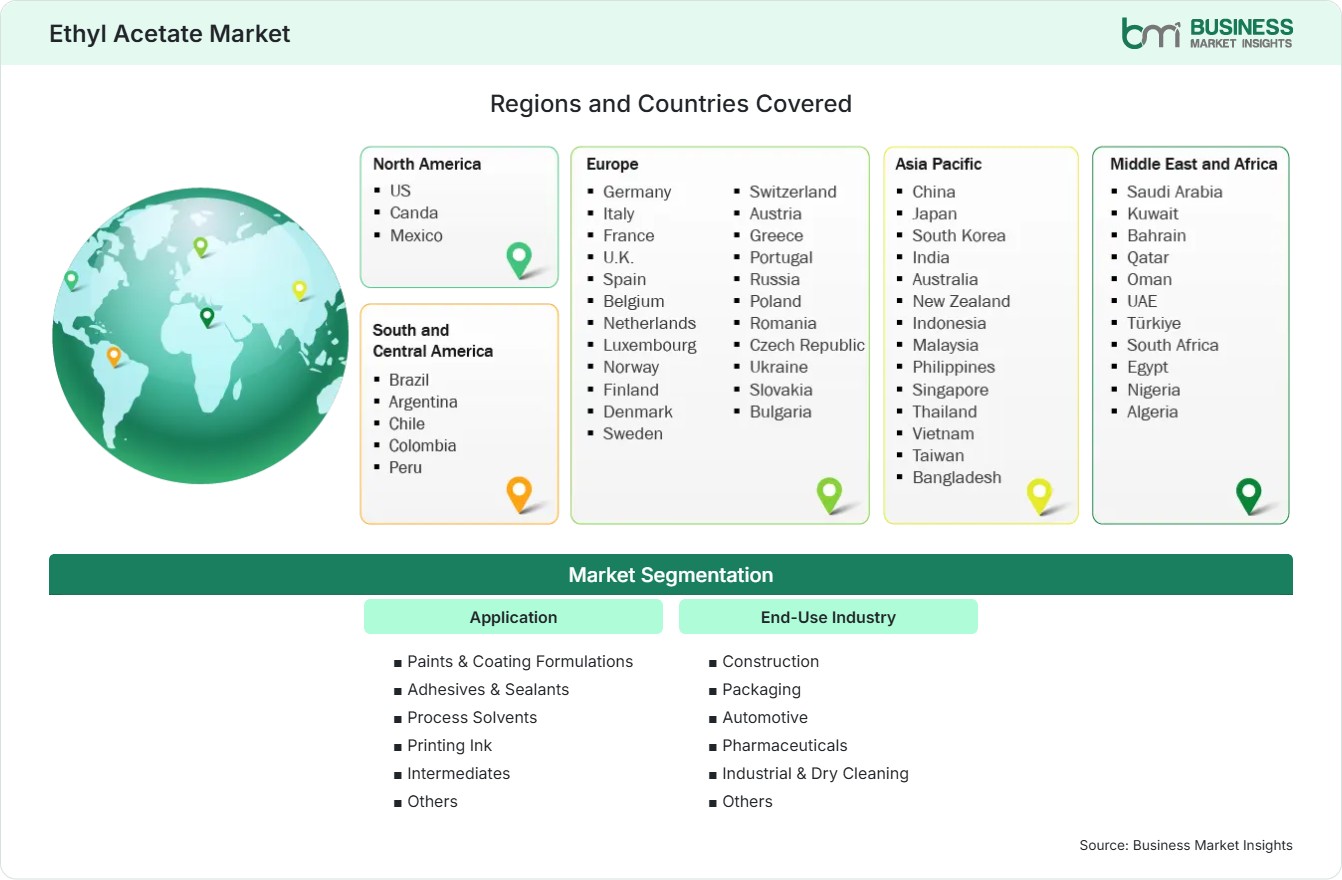
  • Application: Paints & Coating Formulations, Adhesives & Sealants, Process Solvents, Printing Ink, Intermediates, Others
  • End-Use Industry: Construction, Packaging, Automotive, Pharmaceuticals, Industrial & Dry Cleaning, Others
US$ 5.4 Bn Market size in 2025
US$ 10.08 Bn Market Size by 2033
8.11% CAGR, 2026 - 2033
2026-2033 Forecast Period

AI Overview

Ethyl Acetate Market Summary

  • North America Region: North America holds an estimated 18%–22% Ethyl Acetate Market share in 2025, advancing at a modelled CAGR of 6%–8% during 2026–2033, supported by coatings, packaging, pharmaceutical manufacturing, and demand for reliable, high-purity industrial solvents. The United States benefits from established chemical production and diverse downstream industries, with modelled growth of 6%–8% as manufacturers improve solvent efficiency and procurement resilience.
  • Fastest Growing Region: Asia Pacific accounts for an estimated 42%–46% share in 2025 and is modelled to expand at a CAGR of 9%–11% during 2026–2033, driven by industrial capacity, flexible packaging, construction activity, and pharmaceutical manufacturing.
  • Leading Segment: Paints & Coating Formulations represent an estimated 32%–36% of application demand in 2025, with modelled growth of 7%–9% during 2026–2033, supported by resin compatibility, rapid evaporation, formulation versatility, and demand for industrial finishes.
  • High Growth Segment: Packaging represents an estimated 20%–24% of end-use demand in 2025 and is modelled to grow at 9%–11% during 2026–2033, supported by flexible packaging, multilayer films, printing applications, and demand for efficient solvent-based lamination.
  • Key Market Opportunity: Bio-based production, pharmaceutical-grade solvents, solvent recovery, and improved process efficiency offer manufacturers opportunities to differentiate products, manage environmental requirements, and establish long-term supply relationships with quality-sensitive customers.
  • Major Market Players: Celanese Corporation, INEOS AG, Eastman Chemical Company, Laxmi Organic Industries Limited, Jubilant Ingrevia Limited, Godavari Biorefineries Limited, Gujarat Narmada Valley Fertilizers & Chemicals Limited, IOL Chemicals and Pharmaceuticals Limited, Daicel Corporation, and Sasol Limited.
Strategic Insights

Ethyl Acetate Market: Strategic Insights

Ethyl Acetate Market Strategic Framework
FREE PDF
Request your free sample
Request free sample
Stakeholder View

Key Takeaways

  • Supply-chain positioning: Competitive advantage depends on access to ethanol and acetic acid, plant utilisation, energy efficiency, and proximity to customers. Integrated producers can reduce procurement exposure, while regional suppliers can compete through shorter delivery times and specialised grades.
  • Application-led opportunities: Paints and coatings provide a substantial demand base, while packaging, adhesives, and pharmaceutical processing create complementary opportunities. Suppliers should prioritise applications where evaporation behaviour, resin compatibility, purity, and production consistency influence customer purchasing decisions.
  • Technology and product development: Process optimisation, improved distillation, automated quality control, and solvent recovery can improve operating economics. Renewable feedstocks offer another development pathway, although commercial adoption depends on cost, supply reliability, and documented product characteristics.
  • Regional investment priorities: Asia Pacific offers a compelling manufacturing case because of its downstream industrial ecosystem and expanding packaging requirements. India and China are particularly relevant for evaluating capacity, logistics, feedstock access, and opportunities to serve both domestic customers and export markets.
  • Investment and consolidation: Capacity additions and plant debottlenecking can strengthen supplier positions, but investors must assess utilization, feedstock exposure, working-capital requirements, and regional price cycles. Long-term customer agreements can help reduce the earnings volatility associated with commodity solvents.
  • Procurement resilience: Buyers can reduce supply disruption by qualifying multiple producers, defining technical specifications, and evaluating delivered costs rather than headline prices alone. Distributors with appropriate storage and handling capabilities remain important where customers need frequent, smaller-volume deliveries.
Geographic Outlook

Ethyl Acetate Market Regional Highlights

North America Ethyl Acetate Market

North America represents an estimated 18%–22% of global demand in 2025, with modelled growth of 6%–8% annually through 2033. The region benefits from established coatings, packaging, automotive, and pharmaceutical industries. The Ethyl Acetate Market share is influenced by domestic chemical manufacturing, imports, distributor inventories, and demand for dependable industrial grades. The United States remains the principal demand center, while Canada and Mexico provide additional opportunities through manufacturing, trade, and cross-border supply relationships. Producers compete through service, quality consistency, and logistics.

  • Coatings manufacturers require solvents with predictable evaporation and resin compatibility. Suppliers that maintain reliable specifications can support repeat purchasing, particularly among industrial finishers and manufacturers of protective coatings operating under demanding production schedules.
  • Flexible packaging and printing operations use ethyl acetate in solvent-based inks and lamination systems. Demand depends on packaging output, formulation choices, printing efficiency, and customers' ability to manage solvent emissions safely.
  • Pharmaceutical production supports specialized demand where solvent purity and process consistency matter. Suppliers with documented quality systems and reliable delivery can differentiate themselves from vendors competing primarily on commodity pricing.
  • Environmental compliance encourages manufacturers to review solvent handling, capture, and recovery. Investments in ventilation, closed transfer, and recovery systems can influence purchasing decisions without necessarily eliminating demand for conventional solvent-based formulations.

US Ethyl Acetate Market

The US accounts for between 15% and 19% of global demand in 2025, roughly 75%–90% of that in North America. Growth rates are forecast at 6%–8% per year until 2033. The diverse chemical industry provides demand from coatings manufacturers, automotive parts makers, packaging converters, and pharma companies. Both domestic supply and imports affect prices. Growth of the Ethyl Acetate Market is contingent upon production volume, buyers' stocking policies, formulation needs, and the economic viability of alternative solvents.

  • Industrial coatings demand follows activity in manufacturing, construction, maintenance, machinery, and transportation equipment. Producers must balance solvent performance with customer requirements for coating durability, drying time, and emissions management.
  • Packaging converters need dependable solvent supplies to maintain print quality and lamination performance. Suppliers that coordinate deliveries with production schedules can reduce inventory pressure and strengthen relationships with large packaging customers.
  • Pharmaceutical customers place greater emphasis on documentation and controlled handling than on price alone. Suppliers serving this segment must maintain consistent product specifications and demonstrate that manufacturing and distribution procedures satisfy customer qualification requirements.

Europe Ethyl Acetate Market

Europe represents an estimated 16%–20% of global demand in 2025 of the Ethyl Acetate Market, with modelled growth of 5%–7% annually through 2033. Specialty chemicals, packaging, coatings, and pharmaceutical manufacturing support demand. Germany, France, Italy, and the United Kingdom provide important downstream industrial markets, although individual country performance varies with manufacturing output and energy costs. The region's regulatory environment increases the importance of safe handling, emissions controls, and product documentation. Import competition and production economics remain important determinants of supplier profitability.

  • Germany offers demand opportunities in industrial coatings, automotive supply chains, and specialty chemicals. Suppliers with dependable delivery arrangements and consistent quality can support manufacturers that prioritize production reliability and process repeatability.
  • France and Italy provide opportunities in packaging, inks, coatings, and pharmaceutical applications. Customer demand reflects industrial output, product formulation requirements, and the relative economics of solvent-based and alternative technologies.
  • The United Kingdom retains demand across pharmaceutical manufacturing, printing, and industrial applications. Supply continuity and compliance documentation are relevant for buyers managing multiple production sites and cross-border sourcing arrangements.
  • European environmental policy encourages emissions reduction and efficient solvent management. Producers and customers can respond through recovery systems, improved process controls, and application-specific reformulation, although technical performance and conversion costs constrain the speed of change.

Asia Pacific Ethyl Acetate Market

The Asia Pacific region will have a share of worldwide consumption of around 42%-46 % in 2025, growing at 9%-11% per year until 2033. China and India are major producers and consumers of this product, while other nations, such as Japan, South Korea, and Southeast Asia, play a role in manufacturing and downstream production. The scale of industries in this region is sufficient to generate demand in the coatings, adhesives, packaging, and pharmaceuticals industries. The Ethyl Acetate Market growth outlook is closely linked to manufacturing capacity, export competitiveness, feedstock availability, and investment in downstream production.

  • China combines substantial chemical manufacturing capabilities with demand from packaging, coatings, and industrial production. Competitive capacity and domestic distribution can influence regional pricing, making utilization rates and export economics important commercial indicators.
  • India presents opportunities across pharmaceuticals, flexible packaging, paints, and adhesives. Its chemical manufacturing base and downstream demand create scope for domestic supply expansion, provided producers manage feedstock costs, quality requirements, and transport infrastructure.
  • Japan and South Korea offer demand from specialized manufacturing and quality-sensitive industrial applications. Suppliers can compete through consistent specifications, technical support, and dependable supply rather than relying exclusively on price competition.
  • Southeast Asian manufacturing hubs benefit from packaging conversion, consumer goods production, and cross-border trade. Investment opportunities depend on customer concentration, port access, storage infrastructure, and the ability to secure competitively priced material.

Rest of World Ethyl Acetate Market

South and Central America Ethyl Acetate Market constitutes a portion of the demand driven by packaging, coatings, industrial manufacturing, and pharmaceutical applications. Brazil is an important market to consider due to its diverse industrial base and chemical manufacturing sector. The region's growth is forecast at 6%–9% per annum until 2033, with outcomes determined by industrial activity, import dynamics, and currency fluctuations. Regional availability may contribute to flexibility, but consumers are sensitive to raw material prices.

The Middle East and Africa constitute a smaller, yet varied demand base. Opportunities exist in the Gulf countries for industrial development, construction, and chemical processing. Established markets in South Africa and others provide demand for coatings and packaging applications. Growth of the region is forecasted at 7%–10% per annum. Regional distribution channels, port facilities, storage practices, and availability of imports will determine the development of the regional market. Consideration of consumer density and logistical expenses is crucial for manufacturers in making investments.

  • Brazil provides opportunities in packaging, coatings, and chemical processing. Domestic production and imports both influence supply conditions, while currency fluctuations and freight costs affect the competitiveness of alternative suppliers.
  • Mexico and other Latin American markets can benefit from manufacturing links with North America. Buyers value delivery reliability and product consistency, particularly where solvent availability affects continuous packaging and industrial production.
  • Gulf markets offer opportunities associated with construction materials, industrial coatings, and chemical-sector diversification. Investment decisions depend on downstream demand, feedstock economics, logistics infrastructure, and the commercial viability of serving neighboring markets.
  • South Africa provides a distribution and industrial demand base for selected solvent applications. Suppliers must account for import lead times, inventory costs, and the purchasing requirements of coatings and packaging customers.
  • Across Africa, growth depends on manufacturing development, distribution access, and the economics of imported material. Established distributors can support smaller buyers through appropriate storage, technical documentation, and reliable shipment coordination.
Global Market Geography
FREE PDF
Request your free sample
Request free sample
Segment Analysis

Ethyl Acetate Market Segmentation

Application

The paint and coatings segment is the largest end-use segment in this market, with an estimated market share of 32% - 36% in 2025 and growth of 7%- 9% per year until 2033. Adhesives, solvents, and ink segments provide additional demands. The scope of the Ethyl Acetate Market includes industrial formulations and specialized extraction technologies, with volatility, solvency, purity, and compatibility determining suitability.

  • Paints & Coating Formulations: Ethyl acetate dissolves compatible resins and adjusts formulation viscosity and drying behavior. Demand depends on industrial coatings, lacquers, finishing requirements, and customers' need for predictable application performance.
  • Adhesives and Sealants: The solvent supports selected adhesive formulations by helping dissolve polymers and control processing characteristics. Demand follows packaging lamination, product assembly, and applications requiring appropriate bonding performance and drying profiles.
  • Process Solvents: Pharmaceutical extraction, chemical synthesis, and industrial processing require solvents with suitable purity and recovery characteristics. Customers assess process efficiency, residual-solvent specifications, safety procedures, and the economics of reuse.
  • Printing Ink: Ethyl acetate supports resin dissolution, viscosity adjustment, and drying in selected printing systems. Packaging production and flexible-film printing influence demand, while emissions requirements and alternative ink technologies shape formulation decisions.
  • Intermediates: Chemical manufacturers use ethyl acetate in selected synthesis routes and as a feedstock for downstream chemical transformations. Demand depends on process economics, reaction selectivity, product specifications, and the competitiveness of alternative production pathways.

End-Use Industry

Packaging is considered the main end-use industry and is expected to hold around 20% - 24% market share in 2025, with a growth rate of 9% - 11% per year until 2033. Construction and automotive applications rely heavily on coatings and adhesives, and the pharmaceutical industry needs high-quality solvents for use. Additional industrial and dry cleaning applications drive up demand. The trends of the Ethyl Acetate Market are related to the end-use industries.

  • Construction: Demand arises through paints, protective coatings, adhesives, and selected finishing products. Building activity, infrastructure maintenance, and industrial construction influence consumption, alongside formulation changes designed to address emissions and performance requirements.
  • Packaging: Flexible packaging, printed films, and lamination applications support solvent demand. Growth depends on packaged-goods production, printing technology, adhesive compatibility, and the ability of converters to manage emissions and solvent recovery.
  • Automotive: Ethyl acetate serves selected coating, refinishing, adhesive, and component-manufacturing applications. Vehicle production, repair activity, supplier specifications, and transitions toward alternative coating systems influence consumption and procurement decisions.
  • Pharmaceuticals: Ethyl acetate is used in extraction, purification, and selected synthesis processes. Buyers prioritize suitable purity, traceability, residual-solvent control, and dependable supply, making qualification requirements important to supplier selection.
  • Industrial & Dry Cleaning: Selected industrial cleaning, finishing, and textile-related processes use ethyl acetate for its solvent properties. Demand depends on process compatibility, workplace controls, alternative cleaning technologies, and operating costs.
Market Forces

Ethyl Acetate Market Dynamics

Key Market Drivers

Expanding Demand for Industrial Coatings and Surface Finishing

The industrial coating continues to be an important driver of demand for ethyl acetate, since the compound can dissolve certain resins and control viscosity and evaporation. The applications include lacquers, protective coatings, wood coatings, and some automotive refinishing products. The compound's efficiency depends on the formulation used, not on providing an advantage in all possible formulations. Construction maintenance, industrial machinery production, and manufacturing operations drive demand, while consumers strive to strike the right balance between drying properties and workplace regulations and emission limits. Such application-related needs become the basis of the Ethyl Acetate Market growth and buying decisions. Manufacturers that provide quality, consistent deliveries can expect repeat business.

Flexible Packaging and Solvent-Based Printing Requirements

Ethyl Acetate is used by packaging converters in certain ink systems and adhesives because it improves production efficiency through its solvency and evaporation properties. Flexible film, print packaging, and laminating applications drive demand across the supply chains for consumer goods, food packaging, and industrial packaging. Growth is determined by the volume of packaging produced, the configuration of production lines, and the formulations of converters. It is thus apparent that Ethyl Acetate Market Trends depend more on printing and conversion technology than on the volume of packaging produced. Suppliers can improve their position through scheduling deliveries and ensuring uniform specifications. At the same time, emission control, recovery systems, and the development of alternative ink and adhesive formulations affect demand.

Pharmaceutical Processing and Specialised Solvent Demand

Pharmaceutical producers require ethyl acetate for certain applications involving extraction, purification, and synthesis. Applicability is influenced by process design, purity standards, recovery, and final product standards. Pharmaceutical customers tend to be stricter than industrial bulk purchasers when it comes to qualification and documentation. This presents opportunities for suppliers who can consistently control their production and ensure traceability. The Ethyl Acetate Market depends on manufacturing volumes, the composition of active pharmaceuticals, and the economic viability of different process routes. Solvent recovery could help to reduce the amounts of solvent used and wastes produced in situations where the technology is applicable.

Key Market Opportunities

Commercialisation of Renewable-Feedstock Ethyl Acetate

Renewable-feedstock production offers manufacturers an opportunity to differentiate ethyl acetate where buyers seek alternatives to fossil-based chemical inputs. Celanese has presented a product created using renewable bioethanol and acetic acid, illustrating how renewable carbon can be used to produce solvents. Nevertheless, merely being renewable does not provide full environmental benefits. Increasingly, consumers require proof of where the feedstocks come from, how they compare throughout their life cycle to other products, and whether their performance meets the requirements of existing products. It may be helpful for producers to collaborate with renewable ethanol providers, packaging converters, and coating manufacturers to develop demand for their products.

Solvent Recovery and Process-Efficiency Investments

Solvent recovery provides an opportunity to reduce fresh material consumption in applications where collection, separation, and reuse are technically feasible. Distillation and other process controls could be used in order to recover ethyl acetate from appropriate streams, although the recovered substance would have to meet the quality standards of the receiving process. Industrial customers could benefit from lower purchase prices, reduced disposal needs, and more efficient use of resources. Equipment manufacturers, engineering firms, and solvent suppliers could collaborate to recover ethyl acetate to meet specific production-line needs. Cases for investment in the Ethyl Acetate Market arise where there is significant solvent consumption and consistent recovery streams. The cost evaluation of the project should consider energy use, contamination, recovery efficiency, maintenance, and compliance expenses.

Specialised Grades and Emerging Customer Applications

Special grades can serve pharmaceutical processors, chemical producers, and other customers with specific purity requirements and documentation. Producers could tailor their support, quality controls, and supplies to match the customers’ production cycles. The Ethyl Acetate Market Forecasts, in part, depend on whether producers can translate these needs into stable business ties rather than one-off, high-margin sales. There are further possibilities with better logistics and distribution, as well as application development in coordination with adhesive and ink producers. Prior to setting capacity for special grades, producers must determine customer qualification periods, volume expectations, competition, and prices. Specialization will be commercially worthwhile only if the customer perceives some value and can use the material without costly process modifications.

Market Restraints and Challenges

Feedstock Price Volatility and Margin Pressure

Factor: The prices of ethanol and acetic acid are subject to variation due to agricultural feedstocks, energy, chemical market supply/demand dynamics, and local transportation costs. This influences production costs and may alter the competitive advantage of integrated or non-integrated players. Impact: Companies with limited pricing flexibility may see their profit margins decline if the cost of feedstocks rises faster than their selling prices. In contrast, a drop in prices will reduce the value of existing stocks and increase competition among the suppliers. However, diversified purchasing and effective inventory management, along with customer flexibility, will reduce, but not eliminate, the risk related to price fluctuations.

Flammability, Emissions Controls, and Solvent Substitution

Factor: Ethyl acetate is a flammable volatile liquid, which demands proper storage, ventilation, transfer systems, source of ignition controls, and work practices. Environmental regulations and customer sustainability policies could also drive the recovery and substitution of the solvent in certain applications. Impact: Implementing the control and mitigation measures will incur costs. Formulators might want to make use of water and other solvents when technically viable. Nonetheless, solvent replacement is application-specific and may affect drying properties, adhesion, compatibility, or even the manufacturing process. Suppliers must ensure that the handling and application testing are conducted without making false promises about the solvent's health and environmental benefits.

Company Analysis

Competitive Landscape

The Ethyl Acetate Market analysis considers producers with established chemical operations, relevant solvent portfolios, and regional supply capabilities. Competition reflects manufacturing integration, feedstock access, product quality, logistics, and customer relationships. The following companies represent a selection of active industry participants; their inclusion does not imply equal production capacity or market share.

Company Name

Overview

Products and Services relevant to this market

Celanese Corporation

Global chemical and materials producer with an established acetyls business and experience in industrial solvent applications.

Ethyl acetate for coatings, adhesives, flexible packaging, inks, process solvents, and selected applications using renewable feedstocks.

INEOS AG

International chemicals group with substantial experience in commodity chemicals, intermediates, and industrial supply chains.

Ethyl acetate and related chemical products for industrial solvent users, subject to regional production and product availability.

Eastman Chemical Company

Specialty materials and chemicals manufacturer serving diverse industrial markets through established product development and distribution operations.

Solvent products and chemical solutions relevant to coatings, inks, industrial formulations, and downstream processing requirements.

Laxmi Organic Industries Limited

Indian specialty chemicals producer with an established acetyl intermediates and solvent business.

Ethyl acetate and related acetyl products for industrial, pharmaceutical, coatings, and packaging applications.

Jubilant Ingrevia Limited

An Indian life science ingredients and specialty chemicals company with established chemical manufacturing capabilities.

Ethyl acetate and related chemical intermediates serve industrial and specialized downstream manufacturing requirements.

Godavari Biorefineries Limited

An Indian integrated biorefinery and chemicals producer with capabilities linked to renewable agricultural feedstocks.

Ethyl acetate and related chemical products support solvent applications and downstream industrial demand.

Gujarat Narmada Valley Fertilizers & Chemicals Limited

Indian chemicals and fertilizer producer with established industrial chemical manufacturing and distribution operations.

Ethyl acetate and associated chemical offerings for industrial customers, subject to product availability and specifications.

IOL Chemicals and Pharmaceuticals Limited

An Indian chemical and pharmaceutical ingredients manufacturer with established organic chemical production capabilities.

Ethyl acetate and related chemical products serve industrial solvent and pharmaceutical manufacturing customers.

Daicel Corporation

Japanese chemical manufacturer with capabilities spanning organic chemicals, materials, and specialized industrial products.

Chemical products and solvent-related capabilities relevant to industrial formulations and downstream processing applications.

Sasol Limited

International chemicals and energy company with a diversified chemical portfolio and an industrial customer base.

Solvents and related chemical products for selected industrial applications, with specific ethyl acetate availability dependent on the market served.

Trust & Transparency

Research Methodology

The market analysis combines proprietary research with secondary data from government agencies, company disclosures, regulatory filings, industry databases and expert interviews. Market estimates are validated through data triangulation, cross-market benchmarking and analyst review.

View Full Research Methodology

Questions Answered

Frequently Asked Questions

What does an Ethyl Acetate Market Report help procurement teams assess?

A Market Report can help procurement teams compare regional supply conditions, application demand, competitive positioning, production economics, and potential sourcing risks. It can also support supplier qualification, capacity planning, and evaluation of longer-term purchasing agreements.

What should buyers evaluate when selecting an ethyl acetate supplier?

Buyers should verify product specifications, quality documentation, supply continuity, storage and transport capabilities, and consistency between batches. They should also assess the supplier's ability to meet forecast volumes, support audits, communicate supply disruptions, and provide appropriate safety documentation.

Can solvent recovery reduce operating costs for industrial users?

Yes, where recovery is technically feasible, and recovered material meets process specifications. The business case depends on solvent consumption, contamination, recovery efficiency, energy requirements, equipment investment, and waste-handling costs. Recovery should be evaluated for each process rather than assumed to be economical universally.

How does renewable-feedstock ethyl acetate differ from conventional material?

Renewable-feedstock ethyl acetate uses renewable inputs, such as bioethanol, rather than relying exclusively on fossil-derived feedstocks. Its chemical identity remains ethyl acetate, but its renewable carbon content and environmental profile depend on feedstock sourcing and production methods.

What factors most strongly influence ethyl acetate purchasing decisions?

Buyers generally evaluate delivered price, purity, evaporation characteristics, resin compatibility, supply reliability, and handling requirements. Pharmaceutical and specialized applications may require additional documentation and qualification, while high-volume industrial users often place greater emphasis on cost consistency and logistics.

Access the Full Ethyl Acetate Market Report

Get segment-level forecasts, regional estimates, competitive benchmarking, company profiles and downloadable Excel datasets.

Access the full Ethyl Acetate Market Report
350 pages PDF & Excel | 2026-10-22
Similar Research

Related Market Reports