Market Summary
Executive Summary and Global Market Analysis
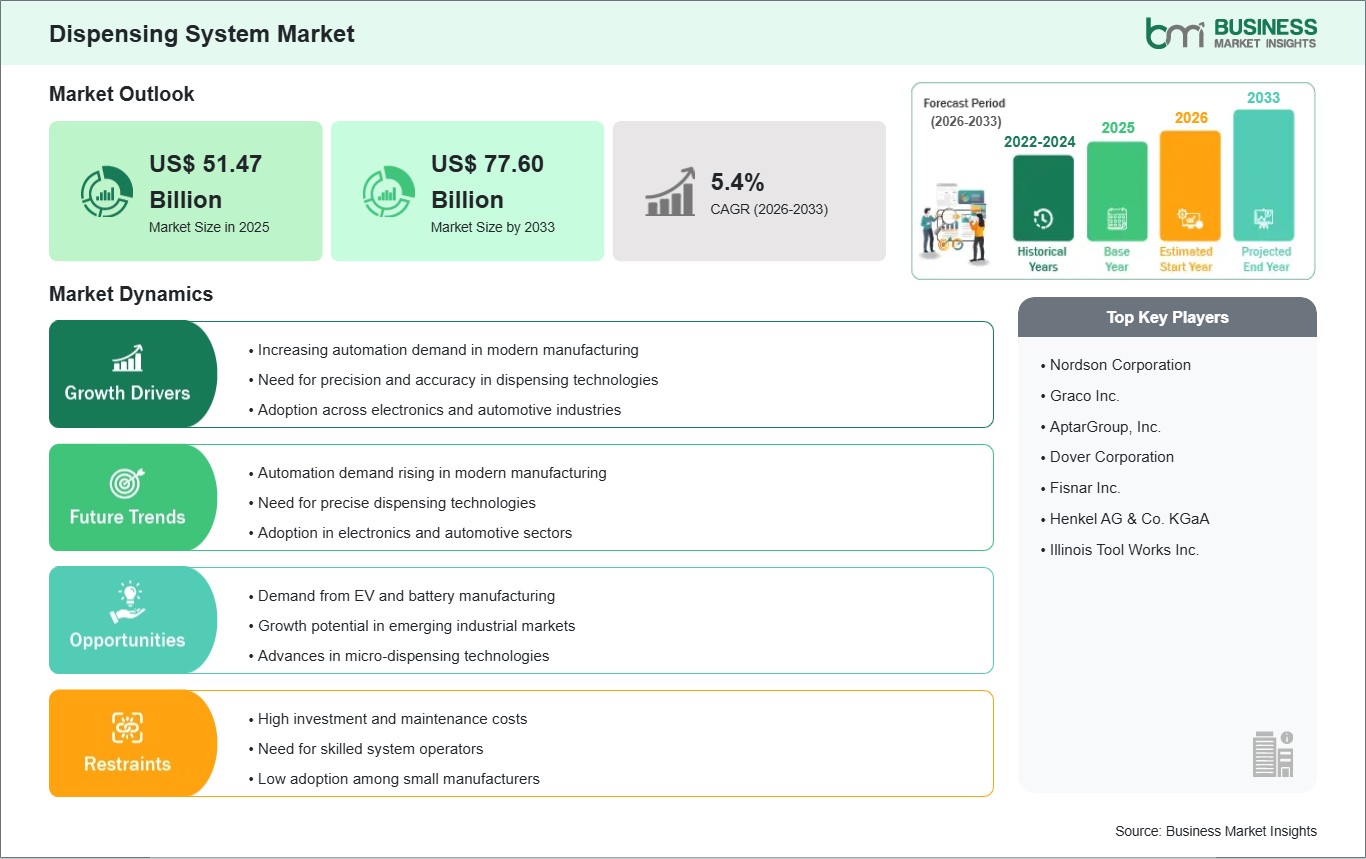
The global Dispensing System market is experiencing steady growth, driven by increasing demand for precision, efficiency, and automation across multiple industries. Dispensing systems are widely used for controlled application of fluids and materials in manufacturing processes, making them critical in sectors such as electronics, automotive, healthcare, and aerospace. Advancements in automation and robotics have significantly enhanced dispensing accuracy, repeatability, and production throughput, further supporting market expansion.
Dispensing systems are designed to accurately control the flow, placement, and volume of fluids or semi-fluids such as adhesives, sealants, lubricants, and chemicals during manufacturing processes. These systems operate using precision components including pumps, valves, controllers, syringes, and nozzles to ensure consistent material delivery. Advanced dispensing systems incorporate programmable controls, sensors, and feedback mechanisms that enable real-time monitoring and adjustment of dispensing parameters such as pressure, flow rate, and timing. Automated and robotic dispensing solutions enhance repeatability, minimize material waste, and reduce dependency on manual labor. Active dispensing systems, in particular, provide superior control by using mechanical or pneumatic force to regulate material flow, making them suitable for high-precision and high-volume applications. Overall, the technical functionality of dispensing systems supports improved production efficiency, product quality, and process reliability across diverse industrial applications.
Segment Analysis
Dispensing System Market Segmentation
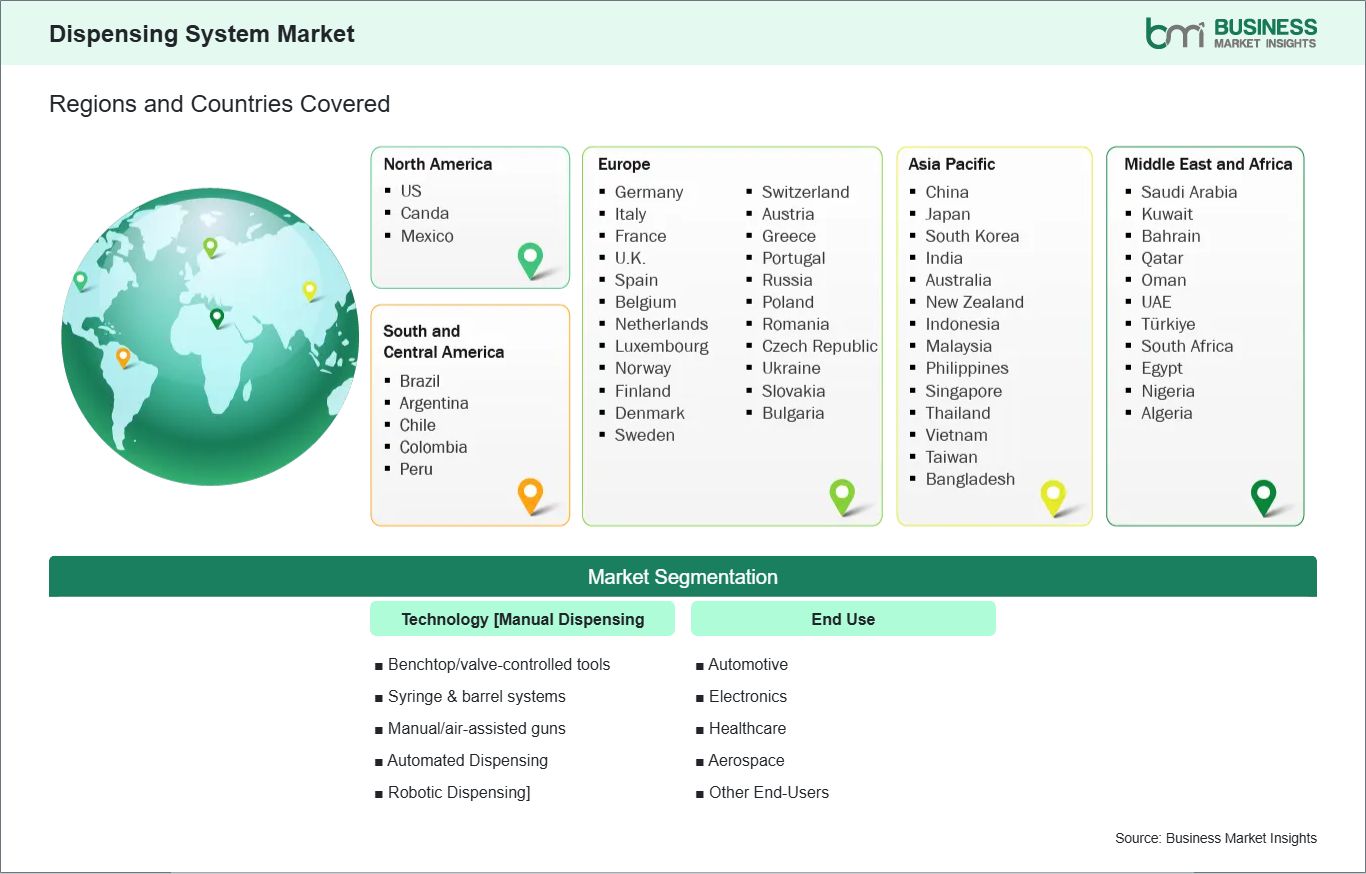
Key segments that contributed to the derivation of the Dispensing System market analysis are technology, end-use.
- Based on technology, the Dispensing System market is segmented into Manual Dispensing, Automated Dispensing, and Robotic Dispensing. Among these, the Automated Dispensing segment accounted for the largest share of the market in 2025.
- By end use, the market is classified into Automotive, Electronics, Healthcare, Aerospace, and Others. The Electronics segment held the largest share of the Dispensing System market in 2025.
Market Forces
Dispensing System Market Drivers and Opportunities
Increasing Demand for Automation in Manufacturing
The global manufacturing landscape is undergoing rapid transformation, driven by the need for higher productivity, precision, and cost efficiency. One of the most significant drivers of the Dispensing System market is the growing adoption of automation technologies. Automated and robotic dispensing systems enable manufacturers to consistently apply adhesives, sealants, and other fluids with minimal human intervention, reducing errors, material waste, and production downtime. Industries such as electronics, automotive, and healthcare are particularly benefiting from these systems, as they support high-precision applications like PCB assembly, component bonding, and medical device manufacturing. The shift towards automation is further accelerated by labor shortages, rising labor costs, and increasing demand for high-quality products, making automated dispensing systems a critical investment for manufacturers seeking to maintain competitiveness.
Expansion in Emerging Markets and Industrial Sectors
Emerging economies, particularly in Asia Pacific and Latin America, present a substantial growth opportunity for dispensing system providers. Rapid industrialization, increasing manufacturing output, and adoption of modern production technologies in these regions are driving demand for precision dispensing solutions. Companies that offer cost-effective, adaptable, and energy-efficient dispensing systems can capitalize on these markets, enabling significant revenue growth while supporting manufacturers in achieving operational efficiency and high-quality production.
Size and Share Analysis
Dispensing System Market Size and Share Analysis
Based on technology, the Dispensing System market is segmented into Manual Dispensing, Automated Dispensing, and Robotic Dispensing. Among these, the Automated Dispensing segment accounted for the largest share of the market in 2025, driven by higher demand for precision, efficiency, and reduced human intervention.
By end use, the market is classified into Automotive, Electronics, Healthcare, Aerospace, and Others. The Electronics segment held the largest share of the Dispensing System market in 2025, owing to the extensive use of dispensing systems in semiconductor manufacturing and PCB assembly.
Report Coverage
Dispensing System Market Report Coverage and Deliverables
The "Dispensing System Market Size and Forecast (2022-2033)" report provides a detailed analysis of the market covering below areas:
- Dispensing System market size and forecast at global, regional, and country levels for all the key market segments covered under the scope
- Dispensing System market trends, as well as market dynamics such as drivers, restraints, and key opportunities
- Dispensing System market analysis covering key market trends, global and regional framework, major players, regulations, and recent market developments
- Industry landscape and competition analysis covering market concentration, heat map analysis, prominent players, and recent developments for the Dispensing System market
- Detailed company profiles, including SWOT analysis
Geographic Insights
Dispensing System Market Geographic Insights
The geographical scope of the Dispensing System market report is divided into five regions: North America, Asia Pacific, Europe, Middle East & Africa, and South & Central America. The Dispensing System market in Asia Pacific is expected to grow significantly during the forecast period.
The global Dispensing System market exhibits varied growth trends across regions. Asia Pacific dominated the market in 2025, driven by rapid industrialization, strong electronics manufacturing presence, and increasing adoption of automation technologies in countries such as China, Japan, and South Korea. The region benefits from high production volumes and cost-effective manufacturing capabilities. North America held a significant share of the market, supported by advanced manufacturing infrastructure, early adoption of robotic and automated dispensing systems, and strong demand from the automotive, healthcare, and aerospace sectors. Continuous technological innovation further contributes to market growth in this region.
Europe represents a mature market, characterized by steady demand from automotive and industrial manufacturing industries. The region’s focus on precision engineering, sustainability, and Industry 4.0 initiatives has encouraged the adoption of advanced dispensing solutions. Meanwhile, South & Central America and the Middle East & Africa are expected to witness moderate growth, supported by increasing industrial investments and gradual adoption of automated manufacturing processes..
Industry Activity
Recent Developments
The Dispensing System market is evaluated by gathering qualitative and quantitative data post primary and secondary research, which includes important corporate publications, association data, and databases. A few of the key developments in the Dispensing System market are:
- Jul 01, 2025, Nordson Corporation announced the launch of the VersaBlue® II Melter, an advanced adhesive dispensing system designed for the hygiene manufacturing sector, including products such as baby diapers, adult incontinence products, and feminine hygiene items. The new melter offers enhanced precision and efficiency with advanced gear dosing, variable-speed drives for consistent adhesive application, and support for EtherCAT and OPC UA for seamless integration with existing production systems. It also delivers up to 10% energy savings through improved thermal insulation and features modern diagnostics to quickly identify errors and reduce unplanned downtime, helping manufacturers improve product quality and operational performance.
- In September 2025, Graco Inc. announced the launch of its E-Flex Pro Electric Dispensing System, designed for precision fluid handling in automotive, electronics, and industrial assembly applications. The system features closed-loop pressure control, programmable shot sizes, and real-time process monitoring to ensure consistent adhesive and sealant application. Equipped with advanced touchscreen controls and Industry 4.0 connectivity, the E-Flex Pro enables seamless integration with automated production lines while reducing material waste and maintenance downtime, helping manufacturers improve productivity and quality
Trust & Transparency
Research Methodology
The market analysis combines proprietary research with secondary data from government agencies, company disclosures, regulatory filings, industry databases and expert interviews. Market estimates are validated through data triangulation, cross-market benchmarking and analyst
review.
View Full Research Methodology
Key Sources Referred:
World Bank - Global Trade IndicatorsWorld Trade Organization (WTO)International Monetary Fund (IMF)International Trade Administration (ITA)Company websiteCompany annual reportsCompany investor presentations