
Cycling Apparel Market Outlook: Size, Share, Trends, Growth Analysis, Competitive Landscape & Forecast, 2026-2033

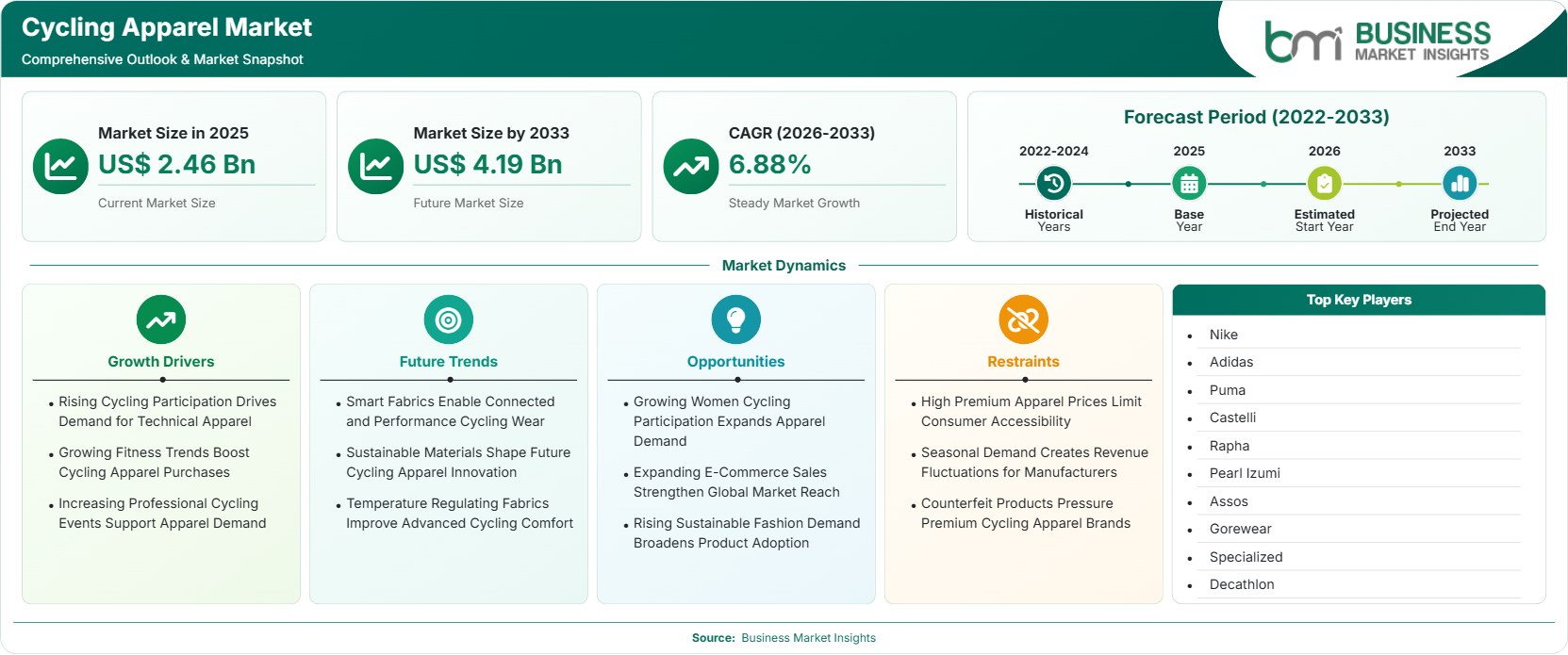
The Cycling Apparel Market size was valued at US$ 2.46 billion in 2025 and is projected to reach US$ 4.19 billion by 2033, growing at a CAGR of 6.88% during 2026–2033, supported by cycling participation, fitness trends, professional events, women's cycling, e-commerce expansion, and sustainable apparel demand.

Report Coverage
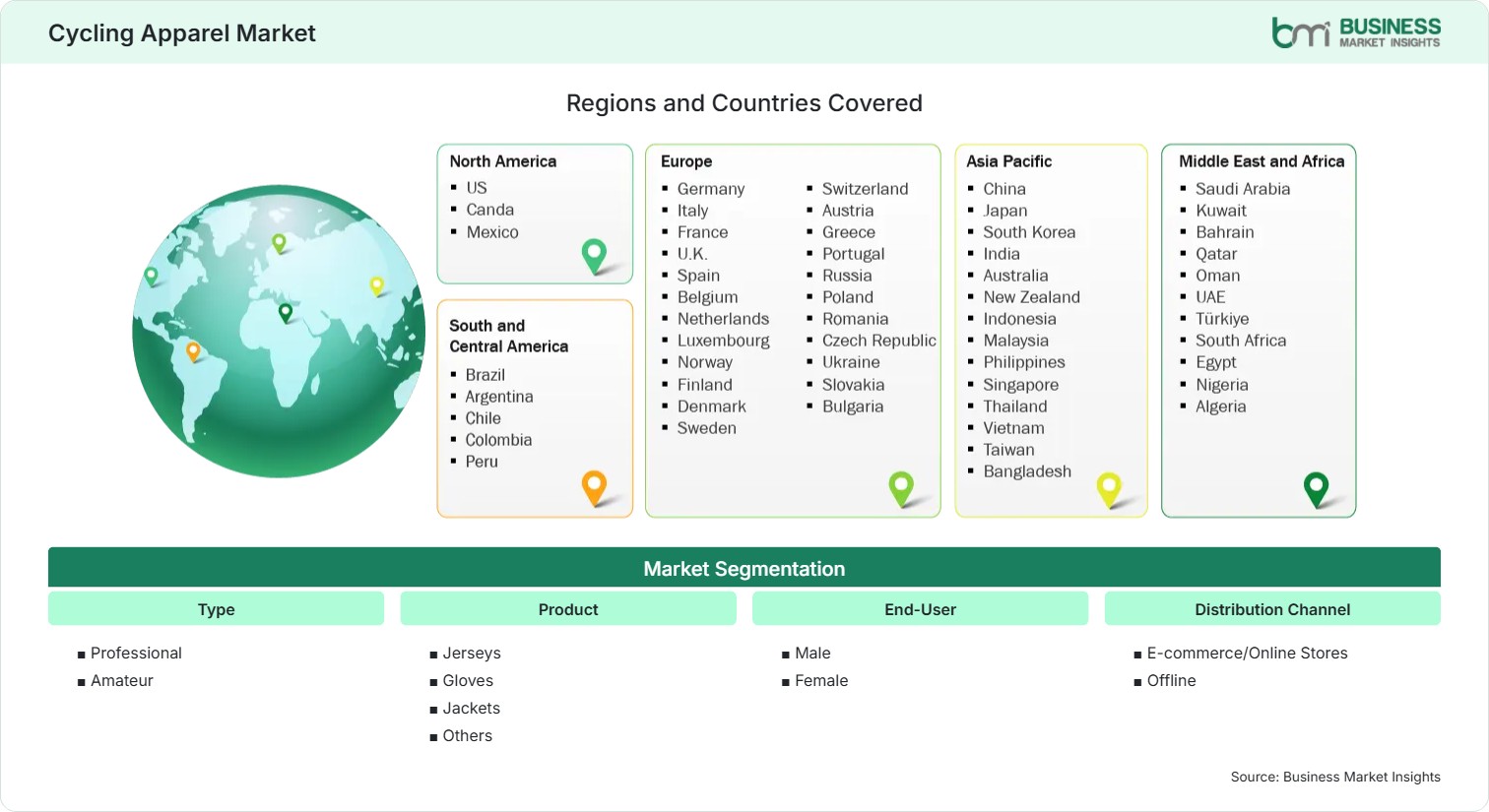
  • Type: Professional, Amateur
  • Product: Jerseys, Gloves, Jackets, Others
  • End-User: Male, Female
  • Distribution Channel: E-commerce/Online Stores, Offline
US$ 2.46 Bn Market size in 2025
US$ 4.19 Bn Market Size by 2033
6.88% CAGR, 2026 - 2033
2026-2033 Forecast Period

01 AI Overview

Cycling Apparel Market Summary

  • North America Region: North America holds a 30%–34% share in 2025, growing at a 6.4%–7.2% CAGR during 2026–2033, influenced by recreational cycling, fitness participation, premium technical apparel, organized events, direct-to-consumer brands, and expanding women's cycling communities. The US Cycling Apparel Market benefits from cycling tourism, endurance events, and increasing demand for performance-oriented clothing, supporting a 6.5%–7.3% CAGR during 2026–2033.
  • Fastest Growing Region: Asia Pacific accounts for a 22%–26% share in 2025 and is advancing at a 7.8%–9.0% CAGR during 2026–2033, supported by urban cycling, rising disposable incomes, e-commerce penetration, cycling events, and growing interest in health-focused lifestyles.
  • Leading Segment: Professional cycling apparel represents a 55%–60% share in 2025 and is expanding at a 6.8%–7.6% CAGR during 2026–2033, supported by performance requirements, team sponsorships, endurance events, technical fabrics, and consumer preference for specialized garments.
  • High Growth Segment: Female cycling apparel represents a 35%–40% share in 2025 and is advancing at a 7.5%–8.5% CAGR during 2026–2033, driven by rising participation, improved product availability, inclusive sizing, women-specific designs, and targeted community marketing.
  • Key Market Opportunity: Product innovation combining lightweight fabrics, thermal regulation, aerodynamic construction, recycled materials, and connected features can create premium opportunities across cycling communities, online channels, and emerging markets.
  • Major Market Players: Nike, Adidas, Puma, Castelli, Rapha, Pearl Izumi, Assos, Gorewear, Specialized, and Decathlon.
02 Strategic Insights

Cycling Apparel Market: Strategic Insights

Cycling Apparel Market Strategic Framework
FREE PDF
Request your free sample
Request free sample
03 Stakeholder View

Key Takeaways

  • There is an evolution towards vertical integration as well as connectivity of the value chain in which companies incorporate material selection, product development, consumer-oriented distribution, specialty retailing, and community involvement for better margins and customer loyalty.
  • Women cyclists provide an interesting avenue for future growth due to the growing number of women cyclists, along with brand-specific products that cater to the comfort needs of women cyclists.
  • Product innovation is progressing from moisture management to aerodynamics, thermo-regulation, reduced weight, recyclable materials, and durability, thus  enabling companies to charge higher prices for their products due to better performance.
  • Asia Pacific represents an appealing investment opportunity due to growing cycling participation, e-commerce, urban fitness culture, and increasing consumer buying power that may expand market reach outside the existing European and North American cycling markets.
  • Collaborations with professional teams, cycling events, athletes, retailers, and online communities continue to be essential business instruments for establishing credibility and translating sports exposure into consumer exposure.
04 Geographic Outlook

Cycling Apparel Market Regional Highlights

North America Cycling Apparel Market

North America represents a 30%–34% share in 2025 and is projected to grow at a 6.4%–7.2% CAGR through 2033. Cycling participation, endurance events, fitness culture, premium apparel demand, and established specialty retail support regional expansion. The US remains the leading contributor, while Canada offers additional potential through recreational cycling and outdoor lifestyles. Brands increasingly use direct-to-consumer platforms and community marketing to reach cyclists seeking technical performance. The regional Cycling Apparel Market share is reinforced by strong purchasing power and established brand awareness.

  • Premium technical garments remain attractive among endurance cyclists seeking aerodynamic fits, advanced moisture management, thermal regulation, and durable materials for varied riding conditions.
  • Organized cycling events and recreational races provide brands with opportunities to increase visibility, introduce performance collections, and establish long-term relationships with enthusiast communities.
  • Direct-to-consumer commerce is expanding product accessibility while enabling brands to collect customer insights, personalize marketing, and introduce seasonal collections more efficiently.
  • Women's cycling participation is encouraging manufacturers to broaden product ranges with dedicated fits, improved sizing, and apparel designed around comfort and performance requirements.

US Cycling Apparel Market

The US accounts for approximately 20%–24% of the global Cycling Apparel Market in 2025 and is expected to expand at a 6.5%–7.3% CAGR during 2026–2033. A mature cycling culture, recreational riding, fitness trends, organized events, and established premium brands support demand. Consumers increasingly purchase technical jerseys, jackets, and gloves through online channels, although specialty stores retain relevance for fitting and product advice. The US also provides a strong environment for sustainable materials and women's cycling initiatives, reinforcing premium product innovation.

  • Cycling clubs, endurance events, and organized rides support demand for specialized garments and encourage consumers to upgrade apparel as performance expectations increase.
  • E-commerce allows brands to serve geographically dispersed cycling communities while expanding product discovery, subscription-style engagement, and direct customer relationships.
  • Sustainability is becoming more relevant to purchasing decisions, encouraging recycled fabrics, durable construction, responsible sourcing, and transparent product communication.

Europe Cycling Apparel Market

Europe holds a 34%–38% share in 2025 and is projected to grow at a 5.9%–6.8% CAGR through 2033. Germany, France, Italy, Spain, and the Netherlands represent important Cycling Apparel Markets supported by cycling culture, professional racing, commuting, and established apparel brands. Italy and France remain influential in performance-oriented cycling, while the Netherlands and Germany provide strong recreational and urban cycling demand. Spain is among the faster-growing markets, with an estimated 7.0%–8.0% CAGR supported by tourism, events, and lifestyle participation.

  • Professional racing remains a powerful product-development and marketing channel, allowing brands to demonstrate technical performance and translate elite designs into consumer collections.
  • Sustainability regulations and consumer awareness are encouraging manufacturers to explore recycled fibers, longer-lasting garments, and improved production transparency.
  • Cycling tourism increases the need for attire that can adapt to long distances, variable weather, and multiple-day recreational activities.
  • Inclusion of women in the sport increases the target market size and encourages more specialized attire.

Asia Pacific Cycling Apparel Market

Asia Pacific represents a 22%–26% share in 2025 and is forecast to expand at a 7.8%–9.0% CAGR through 2033. China, Japan, Australia, South Korea, and India are important markets, while India and Southeast Asia offer higher growth potential. China benefits from manufacturing capabilities, large consumer reach, and expanding cycling communities. Japan and Australia provide mature enthusiast bases. India is among the fastest-growing Cycling Apparel Markets, with an estimated 9.0%–10.5% CAGR, supported by fitness adoption, e-commerce, and emerging cycling communities.

  • Online marketplaces and brand-owned websites are widening access to international and domestic apparel brands, especially among younger consumers seeking performance products.
  • Fitness-focused lifestyles and cycling clubs are supporting demand for jerseys, gloves, jackets, and specialized apparel among recreational riders.
  • Manufacturing capabilities in the region create opportunities for localized production, shorter supply chains, private-label development, and competitive pricing.
  • Growing professional and amateur events are increasing product visibility and strengthening consumer interest in technical cycling clothing.

Rest of World Cycling Apparel Market

South and Central America account for approximately 8%–11% of global demand in 2025, with Brazil and Mexico serving as key Cycling Apparel Markets. The regional outlook is supported by recreational cycling, fitness participation, and cycling tourism. Brazil offers an estimated 7.0%–8.0% CAGR through 2033 as urban and leisure cycling communities expand. Mexico benefits from organized events and online retail development, creating opportunities for accessible performance apparel and international brands.

  • Cycling tourism and organized endurance events can stimulate demand for technical apparel while creating opportunities for brands to build regional visibility.
  • E-commerce is improving access to international products where specialty cycling retail remains limited or geographically concentrated.
  • Climate-specific apparel, including lightweight breathable garments, is particularly relevant in warmer markets and can support localized product development.
  • Fitness initiatives and cycling infrastructure investment are creating new consumer groups beyond traditional cycling enthusiasts.
Global Market Geography
FREE PDF
Request your free sample
Request free sample
05 Segment Analysis

Cycling Apparel Market Segmentation

Type

Professional cycling apparel represented approximately 55%–60% Cycling Apparel Market share in 2025 and is projected to grow at a 6.8%–7.6% CAGR during 2026–2033. Technical performance, organized racing, sponsorships, and advanced fabric development support demand. Amateur products benefit from broader recreational participation, fitness cycling, and accessible pricing, creating substantial volume opportunities across e-commerce and specialty retail.

  • Professional: Professional garments prioritize aerodynamic construction, lightweight materials, thermal control, and ergonomic fits, with demand influenced by racing teams, sponsorships, endurance events, and performance-focused consumers.
  • Amateur: Amateur apparel serves recreational riders and fitness participants through accessible pricing, versatile designs, comfort-oriented construction, and expanding demand from cycling communities and leisure activities.

Product

Jerseys represent approximately 40%–45% share in 2025 and are forecast to expand at a 6.5%–7.3% CAGR through 2033. Jackets, gloves, and other products complement core apparel needs across seasonal conditions and riding environments. Product diversification is supported by technical materials, improved ergonomics, weather protection, and increasing consumer interest in coordinated cycling wardrobes.

  • Jerseys: Jerseys remain essential for recreational and professional riders, with demand shaped by breathable fabrics, moisture management, aerodynamic fits, team designs, and seasonal collections.
  • Gloves: Cycling gloves provide grip, comfort, vibration reduction, and weather protection, with adoption supported by longer rides, performance cycling, and product innovation.
  • Jackets: Jackets address wind, rain, and temperature variation, creating demand for lightweight waterproofing, packability, insulation, and breathable technical construction.

End-User

Male consumers accounted for approximately 60%–65% share in 2025 and are projected to grow at a 6.2%–7.0% CAGR through 2033. Female demand is expanding faster, supported by participation growth, dedicated product development, improved sizing, and community-focused marketing. Brands are increasingly treating women's cycling as a distinct commercial opportunity rather than a limited extension of existing product ranges.

  • Male: Male cyclists represent a large established customer base, supported by professional racing, recreational riding, fitness activities, and extensive availability of performance-oriented apparel.
  • Female: Female participation is increasing demand for dedicated fits, technical fabrics, inclusive sizing, functional designs, and broader product availability across performance and lifestyle categories.

Distribution Channel

E-commerce and online stores represented approximately 35%–40% share in 2025 and are expected to grow at a 8.0%–9.0% CAGR through 2033. Digital channels provide broad product selection, international accessibility, direct brand engagement, and convenient purchasing. Offline channels remain important for technical fitting, specialist advice, and immediate product evaluation, particularly for premium cycling apparel.

  • E-commerce/Online Stores: Online channels expand geographic reach, enable direct-to-consumer strategies, simplify product discovery, and support targeted marketing based on consumer preferences and cycling interests.
  • Offline: Specialty retailers and physical stores provide fitting assistance, product demonstrations, expert recommendations, and immediate availability, retaining relevance for technical and premium apparel purchases.
06 Market Forces

Cycling Apparel Market Dynamics

Key Market Drivers

Rising Cycling Participation Drives Demand for Technical Apparel

Rising levels of engagement in leisure, fitness, commuting, and professional cycling have created a growing need for cycling-specific apparel. Consumers are increasingly opting for gear that provides moisture-wicking, ventilation, ergonomics, and weather protection. Jerseys, jackets, and gloves are benefiting from this evolution in the marketplace as cyclists seek greater comfort on longer routes. Rising participation and awareness of the benefits of technical apparel are driving market growth. The Cycling Apparel Market trends indicate further evolution through innovations in fabric weights, fit, and functionality. Demand for such products can be harnessed through tiered pricing strategies.

Growing Fitness Trends Boost Cycling Apparel Purchases

Increasing interest in health and physical activity is motivating consumers to integrate cycling into their workout plans. This will increase demand for functional clothing among recreational cyclists and fitness-conscious individuals who may not be part of professional biking events. Clothes like jerseys, jackets, and gloves are becoming increasingly common for club rides, outdoor activities, and leisure purposes. Companies are catering to this need by designing clothing that not only offers great functionality but also appeals to consumers' sense of style. Moreover, e-commerce has made it easy for companies to sell their products across geographic regions.

Increasing Professional Cycling Events Support Apparel Demand

Professional cycling races offer brand opportunities, including enhancing their presence and technical capabilities, as well as influencing consumer choices. Professional cyclists and teams use their knowledge of the latest apparel technologies to encourage their fans to buy clothes designed after them. Professional cycling races and endurance events can even bring in more people who will need such clothing. This, combined with sponsorships, collaborations with professional teams, and special collections launched for specific races, offers companies even more opportunities to reach consumers. Thus, the growth of organized professional cycling in both developed and developing markets may increase demand for jerseys, jackets, gloves, and other performance apparel.

Key Market Opportunities

Growing Women Cycling Participation Expands Apparel Demand

Opportunities for product development in this segment arise from increased engagement of women in recreation, fitness, transport, and competitive cycling. Companies can capitalize on this trend by offering women-specific fit, sizing, design, and fabric technology to meet performance needs. The availability of more products will help build customer loyalty and establish good relations with cycling communities. E-commerce is an excellent platform for reaching consumers in markets where specialty stores are few. Sponsorship of women's cycling events and clubs is another way of gaining visibility. Consumers who want performance-oriented yet lifestyle-focused products may appreciate sustainable, multifunctional designs.

Expanding E-Commerce Sales Strengthen Global Market Reach

The e-commerce platform has provided greater avenues for cycling clothing manufacturers to market their goods to consumers beyond just traditional specialty retailer channels. Through digital channels, they have been able to sell their products internationally directly to consumers, expand the range of products available to consumers, and accelerate product launches. Information on product details, customers' reviews, size and fitting details, and even personalized recommendations could help enhance purchase confidence for specialized apparel items. The Cycling Apparel Market forecast is based on the expansion of digital channels, among other factors, as manufacturers sell to cycling communities through these channels across geographic markets.

Rising Sustainable Fashion Demand Broadens Product Adoption

The increasing interest in sustainable fashion opens opportunities for cycling clothing makers to differentiate their products through the use of recycled materials, ethical sourcing practices, durability, and greater transparency in the production process. Environmental features can add value in the minds of sustainability-aware cyclists and contribute to premium positioning when supplemented by performance features. Recycled polyester and other environmentally friendly fabrics can become more relevant in jerseys, jackets, and other clothing items as consumers start evaluating environmental features along with comfort and functional properties.

Market Restraints and Challenges

High Premium Apparel Prices Limit Consumer Accessibility

Factor: Premium cycling apparel often uses advanced textiles, specialized construction, aerodynamic features, and rigorous quality controls, which increase manufacturing and retail costs. Impact: High pricing could limit uptake of the product among occasional users, novices, and price-sensitive buyers, who tend to opt for traditional sportswear due to lower acquisition costs. The manufacturer needs to strike a delicate balance between technical distinction and low prices by using multiple product tiers without compromising the brand’s positioning. Sourcing is another area that may affect costs due to seasonal collections and frequent product changes. Effective sourcing and product planning are needed due to targeted segmentation.

Seasonal Demand Creates Revenue Fluctuations for Manufacturers

Factor: Cycling apparel demand varies according to weather conditions, regional riding seasons, sporting calendars, and consumer purchasing patterns, resulting in uneven sales throughout the year. Impact: Problems such as inventory imbalances, excess inventory, and forced markdowns may be experienced by manufacturers and marketers when there is a mismatch between expected and actual seasonality. The cold-weather market will need to include a range of product lines such as summer jerseys, thermal jackets, rain gear, and transitional wear. Brands with operations in several geographic markets may reduce their vulnerability to seasonality by spreading their seasonal cycles across regions, such as indoor cycling or all-year-round fitness products.

07 Company Analysis

Competitive Landscape

The competitive environment combines global sportswear companies, specialist cycling brands, equipment manufacturers, and vertically integrated retailers. Cycling Apparel Market analysis indicates that competitive differentiation increasingly depends on technical fabric performance, product fit, sustainability, brand credibility, event partnerships, and digital distribution.

Company Name

Overview

Products and Services relevant to this market

Nike

Global sportswear company with broad athletic apparel expertise and strong brand recognition across performance and lifestyle categories.

Performance jerseys, cycling-inspired apparel, athletic jackets, gloves, sportswear, footwear, and digital consumer engagement.

Adidas

International sportswear brand offering technical performance products supported by extensive retail and digital distribution networks.

Cycling jerseys, jackets, gloves, performance apparel, sportswear, sustainable materials, and athlete-focused product development.

Puma

Global athletic brand combining performance technology, fashion positioning, and broad consumer reach across sports categories.

Technical apparel, jerseys, jackets, gloves, training garments, lifestyle products, and performance-oriented sportswear.

Castelli

Specialist cycling apparel brand known for technical innovation, performance-focused construction, and professional cycling heritage.

Cycling jerseys, jackets, gloves, bib apparel, aerodynamic garments, rainwear, and thermal cycling products.

Rapha

Premium cycling brand focused on performance apparel, distinctive design, community engagement, and direct consumer relationships.

Jerseys, jackets, gloves, cycling accessories, performance clothing, club products, and event-oriented apparel collections.

Pearl Izumi

Cycling and outdoor apparel company offering products designed for recreational and performance-oriented riders.

Cycling jerseys, jackets, gloves, shorts, technical apparel, footwear, and weather-specific riding products.

Assos

Swiss cycling apparel specialist emphasizing advanced fabrics, ergonomic design, and premium performance positioning.

High-performance jerseys, jackets, cycling shorts, gloves, base layers, and technical riding apparel.

Gorewear

Technical apparel brand specializing in weather protection, breathable fabrics, and performance clothing for outdoor endurance activities.

Cycling jackets, jerseys, gloves, rainwear, windproof garments, thermal apparel, and technical accessories.

Specialized

Cycling-focused company with deep expertise in bicycles, equipment, and performance apparel for diverse rider segments.

Cycling jerseys, jackets, gloves, technical apparel, accessories, and performance-oriented riding collections.

Decathlon

Global sporting goods retailer offering broad cycling products at accessible price points through integrated retail and digital channels.

Cycling jerseys, jackets, gloves, technical apparel, recreational clothing, accessories, and value-oriented product ranges.

10 Trust & Transparency

Research Methodology

The market analysis combines proprietary research with secondary data from government agencies, company disclosures, regulatory filings, industry databases and expert interviews. Market estimates are validated through data triangulation, cross-market benchmarking and analyst review.

View Full Research Methodology

11 Questions Answered

Frequently Asked Questions

What information is included in a Cycling Apparel Market Report?

The report covers market size, growth projections, segmentation, regional analysis, competitive landscape, key drivers, opportunities, restraints, product trends, distribution developments, and strategic factors influencing industry expansion.

Why are online channels important for cycling apparel brands?

Online channels allow brands to reach broader cycling communities, offer extensive product selections, support direct-to-consumer relationships, introduce new collections quickly, and serve markets where specialty cycling retail remains limited.

How is sustainability influencing cycling apparel demand?

Sustainability is encouraging brands to use recycled fibers, improve manufacturing transparency, extend product durability, and develop responsible sourcing practices as consumers increasingly consider environmental attributes alongside performance and price.

Which product category represents a leading segment?

Jerseys represent a leading product category because they are essential for recreational and professional riders and increasingly incorporate moisture management, breathability, aerodynamic construction, and ergonomic designs.

What factors are supporting the Cycling Apparel Market growth?

Rising cycling participation, fitness activities, professional events, technical fabric innovation, women's cycling, e-commerce expansion, and increasing interest in sustainable apparel are supporting market development across recreational and performance-oriented consumer groups.

Access the Full Cycling Apparel Market Report

Get segment-level forecasts, regional estimates, competitive benchmarking, company profiles and downloadable Excel datasets.

Access the full Cycling Apparel Market Report
350 pages PDF & Excel | 2026-08-06