Market Summary
Executive Summary and Global Market Analysis
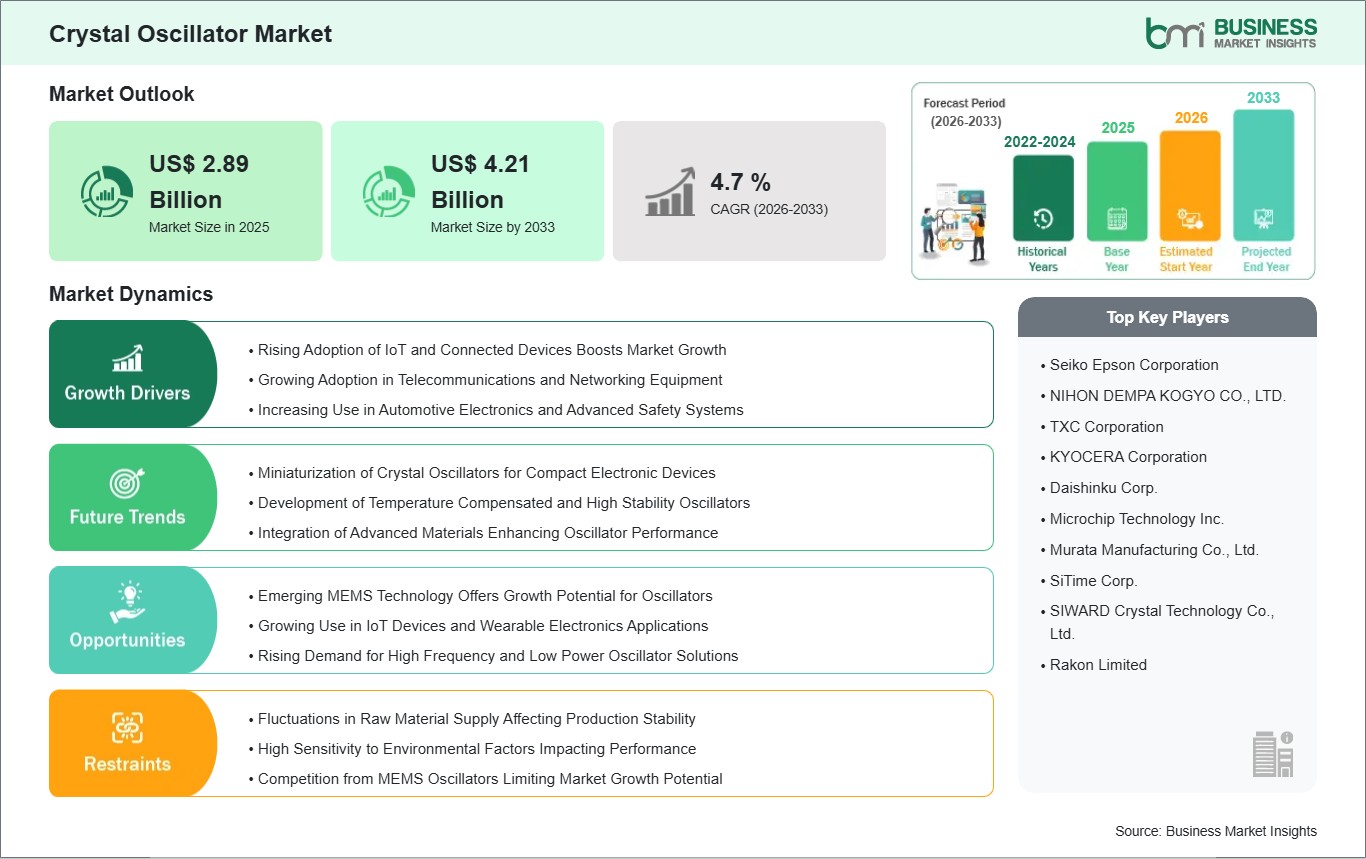
The global crystal oscillator market is an important segment in the overall electronics components industry due to the need for precise frequency control in the proper functioning of electronic devices. Crystal oscillators are timekeeping devices that help in the synchronization of operations in a number of electronic applications. These components have become an integral part of consumer electronics, telecommunications, automobiles, industrial applications, aerospace technology, and medical devices. As global industries become more dependent on electronic devices and digital connectivity, the need for precise timekeeping components is increasing. One of the major factors contributing to the growth of the global crystal oscillator market is the increased use of connected devices and advanced communication technology. The increasing number of smartphones, wearable devices, tablets, networking equipment, and smart home technology have created a need for precise timekeeping components for the proper functioning and connectivity of these devices. Furthermore, the rapid development and expansion of Internet of Things (IoT) technologies in various fields such as manufacturing, healthcare, logistics, and smart infrastructure have also increased the need for compact and low-power oscillators that provide continuous device connectivity. The automotive sector is also contributing to a significant increase in market demand due to the increased use of electronics in vehicles. Today’s vehicles are equipped with a variety of electronic control units and devices that provide infotainment systems, navigation systems, connectivity systems, safety systems, and driver assistance systems. These systems depend on extremely stable timing signals, which are essential for the synchronization of data processing and communication, hence the increased use of crystal oscillators in automotive electronic systems. Despite the bright prospects of the market, there are a few challenges that affect the global crystal oscillator market. For example, other timing technologies, especially oscillators using MEMS, are being considered for use in certain applications owing to their durability and integration capabilities. Furthermore, there is a fluctuation in the availability of quartz crystals, as well as competition among electronic component manufacturers. The global crystal oscillator market is expected to continue with the same pace, driven by the advancement of technology, integration of semiconductors, and the growing use of electronic systems.
Segment Analysis
Crystal Oscillator Market Segmentation
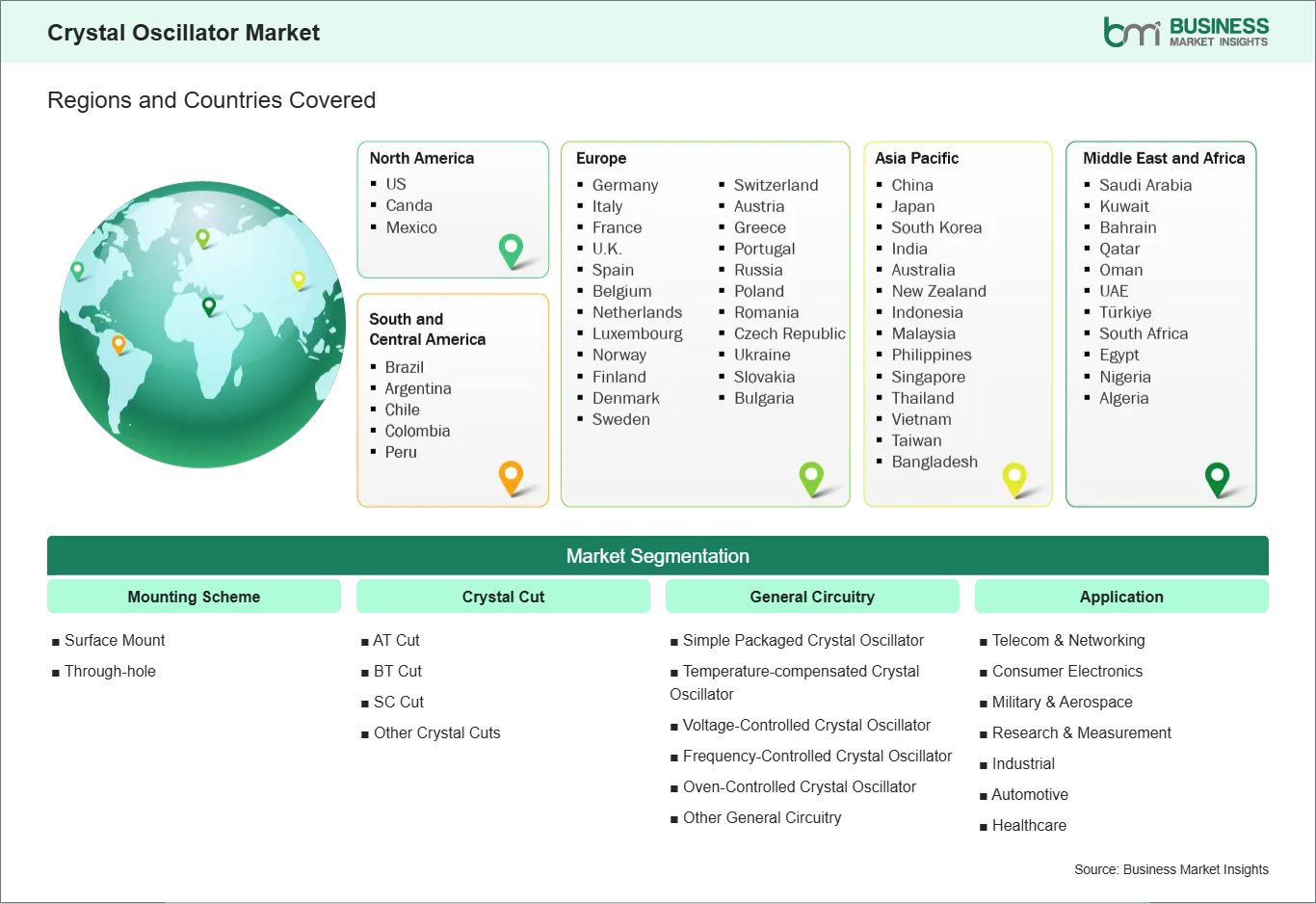
Key segments that contributed to the derivation of the crystal oscillator market analysis are mounting scheme, crystal cut, general circuitry and application.
- By mounting scheme, the crystal oscillator market is segmented into surface mount, through-hole. The surface mount segment dominated the market in 2025.
- Based on crystal cut, the crystal oscillator market is categorized into AT cut, BT cut, SC cut, other crystal cuts. The AT cut segment dominated the market in 2025.
- On the basis of general circuitry, the crystal oscillator market is categorized into simple packaged crystal oscillator (SPXO), temperature-compensated crystal oscillator (TCXO), voltage-controlled crystal oscillator (VCXO), frequency-controlled crystal oscillator (FCXO), oven-controlled crystal oscillator (OCXO), other general circuitry. The temperature-compensated crystal oscillator (TCXO) segment dominated the market in 2025.
- In terms of application, the crystal oscillator market is categorized into telecom & networking, consumer electronics, military & aerospace, research & measurement, industrial, automotive, healthcare. The consumer electronics segment dominated the market in 2025.
Market Forces
Crystal Oscillator Market Drivers and Opportunities
Rising Adoption of IoT and Connected Devices Boosts Market Growth
The rapid growth of the Internet of Things (IoT) is emerging as one of the major growth drivers of the global crystal oscillator market. IoT devices, such as smart homes, wearables, etc., require precise timing signals to ensure their proper functioning and seamless communication. Therefore, with the increasing number of smart devices across various industries and geographies, the requirement for crystal oscillators is increasing. Another factor adding to the growth of the global crystal oscillator market is the roll-out of next-generation communication networks, such as 5G networks. Crystal oscillators are required to ensure accurate frequency and synchronization of these devices. North America and Asia Pacific, being the leading regions, are driving the growth of the global crystal oscillator market. These regions have already taken significant strides in IoT devices, smart homes, etc., and are now moving towards next-generation communication networks, such as 5G networks. Smart factories, automated production lines, connected medical devices, and remote patient monitoring systems all require precise timing solutions to operate effectively. Across Europe, Asia, and the Americas, the integration of IoT technologies into urban, industrial, and energy infrastructure continues to create robust opportunities for crystal oscillators, positioning them as indispensable components in the global connected ecosystem.
Emerging MEMS Technology Offers Growth Potential for Oscillators
In recent times, the potential of microelectromechanical system (MEMS) technology is being increasingly realized as an alternative to traditional crystal oscillators, and it is believed to have huge growth prospects worldwide. The MEMS-based oscillator technology is gaining popularity with the benefits of miniaturization, shock resistance, and improved integration capabilities. The technology is being widely used in various applications across the automotive, consumer electronics, and industrial segments. The usage of MEMS oscillator technology is found to be very high in applications that require robustness and reliability, including advanced driver assistance systems, aerospace, and industrial equipment. The MEMS-based oscillator technology is found to be highly adopted in the North American, European, and Asian markets, indicating the relevance of the technology in the global oscillator market. The development of MEMS is also leading to innovation in low-power and high-performance oscillator technologies. As demand for compact and energy-efficient electronics grows, MEMS oscillators are increasingly applied in wearables, connected healthcare devices, and smart industrial systems. This trend encourages global semiconductor manufacturers to diversify their offerings, gradually incorporating MEMS solutions alongside traditional crystal oscillators and expanding the overall market potential.
Size and Share Analysis
Crystal Oscillator Market Size and Share Analysis
The crystal oscillator market demonstrates steady growth, with size and share analysis highlighting evolving trends and competitive dynamics among key players. The report examines subsegments categorized within mounting scheme, crystal cut, general circuitry and application, offering insights into their contribution to overall market performance.
By mounting scheme, the surface mount subsegment dominated the market in 2025, driven by its compact size, compatibility with automated PCB assembly, and widespread use in modern electronic devices.
Based on crystal cut, the AT cut subsegment dominated the market in 2025, driven by its excellent frequency stability, wide temperature operating range, and suitability for most commercial electronic applications.
On the basis of general circuitry, the temperature-compensated crystal oscillator (TCXO) subsegment dominated the market in 2025, driven by its high frequency stability over temperature variations, making it ideal for telecom, GPS, and wireless communication systems.
In terms of application, the consumer electronics subsegment dominated the market in 2025, driven by the high demand for crystal oscillators in smartphones, laptops, wearables, and other portable electronic devices.
Report Coverage
Crystal Oscillator Market Report Coverage and Deliverables
The "Crystal Oscillator Market Size and Forecast (2022 - 2033)" report provides a detailed analysis of the market covering below areas:
- Crystal Oscillator Market size and forecast at global, regional, and country levels for all the key market segments covered under the scope
- Crystal Oscillator Market trends, as well as drivers, restraints, and opportunities
- Crystal Oscillator Market analysis covering key trends, global and regional framework, major players, regulations, and recent developments
- Industry landscape and competition analysis covering market concentration, heat map analysis, prominent players, and recent developments for the Crystal Oscillator Market
- Detailed company profiles, including SWOT analysis
Geographic Insights
Crystal Oscillator Market Geographic Insights
The geographical scope of the Crystal Oscillator Market report is divided into North America, Asia Pacific, Europe, Middle East & Africa, and South & Central America. North America held the largest share in 2025.
The North American region is currently dominating the crystal oscillator market, driven by the advanced semiconductor industry, widespread use of next-generation communication technologies, and presence of major automotive and electronic companies. The United States and Canada are at the forefront of deploying 5G networks, connected consumer devices, and automotive electronics, which rely heavily on accurate and reliable timing solutions. This is also a key factor for the dominance of the crystal oscillator market in the North American region. Rapid industrial growth, increasing use of smartphones, and a thriving consumer electronics market are boosting the crystal oscillator market in the Asia Pacific. Some of the important countries that are both significant manufacturing centers and consumers, utilizing timing devices in various telecommunication systems, automotive electronics, and IoT applications, include China, Japan, South Korea, and India. Europe represents a segment that is witnessing a steady rise in market potential, mainly driven by its automotive and industrial automation sectors. Countries such as Germany, France, and the U.K. are witnessing a rise in demand due to smart manufacturing, connected mobility solutions, and industrial IoT applications that require accurate frequency control. The Middle East & Africa represents a smaller segment that is witnessing a gradual rise due to increased investments in smart city development, telecom infrastructure development, and industrialization in countries such as the UAE, Saudi Arabia, and South Africa. In the case of South & Central America, there is a steady growth trend driven by the increasing rate of electronics usage, the adoption of automotive electronics, and the growth of industrial and telecommunication networks. This is particularly true in Brazil, Mexico, and Argentina. In conclusion, the North American region remains the most advanced and influential region in the world in terms of the usage of advanced electronics technologies. At the same time, the Asia Pacific region is emerging as a growth engine, while the European region, the Middle East & Africa, and South & Central America continue to play their part through the growth of industrialization and the increasing rate of usage of connected technologies.
Industry Activity
Recent Developments
The Crystal Oscillator Market is evaluated by gathering qualitative and quantitative data post primary and secondary research, which includes important corporate publications, association data, and databases. A few of the key developments in the crystal oscillator market are:
- In February 2024, Nihon Dempa Kogyo Co., Ltd. announced the development and commencement of sampling of the industry’s smallest class 2016‑size small differential output crystal oscillator, designed to support high‑speed optical communication modules used in data centers and next‑generation network systems.
- In January 2024, Seiko Epson Corporation announced the development of a differential output scheme (WA‑LVDS) for its crystal oscillators, enabling flexible selection of low‑noise outputs that better match LSI amplitude requirements. These new differential output configurations are planned to be commercially available in the 2025 fiscal year, supporting higher performance for communication systems and future digital infrastructure.
Trust & Transparency
Research Methodology
The market analysis combines proprietary research with secondary data from government agencies, company disclosures, regulatory filings, industry databases and expert interviews. Market estimates are validated through data triangulation, cross-market benchmarking and analyst
review.
View Full Research Methodology
Key Sources Referred:
World Health Organization (WHO)Organisation for Economic Cooperation and Development (OECD)The World Bank GroupWorldometerThe LancetInternational Bar AssociationInternational Trade Administration