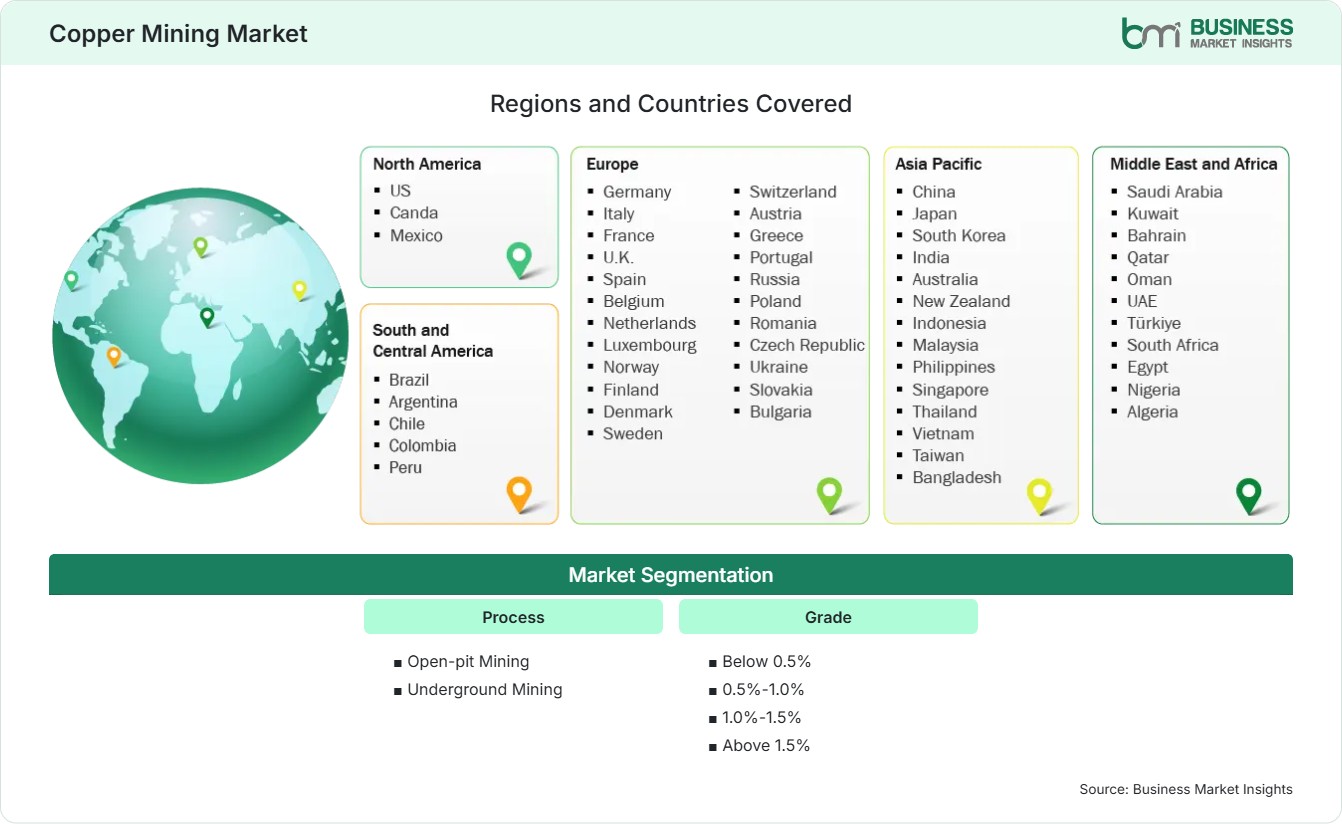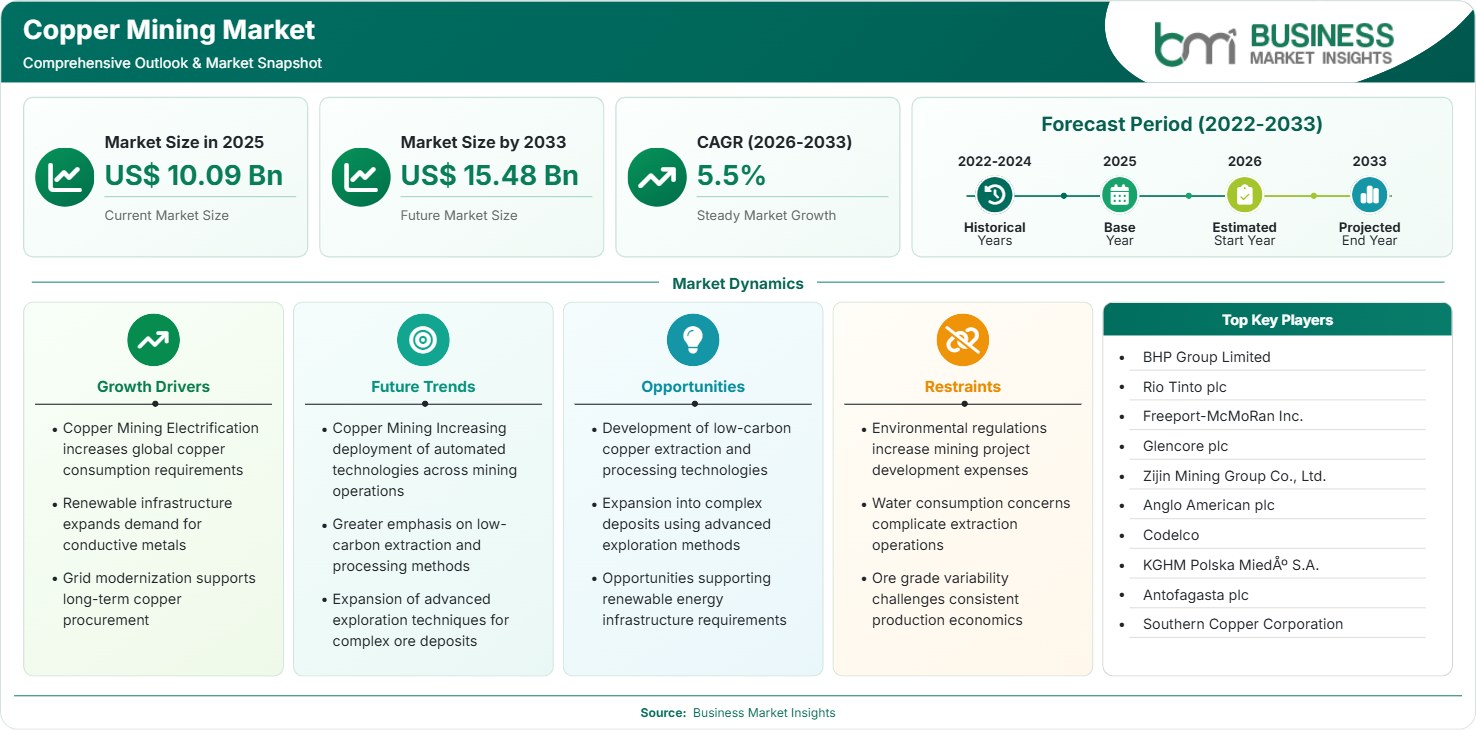
Copper Mining Market Regional Highlights
North America Copper Mining Market
North America represents 18%–21% of the Copper Mining Market share in 2025 and is projected to expand at a 5.2%–5.7% CAGR through 2033. The regional opportunity is supported by critical mineral policies, mine redevelopment, electrification infrastructure, and technology investment.
- The United States is now directing more of its investment towards ensuring domestic security of minerals, modernizing its mines, expanding its processing capacity, and deploying new technology. The USGS stated that mineral-dependent industries had an economic value of US$4.09 trillion in 2025.
- Canada can attract investment and secure long-term agreements for projects that have less exposure to geopolitical risks due to its proven mining expertise, exploration capabilities, existing infrastructure, and access to the industrial markets of North America.
- At large-scale mines, autonomous haulage and remote operating systems are becoming more relevant since they are able to improve utilization, safety, equipment coordination, and operating consistency while dealing with the constraints regarding skilled labor.
- It is still a major factor when it comes to investment since the long periods involved in development increase the level of financial risk. Developers are now more likely to choose brownfield expansions and projects that already have infrastructure to lower the uncertainty of execution.
US Copper Mining Market
The United States accounts for approximately 62%–66% of North American Copper Mining Market value in 2025, with growth estimated at 4.9%–5.4% CAGR through 2033. Demand is reinforced by grid modernization, renewable generation, electric vehicles, semiconductors, construction, and data-center infrastructure. Domestic production strategies increasingly emphasize supply resilience rather than volume alone.
- Since new large-scale projects in the United States require a great deal of permitting, the development of infrastructure, environmental review, and capital investment, copper producers have a strategic reason to enhance recovery rates and mine productivity.
- Adoption of technology is now becoming more focused on autonomous equipment, advanced geological modeling, predictive maintenance, and energy management, which allows existing operations to achieve gradual improvements in productivity without the need for entirely new mine areas.
- The construction of data-centers and power infrastructure leads to greater exposure to electrical systems that contain a lot of copper, thus creating a demand that goes beyond that of traditional construction and industrial uses.
- Even though federal policy towards critical minerals can enhance the visibility of projects, their commercial viability will still depend on the quality of the ore, the operating costs, the infrastructure, the financing conditions, and community acceptance.
Europe Copper Mining Market
Europe holds approximately 10%–13% of the Copper Mining Market share in 2025 and is projected to grow at a 4.7%–5.2% CAGR through 2033. The region is more dependent on imported primary copper than major producing regions, increasing the strategic importance of supply diversification, recycling, refining capacity, and resource partnerships.
- Germany is still a major center of demand at the downstream end since the production of motor vehicles, electrical equipment, machinery, renewable energy infrastructure, and industrial electrification all depend on a steady supply of copper throughout various manufacturing processes.
- Poland has both well-established abilities in mining and metallurgy and a great deal of experience in carrying out operations. In the first six months of 2026, KGHM achieved a production of 351 thousand tonnes of copper, which is payable, thus underlining its strategic importance in the European supply chain.
- The reason Sweden provides opportunities for exploration and the use of technology is that its mining infrastructure, the expertise it has in minerals, and its industrial focus on decarbonization all contribute to interest in developing critical materials at home.
- Spain has a well-established mining sector with possibilities for modernization, expansion, and the introduction of new technologies, especially in the case of brownfield infrastructure, which can lower the requirements for development.
- European producers and those involved in policy-making are placing greater emphasis on traceability, lower-carbon production, recycling, resource efficiency, and diversifying the supply as criteria for strategic purchasing.
Asia Pacific Copper Mining Market
Asia Pacific accounts for approximately 16%–19% of the Copper Mining Market share in 2025 and represents the fastest-growing regional market at a 6.2%–6.8% CAGR through 2033. China dominates regional refining and downstream consumption, while Australia and Indonesia contribute significant mining capacity and project opportunities.
- China still plays a central role in the regional ecosystem since its capacity for manufacturing, its electrical infrastructure, the way it has deployed renewable energy, and its refining capabilities result in a great deal of demand for copper throughout the various industrial value chains.
- India now offers a growing opportunity since the development of the grid, construction work, the growth of electric mobility, renewable energy generation, and investments in manufacturing are all increasing the copper demand for infrastructure projects.
- Australia has well-developed mining capabilities, reliable service support systems, a high level of adoption of advanced equipment, and considerable exploration potential, which benefits both large-scale producers and specialist suppliers of technology.
- Indonesia offers opportunities connected with investment in resource development and processing, although the economics of projects are becoming more dependent on infrastructure, environmental performance, permitting, and downstream integration.
- Advanced manufacturing, batteries, electronics, automobiles, and electrical equipment in Japan and South Korea continue to require a reliable supply of copper.
Rest of World Copper Mining Market
Rest of World represents approximately 31%–35% of the Copper Mining Market share in 2025 and is projected to grow at a 5.8%–6.4% CAGR through 2033. South and Central America remain strategically important because Chile and Peru host major copper operations and established service networks.
- Chile is still a key part of the world's copper supply. In 2025, Codelco achieved a production of 1,334,445 tonnes of fine copper, which shows that the mature Chilean operations and their productivity initiatives remain important.
- Although there is considerable room for expansion in Peru due to the presence of large deposits, the implementation of the projects will depend on obtaining the necessary permits, engaging with the community, developing the infrastructure, managing the water resources, and ensuring political stability.
- Zambia and the Democratic Republic of the Congo offer attractive opportunities in the field of resources, especially when infrastructure investment and processing integration are taken into account, since this can improve the economics of projects and make exports more reliable.
- Brazil and Mexico provide a wide range of opportunities covering mining, industrial consumption, processing, and technology services, and increasing emphasis is being placed on efficiency and resource optimization.
- The Gulf countries are expanding their industrial capabilities in the downstream sector and thus may form partnerships involving the trading of metals, logistics, financing, and future processing infrastructure, even though they have only limited domestic resources for primary products.