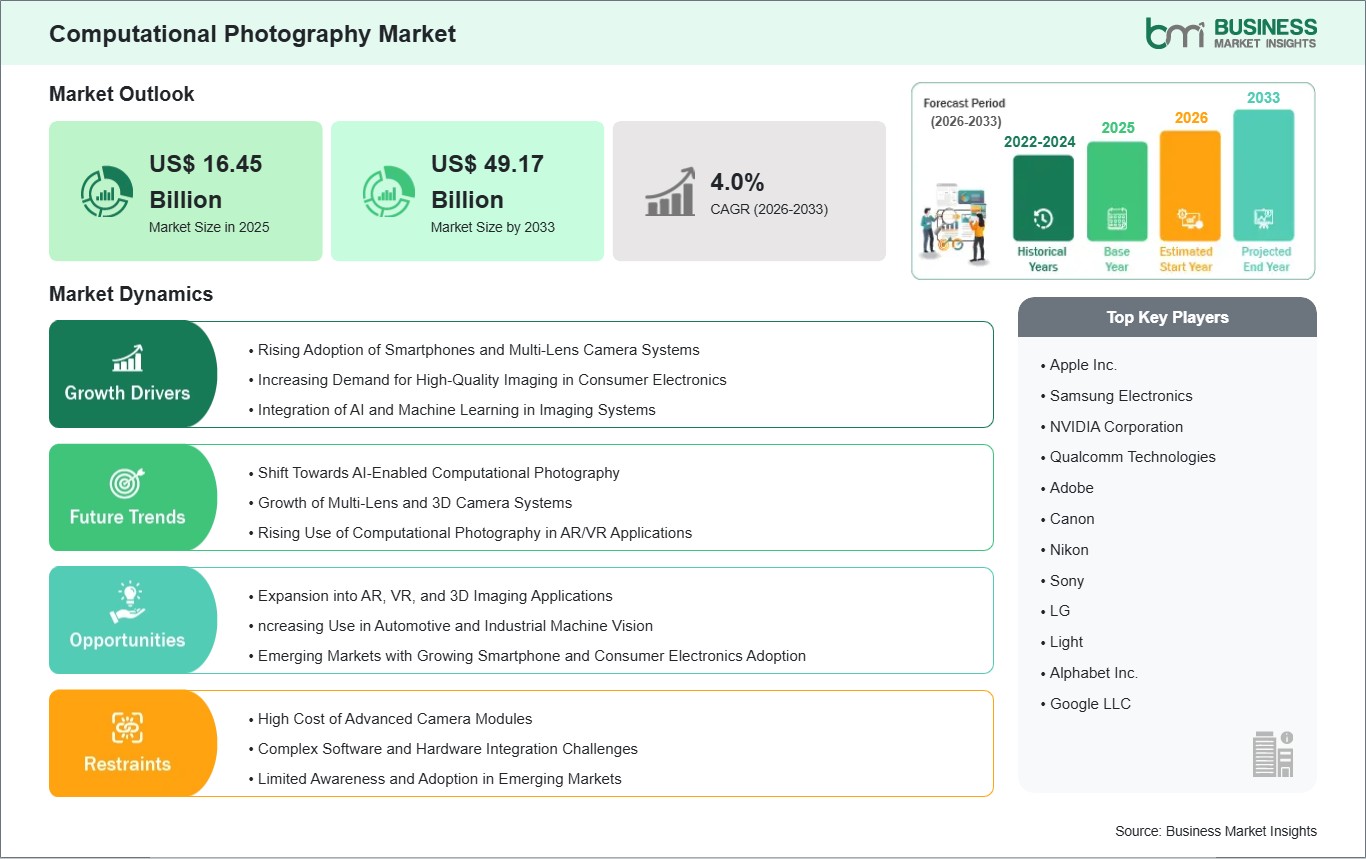
The Computational Photography market size is expected to reach US$ 49.17 billion by 2033 from US$ 16.45 billion in 2025. The market is estimated to record a CAGR of 4.0% from 2026 to 2033.
The global computational photography market is experiencing rapid growth, driven by the rising demand for advanced imaging technologies in smartphones, consumer electronics, automotive, and immersive applications such as augmented reality (AR), virtual reality (VR), and 3D imaging. Computational photography enables enhanced image quality, depth sensing, and post-processing capabilities, which traditional optical systems cannot achieve alone. This has led to widespread adoption across devices requiring high-quality imaging, compact form factors, and intelligent camera features.
From a global perspective, the market is being fueled by increasing smartphone penetration, growing popularity of AR/VR devices, and the integration of AI-powered imaging solutions. Camera modules remain the dominant offering, supported by advancements in multi-lens systems, sensors, and image processing algorithms. Single- and dual-lens cameras, particularly in smartphones, account for the largest share due to cost-effectiveness, ease of integration, and strong consumer preference for high-quality mobile photography.
Regionally, Asia Pacific dominates the market owing to strong electronics manufacturing infrastructure, high smartphone adoption, and investments in AR/VR and imaging technologies. North America and Europe contribute significantly through innovation in high-end consumer electronics, automotive imaging, and industrial machine vision applications. Emerging markets in Latin America and the Middle East & Africa present additional growth opportunities as technology adoption accelerates.
The market outlook remains positive, with further growth expected from the development of AI-enabled cameras, multi-lens imaging systems, and computational algorithms that enhance imaging capabilities in both consumer and industrial applications. Continuous innovations, coupled with increasing demand for immersive and intelligent imaging solutions, are poised to sustain the upward trajectory of the computational photography market globally.

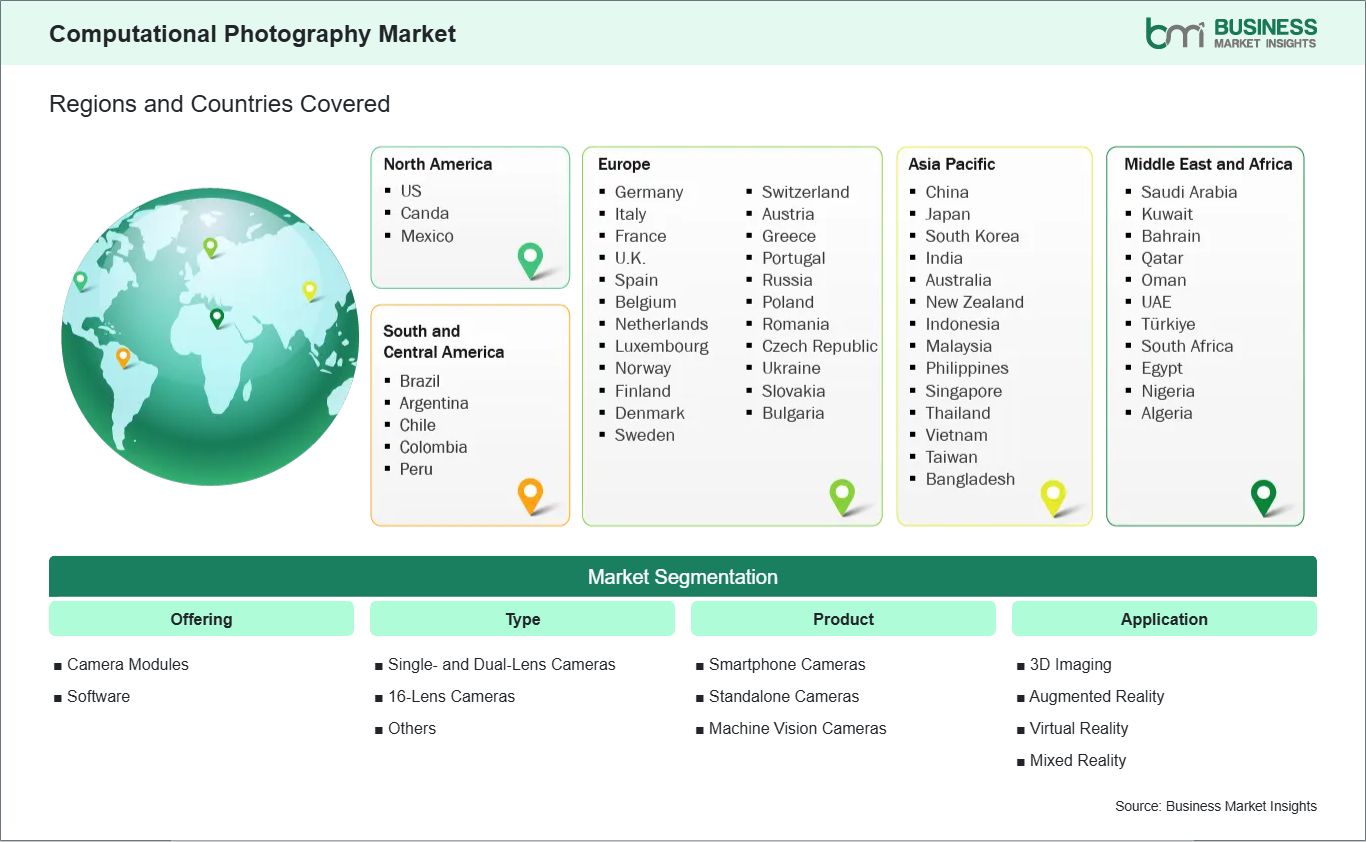
Key segments that contributed to the derivation of the Computational Photography market analysis are type, offering, product, and application.
The growing adoption of smartphones with advanced camera capabilities is a primary driver of the computational photography market. Consumers increasingly demand high-quality images, professional-grade photography features, and enhanced video capabilities directly from their mobile devices. Computational photography addresses these needs by leveraging advanced algorithms, multi-lens camera setups, and AI-powered image processing to improve image quality, dynamic range, low-light performance, and depth perception. Single- and dual-lens cameras, in particular, dominate this space due to their cost-effectiveness, ease of integration, and ability to deliver significant improvements in photography performance over traditional camera systems.
Moreover, the integration of artificial intelligence and machine learning in imaging systems enables features such as scene recognition, portrait mode, super-resolution zoom, and low-light enhancement, further driving adoption. The rising trend of social media usage, content creation, and video streaming has also fueled consumer demand for better camera performance. Leading smartphone manufacturers are investing heavily in computational photography technologies to differentiate their devices in an increasingly competitive market, which in turn boosts market growth.
Additionally, the demand for multi-lens camera modules in emerging markets and mid-range smartphones has accelerated, enabling more affordable access to computational photography capabilities. These factors collectively contribute to the expansion of the market globally, positioning smartphone adoption and multi-lens camera integration as a key driver of growth in the computational photography industry.
The growing adoption of augmented reality (AR), virtual reality (VR), and 3D imaging applications presents a significant opportunity for the computational photography market. These technologies require advanced imaging systems capable of capturing high-resolution, depth-sensitive, and immersive visual content, which conventional cameras cannot fully provide. Computational photography solutions, with features such as multi-lens systems, depth mapping, AI-based image processing, and real-time enhancement, enable more accurate and engaging AR/VR experiences for both consumers and industrial applications.
In the gaming, entertainment, and social media sectors, AR and VR are rapidly gaining traction, driving demand for devices equipped with sophisticated camera modules capable of real-time scene reconstruction and depth sensing. Similarly, 3D imaging is increasingly applied in sectors such as healthcare, automotive, robotics, and industrial inspection, creating a high-growth segment for computational photography. For instance, AR-enabled navigation in automotive applications relies on high-precision imaging, while 3D facial recognition and gesture detection in smartphones depend on advanced computational photography algorithms.
Furthermore, advancements in AI-driven image processing, coupled with decreasing hardware costs and miniaturization of multi-lens camera modules, are enabling broader adoption of computational photography in emerging markets and new devices. These developments open opportunities for market players to expand their product portfolios, partner with AR/VR content creators, and capture growing demand across consumer, automotive, healthcare, and industrial sectors, positioning computational photography as a critical technology for next-generation imaging applications.

By Type the market is divided into Single‑ and Dual‑Lens Cameras, 16‑Lens Cameras, and Others. The single‑ and dual‑lens camera segment accounted for the largest share of the computational photography market in 2025, owing to its cost-effectiveness, wide adoption in smartphones, and ease of integration with existing imaging systems.
By Offering the market is divided into Camera Modules and Software. The camera modules segment held the largest share of the computational photography market in 2025, due to high demand for compact, high-performance imaging components in consumer electronics and mobile devices.
By Product the market is divided into Smartphone Cameras, Standalone Cameras, and Machine Vision Cameras. The smartphone cameras segment accounted for the largest share of the computational photography market in 2025, driven by increasing smartphone penetration, advanced camera features, and growing consumer preference for high-quality mobile photography.
By Application the market is divided into 3D Imaging, Augmented Reality (AR), Virtual Reality (VR), and Mixed Reality (MR). The 3D imaging segment held the largest share of the computational photography market in 2025, owing to its extensive use in facial recognition, depth sensing, and immersive imaging solutions..
| Report Attribute | Details |
|---|---|
| Market size in 2025 | US$ 16.45 Billion |
| Market Size by 2033 | US$ 49.17 Billion |
| Global CAGR (2026 - 2033) | 4.0% |
| Historical Data | 2022-2024 |
| Forecast period | 2026-2033 |
| Segments Covered | By Offering
|
|
Regions and Countries Covered
| |
| North America | US, Canada, Mexico |
| Europe | Belgium, Austria, Finland, Denmark, Greece, Poland, Romania, Russia, Ukraine, Czech Republic, Slovakia, Bulgaria, Italy, Luxembourg, Germany, Switzerland, France, Netherlands, Norway, Portugal, Spain, Sweden, United Kingdom |
| Asia-Pacific | Australia, China, India, Japan, South Korea, Indonesia, Malaysia, Philippines, Singapore, Thailand, Vietnam, Bangladesh, New Zealand, Taiwan |
| South and Central America | Brazil, Argentina, Peru, Chile, Colombia |
| Middle East and Africa | Bahrain, Kuwait, Oman, Qatar, Saudi Arabia, United Arab Emirates, Turkiye, South Africa, Egypt, Algeria, Nigeria |
| Market leaders and key company profiles |
|
The "Computational Photography Market Size and Forecast (2022-2033)" report provides a detailed analysis of the market covering below areas:
The geographical scope of the Computational Photography market report is divided into five regions: North America, Asia Pacific, Europe, Middle East & Africa, and South & Central America. The Computational Photography market in Asia Pacific is expected to grow significantly during the forecast period.
The global computational photography market exhibits strong regional variations driven by smartphone adoption, technological innovation, and emerging use cases such as AR, VR, and 3D imaging. North America holds a leading position, supported by a mature technology ecosystem, high consumer demand for premium devices, and significant R&D investments in AI-enabled imaging and multi-lens camera systems.
Asia Pacific is the fastest-growing region due to high smartphone penetration, large consumer electronics manufacturing hubs, rising disposable incomes, and government support for digital transformation. Key countries driving growth include China, India, South Korea, and Japan. Europe maintains a steady market share, fueled by demand in automotive imaging, industrial applications, and consumer electronics, along with investment in advanced imaging technologies.

The Computational Photography market is evaluated by gathering qualitative and quantitative data post primary and secondary research, which includes important corporate publications, association data, and databases. A few of the key developments in the Computational Photography market are:
The Computational Photography Market is valued at US$ 16.45 Billion in 2025, it is projected to reach US$ 49.17 Billion by 2033.
As per our report Computational Photography Market, the market size is valued at US$ 16.45 Billion in 2025, projecting it to reach US$ 49.17 Billion by 2033. This translates to a CAGR of approximately 4.0% during the forecast period.
The Computational Photography Market report typically cover these key segments-
The historic period, base year, and forecast period can vary slightly depending on the specific market research report. However, for the Computational Photography Market report:
The Computational Photography Market is populated by several key players, each contributing to its growth and innovation. Some of the major players include:
The Computational Photography Market report is valuable for diverse stakeholders, including:
Essentially, anyone involved in or considering involvement in the Computational Photography Market value chain can benefit from the information contained in a comprehensive market report.
Please tell us your area of interest
(Market Segments/ Regions and Countries/ Companies)