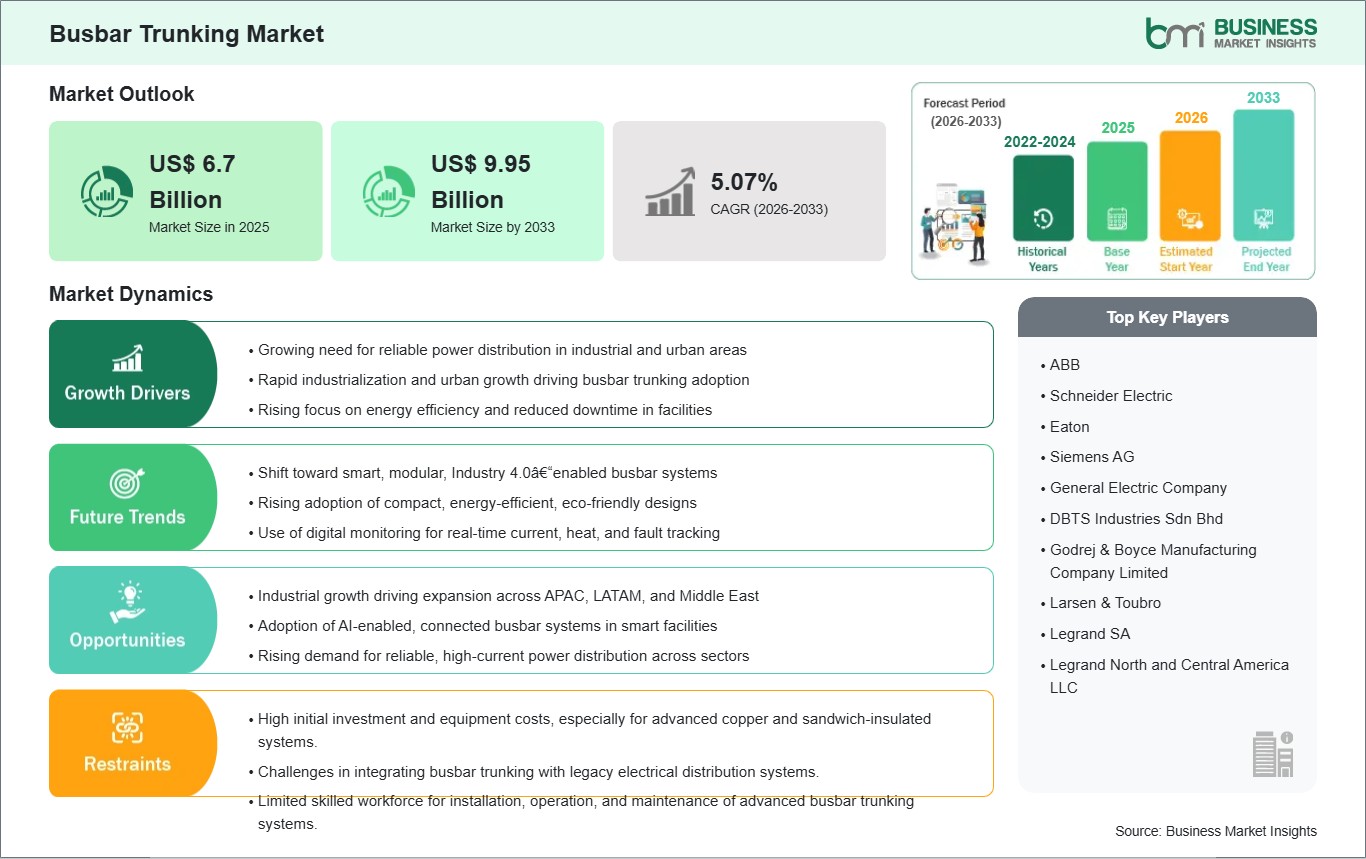
The Busbar Trunking Market size is expected to reach US$ 9.95 Billion by 2033 from US$ 6.7 Billion in 2025. The market is estimated to record a CAGR of 5.07% from 2026 to 2033.
The global Busbar Trunking Market is witnessing robust growth driven by rapid industrialization, urbanization, and the rising demand for efficient power distribution systems. Busbar trunking systems are widely used in industrial, commercial, and residential applications to ensure reliable and safe electrical power transmission. Compared to traditional cabling, busbar trunking provides advantages such as compact design, high current-carrying capacity, reduced energy loss, easier installation, and minimal maintenance.
Technological advancements in conductor materials, insulation systems, and modular designs have further enhanced the performance, safety, and scalability of busbar trunking systems. Copper conductors and sandwich insulation are increasingly preferred due to their superior conductivity, durability, and compact structure, which make them suitable for high-current industrial applications.
Regionally, Asia Pacific dominates the market, with countries such as China, India, and Japan driving growth due to large-scale industrial projects, infrastructure development, and increased adoption of advanced electrical distribution systems. North America and Europe also maintain a steady market share, supported by technological innovation, strict safety regulations, and the presence of key market players. The market is poised for further expansion as industries and commercial establishments prioritize energy-efficient and reliable power distribution solutions.

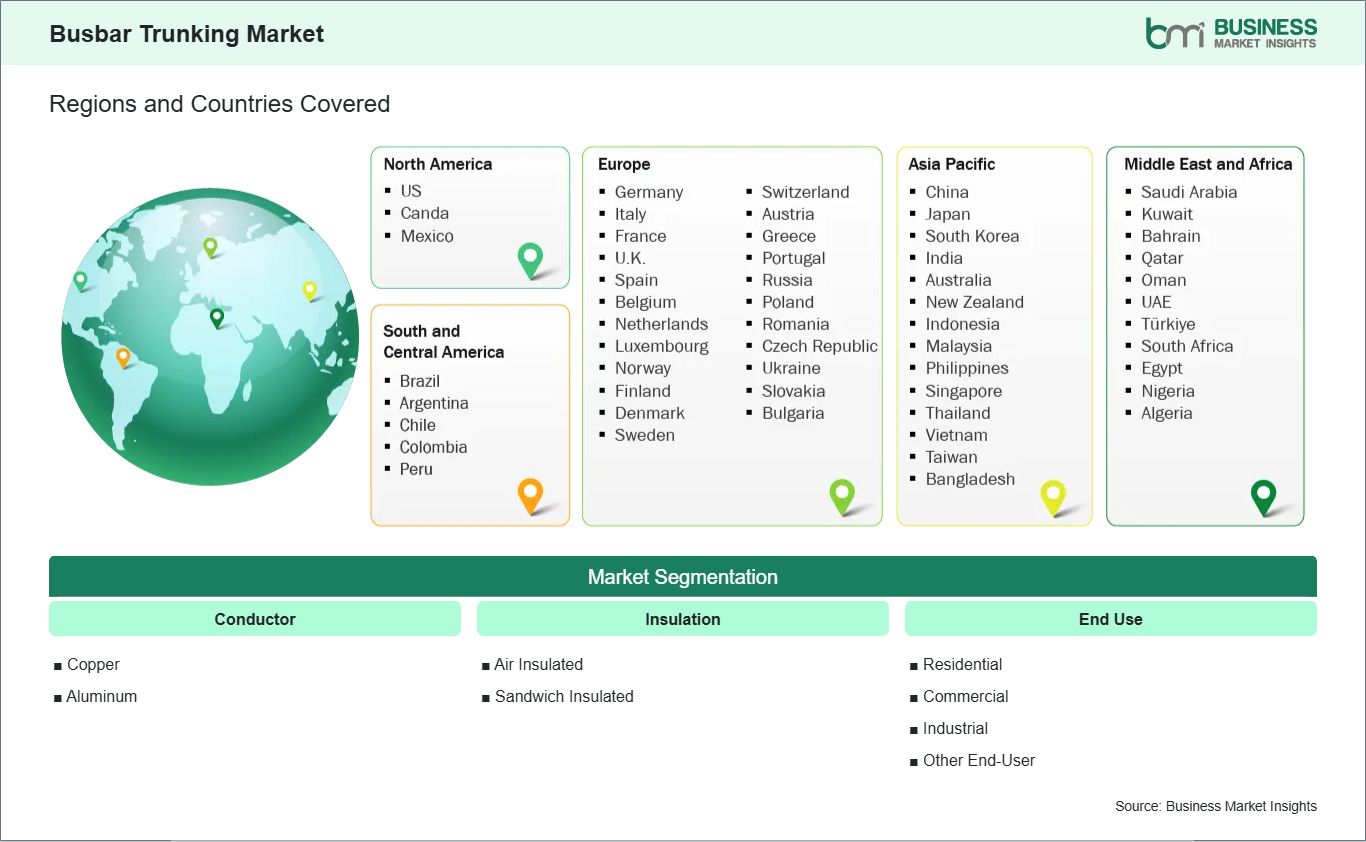
Key segments that contributed to the derivation of the Busbar Trunking market analysis are conductor, insulation, and end use.
A key driver of the global Busbar Trunking Market is the growing demand for efficient, reliable, and safe power distribution systems across industrial, commercial, and residential sectors. Traditional cabling systems are often prone to energy loss, overheating, and complex installation challenges, especially in high-current applications. Busbar trunking systems offer a more efficient alternative, delivering high current-carrying capacity with minimal energy loss and reduced maintenance requirements.
Industries such as manufacturing, automotive, energy, and heavy electrical infrastructure increasingly rely on busbar trunking for reliable power delivery. The compact and modular design of busbar systems allows easy installation, scalability, and adaptability to changing energy requirements. Copper conductors and sandwich-insulated designs enhance durability, safety, and current-handling capacity, making these systems ideal for industrial environments where high performance is critical.
Additionally, urbanization and expansion of commercial and industrial complexes drive the need for safe and organized power distribution solutions. The trend toward smart buildings, data centers, and industrial automation further supports the adoption of busbar trunking systems. These systems enable efficient power management, reduce downtime, and improve overall operational efficiency, making them a preferred choice for modern infrastructure. Overall, the demand for reliable, energy-efficient, and maintenance-friendly power distribution solutions continues to propel market growth, positioning busbar trunking as an essential technology in contemporary electrical systems.
The growing industrialization and infrastructure development in emerging economies present a significant opportunity for the global busbar trunking market. Countries in Asia Pacific, the Middle East, and Latin America are investing heavily in manufacturing facilities, commercial complexes, data centers, and urban infrastructure projects, driving demand for efficient power distribution systems. Busbar trunking systems are increasingly preferred over traditional cabling solutions due to their superior efficiency, scalability, and safety.Emerging economies in Asia Pacific, such as China, India, and Southeast Asian nations, are witnessing rapid growth in industrial and commercial sectors. Expansion in automotive manufacturing, electronics production, renewable energy projects, and smart city initiatives is increasing the need for high-current and reliable electrical distribution systems, positioning busbar trunking as a crucial solution.
Additionally, modernization of existing industrial facilities and retrofitting of electrical systems in developed regions create further opportunities for busbar trunking adoption. The trend toward energy-efficient and sustainable solutions aligns with the adoption of busbar systems, which reduce energy losses, improve operational efficiency, and minimize maintenance costs. Vendors offering advanced busbar trunking solutions, including copper conductors, sandwich insulation, and modular designs, are well-positioned to capitalize on this growing demand. Strategic partnerships, expansion in emerging markets, and customized solutions for industrial and commercial applications provide ample growth potential for market participants globally..

| Report Attribute | Details |
|---|---|
| Market size in 2025 | US$ 6.7 Billion |
| Market Size by 2033 | US$ 9.95 Billion |
| Global CAGR (2026 - 2033) | 5.07% |
| Historical Data | 2022-2024 |
| Forecast period | 2026-2033 |
| Segments Covered | By Conductor
|
|
Regions and Countries Covered
| |
| North America | US, Canada, Mexico |
| Europe | Belgium, Austria, Finland, Denmark, Greece, Poland, Romania, Russia, Ukraine, Czech Republic, Slovakia, Bulgaria, Italy, Luxembourg, Germany, Switzerland, France, Netherlands, Norway, Portugal, Spain, Sweden, United Kingdom |
| Asia-Pacific | Australia, China, India, Japan, South Korea, Indonesia, Malaysia, Philippines, Singapore, Thailand, Vietnam, Bangladesh, New Zealand, Taiwan |
| South and Central America | Brazil, Argentina, Peru, Chile, Colombia |
| Middle East and Africa | Bahrain, Kuwait, Oman, Qatar, Saudi Arabia, United Arab Emirates, Turkiye, South Africa, Egypt, Algeria, Nigeria |
| Market leaders and key company profiles |
|
The "Busbar Trunking Market Size and Forecast (2022–2033)" report provides a detailed analysis of the market covering below areas:
The geographical scope of the Busbar Trunking market report is divided into five regions: North America, Asia Pacific, Europe, Middle East & Africa, and South & Central America. The Busbar Trunking market in Asia Pacific is expected to grow significantly during the forecast period.
The Busbar Trunking Market demonstrates significant regional variation based on industrialization, infrastructure growth, and adoption of advanced power distribution systems. Asia Pacific dominates the market, with countries such as China, India, and Japan leading adoption. Rapid industrialization, large-scale manufacturing projects, and increasing urban infrastructure investments are driving demand for busbar trunking systems in this region.
Europe maintains steady growth, supported by industrial modernization, technological innovation, and strict safety and efficiency regulations. Countries like Germany, the U.K., and France are investing in advanced electrical distribution solutions for industrial plants, data centers, and commercial facilities, boosting market adoption. In North America, the United States and Canada are significant markets due to the high adoption of industrial automation, smart buildings, and energy-efficient infrastructure projects. The presence of key manufacturers and technology providers further drives market growth.Overall, regional dynamics indicate a strong market expansion globally, with Asia Pacific leading in terms of volume and emerging economies providing new avenues for adoption of advanced busbar trunking systems..

The Busbar Trunking market is evaluated by gathering qualitative and quantitative data post primary and secondary research, which includes important corporate publications, association data, and databases. A few of the key developments in the Busbar Trunking market are:
The Busbar Trunking Market is valued at US$ 6.7 Billion in 2025, it is projected to reach US$ 9.95 Billion by 2033.
As per our report Busbar Trunking Market, the market size is valued at US$ 6.7 Billion in 2025, projecting it to reach US$ 9.95 Billion by 2033. This translates to a CAGR of approximately 5.07% during the forecast period.
The Busbar Trunking Market report typically cover these key segments-
The historic period, base year, and forecast period can vary slightly depending on the specific market research report. However, for the Busbar Trunking Market report:
The Busbar Trunking Market is populated by several key players, each contributing to its growth and innovation. Some of the major players include:
The Busbar Trunking Market report is valuable for diverse stakeholders, including:
Essentially, anyone involved in or considering involvement in the Busbar Trunking Market value chain can benefit from the information contained in a comprehensive market report.
Please tell us your area of interest
(Market Segments/ Regions and Countries/ Companies)