Market Summary
Executive Summary and Global Market Analysis
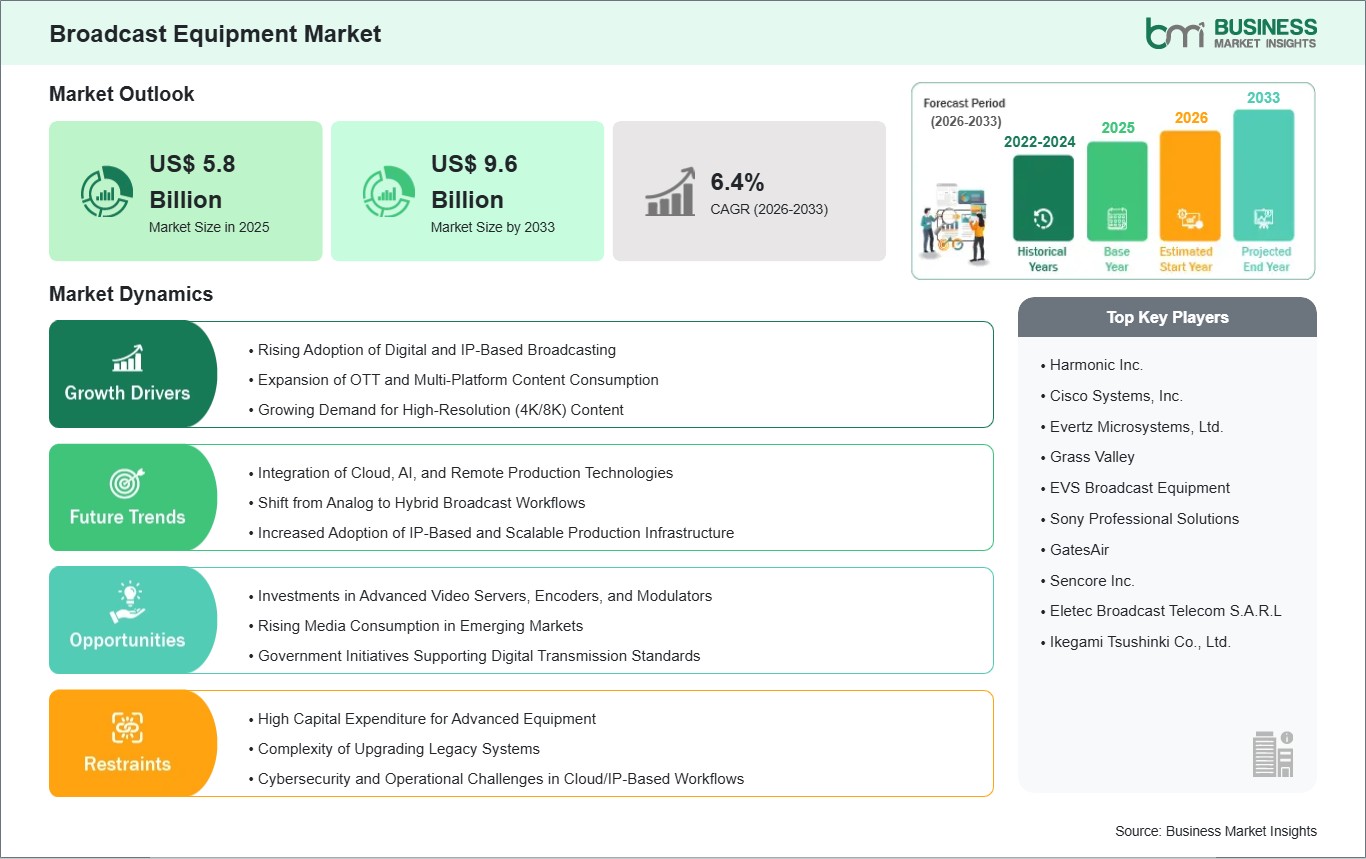
Broadcast equipment comprises the hardware and systems used for capturing, processing, transmitting, and distributing audio‑visual content over radio, television, and digital platforms. These solutions include encoders, transmitters, modulators, dish antennas, video servers, amplifiers, and associated control systems that enable broadcasters to produce and deliver high‑quality content across multiple screens and formats. With the media industry’s shift toward digital and IP‑based broadcasting infrastructures, demand for modern broadcast equipment is rising as traditional analog systems are gradually replaced by scalable and flexible digital workflows that support OTT distribution, cloud‑enabled production, and remote broadcasting operations.
The global broadcast equipment market is experiencing steady growth fueled by the ongoing proliferation of high‑resolution content (including 4K/UHD/8K), expansion of OTT streaming services, and the transition to hybrid broadcast models that blend traditional and internet‑based content delivery. Advancements in technologies such as IP‑based transmission, cloud workflows, and AI‑assisted production tools are enhancing operational efficiency and content quality. Although initial capital expenditures and the complexity of upgrading legacy systems pose challenges, investments in digital broadcasting infrastructure, especially in emerging markets, are reinforcing long‑term growth prospects for broadcast equipment.
Segment Analysis
Broadcast Equipment Market Segmentation
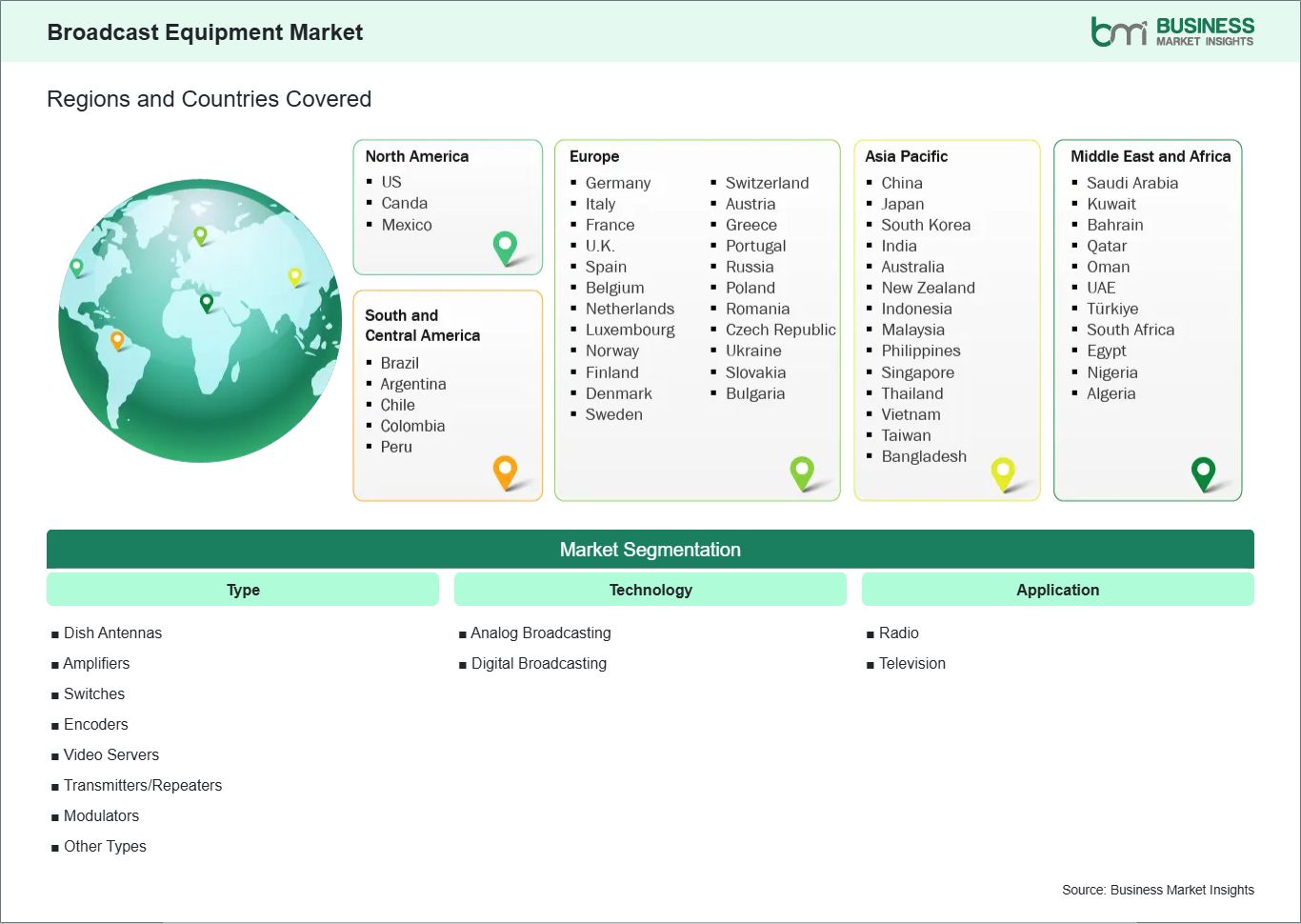
Key segments that contributed to the derivation of the broadcast equipment market analysis are type, technology, and application.
- By type, the market is segmented into Dish Antennas, Amplifiers, Switches, Encoders, Video Servers, Transmitters/Repeaters, Modulators, and Others. The Video Servers segment held the largest share of the market in 2025.
- By technology, the market is segmented into Analog Broadcasting and Digital Broadcasting. The Digital Broadcasting segment held the largest share of the market in 2025.
- By application, the market is segmented into Radio (AM, FM) and Television. The Television segment held the largest share of the market in 2025.
Market Forces
Broadcast Equipment Market Drivers and Opportunities
Rising Demand for Digital and IP-Based Broadcasting
The global shift from traditional analog broadcasting to digital and IP-based infrastructures is a key driver of the broadcast equipment market. Broadcasters are investing in advanced transmitters, encoders, modulators, and video servers to deliver high-quality content across multiple platforms, including over-the-top (OTT) streaming services and mobile applications. Digital and IP-based systems offer enhanced scalability, reliability, and flexibility, enabling broadcasters to optimize content delivery workflows, reduce operational costs, and meet the growing consumer demand for high-definition and ultra-high-definition (4K/8K) content.
Expansion of OTT and Multi-Platform Content Consumption
The rapid growth of OTT platforms, video-on-demand services, and multi-device content consumption is creating significant market opportunities for broadcast equipment providers. To support seamless streaming and live broadcasting across various devices, broadcasters are adopting modern production equipment such as video servers, high-performance encoders, and cloud-based workflows. The rising demand for interactive, on-demand, and personalized content is driving investments in scalable and agile broadcast solutions that can handle high bandwidth, low latency, and dynamic distribution requirements.
Size and Share Analysis
Broadcast Equipment Market Size and Share Analysis
By Type, the Broadcast Equipment Market is segmented into Dish Antennas, Amplifiers, Switches, Encoders, Video Servers, Transmitters/Repeaters, Modulators, and Others. The Video Servers segment held a significant share of the market in 2025. Video servers are central to modern broadcast workflows, enabling the storage, management, and distribution of high-quality video content across multiple platforms, including television and OTT streaming. Their scalability and support for high-resolution formats (4K/8K) make them essential for live broadcasting, on-demand content, and multi-platform distribution. Growing consumer demand for high-definition content and the transition to digital broadcasting are key factors driving adoption of video servers globally.
By Technology, the market is segmented into Analog Broadcasting and Digital Broadcasting. The Digital Broadcasting segment held the largest share of the market in 2025. Digital broadcasting systems provide higher bandwidth efficiency, superior signal quality, and enhanced interactive features compared to traditional analog systems. Broadcasters are increasingly deploying digital transmitters, encoders, and modulators to support IP-based content delivery, hybrid OTT models, and cloud-enabled production workflows. The shift toward digital infrastructure, driven by regulatory mandates and consumer demand for HD/UHD content, is a primary factor fueling growth in this technology segment.
By Application, the market is segmented into Radio (AM, FM) and Television. The Television segment held the largest share of the market in 2025. Television broadcasting remains a key driver of demand for advanced transmitters, modulators, and video servers, particularly as networks upgrade to support high-resolution, multi-channel, and interactive content. Rising investments in live sports, news, and entertainment production, combined with the growing importance of hybrid distribution models integrating traditional TV and OTT platforms, continue to expand opportunities in this application segment.
Report Coverage
Broadcast Equipment Market Report Coverage and Deliverables
Broadcast Equipment Market Report Coverage and Deliverables
The "Broadcast Equipment Market Size and Forecast (2022-2033)" report provides a detailed analysis of the market covering below areas:
- Broadcast equipment market size and forecast at global, regional, and country levels for all the key market segments covered under the scope
- Broadcast equipment market trends, as well as market dynamics such as drivers, restraints, and key opportunities
- Broadcast equipment market analysis covering key market trends, global and regional framework, major players, regulations, and recent market developments
- Industry landscape and competition analysis covering market concentration, heat map analysis, prominent players, and recent developments for the broadcast equipment market
- Detailed company profiles, including SWOT analysis
Geographic Insights
Broadcast Equipment Market Geographic Insights
The geographical scope of the broadcast equipment market report is divided into five regions: North America, Asia Pacific, Europe, Middle East & Africa, and South & Central America. The broadcast equipment market in North America is expected to grow significantly during the forecast period.
North America has emerged as a leading region for the broadcast equipment market, driven by the presence of advanced media networks, early adoption of digital broadcasting standards, and significant investments in IP-based and cloud-enabled production technologies. Countries such as the United States, Canada, and Mexico are at the forefront of this growth, supported by robust broadcasting infrastructure, high consumer demand for high-definition (HD/UHD) content, and a strong focus on live sports, news, and entertainment broadcasting. The growing adoption of OTT platforms, hybrid broadcast models, and remote production workflows is further boosting the deployment of video servers, encoders, modulators, and transmitters across the region.
In addition, North America benefits from a well-established media and entertainment ecosystem, technological leadership in broadcast equipment innovation, and strong regulatory support for digital transmission standards. Investments in AI-enabled content management, cloud-based workflows, and multi-platform content delivery are accelerating the modernization of broadcast infrastructure. The increasing demand for ultra-high-definition content, scalable distribution solutions, and efficient production workflows is expected to sustain strong market growth across television, radio, and digital broadcasting applications in the region.
Industry Activity
Recent Developments
The broadcast equipment market is evaluated by gathering qualitative and quantitative data post primary and secondary research, which includes important corporate publications, association data, and databases. A few of the key developments in the broadcast equipment market are:
- In January 2026, Vislink Technologies, Inc., a global provider of real-time wireless video solutions for live broadcast production, announces a new supplier agreement with Dorna Sports, continuing one of the longest partnerships in live sports broadcasting. The new contract will also cover the introduction of the new Vislink CLIQ RF transmitter, supported by advanced Quantum Receivers to complement the extensive range of Vislink broadcast equipment already deployed at each event.
- In January 2026, FUJIFILM North America Corporation announced the launch of the new "FUJIFILM SX400" (hereafter "SX400") as part of its SX Series lineup of lens-integrated long-range cameras. SX400 is equipped with a new lens designed to suppress noise that occurs when sensitivity is increased, enabling clear imaging of subjects in low light environments.
Trust & Transparency
Research Methodology
The market analysis combines proprietary research with secondary data from government agencies, company disclosures, regulatory filings, industry databases and expert interviews. Market estimates are validated through data triangulation, cross-market benchmarking and analyst
review.
View Full Research Methodology
Key Sources Referred:
World Bank - Global Trade Indicators World Trade Organization (WTO) International Monetary Fund (IMF) International Trade Administration (ITA) Company website Company annual reports Company investor presentations