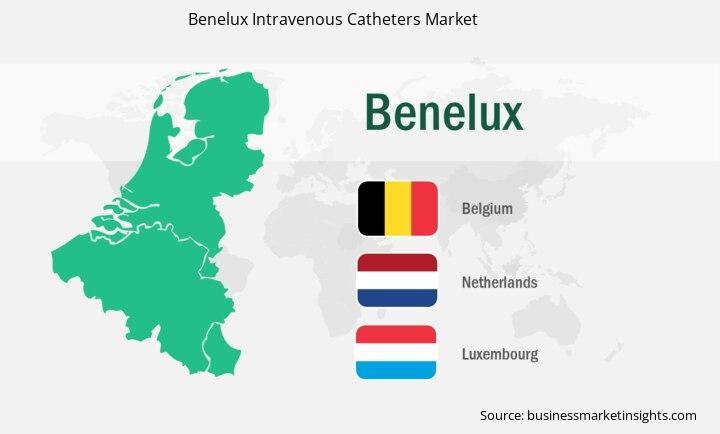
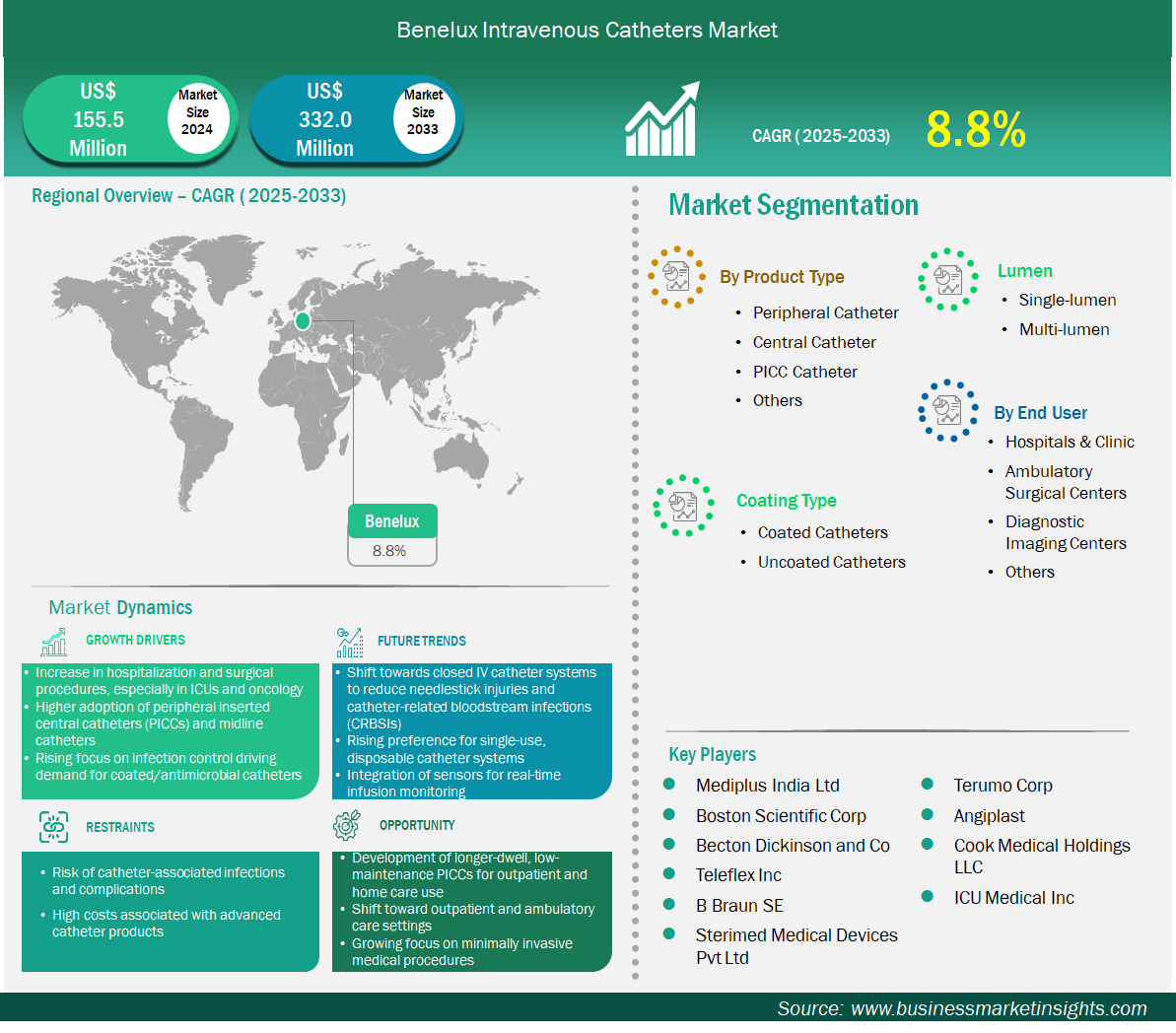
The Benelux intravenous catheters market size is expected to reach US$ 332.0 million by 2033 from US$ 155.5 million in 2024. The market is estimated to record a CAGR of 8.8% from 2025 to 2033.
Executive Summary and Benelux Intravenous Catheters Market Analysis:
The intravenous catheters market in Benelux is experiencing significant growth driven by the increase in hospitalization and surgical procedures; especially in ICUs and oncology, higher adoption of peripherally inserted central catheters (PICCs) and midline catheters, and rising focus on infection control driving demand for coated/antimicrobial catheters. The Benelux intravenous catheters market is anchored by high clinical standardization, integrated payer-provider ecosystems, and concentrated centers of excellence. Belgium’s university hospitals and the Netherlands’ teaching networks drive protocolized peripheral IV placement for perioperative and short-stay care, sustaining high baseline demand for peripheral catheters. The region’s infection control culture—rooted in national indicator dashboards and public reporting—has accelerated migration to coated catheters with antimicrobial surfaces and hemo-compatible polymers, particularly for patients at elevated risk of phlebitis or extended dwell times. Multi-lumen devices are deployed primarily in oncology, hematology, and critical care, where concurrent chemotherapy, parenteral nutrition, and vasoactive agents necessitate line segregation and reliable flow. Hospitals and clinics remain the principal end-users, supported by strong financing models: Dutch insurers incentivize day-case infusions through DRG structures, while Belgian mutualities co-fund pathway design that privileges safe early discharge with robust community nursing. Distribution is mature yet competitive, featuring multinational leaders alongside regional suppliers who excel in service responsiveness and consignment logistics. Procurement is highly data-driven; value analysis committees weigh catheter performance, dwell longevity, and complication rates against total cost of ownership, favouring vendors that offer training, audit tools, and supply resilience. While Luxembourg is smaller, its private hospital segment shows premium uptake of coated and multi-lumen lines aligned with international expat patient expectations. Across Benelux, workforce efficiency and outcome measurement frame purchasing decisions, creating a market that rewards clinically proven coatings, ergonomic designs that reduce insertion attempts, and portfolio breadth spanning peripheral to central access. The result is a stable, quality-focused environment where incremental product differentiation and service guarantees can shift share even without aggressive price moves.
Benelux Intravenous Catheters Market Segmentation Analysis:
Key segments that contributed to the derivation of the intravenous catheters market analysis are product, coating type, lumen, and end user.
- By product, the intravenous catheters market is segmented into peripheral catheter, central catheter, PICC catheter, and others. Peripheral catheter dominated the market in 2024, driven by the standardized nurse-led IV protocols and rapid turnover in day-care settings.
- By coating type, the intravenous catheters market is segmented into coated catheters, uncoated catheters. Coated catheters dominated the market in 2024, driven by hospital-acquired infection reduction targets under national quality benchmarks.
- By lumen, the market is segmented into single-lumen, multi-lumen. Multi-lumen dominated the market in 2024, driven by the complex oncology regimens concentrated in academic medical centers.
- By end user, the market is segmented into hospitals & clinics, ambulatory surgical centers, diagnostic imaging centers, and others. Hospitals & clinics dominated the market in 2024, driven by dense hospital networks and insurer-backed outpatient infusion pathways.
Benelux Intravenous Catheters Market Outlook
The Benelux intravenous catheters market is segmented into Belgium, the Netherlands, and Luxembourg. Benelux growth will be shaped by outpatient infusion expansion, oncology pipeline intensity, and evolving staffing models. Dutch hospitals continue shifting elective infusions into ambulatory centers, increasing turnover of peripheral catheters and raising the bar for quick-insertion, low-irritation designs. Belgian oncology programs are scaling combination regimens and supportive care, sustaining demand for multi-lumen access capable of parallel administration with minimized line manipulation. Coated catheters will benefit from tightening quality thresholds around bloodstream infections, with hospitals piloting outcome-linked contracts that tie reimbursement to infection reductions and dwell-time performance. Vendors that bundle clinical education, insertion simulation, and digital audit tools can secure durable framework agreements as committees emphasize implementation fidelity. Supply continuity is strategic: institutions are mapping dual-sourcing and buffer inventories after recent disruptions, privileging manufacturers with European warehousing and transparent lead-times. Human capital constraints will persist; nurse shortages push adoption of devices with intuitive securement, reduced needlesticks, and simplified flushing protocols, while broader deployment of vascular access teams elevates product standardization across hospital groups. Sustainability criteria are rising; green procurement preferences favour recyclable packaging and lower material footprints, creating differentiation opportunities for eco-conscious designs without compromising sterility. Luxembourg’s premium segment will continue to over-index coated and multi-lumen uptake, while cross-border care with Germany and France shapes portfolio harmonization. Digital documentation integration—barcode tracking, EMR-linked line records, and adverse event capture—will influence purchasing, giving leverage to vendors with interoperable labelling and data standards. Overall, Benelux’s outlook is steady and quality-led: growth hinges on outpatient care, complex therapy intensity, and infection control, rewarding suppliers that deliver proven coatings, clinician productivity, dependable logistics, and sustainability credentials.
Benelux Intravenous Catheters Market Country Insights
Based on region, the Benelux intravenous catheters market is further segmented into Belgium, the Netherlands, and Luxembourg. The Netherlands held the largest share in 2024.
The Netherlands prioritizes pathway standardization and ambulatory efficiency, making peripheral catheters the workhorse of short-stay procedural and infusion care. Academic centers in Amsterdam, Rotterdam, and Utrecht drive continuous improvement cycles, with vascular access teams setting insertion competencies and auditing phlebitis rates, catalysing adoption of coated options for high-risk cohorts. Belgium balances large university hospitals with strong regional facilities; oncology clusters in Leuven and Liège utilize multi-lumen lines to streamline complex regimens, while national nursing bodies promote insertion training and escalation algorithms that reduce catheter failure. Public reporting of infection metrics nudges procurement toward devices with validated antimicrobial performance, and hospital federations increasingly negotiate multi-year agreements that include education and service SLAs. Luxembourg, though smaller, features premium private hospitals catering to multinational populations; procurement favours coated, securement-optimized designs with robust documentation packs and multilingual training content. Cross-border dynamics matter: Dutch hospitals coordinate with German suppliers for redundancy, while Belgian institutions benchmark pricing and performance against French peers, shaping tender requirements around real-world outcomes and support responsiveness. Community nursing is influential—home infusion programs require peripheral lines with reliable dwell and comfortable securement, feeding back user experience into hospital value analysis. Reimbursement nuances guide end-user behaviour: Dutch insurers incentivize ambulatory pathways, Belgium’s mutualities recognize infection-prevention investments, and Luxembourg’s private payers tolerate premium device selection tied to demonstrable complication reduction. The region’s diversity in hospital size and academic intensity requires tailored vendor strategies: high-touch clinical support for teaching hospitals, streamlined logistics and consignment for regional centers, and sustainability-aligned offerings meeting procurement charters. In all three countries, staff efficiency, predictable supply, and audit-ready documentation distinguish winning portfolios, while eco-design and packaging reductions are becoming tie-breakers in competitive tenders.
Benelux Intravenous Catheters Market Company Profiles
Mediplus India Ltd, Boston Scientific Corp, Becton Dickinson and Co, Teleflex Inc, B Braun SE, Sterimed Medical Devices Pvt Ltd, Terumo Corp, Angiplast, Cook Medical Holdings LLC, ICU Medical Inc, are among the key players operating in the market. These players adopt strategies such as expansion, product innovation, and mergers and acquisitions to stay competitive in the market and offer innovative products to their consumers.
Benelux Intravenous Catheters Market Research Methodology:
The following methodology has been followed for the collection and analysis of data presented in this report:
-
Secondary Research
The research process begins with comprehensive secondary research, utilizing both internal and external sources to gather qualitative and quantitative data for each market. Commonly referenced secondary research sources include, but are not limited to:
- Company websites, annual reports, financial statements, broker analyses, and investor presentations
- Industry trade journals and other relevant publications
- Government documents, statistical databases, and market reports
- News articles, press releases, and webcasts specific to companies operating in the market
Note: All financial data included in the Company Profiles section has been standardized to US$. For companies reporting in other currencies, figures have been converted to US$ using the relevant exchange rates for the corresponding year.
-
Primary Research
Business Market Insights conducts a significant number of primary interviews each year with industry stakeholders and experts to validate and analyze the data and gain valuable insights. These research interviews are designed to:
- Refine findings from secondary research
- Enhance the expertise and market understanding of the analysis team
- Gain insights into market size, trends, growth patterns, competitive dynamics, and future prospects
Primary research is conducted via email interactions and telephone interviews with industry experts across various markets, categories, segments, and sub-segments in different regions. Participants typically include:
- Industry stakeholders: Vice Presidents, business development managers, market intelligence managers, and national sales managers
- External experts: Valuation specialists, research analysts, and key opinion leaders with industry-specific expertise
Key Sources Referred:
- World Health Organization (WHO)
- World Heart Federation (WHF)
- Organisation for Economic Cooperation and Development (OECD)
- The World Bank Group
- Worldometer
- The Lancet
- International Bar Association
- International Trade Administration
- Eurostat
Benelux Intravenous Catheters Market Strategic Insights
Benelux Intravenous CathetersMarket Report Highlights
| Report Attribute | Details |
| Market size in 2024 | US$ 155.5 Million |
| Market Size by 2033 | US$ 332.0 Million |
| CAGR (2025 - 2033) | 8.8% |
| Historical Data | 2022-2023 |
| Forecast period | 2025-2033 |
| Segments Covered |
By Product
|
|
Regions and Countries Covered
|
|
| Benelux | Belgium, Netherlands, Luxembourg |
| Market leaders and key company profiles |
|
Benelux Intravenous Catheters Market Country and Regional Insights