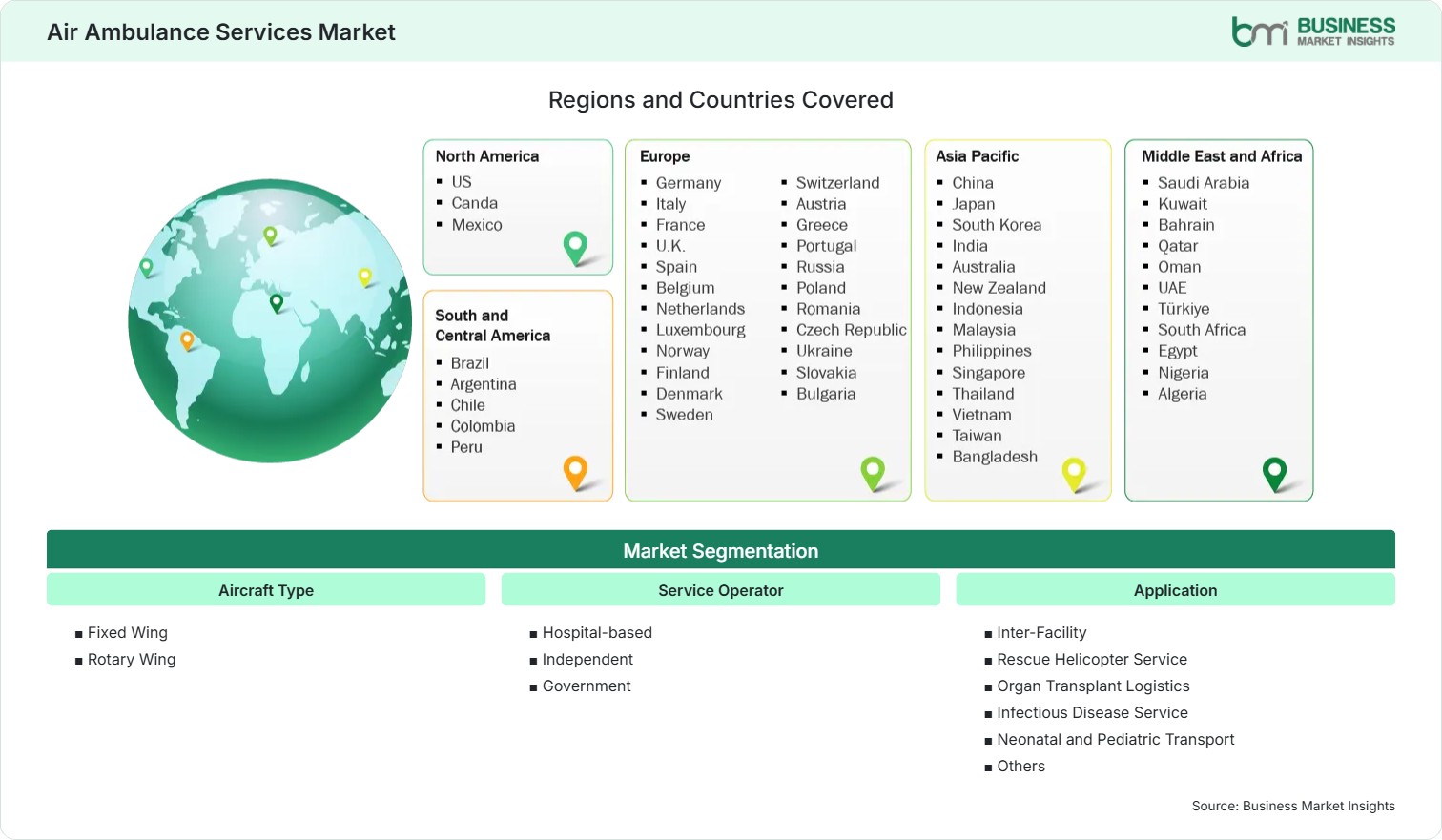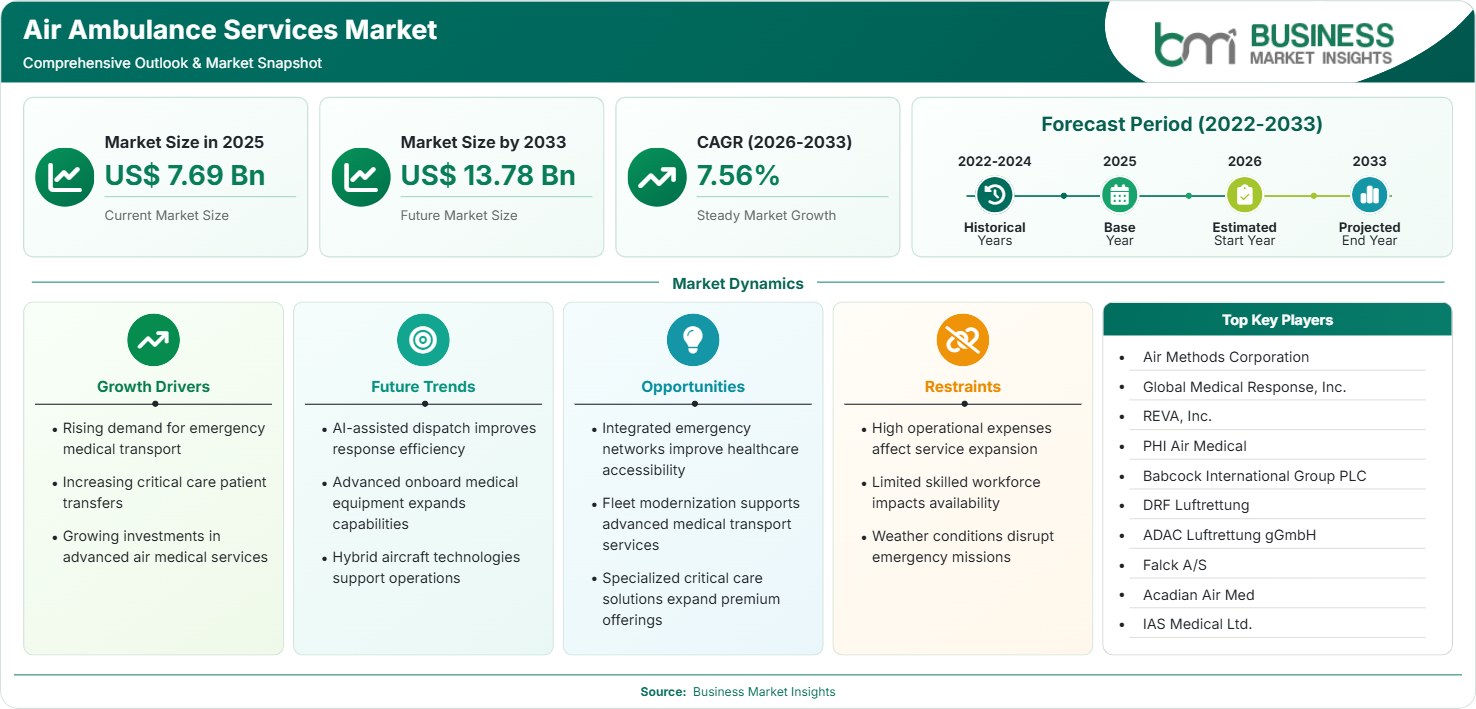
Air Ambulance Services Market Regional Highlights
North America Air Ambulance Services Market
North America accounts for 38%–41% Air Ambulance Services Market share in 2025 and is projected to register a CAGR of 7.2%–7.8% during 2026–2033. Advanced emergency medical systems, extensive aviation infrastructure, and established reimbursement mechanisms continue supporting regional expansion. Healthcare providers are investing in technologically advanced aircraft and digital dispatch systems to improve emergency response times and patient outcomes.
- Hospital systems continue integrating dedicated air medical services into regional trauma and emergency care networks to improve treatment accessibility.
- Fleet modernization programs focus on advanced navigation systems, enhanced patient monitoring equipment, and improved operational safety.
- Growing demand for inter-facility transfers supports higher utilization of both helicopter and fixed-wing medical aircraft.
- Regulatory emphasis on emergency preparedness encourages continued investment in advanced air medical transport capabilities.
US Air Ambulance Services Market
The United States contributes 82%–85% of North American revenue and is anticipated to grow at a CAGR of 7.3%–7.9% during 2026–2033. Large trauma care networks, strong emergency response infrastructure, and increasing demand for specialized patient transport continue driving investments across the sector.
- Healthcare systems continue expanding critical care transport services to improve access across rural communities.
- Fleet modernization programs emphasize patient safety, operational efficiency, and advanced onboard medical technologies.
- Organ transplant logistics remain an important application supporting premium emergency transport services.
- Digital dispatch platforms improve aircraft utilization and emergency response coordination.
Europe Air Ambulance Services Market
Europe represents 27%–30% market share in 2025 and is forecast to grow at a CAGR of 7.1%–7.6% through the forecast period. Strong public healthcare systems, mature helicopter emergency medical services, and government investment in emergency response continue driving market expansion. Germany remains the largest regional market, while Poland records the fastest growth due to expanding healthcare infrastructure.
- Government-funded emergency response programs support stable demand for air ambulance operations.
- Helicopter emergency medical services continue expanding coverage across rural and mountainous regions.
- Fleet upgrades improve operational efficiency while strengthening patient safety standards.
- Cross-border medical transport services continue supporting regional healthcare cooperation.
Asia Pacific Air Ambulance Services Market
Asia Pacific accounts for 24%–27% market share in 2025 and is expected to record the fastest CAGR of 8.3%–8.9% during 2026–2033. Rising healthcare expenditure, expanding hospital infrastructure, and greater government investment in emergency medical systems continue supporting rapid market development across the region.
- Expanding urban populations increase demand for rapid emergency medical transportation.
- Governments continue strengthening disaster response and emergency healthcare infrastructure.
- Private healthcare providers increasingly invest in dedicated medical aviation capabilities.
- Growing medical tourism creates additional demand for specialized patient transport services.
Rest of World Air Ambulance Services Market
The Rest of World region represents 6%–8% market share in 2025 and is projected to expand at a CAGR of 7.4%–8.0% during 2026–2033. Healthcare modernization, improving aviation infrastructure, and increasing government investment continue supporting market development across Latin America, the Middle East, and Africa.
- Brazil remains the leading Latin American market through expanding emergency healthcare services.
- Gulf countries continue investing in advanced medical evacuation and critical care aviation capabilities.
- Public-private partnerships strengthen emergency medical transportation across developing healthcare systems.
- Increasing disaster preparedness initiatives encourage expansion of specialized air medical fleets.