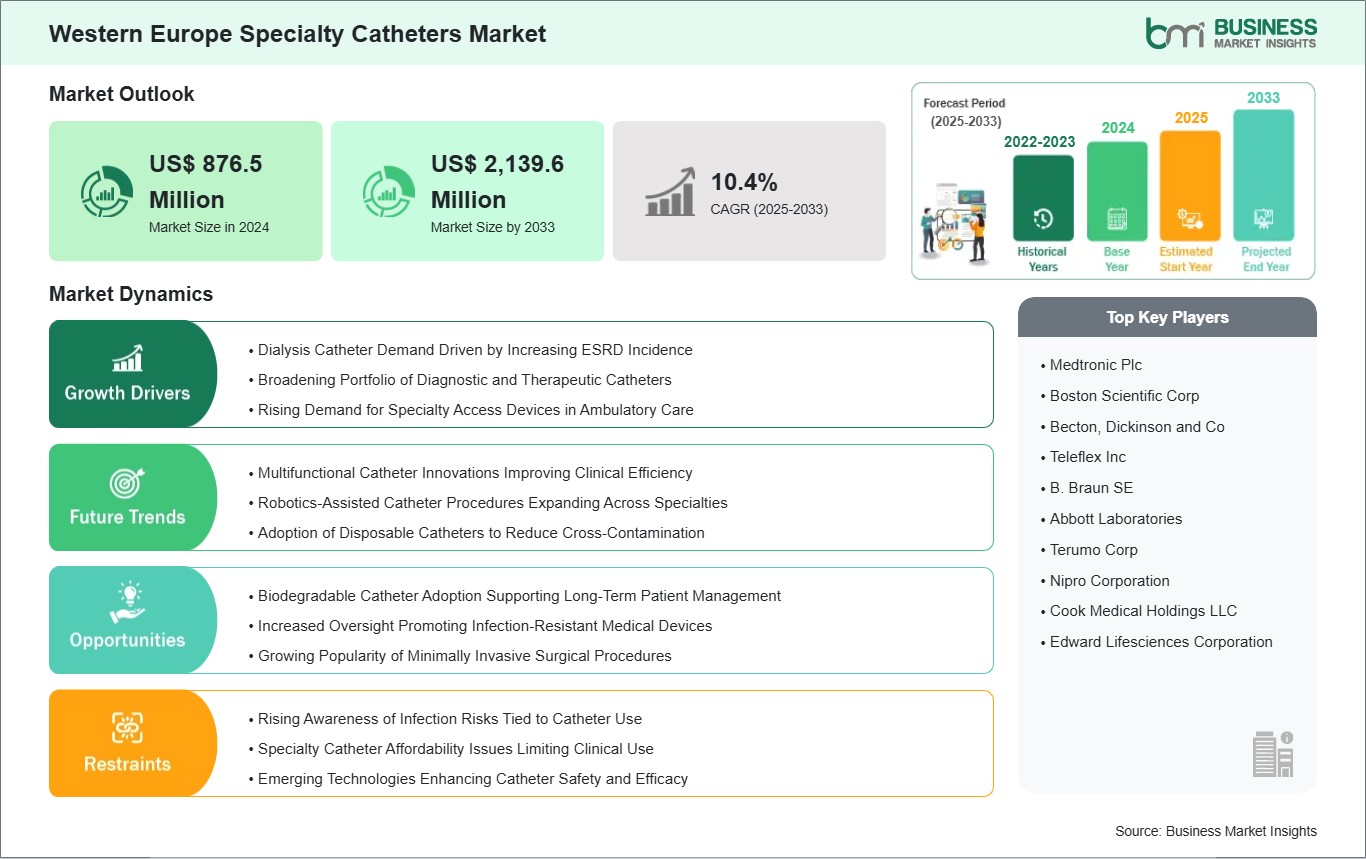
The Western Europe Specialty Catheters market size is expected to reach US$ 2,139.6 million by 2033 from US$ 876.5 million in 2024. The market is estimated to register a CAGR of 10.4 % from 2025 to 2033.
The specialty catheters market in Western Europe is experiencing significant growth driven by the high demand for dialysis catheters used by patients with end-stage renal disease (ESRD), a mature healthcare ecosystem, advanced clinical practices, and strong regulatory oversight. The region's hospitals and clinics are early adopters of innovative catheter technologies, particularly in cardiology, oncology, and nephrology, where minimally invasive procedures are preferred. Specialty catheters such as temperature and pressure monitoring devices, multi-lumen variants, and coated catheters are widely deployed to enhance patient safety and procedural efficiency. Stringent infection control standards and patient safety regulations have accelerated demand for coated catheters, while the prevalence of chronic diseases has driven adoption of multi-lumen devices for complex therapies. The competitive landscape is characterized by multinational MedTech companies with established distribution networks, complemented by regional players offering cost-effective solutions tailored to local needs. Research collaborations between academic institutions and manufacturers are a hallmark of the market, fostering innovation and clinical validation. Additionally, procurement models emphasize evidence-based outcomes, with hospitals prioritizing devices that demonstrate measurable improvements in patient recovery and reduced complications. The market is influenced by sustainability initiatives, as healthcare providers seek products that align with environmental goals, such as recyclable materials and reduced single-use plastics.

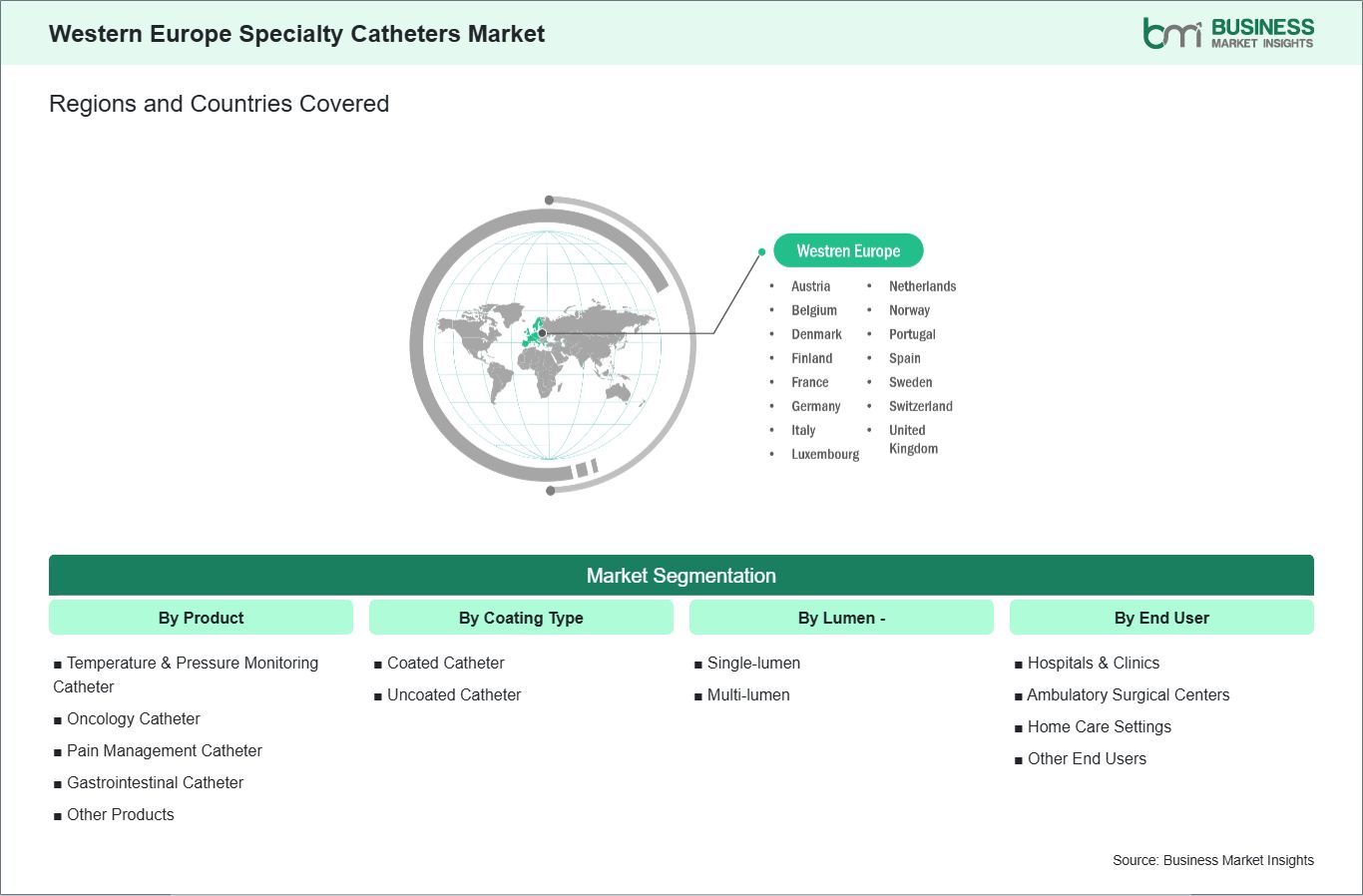
Key segments that contributed to the derivation of the Western Europe Specialty Catheters market analysis are product, coating type, lumen, and end user.
Diagnostic catheters, including coronary angiography catheters, electrophysiology mapping catheters, and neurovascular diagnostic catheters, are used to detect and monitor cardiovascular, neurovascular, and urological disorders. With a growing prevalence of cardiovascular diseases, stroke, and chronic kidney disorders, healthcare providers are investing in advanced diagnostic tools to enable early detection and timely intervention, driving demand for high-precision catheters.
Therapeutic catheters, such as angioplasty balloons, drug-eluting catheters, and ablation catheters, are being utilized in minimally invasive procedures that reduce hospital stays and improve patient outcomes. Countries such as Germany, France, the UK, Italy, and Spain have well-established healthcare infrastructures, including cardiac catheterization labs, interventional radiology centers, and tertiary care hospitals, which support widespread adoption of these procedures. Training programs for interventional cardiologists, radiologists, and urologists enhance procedural volumes, strengthening catheter demand.
Technological advancements, including catheters with improved flexibility, steerability, and imaging compatibility, enable clinicians to perform complex diagnostic and therapeutic interventions safely and efficiently. Combined with high patient awareness, robust insurance coverage, and strong public and private healthcare investments, diagnostic and therapeutic catheters are becoming a core component of modern interventional care in Western Europe, driving market growth.
Patients with conditions such as urinary retention, chronic kidney disease, or long-term vascular access needs often require catheters for extended periods, which can be associated with risks such as infection, encrustation, and biofilm formation. Biodegradable catheters, designed to safely degrade within the body or after removal, reduce the need for repeated catheter replacements, minimizing procedural risks and healthcare costs.
Antimicrobial-coated catheters, commonly treated with silver ions, antibiotic coatings, or advanced polymer technologies, have proven effective in preventing catheter-associated infections (CAIs), which remain a significant concern in hospitals and long-term care facilities across Western Europe. Adoption is pronounced in urban tertiary hospitals, specialized renal and urology centers, and advanced chronic care facilities where long-term catheter use is prevalent.
Growing awareness among clinicians about the clinical and economic benefits of these catheters is accelerating their integration into treatment protocols. Support from national healthcare systems, private hospital networks, and partnerships with international medical device companies is driving adoption. As the prevalence of chronic diseases continues to rise and patient safety becomes an increasing priority in Western Europe, biodegradable and antimicrobial catheters are expected to see steady uptake, representing a public health advancement and a significant opportunity for specialty catheter manufacturers.

The Western Europe specialty catheters market demonstrates steady growth, with size and share analysis highlighting evolving trends and competitive dynamics among key players. The report further examines subsegments categorized within product, coating type, lumen, and end user, offering insights into their contribution to overall market performance.
By product, the temperature and pressure monitoring catheters subsegment dominated the market in 2024, driven by advanced critical care practices and widespread adoption in cardiovascular monitoring.
Based on coating type, the coated catheters subsegment dominated the market in 2024, driven by stringent infection control standards and emphasis on patient safety across healthcare systems.
Based on lumen, the multi-lumen subsegment dominated the market in 2024, driven by demand for multifunctional devices supporting complex therapies in oncology and intensive care.
By end user, the hospitals and clinics subsegment dominated the market in 2024, driven by the concentration of specialized treatment centers and high procedural volumes in the region.
| Report Attribute | Details |
|---|---|
| Market size in 2024 | US$ 876.5 Million |
| Market Size by 2033 | US$ 2,139.6 Million |
| CAGR (2025 - 2033) | 10.4% |
| Historical Data | 2022-2023 |
| Forecast period | 2025-2033 |
| Segments Covered | By Product
|
| Regions and Countries Covered | Western Europe
|
| Market leaders and key company profiles |
|
The "Western Europe Specialty Catheters Market Size and Forecast (2025-2033)" report provides a detailed analysis of the market covering below areas:
The geographical scope of the Western Europe Specialty Catheters market report is divided into: Belgium, the Netherlands, Luxembourg, Germany, France, Italy, Spain, Switzerland, Sweden, Austria, the United Kingdom, Denmark, Portugal, Norway, and Finland. Germany held the largest share in 2024.
Country-level dynamics across Western Europe reveal diverse drivers shaping adoption. Germany, with its advanced healthcare infrastructure and strong reimbursement framework, is a leading adopter of specialty catheters, particularly in cardiology and oncology. France emphasizes infection control, with coated catheters gaining traction due to government-led initiatives to reduce hospital-acquired infections. The UK is influenced by its focus on digital health integration, with catheter systems linked to national electronic health record platforms. Italy demonstrates strong demand for multi-lumen catheters in oncology and dialysis, while Spain is expanding access to minimally invasive procedures across public and private sectors. Smaller markets such as Belgium, the Netherlands, and Switzerland are leveraging their strong research ecosystems to pilot innovative catheter technologies, often in collaboration with multinational firms. These country-specific insights highlight the importance of tailoring strategies to local healthcare priorities. In Germany, partnerships with large hospital networks are essential. In France, demonstrating infection control outcomes is critical. In the UK, digital compatibility drives adoption. In Italy, oncology-focused solutions are key. These variations underscore that success in Western Europe requires a nuanced approach balancing innovation, affordability, and alignment with national healthcare agendas.

The Western Europe Specialty Catheters market is evaluated by gathering qualitative and quantitative data post primary and secondary research, which includes important corporate publications, association data, and databases. A few of the key developments in the Western Europe specialty catheters market are:
The Western Europe Specialty Catheters Market is valued at US$ 876.5 Million in 2024, it is projected to reach US$ 2,139.6 Million by 2033.
As per our report Western Europe Specialty Catheters Market, the market size is valued at US$ 876.5 Million in 2024, projecting it to reach US$ 2,139.6 Million by 2033. This translates to a CAGR of approximately 10.4% during the forecast period.
The Western Europe Specialty Catheters Market report typically cover these key segments-
The historic period, base year, and forecast period can vary slightly depending on the specific market research report. However, for the Western Europe Specialty Catheters Market report:
The Western Europe Specialty Catheters Market is populated by several key players, each contributing to its growth and innovation. Some of the major players include:
The Western Europe Specialty Catheters Market report is valuable for diverse stakeholders, including:
Essentially, anyone involved in or considering involvement in the Western Europe Specialty Catheters Market value chain can benefit from the information contained in a comprehensive market report.
Please tell us your area of interest
(Market Segments/ Regions and Countries/ Companies)