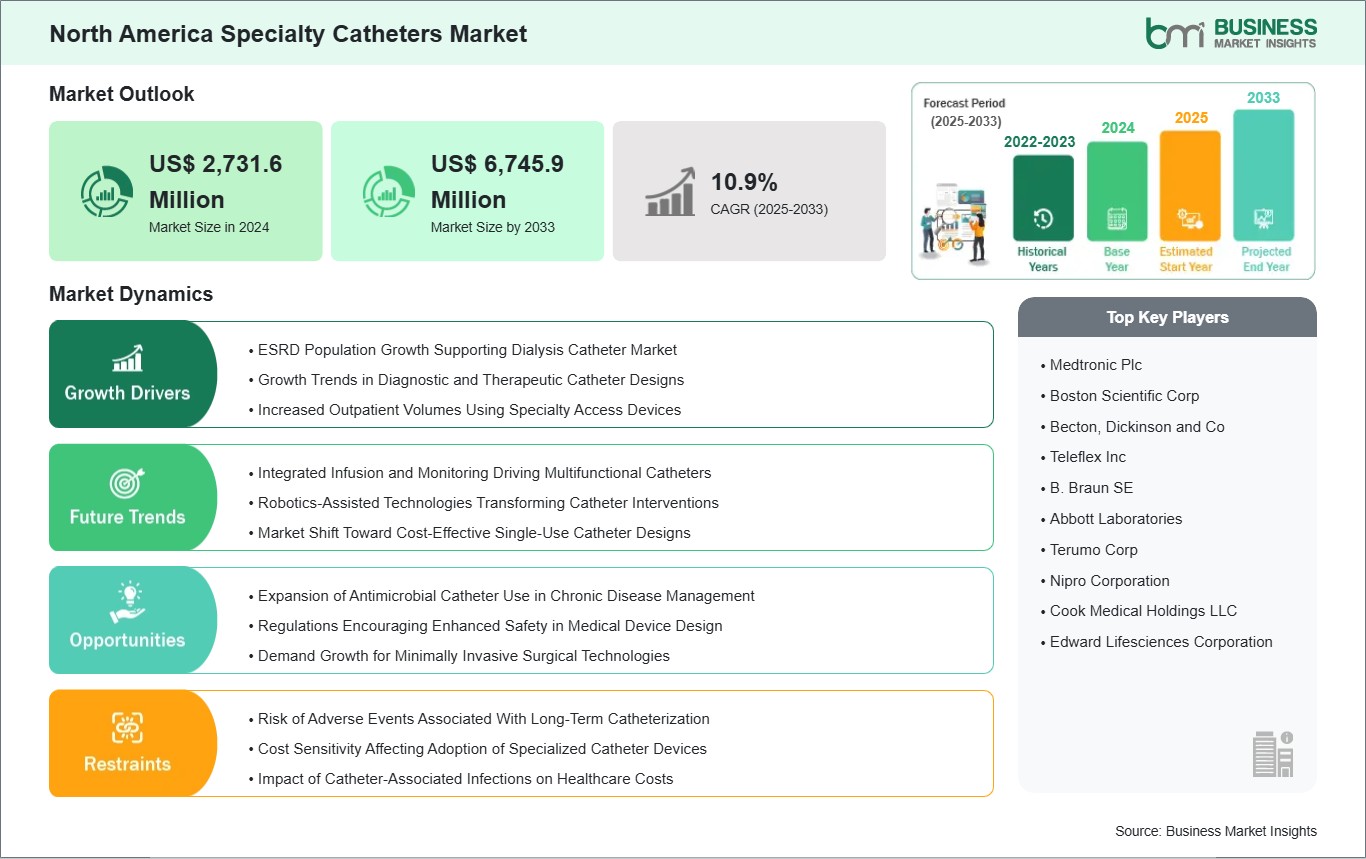
The North America Specialty Catheters market size is expected to reach US$ 6,745.9 million by 2033 from US$ 2,731.6 million in 2024. The market is estimated to register a CAGR of 10.9% from 2025 to 2033.
The specialty catheters market in North America is experiencing significant growth driven by the high demand for dialysis catheters used by patients with end-stage renal disease (ESRD), high clinical sophistication, strong regulatory oversight, and consistent integration of advanced medical technologies into routine care. Specialty catheters are embedded in procedural protocols across cardiology, critical care, neurology, and oncology, reflecting the region's emphasis on precision-driven and minimally invasive interventions. Healthcare providers prioritize device reliability, procedural accuracy, and patient safety, making specialty catheters a critical component of care delivery in acute and chronic treatment settings. From a market analysis standpoint, procurement decisions are influenced by clinical evidence, product standardization, and alignment with hospital accreditation requirements. Large hospital systems and integrated delivery networks play a central role in shaping demand patterns, leveraging long-term vendor contracts and group purchasing organizations. Regulatory compliance with agencies such as the FDA drives continuous product evaluation, resulting in shorter product life cycles and sustained innovation. Competitive intensity remains high, with manufacturers differentiating through material science, catheter design optimization, and advanced coating technologies. Training, technical support, and post-market surveillance are important in strengthening supplier relationships. Supply chains in North America are highly structured, enabling consistent product availability and rapid adoption of newly approved devices. The market reflects maturity and operational discipline, supported by a strong focus on quality assurance, procedural efficiency, and long-term clinical value rather than cost-driven adoption.

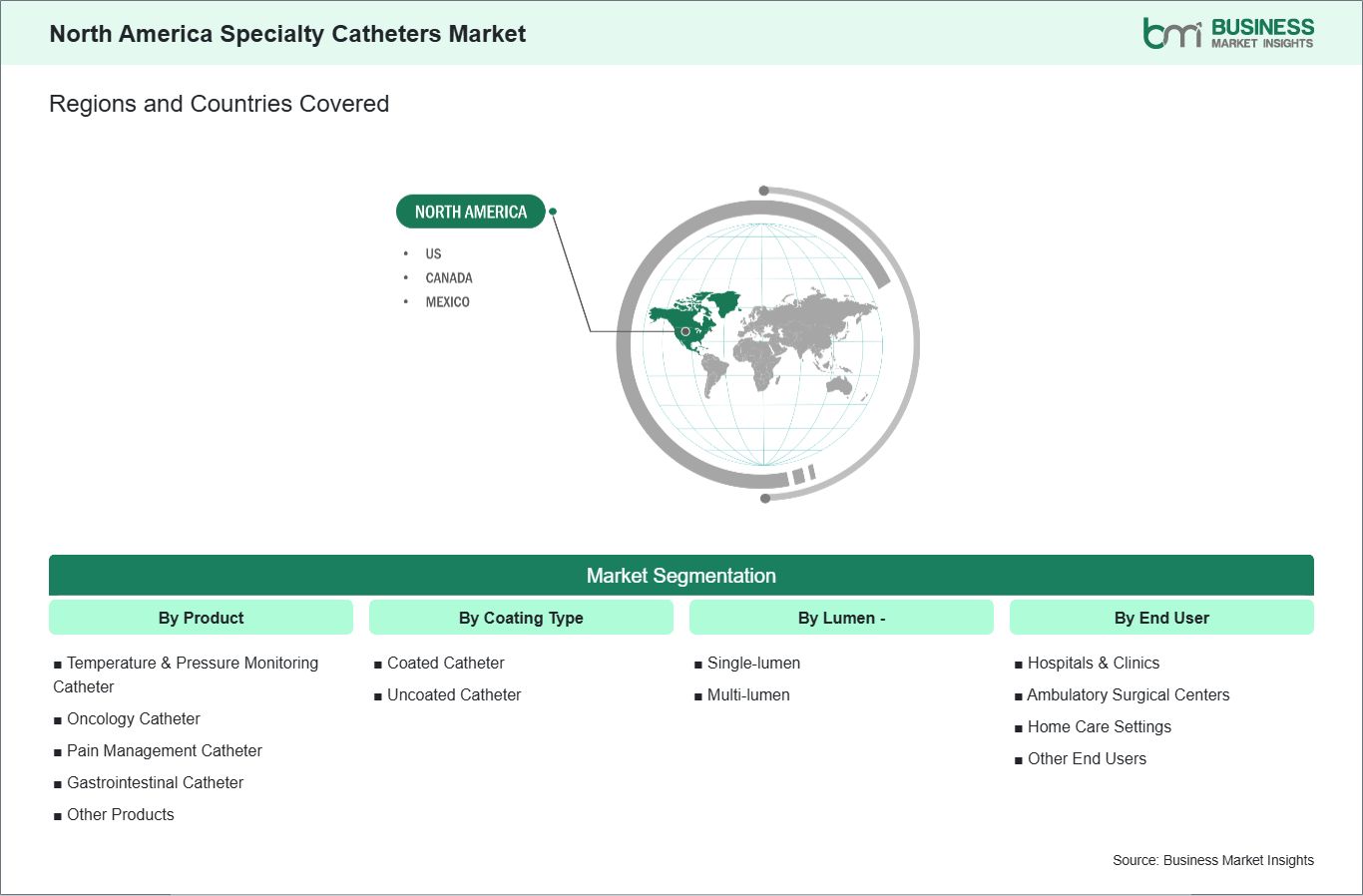
Key segments that contributed to the derivation of the North America Specialty Catheters market analysis are product, coating type, lumen, and end user.
Diagnostic catheters, including coronary angiography, electrophysiology mapping, and neurovascular diagnostic catheters, are used to detect and monitor cardiovascular, neurovascular, and urological conditions. High prevalence of cardiovascular diseases, stroke, and chronic kidney disorders drives demand for advanced diagnostic tools, enabling early detection and timely intervention.
Therapeutic catheters, such as angioplasty balloons, drug-eluting catheters, and ablation catheters, are employed in minimally invasive procedures that reduce hospital stays and improve patient outcomes. North America's well-established healthcare infrastructure, including extensive cardiac catheterization labs, interventional radiology centers, and tertiary care hospitals, supports high procedural volumes and facilitates the adoption of advanced catheter technologies.
Technological innovations, such as improved flexibility, steerability, biocompatibility, and imaging compatibility, allow clinicians to perform complex interventions safely and efficiently. Additionally, strong clinician training programs, rapid product innovation, and a robust medical device industry contribute to market growth.
Favorable reimbursement policies, high patient awareness, and significant private healthcare investment support catheter adoption. As the population ages and chronic disease prevalence rises, demand for diagnostic and therapeutic catheters is expected to continue growing. North America represents a mature but steadily expanding market, offering opportunities for manufacturers and healthcare providers in advanced interventional care.
Patients with conditions such as urinary retention, chronic kidney disease, or long-term vascular access requirements need catheters for extended periods, which can pose risks such as infection, encrustation, and biofilm formation. Biodegradable catheters, designed to safely degrade in the body or after removal, reduce the need for repeated catheter replacements, lowering procedural risks and healthcare costs.
Antimicrobial-coated catheters, frequently treated with silver ions, antibiotic coatings, or advanced polymer technologies, are effective in preventing catheter-associated infections (CAIs), a critical concern in hospitals and long-term care facilities across North America. With stringent infection-control standards and regulatory oversight, these catheters enhance patient safety while supporting hospital efficiency. Adoption is strong in tertiary care hospitals, dialysis centers, and specialized urology clinics, where chronic catheter use is prevalent.
Growing clinical awareness of the benefits—in patient outcomes and cost savings—is accelerating their integration into treatment protocols. Support from private hospital networks, insurance reimbursement frameworks, and clinical guidelines also encourages broader uptake. As the prevalence of chronic diseases and aging populations rises, North America is witnessing the steady adoption of biodegradable and antimicrobial catheters, representing an innovation in patient safety and a significant opportunity for specialty catheter manufacturers.

The North America specialty catheters market demonstrates steady growth, with size and share analysis highlighting evolving trends and competitive dynamics among key players. The report further examines subsegments categorized within product, coating type, lumen, and end user, offering insights into their contribution to overall market performance.
By product, the temperature and pressure monitoring catheters subsegment dominated the market in 2024, driven by high procedure volumes and strong adoption of advanced hemodynamic monitoring across critical care and interventional settings in North America.
Based on coating type, the coated catheters subsegment dominated the market in 2024, driven by stringent infection control standards and widespread use of antimicrobial and hydrophilic coatings to reduce hospital-acquired complications.
Based on lumen, the multi-lumen subsegment dominated the market in 2024, driven by the need for simultaneous administration of multiple therapies in complex and high-acuity patient management.
By end user, the hospitals and clinics subsegment dominated the market in 2024, driven by well-established healthcare infrastructure, availability of specialized clinicians, and high utilization of specialty catheter-based procedures across North America.
| Report Attribute | Details |
|---|---|
| Market size in 2024 | US$ 2,731.6 Million |
| Market Size by 2033 | US$ 6,745.9 Million |
| CAGR (2025 - 2033) | 10.9% |
| Historical Data | 2022-2023 |
| Forecast period | 2025-2033 |
| Segments Covered | By Product
|
| Regions and Countries Covered | North America
|
| Market leaders and key company profiles |
|
The "North America Specialty Catheters Market Size and Forecast (2025-2033)" report provides a detailed analysis of the market covering below areas:
The geographical scope of the North America Specialty Catheters market report is divided into: United States, Canada, and Mexico. The United States held the largest share in 2024.
Country-level performance within the North America specialty catheters market is driven by healthcare system structure, policy environment, and institutional adoption patterns. The US represents the most advanced landscape, supported by extensive hospital networks, high procedural volumes, and early adoption of next-generation catheter technologies. Strong investment in research, clinical trials, and physician training accelerates the introduction of specialty catheters into clinical practice. Canada demonstrates a more centralized procurement approach, with public healthcare systems emphasizing cost-effectiveness, long-term performance, and standardized device utilization. Adoption in Canada is influenced by provincial healthcare policies and emphasis on equitable access, leading to steady but measured integration of specialty catheter technologies. Mexico is emerging as an important contributor in North America, supported by expanding private healthcare infrastructure and increasing demand for advanced medical procedures in urban centers. Growth is reinforced by cross-border healthcare collaboration and rising investment in specialty care facilities. Across the region, country-specific regulatory pathways, reimbursement frameworks, and clinical practice standards shape adoption trends. Manufacturers operating in North America must tailor strategies at the national level, balancing innovation with compliance and system-specific requirements to achieve sustained engagement.

The North America Specialty Catheters market is evaluated by gathering qualitative and quantitative data post primary and secondary research, which includes important corporate publications, association data, and databases. A few of the key developments in the North America specialty catheters market are:
The North America Specialty Catheters Market is valued at US$ 2,731.6 Million in 2024, it is projected to reach US$ 6,745.9 Million by 2033.
As per our report North America Specialty Catheters Market, the market size is valued at US$ 2,731.6 Million in 2024, projecting it to reach US$ 6,745.9 Million by 2033. This translates to a CAGR of approximately 10.9% during the forecast period.
The North America Specialty Catheters Market report typically cover these key segments-
The historic period, base year, and forecast period can vary slightly depending on the specific market research report. However, for the North America Specialty Catheters Market report:
The North America Specialty Catheters Market is populated by several key players, each contributing to its growth and innovation. Some of the major players include:
The North America Specialty Catheters Market report is valuable for diverse stakeholders, including:
Essentially, anyone involved in or considering involvement in the North America Specialty Catheters Market value chain can benefit from the information contained in a comprehensive market report.
Please tell us your area of interest
(Market Segments/ Regions and Countries/ Companies)