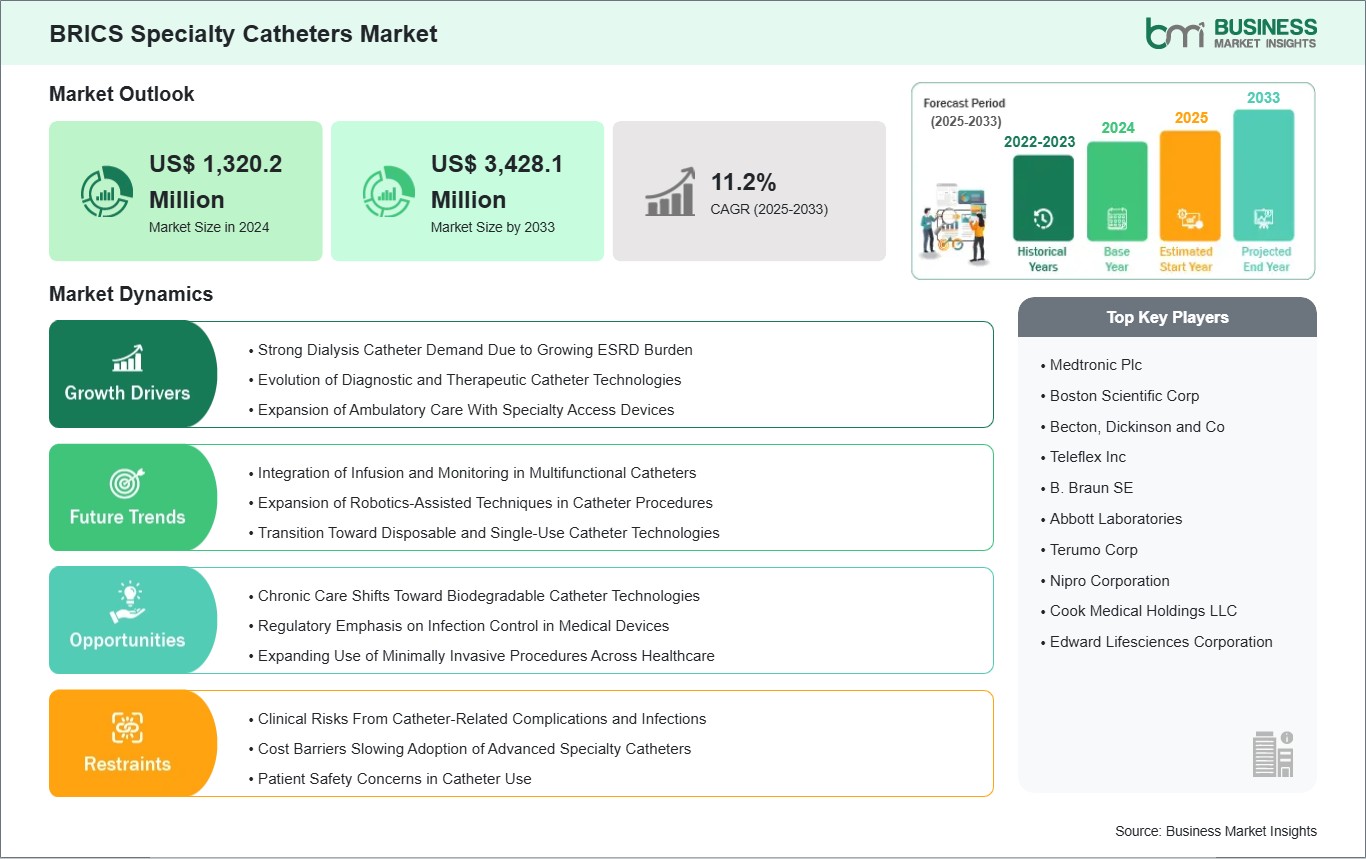
The BRICS Specialty Catheters market size is expected to reach US$ 3,428.1 million by 2033 from US$ 1,320.2 million in 2024. The market is estimated to register a CAGR of 11.2% from 2025 to 2033.
The specialty catheters market in BRICS is experiencing significant growth driven by the high demand for dialysis catheters used by patients with end-stage renal disease (ESRD). The region is characterized by heightened clinical demand across critical care and interventional segments, underpinned by evolving hospital protocols and expanding procedural portfolios. In recent years, healthcare providers across Brazil, Russia, India, China, and South Africa have integrated advanced catheter technologies to support diagnostic precision, therapeutic efficacy, and procedural safety. This trend is driven by a confluence of demographic shifts—such as aging populations and increased prevalence of chronic conditions requiring vascular access—and systemic upgrades in health infrastructure. Unlike commodity catheter products, specialty catheters are differentiated by design complexity, performance attributes, and application specificity, enabling healthcare professionals to address nuanced clinical challenges across cardiology, oncology, nephrology, and intensive care units. From an analytical standpoint, adoption patterns reveal that technologically enhanced products, such as those with antimicrobial coatings and multi‑function lumens, are achieving preference over legacy designs due to their contribution to reduced complication rates and improved workflow efficiencies.
Competitive dynamics in the market are evolving, with multinational medical device companies deepening regional footprints through channel partnerships, localized service delivery, and targeted educational initiatives. Regulatory environments across BRICS nations vary, but harmonization efforts around quality standards and device approvals have resulted in shorter time‑to‑market for compliant innovations. Procurement strategies within private hospital networks emphasize value‑based outcomes, fostering procurement preferences for premium products that demonstrate measurable impact on clinical pathways. As a result, the analytical landscape highlights the strategic importance of specialty catheters in modern care delivery and the operational imperatives providers face in balancing cost efficiency with clinical performance.

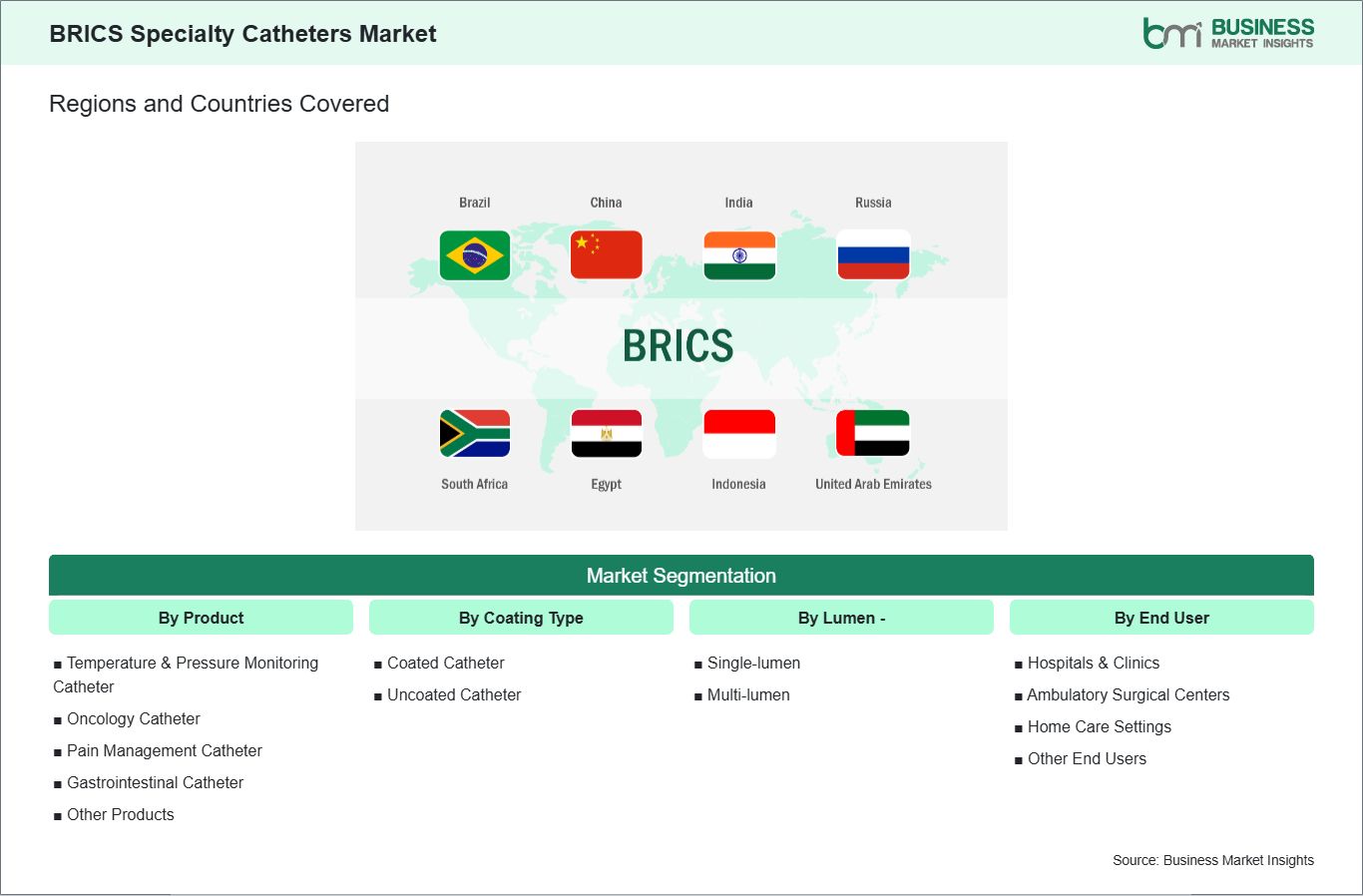
Key segments that contributed to the derivation of the BRICS Specialty Catheters market analysis are product, coating type, lumen, and end user.
Diagnostic catheters, including coronary angiography catheters, electrophysiology mapping catheters, and neurovascular diagnostic catheters, are widely used to detect and monitor cardiovascular, neurovascular, and urological disorders, which are prevalent across BRICS nations due to rising lifestyle-related diseases and aging populations. Healthcare providers are investing in advanced diagnostic tools, enabling early detection and timely intervention, which drives demand for high-precision catheters in these emerging markets.
Therapeutic catheters, such as angioplasty balloons, drug-eluting catheters, ablation catheters, and structural heart catheters, are being employed in minimally invasive procedures that reduce hospital stays, lower procedural risks, and improve patient outcomes. BRICS countries are seeing expansion of cardiac catheterization labs, interventional radiology centers, and tertiary care hospitals, especially in Brazil, China, India, and South Africa, providing the infrastructure necessary for catheter-based interventions. Training programs for interventional cardiologists, radiologists, and urologists are enhancing procedural volumes, supporting catheter demand.
Technological advancements, including catheters with improved flexibility, steerability, imaging compatibility, and drug-delivery capabilities, allow clinicians to perform complex diagnostic and therapeutic interventions safely. Combined with increasing patient awareness, expanding insurance coverage, and private healthcare investments, diagnostic and therapeutic catheters are becoming central to interventional care in BRICS nations, driving market growth.
Patients with conditions such as urinary retention, chronic kidney disease, or long-term vascular access requirements often need catheters for extended periods, which carry risks such as infection, encrustation, and biofilm formation. Biodegradable catheters, which naturally degrade within the body or after removal, reduce the need for repeated replacements, minimizing procedural risks and lowering healthcare costs.
Antimicrobial-coated catheters, treated with silver ions, antibiotics, or hydrophilic coatings, have proven effective in preventing catheter-associated infections (CAIs) — a concern even in tertiary hospitals across BRICS countries. Adoption is pronounced in urban teaching hospitals, specialized renal centers, and urology clinics, where long-term catheter use is common.
Increasing awareness among clinicians about the clinical and economic benefits of these catheters is accelerating their integration into treatment protocols. Governments and private hospital networks are supporting the use of advanced catheters through procurement programs, clinical guidelines, and partnerships with international medical device companies. With the prevalence of chronic diseases rising and patient safety gaining higher priority, biodegradable and antimicrobial catheters are expected to see steady adoption across BRICS nations, representing a public health advancement and a significant opportunity for specialty catheter manufacturers.

The BRICS specialty catheters market demonstrates steady growth, with size and share analysis highlighting evolving trends and competitive dynamics among key players. The report further examines subsegments categorized within product, coating type, lumen, and end user, offering insights into their contribution to overall market performance.
By product, the temperature and pressure monitoring catheters subsegment dominated the market in 2024, driven by growing demand for accurate and continuous hemodynamic monitoring in critical care and complex surgical procedures.
Based on coating type, the coated catheters subsegment dominated the market in 2024, driven by increasing focus on reducing infection risks and improving biocompatibility and patient safety.
Based on lumen, the multi-lumen subsegment dominated the market in 2024, driven by the need for multitasking during interventions, enabling simultaneous infusion, monitoring, and therapy through a single access.
By end user, the hospitals and clinics subsegment dominated the market in 2024, driven by higher procedure volumes and the availability of advanced care infrastructure that requires extensive use of specialty catheters.
| Report Attribute | Details |
|---|---|
| Market size in 2024 | US$ 1,320.2 Million |
| Market Size by 2033 | US$ 3,428.1 Million |
| CAGR (2025 - 2033) | 11.2% |
| Historical Data | 2022-2023 |
| Forecast period | 2025-2033 |
| Segments Covered | By Product
|
| Regions and Countries Covered | BRICS
|
| Market leaders and key company profiles |
|
The "BRICS Specialty Catheters Market Size and Forecast (2025–2033)" report provides a detailed analysis of the market covering below areas:
The geographical scope of the BRICS Specialty Catheters market report is divided into: Russia, Brazil, South Africa, India, the UAE, and China. China held the largest share in 2024.
Within the BRICS cohort, each country presents a unique operational and strategic context that influences specialty catheter utilization and demand archetypes. China stands out for its scale and rapid integration of digitally enabled catheter technologies, supported by domestic manufacturing acceleration and policy incentives for innovation. Hospitals in China are leveraging advanced catheter platforms in cardiology and oncology, where procedure volumes have grown substantially. Brazil has seen increasing integration of advanced catheterization suites within private and public hospitals, driven by competitive pressures among premier healthcare providers to deliver differentiated cardiac and interventional services. Clinician networks in Brazil are notable for early adoption of next‑generation coated and multi‑lumen catheters, reflecting a strong procedural confidence and rigorous clinical evaluation culture.
In Russia, demand is concentrated in urban tertiary facilities where governmental reforms have prioritized modernization of diagnostic and critical care units; this has catalyzed procurement of specialty catheters aligned with standardized clinical pathways. India's landscape is marked by a dual demand stream: high‑end private care facilities adopting cutting‑edge solutions and a growing base of mid‑tier hospitals upgrading from basic catheter systems to reduce infection rates and improve clinical throughput. India's robust medical education ecosystem plays a role in shaping adoption curves. South Africa exhibits a demand profile influenced by public‑private healthcare dynamics and a strong emphasis on addressing infectious disease comorbidities through specialty catheter solutions that reduce hospital stay durations and complication margins. Across these nations, regulatory nuances, clinician training paradigms, and procurement strategies vary, but all reflect an overarching commitment to improving care standards through targeted adoption of specialty catheter technologies.

The Benelux Specialty Catheters market is evaluated by gathering qualitative and quantitative data post primary and secondary research, which includes important corporate publications, association data, and databases. A few of the key developments in the Benelux specialty catheters market are:
The BRICS Specialty Catheters Market is valued at US$ 1,320.2 Million in 2024, it is projected to reach US$ 3,428.1 Million by 2033.
As per our report BRICS Specialty Catheters Market, the market size is valued at US$ 1,320.2 Million in 2024, projecting it to reach US$ 3,428.1 Million by 2033. This translates to a CAGR of approximately 11.2% during the forecast period.
The BRICS Specialty Catheters Market report typically cover these key segments-
The historic period, base year, and forecast period can vary slightly depending on the specific market research report. However, for the BRICS Specialty Catheters Market report:
The BRICS Specialty Catheters Market is populated by several key players, each contributing to its growth and innovation. Some of the major players include:
The BRICS Specialty Catheters Market report is valuable for diverse stakeholders, including:
Essentially, anyone involved in or considering involvement in the BRICS Specialty Catheters Market value chain can benefit from the information contained in a comprehensive market report.
Please tell us your area of interest
(Market Segments/ Regions and Countries/ Companies)