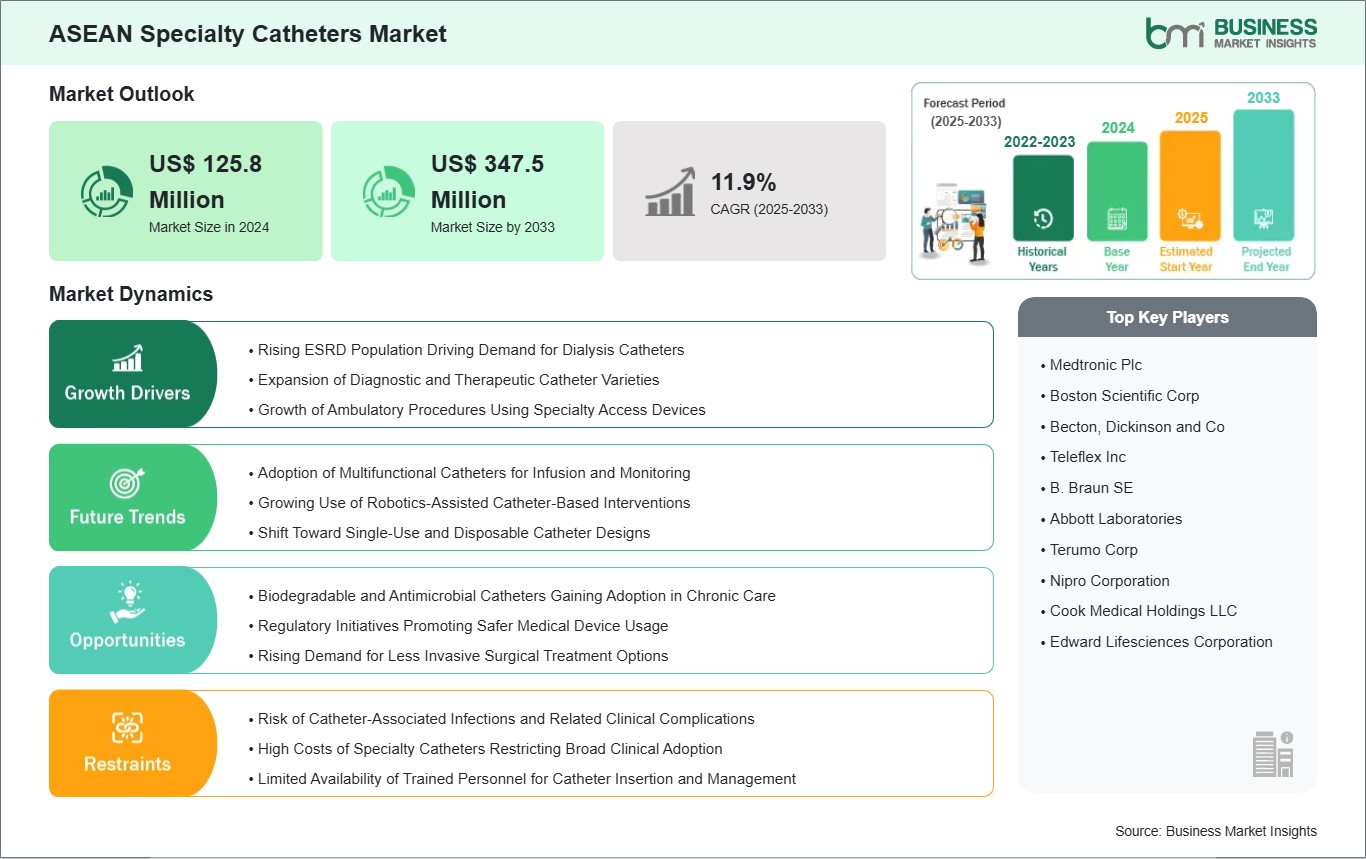
The ASEAN Specialty Catheters market size is expected to reach US$ 347.5 million by 2033 from US$ 125.8 million in 2024. The market is estimated to register a CAGR of 11.9% from 2025 to 2033.
The specialty catheters market in ASEAN is experiencing significant growth driven by the high demand for dialysis catheters used by patients with end-stage renal disease (ESRD), advancements in minimally invasive interventions, and the rising prevalence of chronic diseases such as cardiovascular, urological, and neurovascular disorders. Healthcare providers in the region are adopting specialty catheters to improve patient outcomes, reduce procedural risks, and shorten recovery times compared to conventional surgical approaches. Hospitals and clinics are integrating multi-lumen and coated catheter systems into standard care protocols to streamline procedures and minimize infection risks.
There is a growing emphasis on precision diagnostics, with temperature and pressure monitoring catheters becoming critical tools for real-time physiological assessments. Policy support in ASEAN countries has facilitated better procurement processes and accelerated the introduction of new devices, while ongoing healthcare infrastructure investments are enhancing the availability of interventional facilities in urban centers. Competitive strategies among manufacturers now focus on innovation in design, safety, and ease of use, along with clinician training programs to build familiarity with advanced catheter systems. In parallel, rising healthcare awareness among patients has increased demand for procedures that are less invasive yet effective. Overall, the market is shaped by the convergence of clinical necessity, technological innovation, and systemic support, establishing specialty catheters as a key component of modern interventional care in ASEAN.

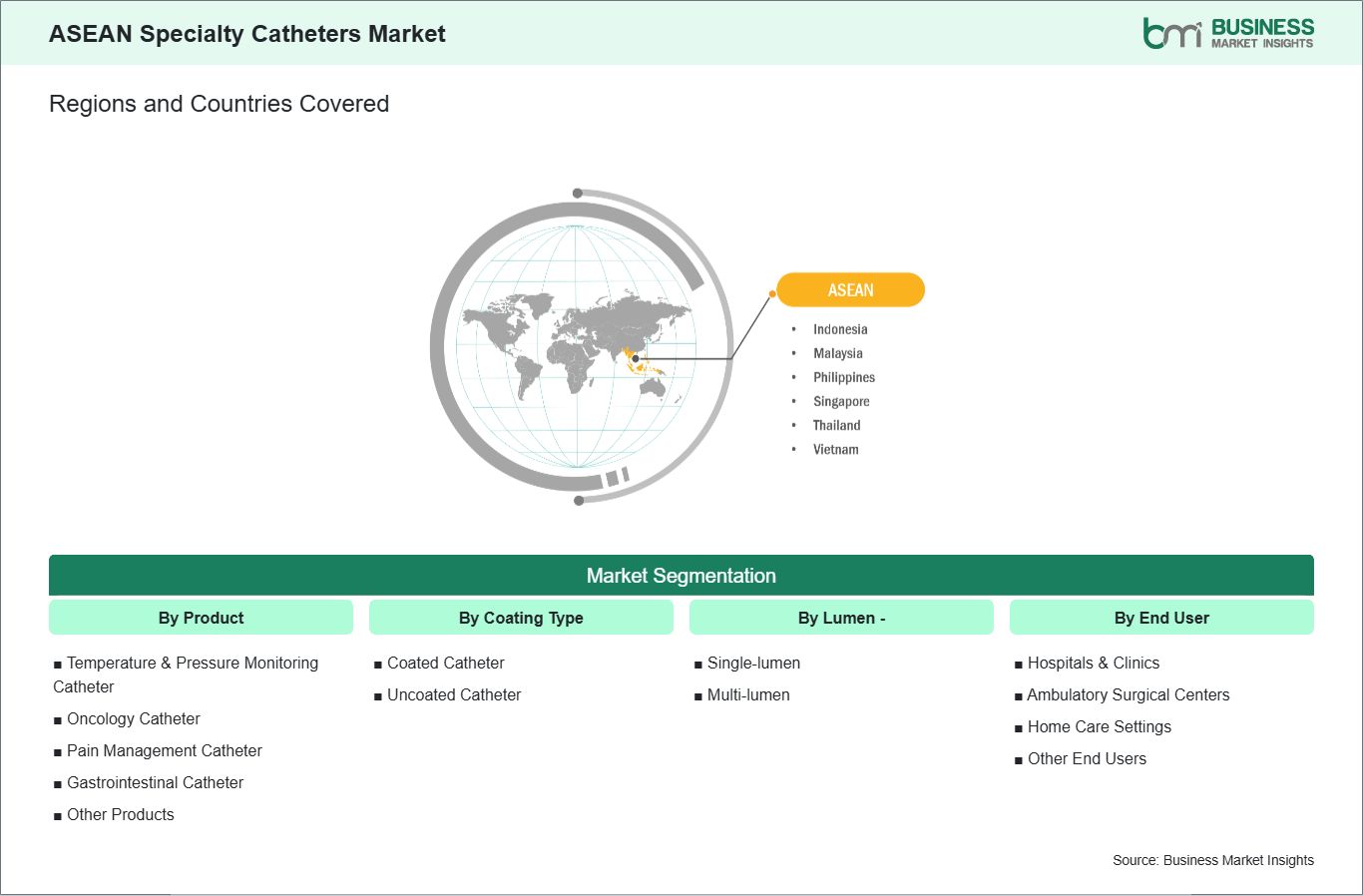
Key segments that contributed to the derivation of the ASEAN Specialty Catheters market analysis are product, coating type, lumen, and end user.
Diagnostic catheters, including coronary angiography catheters, neurovascular diagnostic catheters, and electrophysiology mapping catheters, are used for early detection and monitoring of cardiovascular diseases, stroke, and urological conditions, which are on the rise in countries such as Indonesia, Thailand, Vietnam, and the Philippines. The increasing prevalence of lifestyle-related diseases, aging populations, and the growing burden of chronic illnesses have driven healthcare providers to invest in advanced diagnostic tools, creating higher demand for precise and reliable catheters.
Therapeutic catheters, such as angioplasty balloons, drug-eluting catheters, ablation catheters, and structural heart catheters, are becoming more widely adopted in minimally invasive procedures that improve patient recovery and reduce hospital stays. ASEAN countries are witnessing the expansion of cardiac catheterization labs, interventional radiology units, and tertiary care hospitals, particularly in urban centers. In addition, physician training programs and regional healthcare initiatives are improving procedural volumes, boosting the need for diagnostic and therapeutic catheters.
Technological innovation is driving demand, with catheters offering enhanced flexibility, steerability, imaging compatibility, and drug-delivery capabilities. Combined with increasing patient awareness, rising insurance coverage, and private hospital investments, diagnostic and therapeutic catheters are becoming integral to modern interventional care in ASEAN, supporting sustained market expansion.
Patients with urinary retention, chronic kidney disease, or long-term vascular access requirements often need catheters for extended periods, which carry risks such as infection, encrustation, and biofilm formation. Biodegradable catheters, designed to degrade naturally or after removal, reduce the need for repeated replacements, minimizing procedural complications and healthcare costs.
Antimicrobial-coated catheters, treated with silver ions, antibiotic coatings, or hydrophilic surfaces, are effective in preventing catheter-associated infections (CAIs), a major concern in hospitals and chronic care centers throughout ASEAN. Countries such as Indonesia, Thailand, Vietnam, Malaysia, and the Philippines face challenges in infection control, making these catheters valuable in improving patient safety and reducing hospital burden. Adoption is strongest in urban tertiary hospitals, renal care centers, and urology specialty clinics, where long-term catheter use is common.
Awareness among clinicians regarding the clinical and economic benefits of biodegradable and antimicrobial catheters is increasing, supported by hospital procurement policies, clinical guidelines, and collaborations with international medical device manufacturers. With the rising prevalence of chronic diseases and emphasis on patient safety, these advanced catheters are expected to see steady adoption across ASEAN, offering improved health outcomes and a substantial opportunity for specialty catheter manufacturers.

The ASEAN specialty catheters market demonstrates steady growth, with size and share analysis highlighting evolving trends and competitive dynamics among key players. The report further examines subsegments categorized within product, coating type, lumen, and end user, offering insights into their contribution to overall market performance.
By product, the temperature and pressure monitoring catheters subsegment dominated the market in 2024, driven by the rising adoption of advanced monitoring tools to support real-time clinical decision-making in critical and surgical care.
Based on coating type, the coated catheters subsegment dominated the market in 2024, driven by strong demand for improved patient safety, comfort, and lower infection risk during prolonged catheterization.
Based on lumen, the multi-lumen subsegment dominated the market in 2024, driven by its ability to streamline complex procedures by enabling multiple therapies and measurements through a single access point.
By end user, the hospitals and clinics subsegment dominated the market in 2024, driven by their role as primary treatment centers for high-acuity patients requiring specialized and high-volume catheter-based interventions.
| Report Attribute | Details |
|---|---|
| Market size in 2024 | US$ 125.8 Million |
| Market Size by 2033 | US$ 347.5 Million |
| CAGR (2025 - 2033) | 11.9% |
| Historical Data | 2022-2023 |
| Forecast period | 2025-2033 |
| Segments Covered | By Product
|
| Regions and Countries Covered | ASEAN
|
| Market leaders and key company profiles |
|
The "ASEAN Specialty Catheters Market Size and Forecast (2025-–2033)" report provides a detailed analysis of the market covering below areas:
The geographical scope of the ASEAN Specialty Catheters market report is divided into: Indonesia, Malaysia, the Philippines, Singapore, Thailand, and Vietnam. Indonesia held the largest share in 2024.
Country-level dynamics reveal a diverse landscape in the ASEAN specialty catheters market. Indonesia serves as a center of innovation and early adoption, driven by sophisticated healthcare infrastructure, high procedural volumes, and a strong medical tourism ecosystem. Thailand leverages its reputation for cost-effective, high-quality care to attract international patients for interventional procedures, creating demand for premium catheter technologies.
Malaysia benefits from domestic production and strong private hospital networks, providing a reliable distribution channel for advanced catheters. Singapore's large population and expanding hospital networks present opportunities for increased penetration, particularly in urban centers where demand for minimally invasive procedures is rising. Vietnam and the Philippines are focused on expanding specialty care capacity, with private hospitals and multi-specialty clinics driving adoption of multi-lumen and coated catheters to improve procedural efficiency and safety. Across all markets, government initiatives to improve healthcare access, along with growing patient awareness, are key enablers of adoption. Manufacturers operating in the region must navigate regulatory differences, infrastructure disparities, and reimbursement frameworks while tailoring strategies to local clinical practices. This fragmented yet interconnected ecosystem underscores the need for localized market intelligence and strategic partnerships to achieve sustainable growth across ASEAN countries.

The ASEAN Specialty Catheters market is evaluated by gathering qualitative and quantitative data post primary and secondary research, which includes important corporate publications, association data, and databases. A few of the key developments in the ASEAN specialty catheters market are:
The ASEAN Specialty Catheters Market is valued at US$ 125.8 Million in 2024, it is projected to reach US$ 347.5 Million by 2033.
As per our report ASEAN Specialty Catheters Market, the market size is valued at US$ 125.8 Million in 2024, projecting it to reach US$ 347.5 Million by 2033. This translates to a CAGR of approximately 11.9% during the forecast period.
The ASEAN Specialty Catheters Market report typically cover these key segments-
The historic period, base year, and forecast period can vary slightly depending on the specific market research report. However, for the ASEAN Specialty Catheters Market report:
The ASEAN Specialty Catheters Market is populated by several key players, each contributing to its growth and innovation. Some of the major players include:
The ASEAN Specialty Catheters Market report is valuable for diverse stakeholders, including:
Essentially, anyone involved in or considering involvement in the ASEAN Specialty Catheters Market value chain can benefit from the information contained in a comprehensive market report.
Please tell us your area of interest
(Market Segments/ Regions and Countries/ Companies)