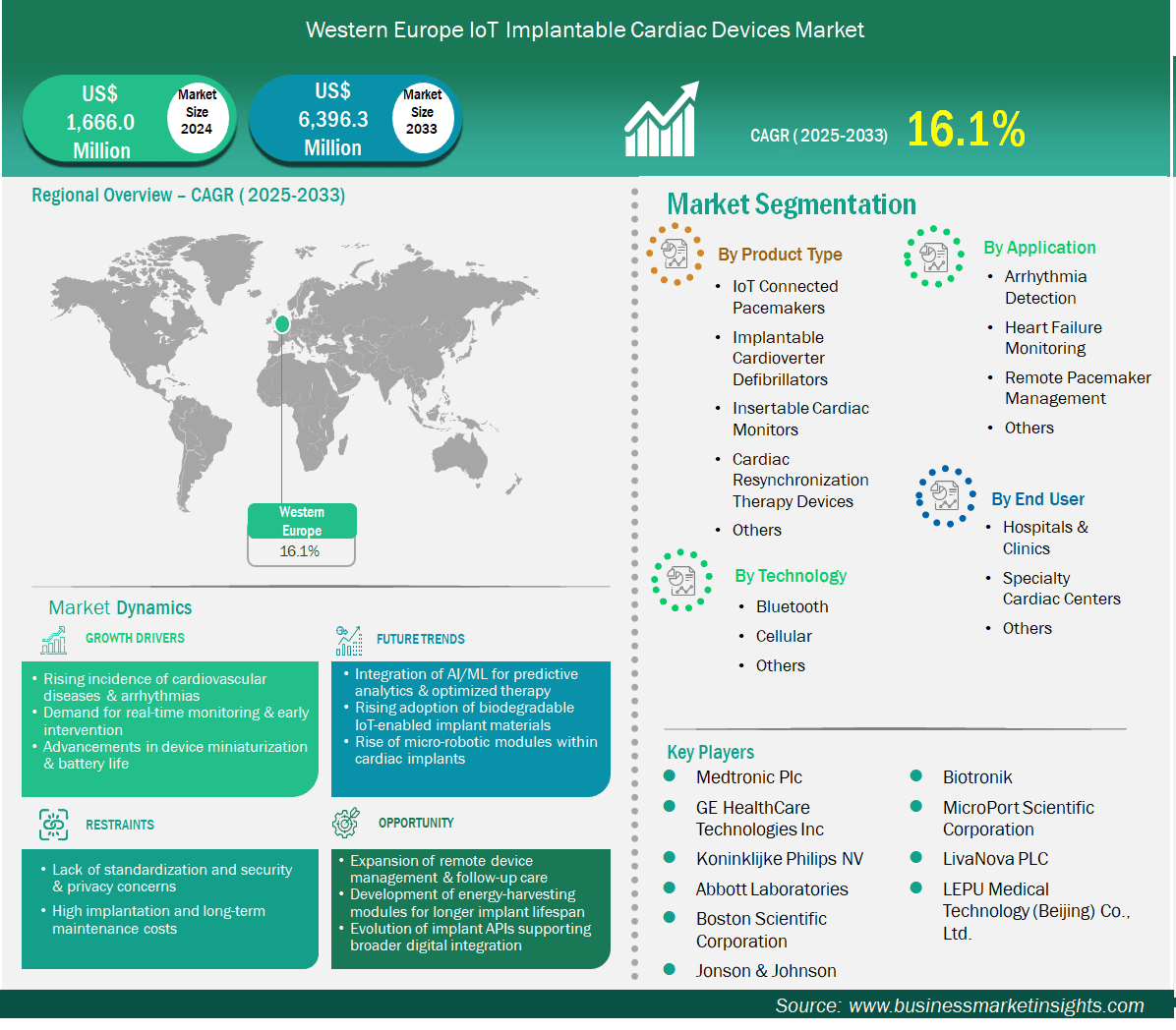
The Western Europe IoT implantable cardiac devices market size is expected to reach US$ 6,396.3 million by 2033 from US$ 1,666.0 million in 2024. The market is estimated to record a CAGR of 16.1% from 2025 to 2033.
Executive Summary and Western Europe IoT Implantable Cardiac Devices Market Analysis:
The IoT implantable cardiac devices market in Western Europe is experiencing significant growth driven by the rising incidence of cardiovascular diseases & arrhythmias, demand for real-time monitoring & early intervention, advancements in device miniaturization & battery life. The IoT Implantable Cardiac Devices market in Western Europe is one of the most mature markets worldwide, which is mainly supported by the well-developed healthcare systems, robust regulatory frameworks, and high adoption of connected technologies. Germany, France, Italy, and Spain are the country’s leading the adoption, where connected pacemakers and implantable defibrillators are being extensively used in tertiary hospitals. Bluetooth-enabled devices are preferred due to their low cost and easy integration with national e-health platforms, whereas cellular-enabled devices are slowly attracting users in urban areas with advanced telecom infrastructure. Hospitals and clinics are still the main end users, and they are being supported by centralized healthcare systems and specialized cardiac centers. The big multinational companies like Medtronic, Abbott, and Philips have a strong presence, whereas the local regional players in Germany and France are coming up with advanced IoT-enabled solutions that are customized for the local requirements. The main issues are the strictly regulated frameworks like EU MDR, the reimbursement problems caused by public healthcare systems, and the need for interoperability between different national health systems. However, Western Europe is still quite strong in this market due to well-funded government-supported healthcare programs, aging populations, and growing awareness of preventive cardiology. The market analysis indicates that Western Europe is shifting from conventional cardiac care to IoT-enabled solutions, thus setting the region as a leader in the global implantable cardiac devices market.
Western Europe IoT Implantable Cardiac Devices Market Segmentation Analysis:
Key segments that contributed to the derivation of the IoT implantable cardiac devices market analysis are product, technology, application, and end user.
- By product, the IoT implantable cardiac devices market is segmented into IoT connected pacemakers, implantable cardioverter defibrillators, insertable cardiac monitors, cardiac resynchronization therapy devices, and others. IoT connected pacemakers dominated the market in 2024, driven by aging populations and advanced adoption in Western European cardiac centers.
- By technology, the IoT implantable cardiac devices market is segmented into Bluetooth, cellular, and others. Bluetooth dominated the market in 2024, driven by seamless integration with digital health ecosystems and smartphone ubiquity.
- In terms of application, the market is segmented into arrhythmia detection, heart failure monitoring, remote pacemaker management, and others. Arrhythmia detection dominated the market in 2024, driven by a strong focus on preventive cardiology and early screening programs.
- By end user, the market is segmented into hospitals & clinics, specialty cardiac centers, and others. The hospitals & clinics dominated the market in 2024, driven by specialized hospital networks delivering advanced cardiac care.
Western Europe IoT Implantable Cardiac Devices Market Outlook
The Western Europe IoT Implantable Cardiac Devices market trajectory is characterized by sustained growth, supported by infrastructure improvements and the digital health adoption. During the upcoming years, adoption will be substantially influenced by government-supported healthcare reforms that are government-supported, expanding telecom networks that are expanding, and a remote monitoring supply that is increasing. Bluetooth-enabled pacemakers will still be the major choice; however, it is anticipated that cellular-enabled devices will become more popular as the 5G infrastructure matures in the region. Integration of IoT devices with national electronic health record systems will be the main focus of strategic investment, as this will open the opportunities of real-time monitoring and predictive analytics. Governments are investing in improving cardiovascular health with Germany’s Digital Healthcare Act and France’s telemedicine expansion, which support IoT integration. The training of healthcare professionals will be essential, as only then can proper implantation and monitoring be guaranteed. Demand will be driven by urban centers such as Berlin, Paris, Madrid, and Milan. The forecast also recognizes the significance of security measures as Western European authorities require stringent data protection for connected devices. In general, the Western European market is largely characterized by connected ecosystems, predictive monitoring, and government-led adoption strategies.
Western Europe IoT Implantable Cardiac Devices Market Country Insights
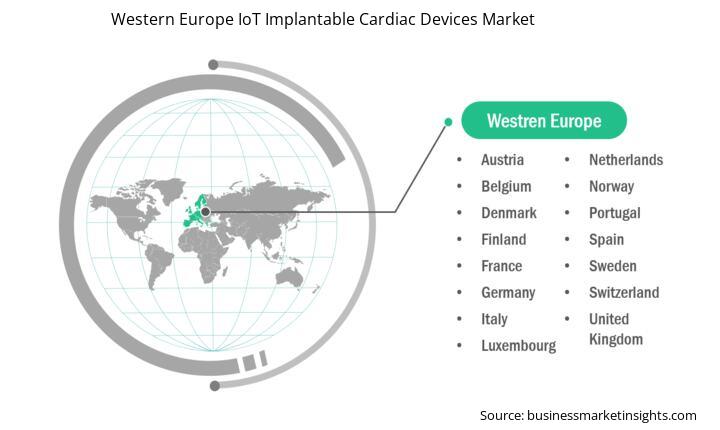
Based on country, the Western Europe IoT implantable cardiac devices market is segmented into Belgium, the Netherlands, Luxembourg, Germany, France, Italy, Spain, Switzerland, Sweden, Austria, the United Kingdom, Denmark, Portugal, Norway, and Finland. Germany held the largest share in 2024.
Detailed information at a country level reveals different adoption patterns in Western Europe. Germany is the leader with its massive investment in digital health infrastructure and overall use of connected pacemakers. France is growing in preventive cardiology, which is the main reason for the high demand for IoT-enabled cardiac devices, both in urban and rural areas. Italy, with its large population, is gradually adopting the use of implantable defibrillators and pacemakers; however, affordability and access remain the two major problems. Spain is an excellent example of a market with enormous potential, which is being driven by its healthcare modernization efforts and the growing prevalence of cardiovascular diseases. Success in this field depends on the ability to adjust strategies to local circumstances, striking the right balance between affordability and innovation, and utilizing partnerships to bridge the gaps in infrastructure and expertise.
Western Europe IoT Implantable Cardiac Devices Market Company Profiles
Medtronic Plc, GE HealthCare Technologies Inc, Koninklijke Philips NV, Abbott Laboratories, Boston Scientific Corporation, Johnson & Johnson, Biotronik, MicroPort Scientific Corporation, LivaNova PLC, LEPU Medical Technology (Beijing) Co., Ltd., are among the key players operating in the market. These players adopt strategies such as expansion, product innovation, and mergers and acquisitions to stay competitive in the market and offer innovative products to their consumers.
Western Europe IoT Implantable Cardiac Devices Market Research Methodology:
The following methodology has been followed for the collection and analysis of data presented in this report:
Secondary Research
The research process begins with comprehensive secondary research, utilizing both internal and external sources to gather qualitative and quantitative data for each market. Commonly referenced secondary research sources include, but are not limited to:
- Company websites, annual reports, financial statements, broker analyses, and investor presentations
- Industry trade journals and other relevant publications
- Government documents, statistical databases, and market reports
- News articles, press releases, and webcasts specific to companies operating in the market
Note: All financial data included in the Company Profiles section has been standardized to US$. For companies reporting in other currencies, figures have been converted to US$ using the relevant exchange rates for the corresponding year.
Primary Research
Business Market Insights conducts a significant number of primary interviews each year with industry stakeholders and experts to validate and analyze the data and gain valuable insights. These research interviews are designed to:
- Refine findings from secondary research
- Enhance the expertise and market understanding of the analysis team
- Gain insights into market size, trends, growth patterns, competitive dynamics, and future prospects
Primary research is conducted via email interactions and telephone interviews with industry experts across various markets, categories, segments, and sub-segments in different regions. Participants typically include:
- Industry stakeholders: Vice Presidents, business development managers, market intelligence managers, and national sales managers
- External experts: Valuation specialists, research analysts, and key opinion leaders with industry-specific expertise
Key Sources Referred:
- World Health Organization (WHO)
- Organisation for Economic Cooperation and Development (OECD)
- The World Bank Group
- Worldometer
- The Lancet
- International Bar Association
- International Trade Administration
- Eurostat
- United Nations Department of Economic and Social Affairs
Western Europe IoT Implantable Cardiac Devices Market Strategic Insights
Western Europe IoT Implantable Cardiac DevicesMarket Report Highlights
| Report Attribute | Details |
| Market size in 2024 | US$ 1,666.0 Million |
| Market Size by 2033 | US$ 6,396.3 Million |
| CAGR (2025 - 2033) | 16.1% |
| Historical Data | 2022-2023 |
| Forecast period | 2025-2033 |
| Segments Covered |
By Product
|
|
Regions and Countries Covered
|
|
| Western Europe | Belgium, Netherlands, Luxembourg, Germany, France, Italy, Spain, Switzerland, Sweden, Austria, United Kingdom, Denmark, Portugal, Norway, Finland |
| Market leaders and key company profiles |
|
Western Europe IoT Implantable Cardiac Devices Market Country and Regional Insights