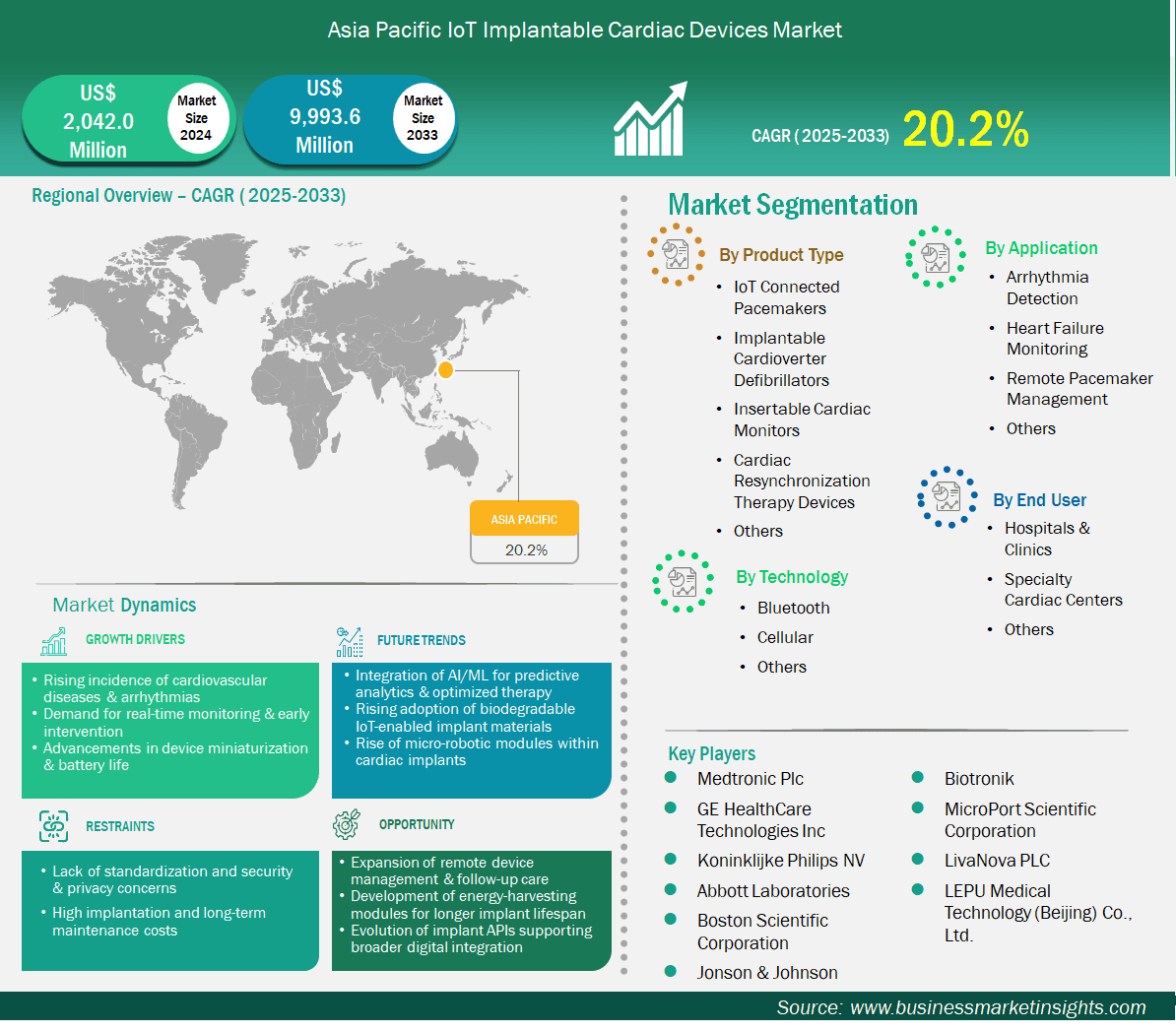
The Asia Pacific IoT implantable cardiac devices market size is expected to reach US$ 9,993.6 million by 2033 from US$ 2,042.0 million in 2024. The market is estimated to record a CAGR of 20.2% from 2025 to 2033.
Executive Summary and Asia Pacific IoT Implantable Cardiac Devices Market Analysis:
The IoT implantable cardiac devices market in Asia Pacific is experiencing significant growth driven by the rising incidence of cardiovascular diseases & arrhythmias, demand for real-time monitoring & early intervention, advancements in device miniaturization & battery life. The Asia Pacific IoT Implantable Cardiac Devices market is a high-growth market and a major contributor to global implantable cardiac devices due to shifting demographics, increasing prevalence of cardiovascular disease, and increasing healthcare investments. Countries like China, India, Japan, and Australia have led the adoption of connected pacemakers and implantable defibrillators in cities. As they are compatible with the widely used smartphones across the region, Bluetooth-enabled devices are preferred because of their lower cost and ease of integration. Hospitals and clinics are still the main end users as they have the necessary infrastructure and expertise for implantation and monitoring. Global companies such as Medtronic, Abbott, and Philips are expanding their footprints by collaborating with local distributors, while regional players in Japan and South Korea are working on developing advanced IoT-enabled solutions that are suitable for the local market. The major issues are the differences in healthcare access between urban and rural areas, the fragmented regulatory frameworks, and the affordability problem in emerging economies. However, the large population base of the Asia Pacific, and the digitally enabled healthcare services by the government are some of the opportunities for the region. The market analysis indicates that the Asia Pacific is shifting from traditional cardiac care towards IoT-enabled solutions; thus, the region is becoming a growth driver for global implantable cardiac technologies.
Asia Pacific IoT Implantable Cardiac Devices Market Segmentation Analysis:
Key segments that contributed to the derivation of the IoT implantable cardiac devices market analysis are product, technology, application, and end user.
- By product, the IoT implantable cardiac devices market is segmented into IoT connected pacemakers, implantable cardioverter defibrillators, insertable cardiac monitors, cardiac resynchronization therapy devices, and others. IoT connected pacemakers dominated the market in 2024, driven by the rising incidence of lifestyle‑related cardiac disorders and rapid device adoption in urban Asia.
- By technology, the IoT implantable cardiac devices market is segmented into Bluetooth, cellular, and others. Bluetooth dominated the market in 2024, driven by affordability and compatibility with smartphones, which dominate the Asia Pacific markets.
- In terms of application, the market is segmented into arrhythmia detection, heart failure monitoring, remote pacemaker management, and others. Arrhythmia detection dominated the market in 2024, driven by increasing demand for continuous monitoring in countries with high atrial fibrillation prevalence.
- By end user, the market is segmented into hospitals & clinics, specialty cardiac centers, and others. Hospitals & clinics dominated the market in 2024, driven by the concentration of advanced cardiac care in tertiary hospitals across the Asia Pacific.
Asia Pacific IoT Implantable Cardiac Devices Market Outlook
Asia Pacific's market for IoT Implantable Cardiac Devices has a bright future with a strong growth potential, which is largely driven by the region's commitment to improving its infrastructure and the adoption of digital health. The the biggest change for telecom networks in the region over the coming years will be the spread of cellular-enabled devices. They will expand, and 5G will become the standard in countries like China, South Korea, and Japan. Nevertheless, Bluetooth-enabled pacemakers will be the major product. Health strategic investments will become more affordable as there will be more modular device designs and subscription-based monitoring services that will be suitable for healthcare systems of different levels. Cardiovascular health will become the focus of governments with the launch of programs like Ayushman Bharat in India and Healthy China 2030, which, among others, will facilitate the support for the implementation of the IoT. Besides implementation, a training program for health professionals will be needed for efficient monitoring as well. Big cities like Shanghai, Tokyo, Mumbai, and Sydney will see demand as the leading force, whereas rural areas will need schemes to obtain the product. The Asia Pacific region, in general, will be a market characterized by affordability, innovation, and local strategies in line with the different healthcare landscapes.
Asia Pacific IoT Implantable Cardiac Devices Market Country Insights
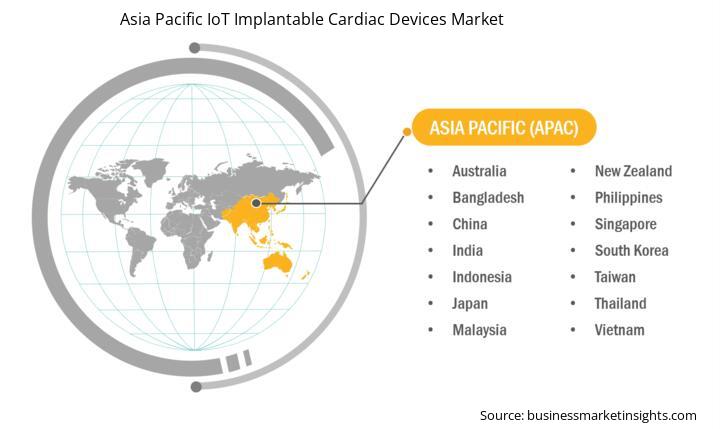
Based on country, the Asia Pacific IoT implantable cardiac devices market is segmented into China, India, Japan, Australia, Bangladesh, Indonesia, Malaysia, New Zealand, the Philippines, Singapore, South Korea, Taiwan, Thailand, and Vietnam. China held the largest share in 2024.
Insights at the country level show that there are different patterns of adoption in the Asia Pacific region. China is the leader with its grand-scale investments in healthcare facilities and a robust government support for digital health initiatives. Japan mainly focuses on innovation, where local companies are developing advanced IoT-enabled cardiac devices, and hospitals are getting predictive monitoring solutions. India is a high-potential market that is being driven by a huge population and the increasing burden of cardiovascular diseases; however, affordability and access are still the major challenges. Both Australia and South Korea are leading the way in the use of IoT-enabled devices that are supported by advanced healthcare systems and a strong telemedicine penetration. The countries of Southeast Asia, which include Indonesia, Thailand, and Vietnam, are slowly coming into the market through pilot programs and donor-funded initiatives aimed at making cardiac care more accessible. Local partnerships are very important, with multinational players collaborating with regional distributors and healthcare providers to navigate regulatory complexities and ensure supply chain efficiency. Asia Pacific is a combination of opportunities with mature markets setting the benchmarks and emerging ones offering the growth potential.
Asia Pacific IoT Implantable Cardiac Devices Market
Company Profiles
Medtronic Plc, GE HealthCare Technologies Inc, Koninklijke Philips NV, Abbott Laboratories, Boston Scientific Corporation, Johnson & Johnson, Biotronik, MicroPort Scientific Corporation, LivaNova PLC, LEPU Medical Technology (Beijing) Co., Ltd., are among the key players operating in the market. These players adopt strategies such as expansion, product innovation, and mergers and acquisitions to stay competitive in the market and offer innovative products to their consumers.
Asia Pacific IoT Implantable Cardiac Devices Market Research Methodology:
The following methodology has been followed for the collection and analysis of data presented in this report:
Secondary Research
The research process begins with comprehensive secondary research, utilizing both internal and external sources to gather qualitative and quantitative data for each market. Commonly referenced secondary research sources include, but are not limited to:
- Company websites, annual reports, financial statements, broker analyses, and investor presentations
- Industry trade journals and other relevant publications
- Government documents, statistical databases, and market reports
- News articles, press releases, and webcasts specific to companies operating in the market
Note: All financial data included in the Company Profiles section has been standardized to US$. For companies reporting in other currencies, figures have been converted to US$ using the relevant exchange rates for the corresponding year.
Primary Research
Business Market Insights conducts a significant number of primary interviews each year with industry stakeholders and experts to validate and analyze the data and gain valuable insights. These research interviews are designed to:
- Refine findings from secondary research
- Enhance the expertise and market understanding of the analysis team
- Gain insights into market size, trends, growth patterns, competitive dynamics, and future prospects
Primary research is conducted via email interactions and telephone interviews with industry experts across various markets, categories, segments, and sub-segments in different regions. Participants typically include:
- Industry stakeholders: Vice Presidents, business development managers, market intelligence managers, and national sales managers
- External experts: Valuation specialists, research analysts, and key opinion leaders with industry-specific expertise
Key Sources Referred:
- World Health Organization (WHO)
- Organisation for Economic Cooperation and Development (OECD)
- The World Bank Group
- Worldometer
- The Lancet
- International Bar Association
- International Trade Administration
- Eurostat
- United Nations Department of Economic and Social Affairs
Asia Pacific IoT Implantable Cardiac Devices Market Strategic Insights
Asia Pacific IoT Implantable Cardiac DevicesMarket Report Highlights
| Report Attribute | Details |
| Market size in 2024 | US$ 2,042.0 Million |
| Market Size by 2033 | US$ 9,993.6 Million |
| CAGR (2025 - 2033) | 20.2% |
| Historical Data | 2022-2023 |
| Forecast period | 2025-2033 |
| Segments Covered |
By Product
|
|
Regions and Countries Covered
|
|
| Asia Pacific | China, Japan, South Korea, India, Australia, New Zealand, Indonesia, Malaysia, Philippines, Singapore, Thailand, Vietnam, Taiwan, Bangladesh |
| Market leaders and key company profiles |
|
Asia Pacific IoT Implantable Cardiac Devices Market Country and Regional Insights