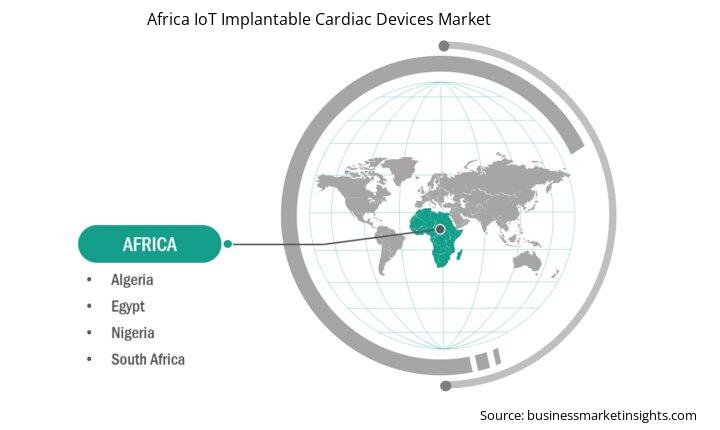
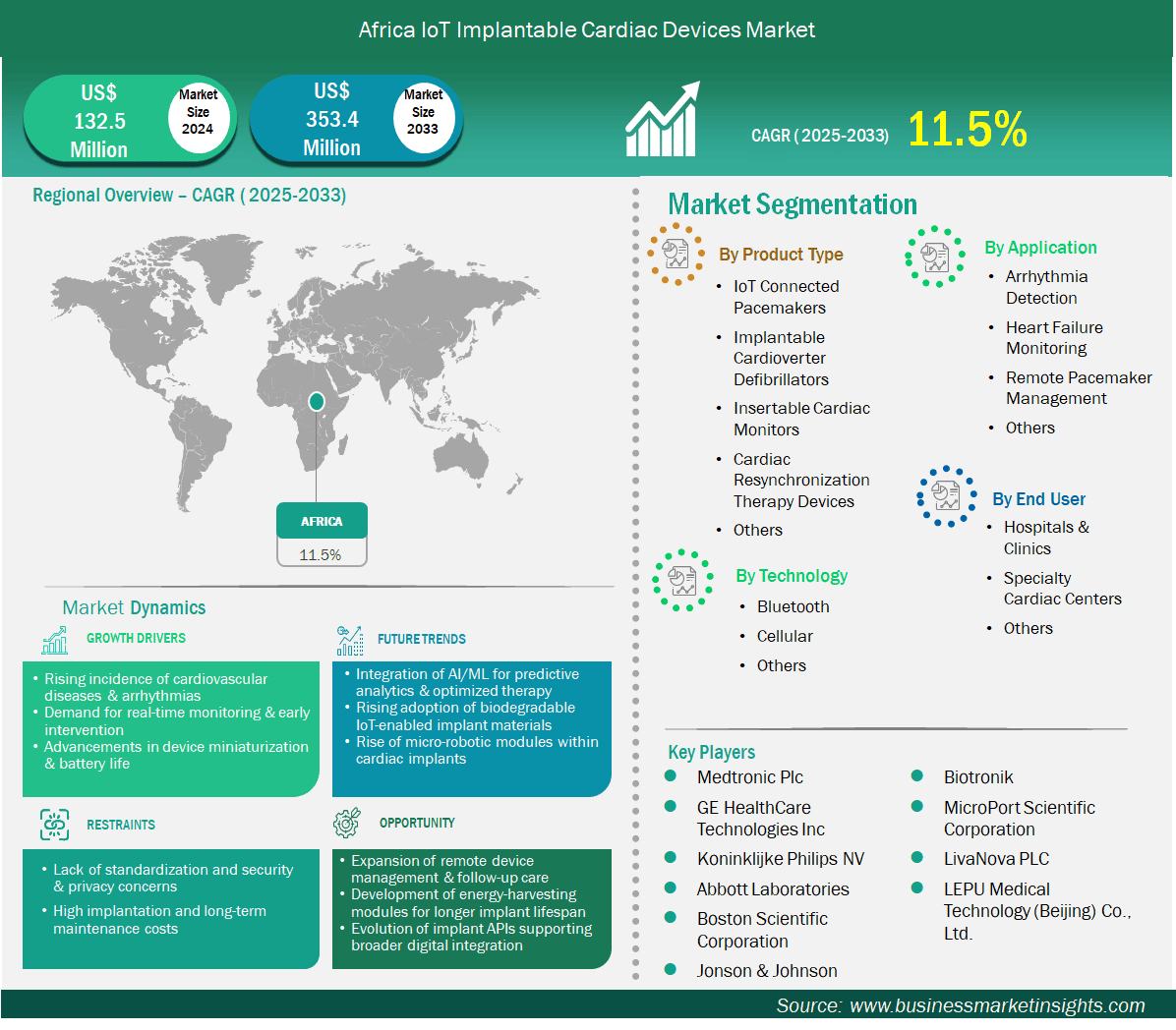
The Africa IoT implantable cardiac devices market size is expected to reach US$ 353.4 million by 2033 from US$ 132.5 million in 2024. The market is estimated to record a CAGR of 11.5% from 2025 to 2033.
Executive Summary and Africa IoT Implantable Cardiac Devices Market Analysis:
The IoT implantable cardiac devices market in Africa is experiencing significant growth driven by the rising incidence of cardiovascular diseases & arrhythmias, demand for real-time monitoring & early intervention, advancements in device miniaturization & battery life. The IoT Implantable Cardiac Devices market in Africa is becoming a key factor in the region's healthcare modernization. Cardiovascular disease is still one of the major diseases, and thus, the need for advanced monitoring solutions is growing rapidly. Internet-of-Things (IoT)-enabled pacemakers, implantable cardioverter defibrillators, and insertable cardiac monitors are utilized to treat arrhythmias and heart failure. The connectivity based on Bluetooth is leading due to its low cost and compatibility with smartphones, which are very much used in African urban areas.
On the other hand, devices enabled with cellular technology, although they are better in terms of real-time transmission, are not free from the problems of the infrastructure and are expensive; hence, the adoption in rural areas is limited. Hospitals and clinics are still the main end-users as they have the required surgical skills and the infrastructure for monitoring. On the one hand, multinational players are expanding their footprints through collaborations with local distributors, while on the other hand, ICU Medical and BD position themselves in the market for consumables and accessories that facilitate device demand. Africa's demographic profile, characterized by the increasing urban population and the emerging middle-class population, is opening up opportunities. The market is in a transition phase, i.e., it is balancing the adoption of traditional devices with innovations driven by IoT to ensure better patient outcomes, remote monitoring, and reduction of healthcare costs. Analysis reveals a market with high demand, changing technology adoption, and competition strategies of global and regional players.
Africa IoT Implantable Cardiac Devices Market Segmentation Analysis:
Key segments that contributed to the derivation of the IoT implantable cardiac devices market analysis are product, technology, application, and end user.
- By product, the IoT implantable cardiac devices market is segmented into IoT connected pacemakers, implantable cardioverter defibrillators, insertable cardiac monitors, cardiac resynchronization therapy devices, and others. IoT connected pacemakers dominated the market in 2024, driven by the high prevalence of bradyarrhythmia and widespread adoption of connected pacemaker implants for long‑term rhythm management.
- By technology, the IoT implantable cardiac devices market is segmented into Bluetooth, cellular, and others. Bluetooth dominated the market in 2024, driven by low‑cost, low‑power connectivity and compatibility with smartphones widely used across Africa.
- In terms of application, the market is segmented into arrhythmia detection, heart failure monitoring, remote pacemaker management, and others. Arrhythmia detection dominated the market in 2024, driven by the rising incidence of atrial fibrillation and the need for continuous monitoring in resource‑limited settings.
- By end user, the market is segmented into hospitals & clinics, specialty cardiac centers, and others. Hospitals & clinics dominated the market in 2024, driven by the concentration of advanced cardiac care infrastructure and reliance on institutional monitoring in Africa.
Africa IoT Implantable Cardiac Devices Market Outlook
The future of the African IoT Implantable Cardiac Devices market is characterized by gradual growth, largely influenced by digital health programs, the use of telemedicine, and the upgrading of infrastructure. The market will change over the next years as it moves beyond hospital-centric monitoring to hybrid models that combine home-based care and remote diagnostics. While Bluetooth-enabled pacemakers will still be the main trend, it's expected that cellular-based devices will slowly take over as telecom infrastructure gets better and 5G networks spread out in the major economies. The strategic investment by multinational MedTech companies will revolve around making the product affordable, with the African healthcare system being the recipient of modular device designs and subscription-based monitoring services. Governments, on the other hand, are actively incorporating cardiovascular health into their national health priorities. Training programs for healthcare professionals will also play the role of a catalyst in implementing and monitoring IoT healthcare-enabled devices. Through the steady rise of the middle-class population in Africa, the demand for cutting-edge cardiac treatment will be fuelled, most especially in metropolises like Johannesburg, Nairobi, Lagos, and Cairo. The innovation in the area of consumables and accessories, for instance, disposable sensors, transducer kits, and wireless monitoring hubs, will not only attract users but also complete the ecosystem. Despite the existence of fragmented regulatory frameworks and affordability issues, the African continent is on its way to embracing global standards in IoT-enabled cardiac care. The forecast reveals that Africa's growth will be driven by factors such as affordability, infrastructure readiness, and strategic partnerships that connect the expert knowledge and the unserved areas.
Africa IoT Implantable Cardiac Devices Market Country Insights
Based on country, the Africa IoT implantable cardiac devices market is segmented into Egypt, South Africa, Nigeria, and Algeria. Egypt held the largest share in 2024.
Insights at the country level depict a difference in the adoption and readiness of the region. Egypt is at the forefront of the region as it gets the benefits of advanced healthcare facilities, established private hospital networks, and strong partnerships with multinational device manufacturers. On the other hand, Nigeria, with its huge population and the rising prevalence of cardiovascular diseases, is a market with great potential. However, there are still challenges in the healthcare sector infrastructure and a lack of affordability. South Africa is experiencing a growing adoption of implantable monitors and pacemakers, especially in big cities like Cairo and Alexandria. Success in this region will require forming strategies considering local contexts, affordability with innovation, and using partnerships to overcome the gaps in infrastructure and expertise. Analysis at the country-level perspective reveals that Africa’s growth in IoT cardiac care is complex and has multiple dimensions, thus there is a need for the deployment of nuanced approaches to ensure sustainable adoption.
Africa IoT Implantable Cardiac Devices Market Company Profiles
Medtronic Plc, GE HealthCare Technologies Inc, Koninklijke Philips NV, Abbott Laboratories, Boston Scientific Corporation, Johnson & Johnson, Biotronik, MicroPort Scientific Corporation, LivaNova PLC, LEPU Medical Technology (Beijing) Co., Ltd., are among the key players operating in the market. These players adopt strategies such as expansion, product innovation, and mergers and acquisitions to stay competitive in the market and offer innovative products to their consumers.
Africa IoT Implantable Cardiac Devices Market Research Methodology:
The following methodology has been followed for the collection and analysis of data presented in this report:
Secondary Research
The research process begins with comprehensive secondary research, utilizing both internal and external sources to gather qualitative and quantitative data for each market. Commonly referenced secondary research sources include, but are not limited to:
- Company websites, annual reports, financial statements, broker analyses, and investor presentations
- Industry trade journals and other relevant publications
- Government documents, statistical databases, and market reports
- News articles, press releases, and webcasts specific to companies operating in the market
Note: All financial data included in the Company Profiles section has been standardized to US$. For companies reporting in other currencies, figures have been converted to US$ using the relevant exchange rates for the corresponding year.
Primary Research
Business Market Insights conducts a significant number of primary interviews each year with industry stakeholders and experts to validate and analyze the data and gain valuable insights. These research interviews are designed to:
- Refine findings from secondary research
- Enhance the expertise and market understanding of the analysis team
- Gain insights into market size, trends, growth patterns, competitive dynamics, and future prospects
Primary research is conducted via email interactions and telephone interviews with industry experts across various markets, categories, segments, and sub-segments in different regions. Participants typically include:
- Industry stakeholders: Vice Presidents, business development managers, market intelligence managers, and national sales managers
- External experts: Valuation specialists, research analysts, and key opinion leaders with industry-specific expertise
Key Sources Referred:
- World Health Organization (WHO)
- Organisation for Economic Cooperation and Development (OECD)
- The World Bank Group
- Worldometer
- The Lancet
- International Bar Association
- International Trade Administration
- Eurostat
- United Nations Department of Economic and Social Affairs
Africa IoT Implantable Cardiac Devices Market Strategic Insights
Africa IoT Implantable Cardiac DevicesMarket Report Highlights
| Report Attribute | Details |
| Market size in 2024 | US$ 132.5 Million |
| Market Size by 2033 | US$ 353.4 Million |
| CAGR (2025 - 2033) | 11.5% |
| Historical Data | 2022-2023 |
| Forecast period | 2025-2033 |
| Segments Covered |
By Product
|
|
Regions and Countries Covered
|
|
| Africa | Egypt, South Africa, Nigeria, Algeria |
| Market leaders and key company profiles |
|
Africa IoT Implantable Cardiac Devices Market Country and Regional Insights