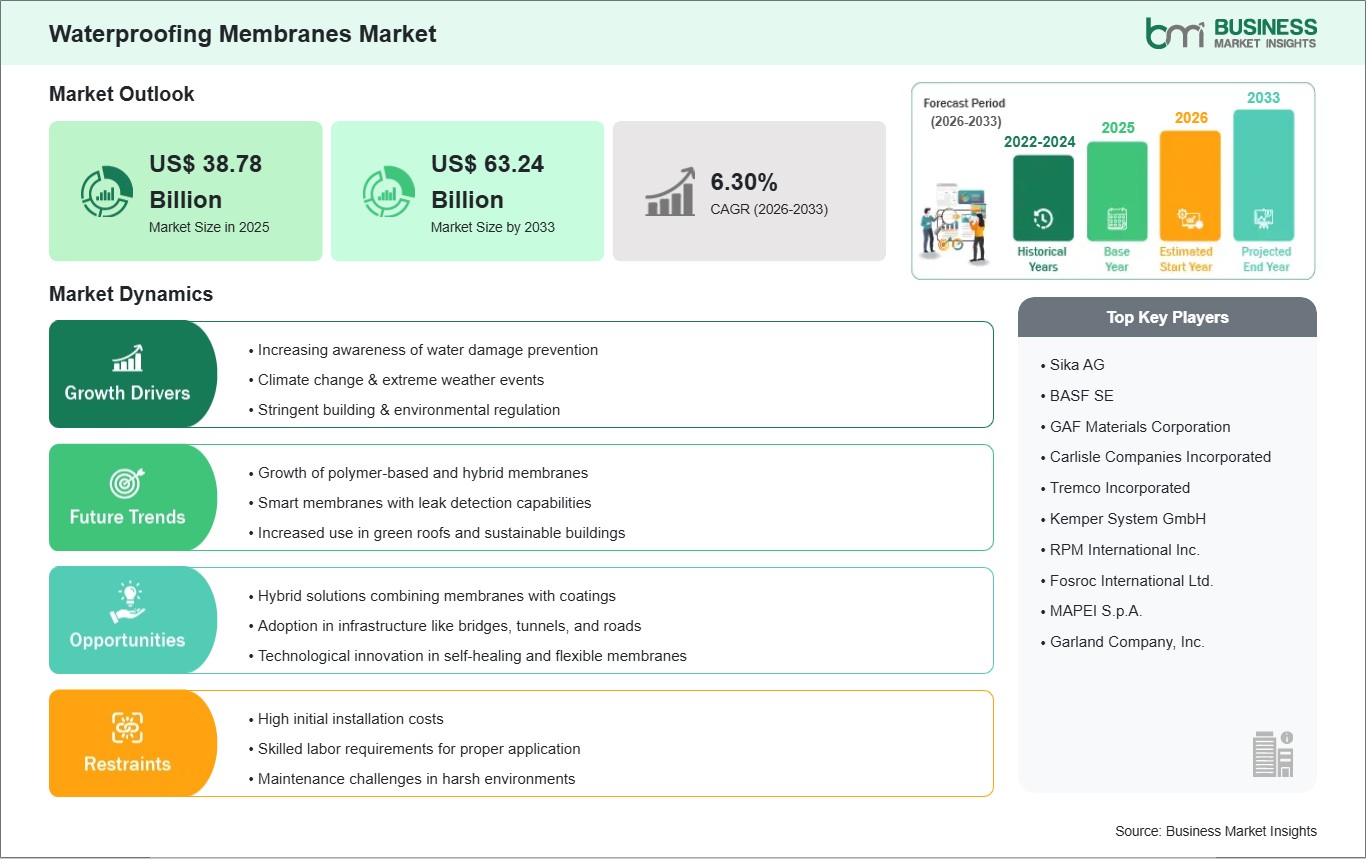
The Waterproofing Membranes Market size is expected to reach US$ 63.24 billion by 2033 from US$ 38.78 billion in 2025. The market is estimated to record a CAGR of 6.30% from 2026 to 2033.
The global waterproofing membranes market is a critical segment of the construction and infrastructure industries, providing essential protection against water infiltration, structural damage, and long-term maintenance costs. These membranes are used in a variety of applications, including roofing, basements, tunnels, bridges, and industrial facilities, where effective water resistance is paramount. Growth in this market is driven by increasing urbanization, rising construction activities, and the need for sustainable infrastructure that can withstand extreme weather events and aging building conditions.
Additionally, growing awareness of water-related structural damage and the long-term economic benefits of preventive waterproofing solutions is fuelling demand globally. Technological innovation is a key factor shaping market expansion, with advanced materials such as modified bitumen, liquid-applied membranes, and polymer-based solutions offering improved flexibility, durability, and environmental performance. However, the market faces challenges such as high initial installation costs and the need for skilled labour to ensure proper application. In some regions, lack of awareness about long-term maintenance benefits or preference for conventional methods can also restrain adoption. Despite these challenges, the global waterproofing membranes market continues to evolve as sustainability, durability, and performance requirements drive investment in innovative solutions across residential, commercial, and infrastructure sectors.

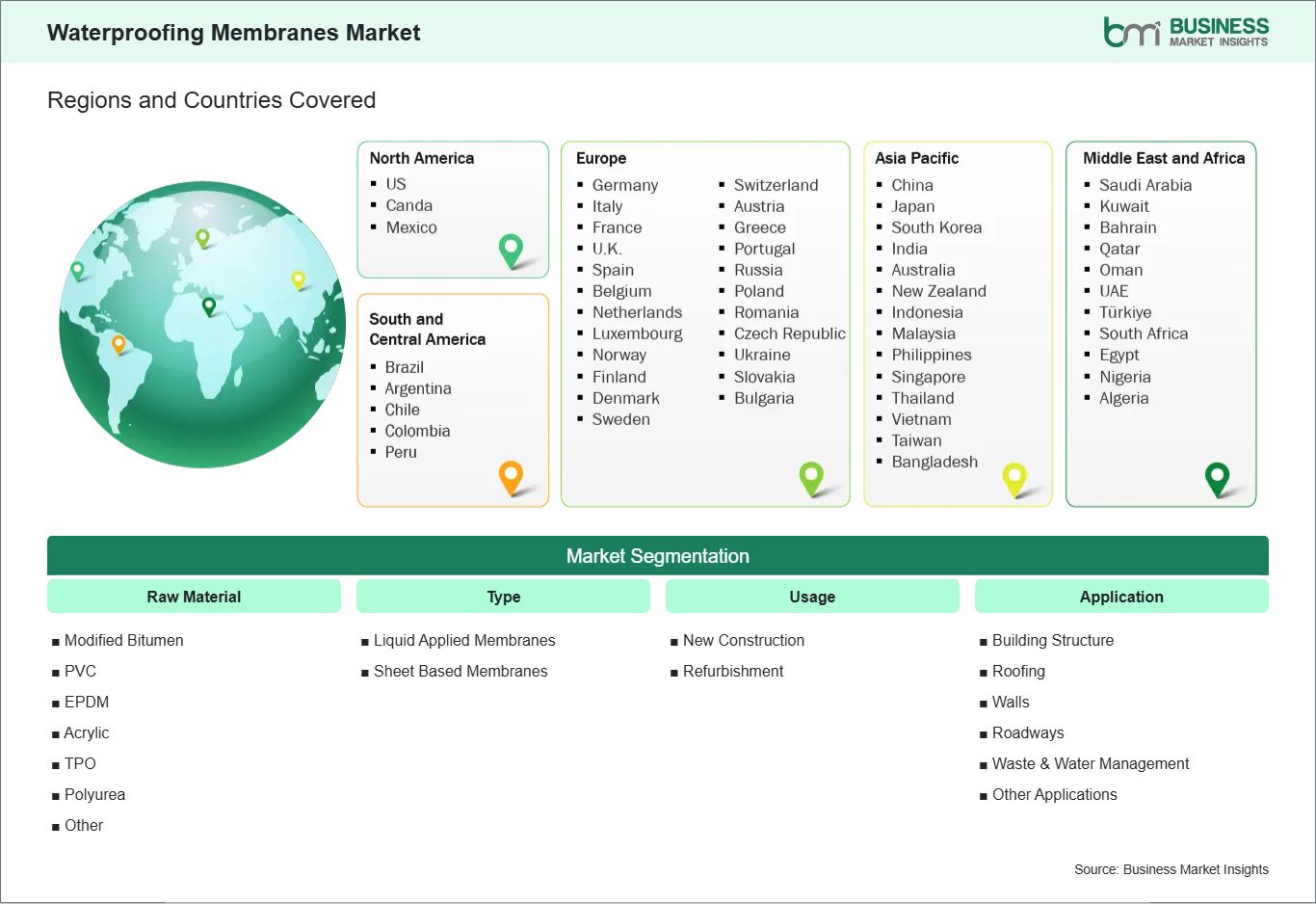
Key segments that contributed to the derivation of the waterproofing membranes market analysis are raw material, type, usage, and application
The increasing concerns about the durability of structures and water-related damages are motivating the use of water coatings in Western Europe. The regular occurrence of rain, flood risks in river valleys, and the age of the building infrastructure are motivating the use of protective water coatings that can help prevent seepages, corrosion, and mold formation. In residential and commercial building projects, water-based and elastomeric water coatings are being used to provide improved durability to the structures.
The investment of the public and private sectors in infrastructure projects is also motivating the use of water protective coatings. The renovation of infrastructure, including public buildings, bridges, and transportation nodes, in urban areas is incorporating water protective coatings to provide improved durability to the structures. The use of water protective coatings, which can provide barrier protection, is a standard requirement in the contracts for renovating infrastructure, which can help provide improved durability to the structures over a period of time.
In addition, consumer awareness is increasing, and this is largely being driven by insurance incentives and considerations for real estate valuations. For example, individuals in areas that often face heavy precipitation and seasonal flooding are increasingly using water coatings in basements, roof decks, and bathroom areas to prevent damage risks. Market analysts indicate that this increasing consumer awareness is helping to expand market penetration for water coatings, especially in Western Europe, at a growth rate of 6-8% per annum.
The hybrid water protection systems, which involve the integration of membrane and water coatings, are becoming increasingly popular in Western Europe, especially in the field of construction and infrastructure development. This has seen the widespread adoption of hybrid water protection systems in roofing, podium deck, and underground water protection applications.
The hybrid water protection systems have also seen widespread adoption in the industrial sector. In the past, factories and warehouses used hybrid water protection systems to achieve seamless water protection and chemical resistance in areas prone to moisture, cleaning agents, and other factors. This has seen the widespread adoption of hybrid water protection systems in the industrial sector, with facility managers able to achieve seamless performance and efficiency in the maintenance of the facilities.
Architectural and urban development projects are also incorporating hybrid systems due to aesthetic and functional advantages. Public spaces such as plazas, pedestrian walkways, sports facilities, among others, are increasingly using membrane coating combinations due to their long-lasting water-resistance capabilities. This is in response to the need by various manufacturers to offer high-quality products compatible with various surfaces, thus allowing architects and developers in Western Europe to satisfy various regulatory requirements as well as customer demands.

The global Waterproofing membranes market is experiencing steady growth, with market size and share analysis reflecting evolving treatment preferences and competitive dynamics among key players. The report evaluates important subsegments categorized within raw material, type, usage, and application highlighting their respective contributions to overall market performance.
By raw material, the modified bitumen subsegment dominated the market in 2025 because it combines strong water resistance, durability, and ease of application at a competitive cost. Modified bitumen membranes are reinforced with polymers that enhance flexibility and adhesion, allowing them to perform reliably under temperature fluctuations, heavy loads, and stress conditions common in both roofing and below‑grade applications.
By type, the sheet based membranes segment subsegment dominated the market in 2025 because they ensure consistent thickness, uniform protection, and controlled installation quality over large surface areas. Sheets are factory‑manufactured under strict quality standards, minimizing field variability and reducing the risk of weak spots that can occur with liquid applications.
By usage, the new construction subsegment dominated the market in 2025 because waterproofing is a fundamental requirement in every new building project from the earliest structural phases through finishing.
By application, the roofing subsegment dominated the market in 2025 because roofs represent one of the most critical and vulnerable locations for water ingress, requiring highly reliable waterproofing solutions to protect interiors, structural components, and finishes.
| Report Attribute | Details |
|---|---|
| Market size in 2025 | US$ 38.78 Billion |
| Market Size by 2033 | US$ 63.24 Billion |
| Global CAGR (2026 - 2033) | 6.30% |
| Historical Data | 2022-2024 |
| Forecast period | 2026-2033 |
| Segments Covered | By Raw Material
|
|
Regions and Countries Covered
| |
| North America | US, Canada, Mexico |
| Europe | Belgium, Austria, Finland, Denmark, Greece, Poland, Romania, Russia, Ukraine, Czech Republic, Slovakia, Bulgaria, Italy, Luxembourg, Germany, Switzerland, France, Netherlands, Norway, Portugal, Spain, Sweden, United Kingdom |
| Asia-Pacific | Australia, China, India, Japan, South Korea, Indonesia, Malaysia, Philippines, Singapore, Thailand, Vietnam, Bangladesh, New Zealand, Taiwan |
| South and Central America | Brazil, Argentina, Peru, Chile, Colombia |
| Middle East and Africa | Bahrain, Kuwait, Oman, Qatar, Saudi Arabia, United Arab Emirates, Turkiye, South Africa, Egypt, Algeria, Nigeria |
| Market leaders and key company profiles |
|
The "Waterproofing Membranes Market Size and Forecast (2022 - 2033)" report provides a detailed analysis of the market covering below areas:
The geographical scope of the waterproofing membranes market report is divided into: North America, Asia Pacific, Europe, Middle East & Africa, and South & Central America. North America held the largest share in 2025.
North America leads the global waterproofing membranes market, supported by a mature construction industry, advanced building codes, and strong adoption of sustainable infrastructure practices. The United States drives the regional market, with increasing use of high-performance membranes in commercial and residential buildings, particularly in regions prone to heavy rainfall or flooding. Roofing systems, basements, and foundation protection are primary applications, reflecting the need for long-term durability and reduced maintenance costs.
Canada contributes to market growth through infrastructure projects requiring robust waterproofing solutions, including bridges, tunnels, and industrial facilities exposed to extreme climatic conditions. Technological innovation and R&D are central to the region’s leadership, with manufacturers developing hybrid polymer membranes, eco-friendly liquid-applied coatings, and self-healing materials to enhance performance. North America’s dominance is further reinforced by stringent regulatory standards, sustainability initiatives, and a highly skilled workforce capable of implementing advanced installation techniques, making the region a global benchmark for waterproofing membrane solutions.

The waterproofing membranes market is evaluated by gathering qualitative and quantitative data post primary and secondary research, which includes important corporate publications, association data, and databases. A few of the key developments in the Waterproofing membranes market are:
The Waterproofing Membranes Market is valued at US$ 38.78 Billion in 2025, it is projected to reach US$ 63.24 Billion by 2033.
As per our report Waterproofing Membranes Market, the market size is valued at US$ 38.78 Billion in 2025, projecting it to reach US$ 63.24 Billion by 2033. This translates to a CAGR of approximately 6.30% during the forecast period.
The Waterproofing Membranes Market report typically cover these key segments-
The historic period, base year, and forecast period can vary slightly depending on the specific market research report. However, for the Waterproofing Membranes Market report:
The Waterproofing Membranes Market is populated by several key players, each contributing to its growth and innovation. Some of the major players include:
The Waterproofing Membranes Market report is valuable for diverse stakeholders, including:
Essentially, anyone involved in or considering involvement in the Waterproofing Membranes Market value chain can benefit from the information contained in a comprehensive market report.
Please tell us your area of interest
(Market Segments/ Regions and Countries/ Companies)