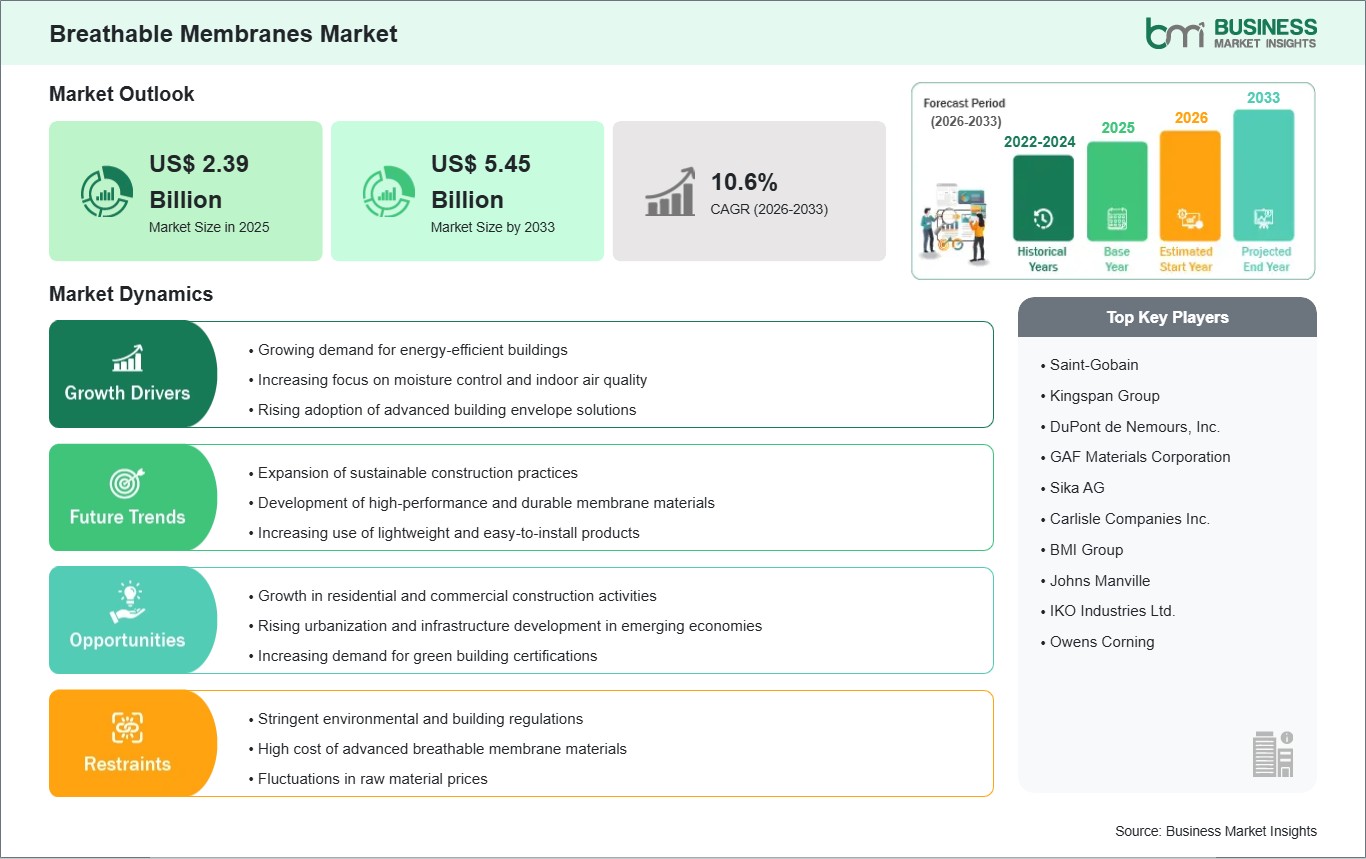
The Breathable Membranes Market size is expected to reach US$ 5.45 billion by 2033 from US$ 2.39 billion in 2025. The market is estimated to record a CAGR of 10.6% from 2026 to 2033.
The global breathable membranes market is experiencing consistent growth, driven by increasing demand for energy-efficient and moisture-resistant building materials. Breathable membranes are widely used in construction to allow water vapor to escape while preventing liquid water penetration, thereby enhancing building durability and indoor air quality. These membranes are essential components in modern building envelopes, particularly in roofing and wall systems.
The growing emphasis on sustainable construction practices and energy efficiency standards is significantly influencing market expansion. Governments and regulatory bodies are promoting the use of advanced building materials that improve insulation and reduce energy consumption. Breathable membranes contribute to these objectives by preventing condensation, reducing heat loss, and protecting structural components from moisture damage.
Technological advancements in material science are enabling the development of high-performance membranes with improved permeability, strength, and weather resistance. Manufacturers are focusing on lightweight, easy-to-install products that enhance construction efficiency. Additionally, increasing urbanization and infrastructure development, particularly in emerging economies, are creating strong demand for breathable membranes in residential and commercial construction projects.

Key segments that contributed to the derivation of the breathable membranes market analysis are type and application.
Significant factor driving the growth of the breathable membrane market is the focus on increasing energy efficiency in buildings. Modern building methods are highly focused on reducing energy use and improving thermal performance, resulting in an increasing number of complex advanced building envelope solutions. Breathable membranes are critical components of these advanced building systems, permitting moisture vapour drainage from inside the building envelope while preventing the entry of external moisture; thus, maintaining the insulation performance level and the structural integrity of the building envelope.
In energy-efficient buildings, maintaining a proper balance between the air-tightness and ventilation of the building envelope is crucial. Breathable membranes allow this by preventing the formation of condensation in the walls and/or roof of the building; if there is a build-up of excess moisture in the building envelope, it will affect the insulation and decrease its thermal resistance, and may also promote the growth of mould, which has a negative impact on the quality of indoor air. Therefore, the use of breathable membranes also promotes the health, safetyand welfare of the occupants of a building by helping to achieve a healthier and more durable living environment.
Governments around the world, particularly in developed countries, are establishing building codes and regulations that require the use of energy-efficient materials in building construction and renovation. Growing demand for energy-efficient materials has encouraged building owners and managers to use breathable membranes to achieve building codes and standards such as green building certifications and energy performance-related directives. These codes and standards are of utmost importance to building owners and contractors in all regions, but especially important in developed countries where there is a heavy emphasis on sustainability. In addition, as more and more people become aware of the long-term benefits of using energy-efficient products, they are also making choices about the products and services they purchase based on their sustainability.
Breathable membranes are well positioned to benefit from the global movement toward sustainability in construction. There are two main drivers behind the increased adoption of sustainable construction; environmental concern and regulatory pressure. Governments around the world are working to pass legislation that will reduce the environmental impact of buildings through the use of alternative building materials, including breathable membranes. In addition, utilizing breathable membranes strengthens the overall performance of a building while supporting the principles of sustainable design.
As well as contributing to the use of renewable materials for construction, breathable membranes are also an important component of improving energy efficiency and reducing carbon emissions through construction practices. By effectively insulating buildings, breathable membranes prevent heat from escaping or becoming trapped inside, allowing buildings to reduce costs associated with unnecessary heating and cooling and therefore decrease energy consumption and carbon production.
Manufacturers have begun to place a higher priority on developing more environmentally friendly breathable membranes made from materials that can be recycled or that have less of an impact on the environment than traditional breathable membranes. Recent advances in polymer technology have enabled the production of breathable membranes that have lower environmental impacts while still providing high-quality performance; these advances will continue to attract the interest of builders and developers.
The growing demand for green building certifications has also contributed to the use of breathable membranes. Many green building certification programs include criteria that require the use of materials that improve the energy efficiency, indoor air quality and sustainability of the overall building; breathable membranes help meet these criteria.

The Breathable Membranes Market demonstrates steady growth, with size and share analysis highlighting evolving trends and competitive dynamics among key players. The report examines subsegments categorized within type and application, offering insights into their contribution to overall market performance.
By type, the polypropylene (PP) subsegment dominated the market in 2025, driven by its superior durability, permeability, and cost-effectiveness.
Based on usability, the disposable subsegment dominated the breathable membranes market in 2025, driven by its widespread adoption in hygiene products, medical applications, and single-use protective solutions.
In terms of application, the pitched roof subsegment dominated the market in 2025, driven by widespread use in residential construction and roofing systems.
| Report Attribute | Details |
|---|---|
| Market size in 2025 | US$ 2.39 Billion |
| Market Size by 2033 | US$ 5.45 Billion |
| Global CAGR (2026 - 2033) | 10.6% |
| Historical Data | 2022-2024 |
| Forecast period | 2026-2033 |
| Segments Covered | By Type
|
|
Regions and Countries Covered
| |
| North America | US, Canada, Mexico |
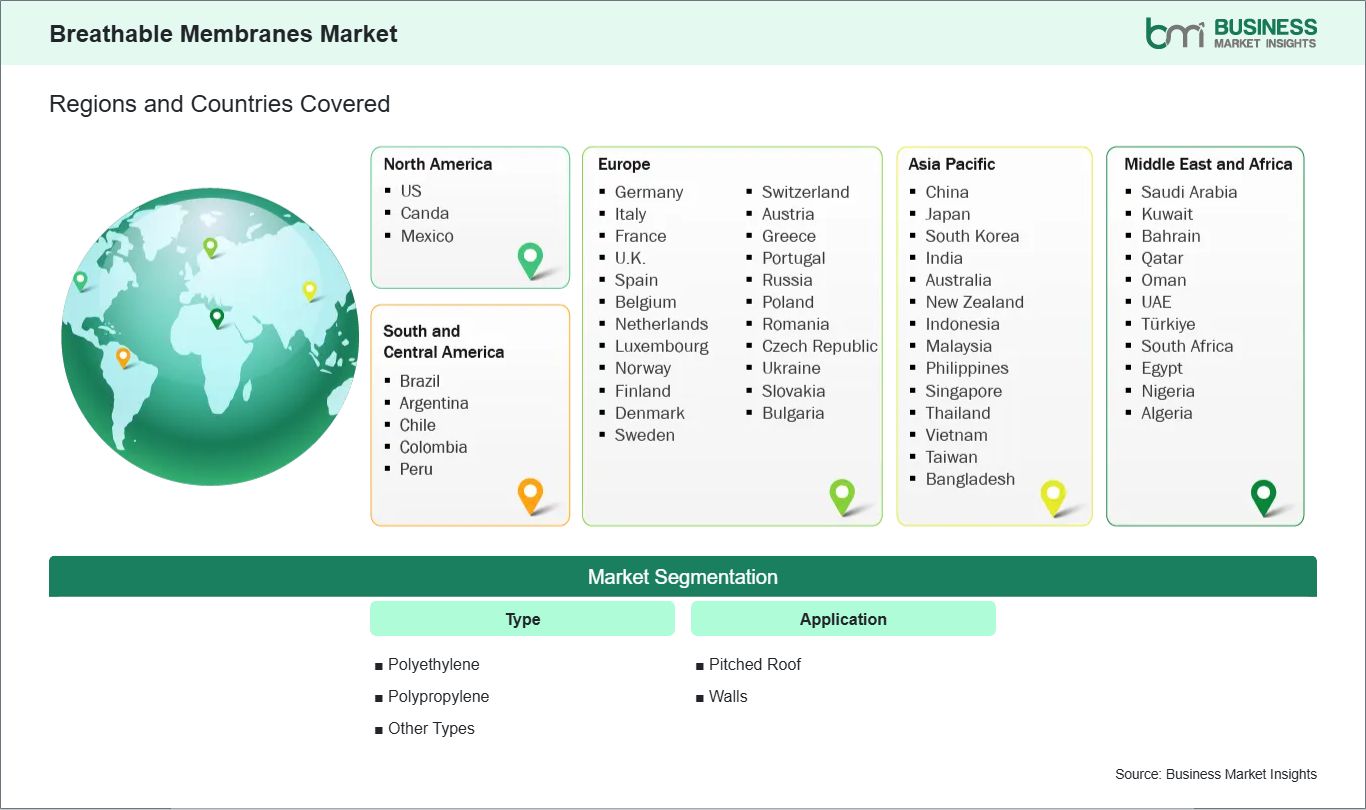
| Europe | Belgium, Austria, Finland, Denmark, Greece, Poland, Romania, Russia, Ukraine, Czech Republic, Slovakia, Bulgaria, Italy, Luxembourg, Germany, Switzerland, France, Netherlands, Norway, Portugal, Spain, Sweden, United Kingdom |
| Asia-Pacific | Australia, China, India, Japan, South Korea, Indonesia, Malaysia, Philippines, Singapore, Thailand, Vietnam, Bangladesh, New Zealand, Taiwan |
| South and Central America | Brazil, Argentina, Peru, Chile, Colombia |
| Middle East and Africa | Bahrain, Kuwait, Oman, Qatar, Saudi Arabia, United Arab Emirates, Turkiye, South Africa, Egypt, Algeria, Nigeria |
| Market leaders and key company profiles |
|
The "Breathable Membranes Market Size and Forecast (2022 - 2033)" report provides a detailed analysis of the market covering below areas:
The geographical scope of the Breathable Membranes Market report is divided into North America, Asia Pacific, Europe, Middle East & Africa, and South & Central America. North America held the largest share in 2025.
North America represents a mature market with steady demand for breathable membranes, particularly in residential construction and renovation projects. The United States and Canada are focusing on improving building energy performance and indoor air quality, which is driving the use of moisture-control solutions such as breathable membranes.
Europe market is growing due to its strong focus on energy-efficient construction and stringent building regulations. Countries such as Germany, the UK, and France have implemented strict energy performance standards that encourage the use of advanced building materials, including breathable membranes. The region’s emphasis on sustainability and green building practices is a major driver for market growth.
Asia Pacific is experiencing rapid growth, driven by urbanization and increasing construction activities in countries such as China and India. The rising demand for residential and commercial buildings, coupled with growing awareness of energy efficiency, is boosting the adoption of breathable membranes. Government initiatives promoting sustainable infrastructure development are further supporting market expansion in the region.
In the Middle East & Africa, the market is gradually expanding due to infrastructure development and increasing construction investments. Meanwhile, South & Central America is witnessing moderate growth, supported by rising urbanization and housing demand.
Across all regions, regulatory frameworks, climate conditions, and construction practices play a crucial role in shaping market dynamics. Manufacturers are adapting their product offerings to meet regional requirements, ensuring sustained growth in the global breathable membranes market.

The Breathable Membranes Market is evaluated by gathering qualitative and quantitative data post primary and secondary research, which includes important corporate publications, association data, and databases. A few of the key developments in the breathable membranes market are:
The Breathable Membranes Market is valued at US$ 2.39 Billion in 2025, it is projected to reach US$ 5.45 Billion by 2033.
As per our report Breathable Membranes Market, the market size is valued at US$ 2.39 Billion in 2025, projecting it to reach US$ 5.45 Billion by 2033. This translates to a CAGR of approximately 10.6% during the forecast period.
The Breathable Membranes Market report typically cover these key segments-
The historic period, base year, and forecast period can vary slightly depending on the specific market research report. However, for the Breathable Membranes Market report:
The Breathable Membranes Market is populated by several key players, each contributing to its growth and innovation. Some of the major players include:
The Breathable Membranes Market report is valuable for diverse stakeholders, including:
Essentially, anyone involved in or considering involvement in the Breathable Membranes Market value chain can benefit from the information contained in a comprehensive market report.
Please tell us your area of interest
(Market Segments/ Regions and Countries/ Companies)