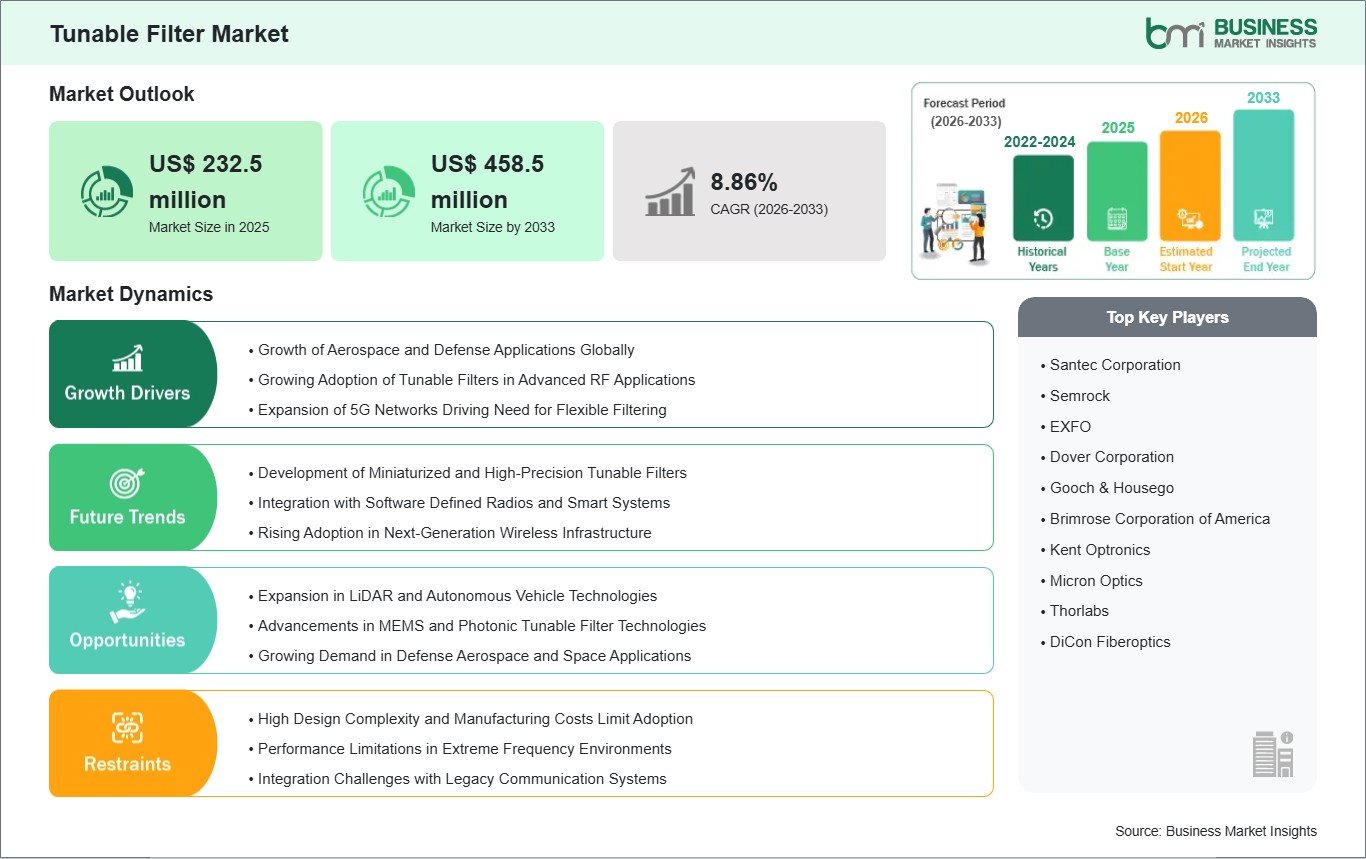
The Tunable Filter Market size is expected to reach US$ 458.5 million by 2033 from US$ 232.5 million in 2025. The market is estimated to record a CAGR of 8.86% from 2026 to 2033.
Tunable filters are in high demand across various industries due to their ability to manage wavelengths and frequencies in real time. This is unlike traditional filters that do not offer such dynamism. Various industries are adopting tunable filters due to their ability to efficiently manage signals. Telecommunications is the leading driver in this market. Various telecommunications systems, including next-generation fiber optics, 5G infrastructure, and cloud communication systems, are using tunable filters. These systems are critical in managing the rising data consumption and high-speed connectivity. Tunable filters improve the overall performance of communication systems by efficiently managing bandwidth, minimizing interference, and improving overall signal quality. These factors are critical in telecommunications systems. Other industries, including defense, aerospace, and security, are using tunable filters in radar systems, hyperspectral systems, and surveillance systems. These systems are critical in various applications due to their ability to offer high spectral accuracy.
Healthcare and scientific research areas are also increasingly using tunable filters in advanced biomedical imaging systems, spectroscopy systems, and environmental monitoring systems for greater precision and operating versatility. Progress in miniaturization technology, particularly MEMS and integrated photonics, has enabled more compact, efficient, and easier-to-integrate filter solutions, thereby expanding their usage in various areas. However, some of the factors affecting the market include high production costs, integration difficulties, and technological limitations such as temperature sensitivity and multi-component system compatibility.
However, emerging areas such as quantum communication systems, LiDAR systems for autonomous vehicles, and next-generation optical sensing systems offer tremendous opportunities for market growth, thereby making this market a vibrant and developing segment in the overall photonics and optics market.

Key segments that contributed to the derivation of the tunable filter market analysis are type, system type and application.
The global humidity sensor market is growing at a high rate due to the increasing requirements of the aerospace and defense industry. In the aerospace industry, environmental monitoring plays a key role in the efficiency of the aircraft. Humidity sensors play a critical role in the environmental control system of aircraft. They ensure the comfort of the passengers while also protecting the aircraft's sensitive electronic and mechanical systems from humidity. In the defense industry, humidity sensors play a critical role in missile systems, radar systems, and other defense systems. They ensure that the systems do not fail due to humidity. In countries like the US and European nations, major defense contractors and aircraft manufacturers are using high-precision humidity sensors in their systems. They play a critical role in the condition monitoring system. They ensure that the systems do not fail due to humidity. They also ensure that the systems operate at high efficiency. In the defense industry, the demand for humidity sensors that can operate in extreme temperatures, high altitudes, and humidity levels has led to innovation in sensor technology.
Emerging markets in Asia Pacific and the Middle East are also contributing to the overall global market by investing in aerospace infrastructure and defense systems. Countries such as India, Korea, and Saudi Arabia are equipping their new fleets and critical infrastructure with advanced environmental sensing systems. This is not just creating a larger market for critical humidity sensor systems but is also driving global suppliers to improve their support, manufacturing, and service offerings in these regions.
The development of autonomous vehicle technology and LiDAR technology is creating new growth opportunities for humidity sensors across the world. Humidity measurement plays a critical role in maintaining the efficiency of LiDAR technology and other optical sensor systems, as humidity and fog can affect the efficiency of the systems. Humidity sensors play a critical role in providing real-time information to ensure the efficient operation of autonomous vehicle technology in different weather conditions.
Car manufacturers and technology developers in Europe and North America use high-precision humidity sensors in multi-sensor fusion systems. These sensors ensure the efficiency of LiDAR technology, radar technology, and camera systems in different weather conditions. With the advancement of autonomous driving technology, the need to develop environmental sensors that ensure the best performance continues to grow. In other areas, like robots, drones, and unmanned aerial systems (UAS), humidity sensors have been used to ensure stability and precision in system operation. In terms of geographic location, the Asia Pacific region remains a hub for innovation in the use of LiDAR technology integrated with environmental sensors. Countries like China, Japan, and Korea have been at the forefront in advancing research in LiDAR technology integrated with environmental sensors. This underlines the importance of humidity sensors in the development of future autonomous systems.
The tunable filter market demonstrates steady growth, with size and share analysis highlighting evolving trends and competitive dynamics among key players. The report examines subsegments categorized within type, system type and application, offering insights into their contribution to overall market performance.
By type, the liquid crystal tunable filters (LCTFs) subsegment dominated the market in 2025, driven by their high wavelength selectivity, fast tunability, and wide use in imaging and spectroscopy applications.
Based on system type, the commercial subsegment dominated the market in 2025, driven by strong demand from commercial spectrometers, avionics, and industrial inspection systems, which contribute to larger market adoption than military systems.
On the basis of application, the commercial subsegment dominated the market in 2025, driven by extensive deployment in industrial, research, and surveillance applications that require precise and reliable tunable filtering solutions.
| Report Attribute | Details |
|---|---|
| Market size in 2025 | US$ 232.5 million |
| Market Size by 2033 | US$ 458.5 million |
| Global CAGR (2026 - 2033) | 8.86% |
| Historical Data | 2022-2024 |
| Forecast period | 2026-2033 |
| Segments Covered | By Type
|
|
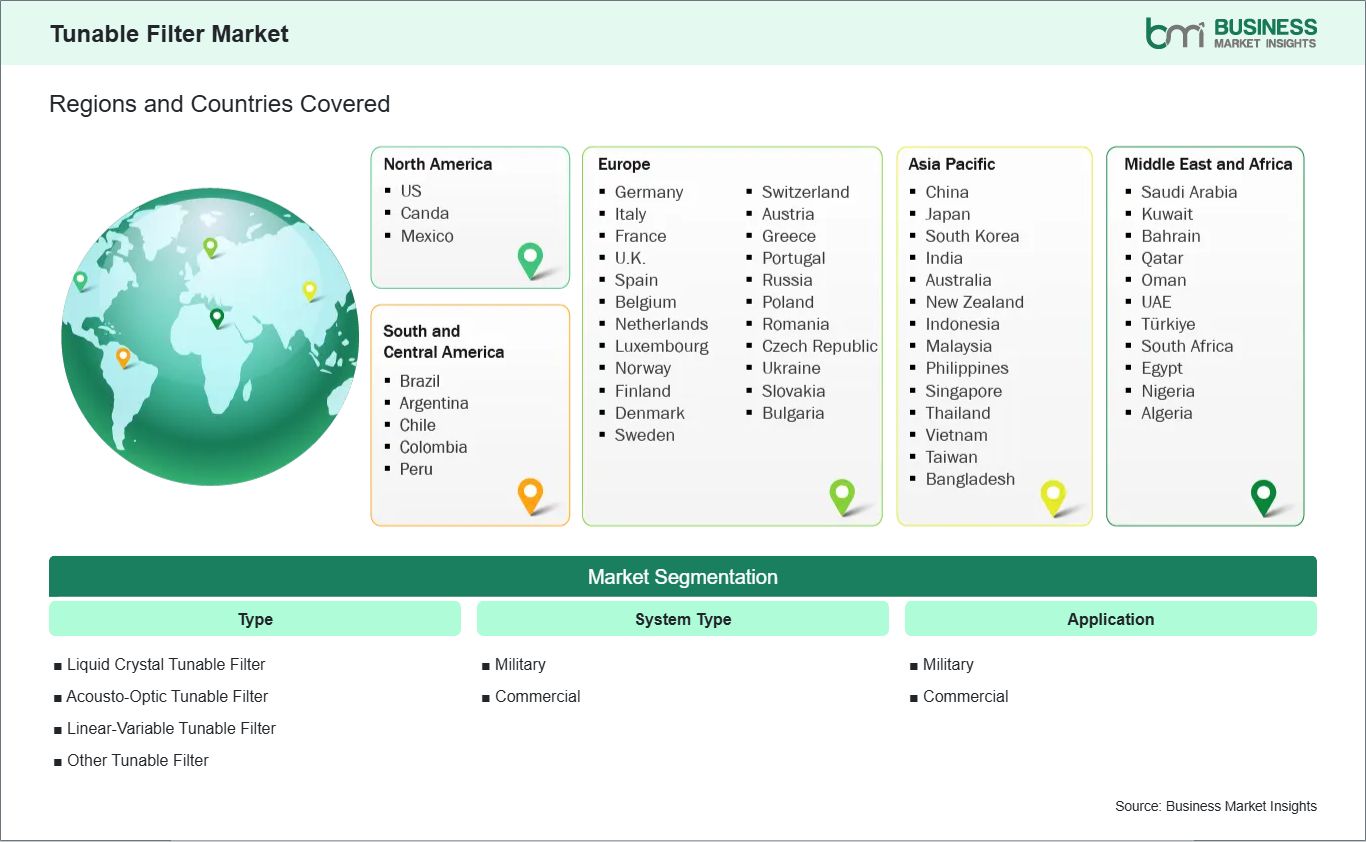
Regions and Countries Covered
| |
| North America | US, Canada, Mexico |
| Europe | Belgium, Austria, Finland, Denmark, Greece, Poland, Romania, Russia, Ukraine, Czech Republic, Slovakia, Bulgaria, Italy, Luxembourg, Germany, Switzerland, France, Netherlands, Norway, Portugal, Spain, Sweden, United Kingdom |
| Asia-Pacific | Australia, China, India, Japan, South Korea, Indonesia, Malaysia, Philippines, Singapore, Thailand, Vietnam, Bangladesh, New Zealand, Taiwan |
| South and Central America | Brazil, Argentina, Peru, Chile, Colombia |
| Middle East and Africa | Bahrain, Kuwait, Oman, Qatar, Saudi Arabia, United Arab Emirates, Turkiye, South Africa, Egypt, Algeria, Nigeria |
| Market leaders and key company profiles |
|
The "Tunable Filter Market Size and Forecast (2022 - 2033)" report provides a detailed analysis of the market covering below areas:
The geographical scope of the Tunable Filter Market report is divided into North America, Asia Pacific, Europe, Middle East & Africa, and South & Central America. North America held the largest share in 2025.
The market for Tunable Filter Market has shown significant diversification, with North America dominating the global market due to its advanced technology infrastructure, well-developed telecommunication network, and presence of prominent market players investing heavily in R&D activities. The United States and Canada are at the forefront of adopting tunable filters for various applications, including 5G communications, aerospace, defense, and medical imaging.
Europe is another prominent market for tunable filters, with significant investment in photonics, industrial automation, and modernizing its defense capabilities. Countries such as Germany, the UK, and France are increasingly using tunable filters for developing precise optical and telecommunication systems.
The Asia-Pacific market is showing significant growth potential due to increased growth in telecommunication infrastructure, adoption of 5G technology, and industrial automation in countries such as China, Japan, South Korea, and India. Concurrently,
the market in the Middle East & Africa region is smaller but rising steadily, with nations such as the UAE, Saudi Arabia, and South Africa increasingly investing in smart city technologies, advanced communications systems, and defense systems that incorporate tunable filter technologies.
The South & Central America market reflects a moderate growth trend, mainly driven by Brazil and Argentina, due to increased telecom network rollouts and a gradually rising rate of digitalization in their industrial sector, even though their market share is low compared to North America and Europe.
Thus, these regional market trends indicate a global tunable filter market that is dominated by innovation and adoption in North America, with robust secondary markets in Europe and Asia Pacific, and rising incremental growth in the Middle East & Africa and South & Central America regions.

The Tunable Filter Market is evaluated by gathering qualitative and quantitative data post primary and secondary research, which includes important corporate publications, association data, and databases. A few of the key developments in the tunable filter market are:
The Tunable Filter Market is valued at US$ 232.5 million in 2025, it is projected to reach US$ 458.5 million by 2033.
As per our report Tunable Filter Market, the market size is valued at US$ 232.5 million in 2025, projecting it to reach US$ 458.5 million by 2033. This translates to a CAGR of approximately 8.86% during the forecast period.
The Tunable Filter Market report typically cover these key segments-
The historic period, base year, and forecast period can vary slightly depending on the specific market research report. However, for the Tunable Filter Market report:
The Tunable Filter Market is populated by several key players, each contributing to its growth and innovation. Some of the major players include:
The Tunable Filter Market report is valuable for diverse stakeholders, including:
Essentially, anyone involved in or considering involvement in the Tunable Filter Market value chain can benefit from the information contained in a comprehensive market report.
Please tell us your area of interest
(Market Segments/ Regions and Countries/ Companies)