Market Summary
Executive Summary and Global Market Analysis
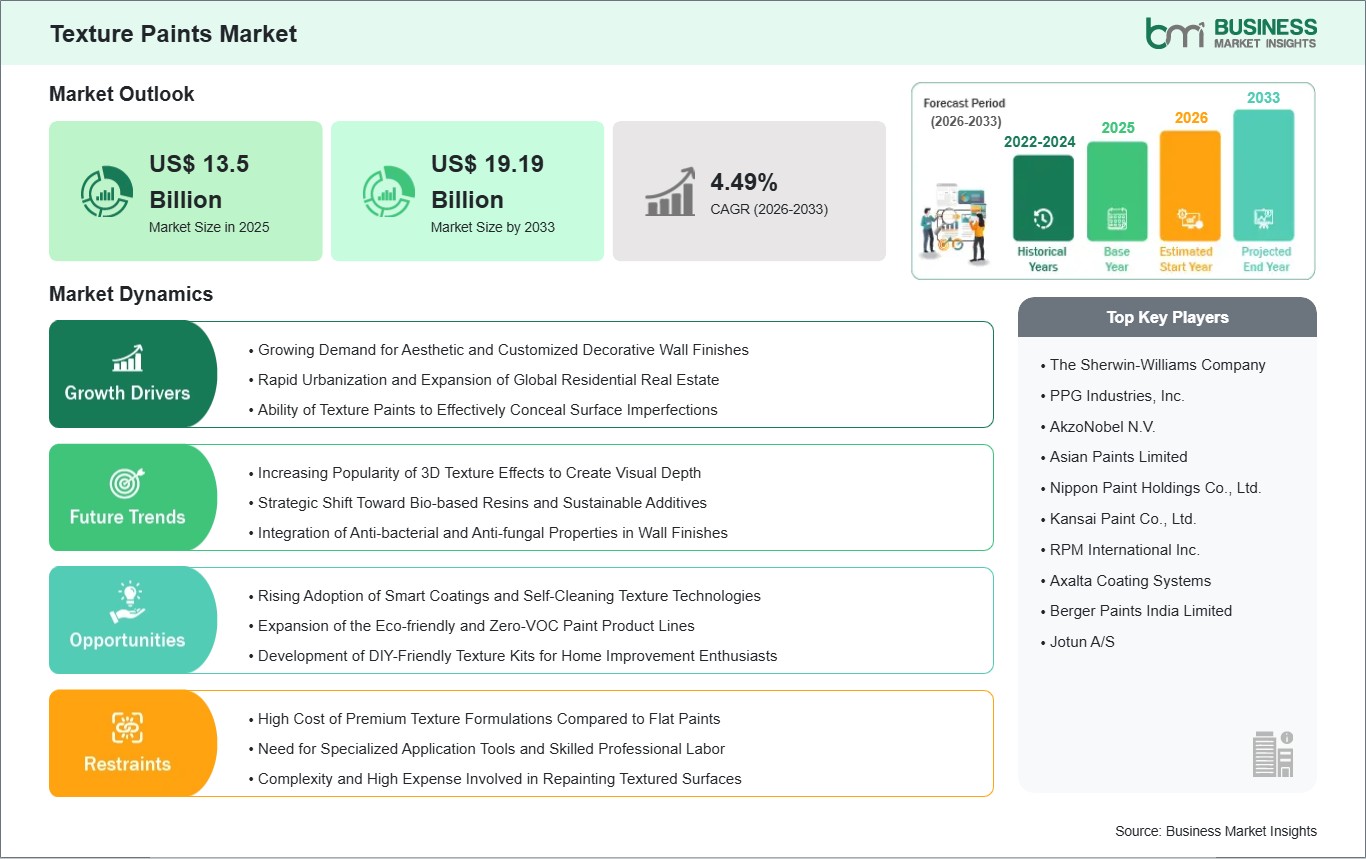
The global texture paints market has seen significant growth, attributed to the combined effect of urbanization and the changing demand for premium textures. With the rise in the global middle-class population, especially in the Asia Pacific and North America regions, spending on home textiles has reached a historical high. Texture paints have become popular as they provide not only aesthetic and tactile appeal but also functional benefits. However, the texture paint market is witnessing a major transformation in terms of water-based technology, due to environmental regulations and the awareness of indoor air quality.
Innovation remains the primary differentiator for key market players, who are increasingly focusing on specialized resins and sustainable additives to meet the demands of the modern green building sector. While the residential segment continues to be the dominant revenue driver, the commercial and hospitality industries are increasingly adopting textured finishes to create distinctive brand environments. Challenges such as high application costs and the requirement for professional skill sets persist; however, the rise of DIY-friendly products is helping to democratize the market. Overall, the industry is poised for steady expansion as it integrates digital color matching and smart-coating functionalities into its core offerings.
Segment Analysis
Texture Paints Market Segmentation
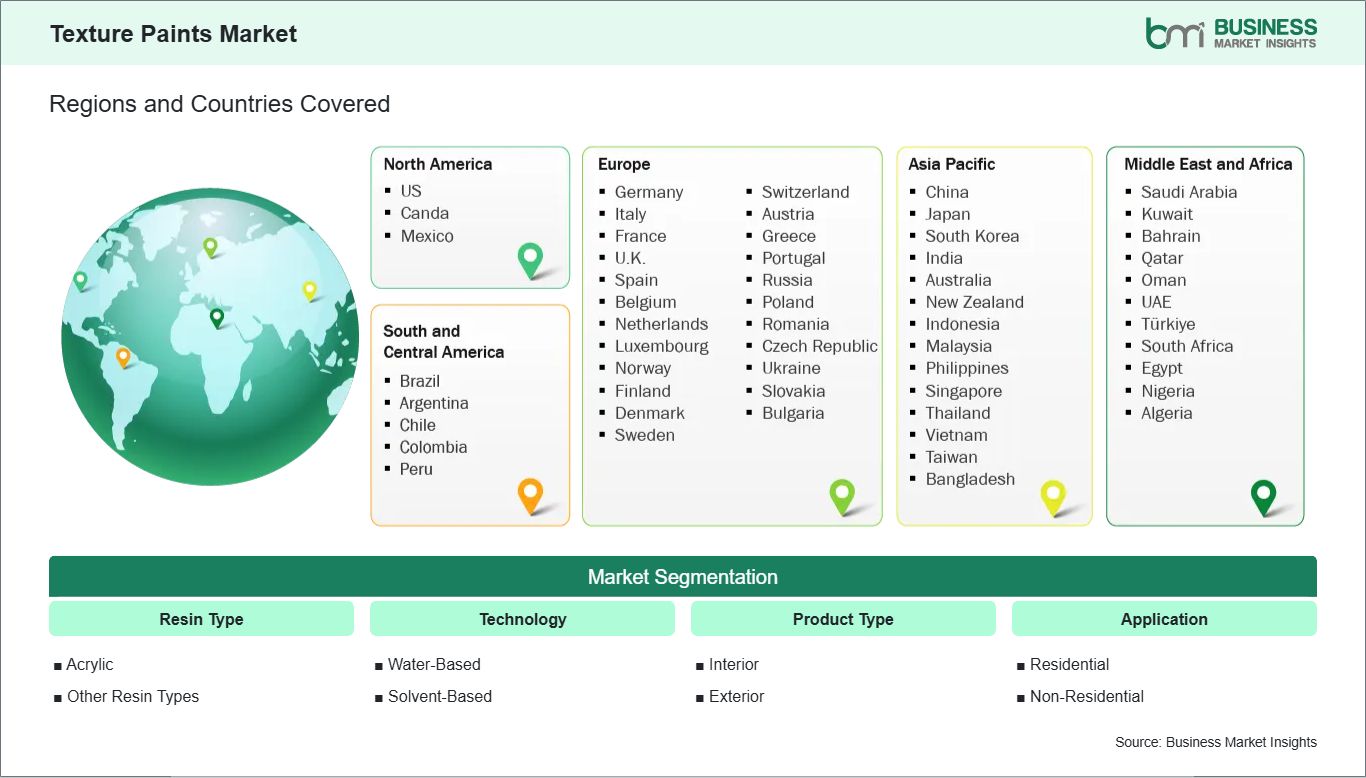
Key segments that contributed to the derivation of the Texture Paints market analysis are resin type, technology, product type, and application.
- By resin type, the texture paints market is segmented into Acrylic and Others. The Acrylic segment dominated the market in 2025.
- By technology, the texture paints market is segmented into Water-Based and Solvent-Based. The Water-Based segment dominated the market in 2025.
- By product type, the texture paints market is segmented into Interior and Exterior. The Interior segment dominated the market in 2025.
- By application, the texture paints market is segmented into Residential and Non-Residential. The Residential segment dominated the market in 2025.
Market Forces
Texture Paints Market Drivers and Opportunities
Growing Demand for Aesthetic and Customized Decorative Wall Finishes
The change in consumer behavior from a simple choice of colors to a more complex experience of textures is a significant driver for the texture paints market. Today`s home owners and interior designers do not consider the walls as a boundary that needs to be painted; rather, they consider them as a canvas that expresses their personality. Texture paints provide a unique range of finishes that can be achieved, such as sand, stucco, and metallic finishes, giving a three-dimensional dimension that flat paints cannot provide. The trend towards 'luxury for less' enables home owners to mimic high-end architectural finishes such as stone or distressed wood, resulting in a high volume of the decorative coating market.
Apart from this, the use of unique textures has also found applications in the commercial and hospitality industries. Hotels, restaurants, and showrooms use specific textures to create a welcoming ambiance or to convey a luxurious feel. Such requirements are also being fulfilled due to advances in color science and pigment stability, ensuring that these complex textures do not lose their colors over time. With social media platforms increasingly affecting home decor trends, the desire for visually appealing and ‘Instagram-worthy’ interiors ensures a constant demand for customized textures among different demographics.
Rising Adoption of Smart Coatings and Self-Cleaning Texture Technologies
For those involved in the decorative finish market, the combining of functional intelligence with decorative finishes presents an unprecedented opportunity. A growing number of manufacturers are finding ways to integrate "intelligent" texture paints into their production processes that not only look aesthetically pleasing but also possess functional features such as being able to self-clean and air purify. Nanotechnology used in these coatings has the ability to repel water and resist dust accumulation, making it easier for exterior surfaces to appear clean without needing regular maintenance. This is especially appealing to owners and operators of high-rise buildings and urban infrastructure where it may be difficult or cost prohibitive to arrange for professional cleaning services on a regular basis. The ability to use photocatalytic technology to break down pollutants further strengthens the argument to use these paintings as active players in improving the quality of the air in urban locations.
Moreover, the development of thermal-insulating texture paints is gaining traction in regions with extreme climates. These formulations contain microspheres that reflect heat, helping to maintain indoor temperatures and reduce energy consumption for air conditioning. As green building certifications like LEED become more prevalent, the demand for such high-performance, functional textures is expected to accelerate. By merging the aesthetic appeal of traditional texture paints with advanced material science, companies can justify premium pricing and differentiate themselves in a competitive landscape. This technological evolution ensures that texture paints remain relevant in the transition toward sustainable and "living" architecture.
Size and Share Analysis
Texture Paints Market Size and Share Analysis
The global Texture Paints market is experiencing steady growth, with market size and share analysis reflecting evolving treatment preferences and competitive dynamics among key players. The report evaluates important subsegments categorized within resin type, technology, product type, and application, highlighting their respective contributions to overall market performance.
By resin type, the Acrylic subsegment dominated in 2025 due to its superior binding properties, which allow for a high degree of flexibility and resistance to cracking. Its excellent UV stability and washability make it the gold standard for creating durable, tactile finishes that maintain color integrity over time.
By technology, the Water-Based subsegment dominated in 2025 as a result of stringent global regulations regarding volatile organic compound (VOC) emissions. These formulations offer lower toxicity, reduced odor, and easier cleanup, aligning with the rising consumer preference for sustainable and health-conscious home improvement products.
By product type, the Interior subsegment dominated in 2025 driven by the intense trend toward personalized home aesthetics and feature walls. Texture paints allow homeowners to mimic expensive materials like marble, silk, or concrete at a fraction of the cost, significantly boosting demand within indoor living spaces.
By application, the Residential subsegment dominated in 2025 because of the massive surge in home renovation projects and the growth of the middle-class population in emerging economies. The desire to conceal wall imperfections and increase property value through decorative finishes makes texture paints a staple in modern housing.
Report Coverage
Texture Paints Market Report Coverage and Deliverables
The "Texture Paints Market Size and Forecast (2022 - 2033)" report provides a detailed analysis of the market covering below areas:
- Texture Paints market size and forecast at the regional and country levels for segments covered under the scope
- Texture Paints market trends, as well as drivers, restraints, and opportunities
- Texture Paints market analysis covering key trends, regional framework, major players, regulations, and recent developments
- Industry landscape and competition analysis covering market concentration, heat map analysis, prominent players, and recent developments for the Texture Paints market
- Detailed company profiles, including SWOT analysis
Geographic Insights
Texture Paints Market Geographic Insights
The geographical scope of the Texture Paints market report is divided into: North America, Asia Pacific, Europe, Middle East & Africa, and South & Central America. North America held the largest share in 2025.
North America stands as a leading force in the texture paints market, underpinned by a highly mature construction industry and a pervasive culture of home improvement and remodeling. The region`s dominance is fueled by a high per capita disposable income, which allows consumers to invest in premium, high-margin decorative products for both interior and exterior applications. The presence of global industry giants and a sophisticated distribution network ensures that the latest innovations in acrylic and water-based technologies are rapidly commercialized. Furthermore, stringent environmental regulations from agencies like the EPA have made the region a hub for the development of low-VOC and zero-emission paint formulations.
The market in North America is also uniquely influenced by a strong fixer-upper trend, supported by popular media and specialized retail chains that facilitate large-scale residential renovations. While new construction remains a factor, the refurbishment of aging housing stock in suburban areas provides a consistent demand for texture paints to refresh and modernize outdated surfaces. Additionally, the commercial real estate sector in the United States and Canada utilizes advanced textured coatings to meet high standards of durability and aesthetic differentiation in office spaces and retail hubs. As the region continues to embrace sustainable architecture, the integration of energy-efficient and insulating textures is expected to further solidify North America`s top-tier market position.
Industry Activity
Recent Developments
The Texture Paints market is evaluated by gathering qualitative and quantitative data post primary and secondary research, which includes important corporate publications, association data, and databases. A few of the key developments in the Texture Paints market are:
- In December 2023, Nippon Paint Holdings, announced that it acquired Vibgyor Paints and Chemicals Pvt. Ltd. to strengthen its industrial coatings and decorative paint portfolio in India, supporting expansion in texture and specialty coatings.
- In July 2023, DAP Global Inc., announced the launch of a new spray texture paint product line featuring adjustable nozzle technology for improved application across walls and ceilings.
- In 2023, Sherwin-Williams, announced continued investments in customer-focused innovation and growth within its architectural coatings segment, including advanced decorative and textured coating solutions.
Trust & Transparency
Research Methodology
The market analysis combines proprietary research with secondary data from government agencies, company disclosures, regulatory filings, industry databases and expert interviews. Market estimates are validated through data triangulation, cross-market benchmarking and analyst
review.
View Full Research Methodology
Key Sources Referred:
Paint and Decorating Contractors of America (PDCA)American Coatings Association (ACA)European Coatings Association (CEPE)Indian Paint Association (IPA)China National Coatings Industry Association (CNCIA)Japan Paint Manufacturers Association (JPMA)Brazilian Paint Manufacturers Association (ABRAFATI)Company WebsitesCompany Annual ReportsCompany Investor Presentations