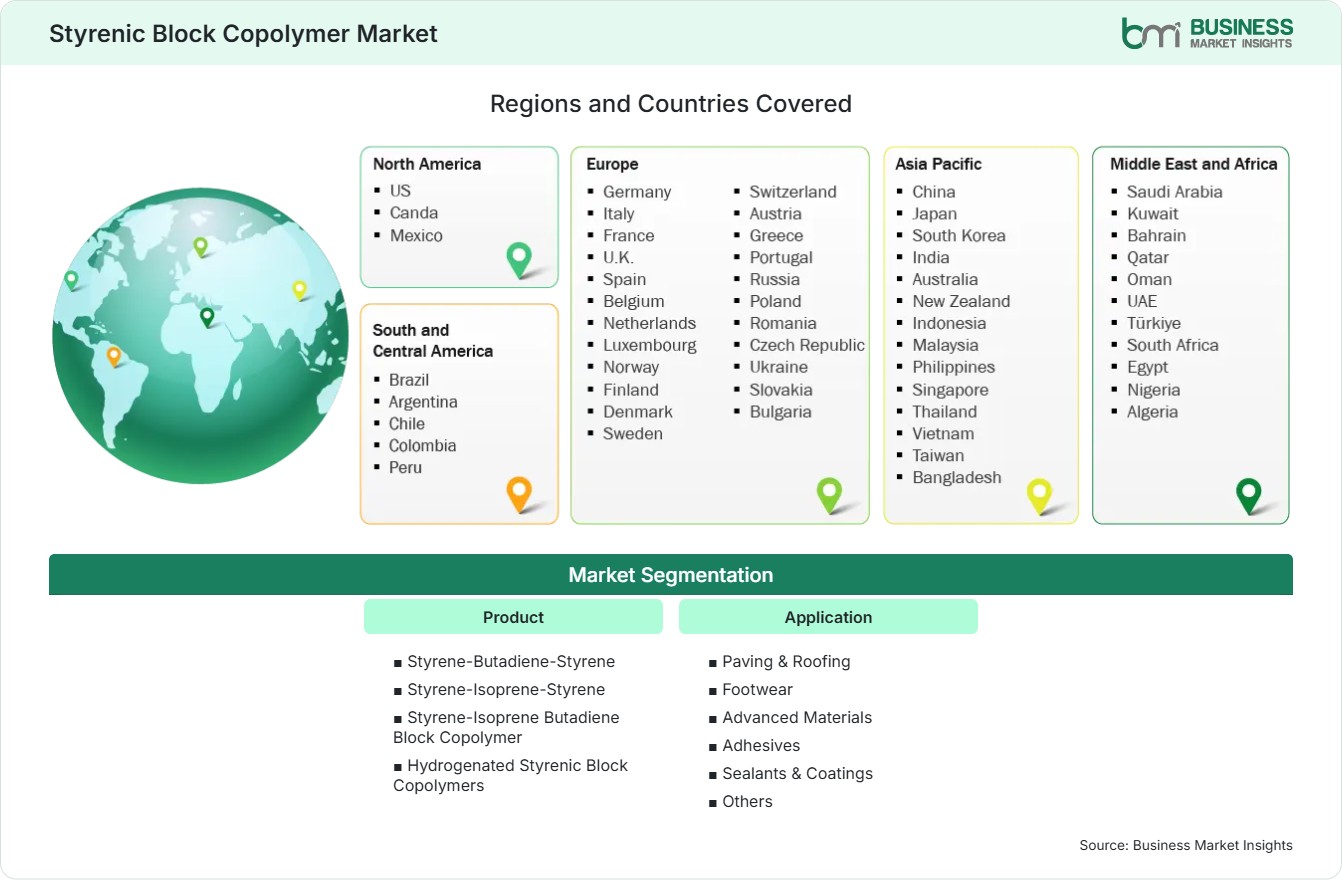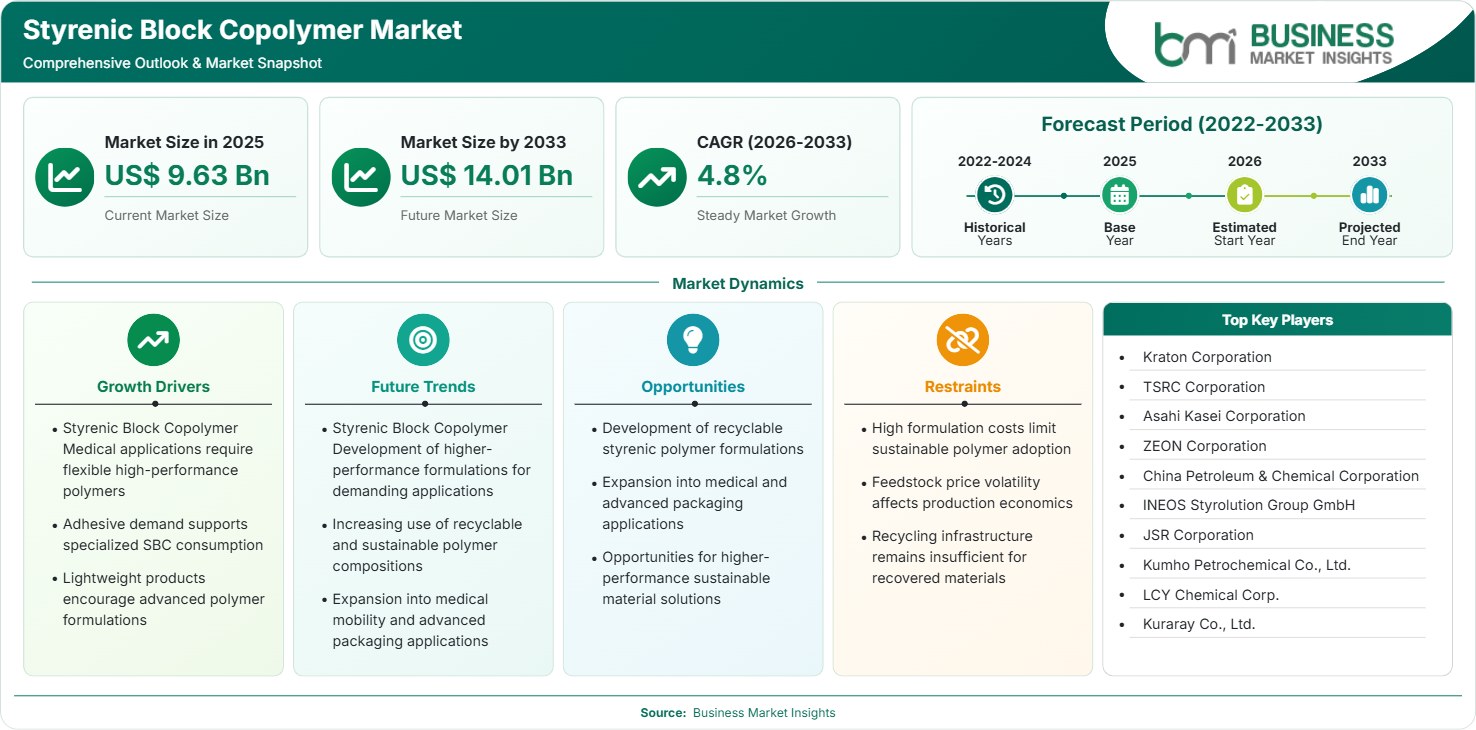
Styrenic Block Copolymer Market Regional Highlights
North America Styrenic Block Copolymer Market
North America represents a 21%–24% share in 2025 and is projected to grow at a 4.2%–4.6% CAGR through 2033. Demand centers on roofing, paving, adhesives, footwear, healthcare, and advanced elastomers. The U.S. dominates consumption, while Canada and Mexico provide additional infrastructure and manufacturing opportunities. Durable roofing, medical materials, and specialty compounds support premium grades. Domestic supply, technical service, and formulation consistency remain important as logistics face geopolitical and freight risks.
- Modified bitumen remains a core outlet because SBS improves elasticity, fatigue resistance, deformation control, and temperature performance in roofing and paving formulations.
- Healthcare converters increasingly evaluate the Styrenic Block Copolymer Market for tubing, films, bags, and flexible components requiring processability and plasticizer-free designs.
- Automotive and consumer manufacturers use HSBC compounds for soft-touch surfaces, seals, damping components, and flexible parts requiring durability.
- Established petrochemical infrastructure supports regional supply resilience, while qualification requirements limit rapid supplier switching.
US Styrenic Block Copolymer Market
The U.S. Styrenic Block Copolymer Market represents 88%–92% of North American demand in 2025 and grows at a 4.3%–4.6% CAGR through 2033. Roofing replacement, infrastructure, medical conversion, footwear, adhesives, and consumer products sustain demand. Feedstock availability and advanced polymer processing strengthen the ecosystem. Demand favors grades delivering longer service life, efficient processing, and recycling compatibility. Premium HSBC adoption should outpace commodity applications as manufacturers prioritize durability, compliance, lightweighting, and specialized performance across healthcare, mobility, electronics, and consumer applications.
- Roofing and paving benefit from infrastructure replacement requirements where polymer modification improves durability and temperature performance.
- Medical converters are assessing SBC architectures for tubing, films, bags, and flexible components supporting product redesign.
- Advanced converter and healthcare ecosystems make the U.S. attractive for specialty-grade development, qualification, and application engineering.
Europe Styrenic Block Copolymer Market
Europe accounts for a 22%–25% share in 2025 and is forecast to expand at a 4.0%–4.4% CAGR through 2033. Germany, Italy, France, and the United Kingdom remain major markets, while Poland and Spain provide higher-growth opportunities. Sustainability regulation is reshaping procurement toward recyclable designs, durable construction materials, lower-carbon feedstocks, and longer product lifecycles. High energy costs favor specialty grades and technical support. Construction renovation, automotive interiors, medical products, adhesives, and advanced materials remain important outlets.
- Germany leads regional industrial demand through automotive, construction, engineering plastics, and specialty polymer processing.
- Italy provides opportunities in footwear, adhesives, flexible materials, and polymer conversion, while Spain benefits from construction and consumer manufacturing.
- The United Kingdom offers opportunities in healthcare, packaging, adhesives, and advanced materials requiring documented performance.
- European sustainability requirements favor HSBC and recyclable formulations supported by traceable feedstocks and lifecycle documentation.
Asia Pacific Styrenic Block Copolymer Market
Asia Pacific holds a 34%–38% Styrenic Block Copolymer Market share in 2025 and records the fastest regional trajectory at a 4.8%–5.3% CAGR through 2033. China remains the largest market, while India, Indonesia, Thailand, and Vietnam provide strong opportunities. Demand reflects footwear, construction, automotive manufacturing, consumer electronics, packaging, and healthcare conversion. Regional feedstock availability and manufacturing scale support competitive production. Localized capacity, inventories, technical services, and application development will increasingly influence supplier selection.
- China remains the volume leader because of extensive footwear, infrastructure, adhesive, automotive, and polymer-processing capacity.
- India combines footwear, infrastructure, healthcare, and consumer manufacturing, creating opportunities for established grades and specialty HSBC applications.
- Indonesia, Thailand, and Vietnam benefit from manufacturing relocation, footwear exports, construction, and consumer-product conversion.
- Japan and South Korea remain technology-intensive markets focused on electronics, medical applications, advanced compounding, and premium HSBC grades.
Rest of World Styrenic Block Copolymer Market
South and Central America provide developing opportunities through road construction, roofing, footwear, packaging, and adhesives. Brazil remains the leading market, while Mexico-linked supply chains influence regional availability. Demand is projected at a 4.0%–4.5% CAGR through 2033 as infrastructure and consumer manufacturing expand.
The Middle East and Africa offer opportunities in construction, waterproofing, footwear, healthcare, and industrial conversion. Saudi Arabia and the UAE lead regional investment, while South Africa provides a diversified manufacturing base. Regional demand is forecast at a 4.1%–4.6% CAGR through 2033.
- Brazil provides the strongest South American opportunity through infrastructure, footwear, roofing, adhesives, and domestic manufacturing.
- Saudi Arabia and the UAE benefit from construction investment, industrial diversification, logistics infrastructure, and petrochemical integration.
- South Africa remains relevant for roofing, footwear, packaging, automotive components, and industrial applications.
- Local inventories, technical distribution, and application support can improve competitiveness against international suppliers.