
Special Mission Aircraft Market Outlook: Size, Share, Trends, Growth Analysis, Competitive Landscape & Forecast, 2026-2033

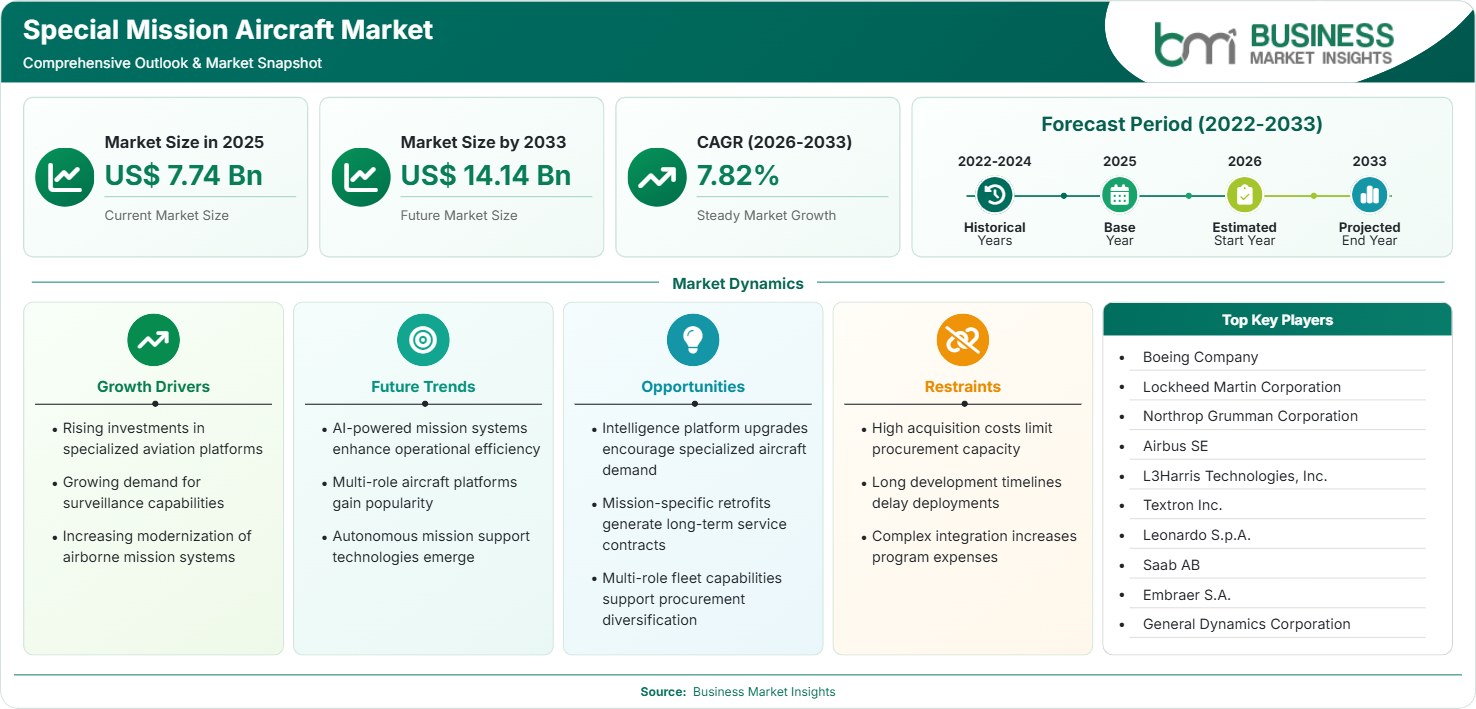
The Special Mission Aircraft Market size was valued at US$ 7.74 billion in 2025 and is projected to reach US$ 14.14 billion by 2033, expanding at a CAGR of 7.82% during 2026–2033. Rising investments in specialized aviation platforms, growing surveillance requirements, and continuous modernization of airborne mission systems are supporting long-term market expansion across defense and homeland security sectors.

Report Coverage
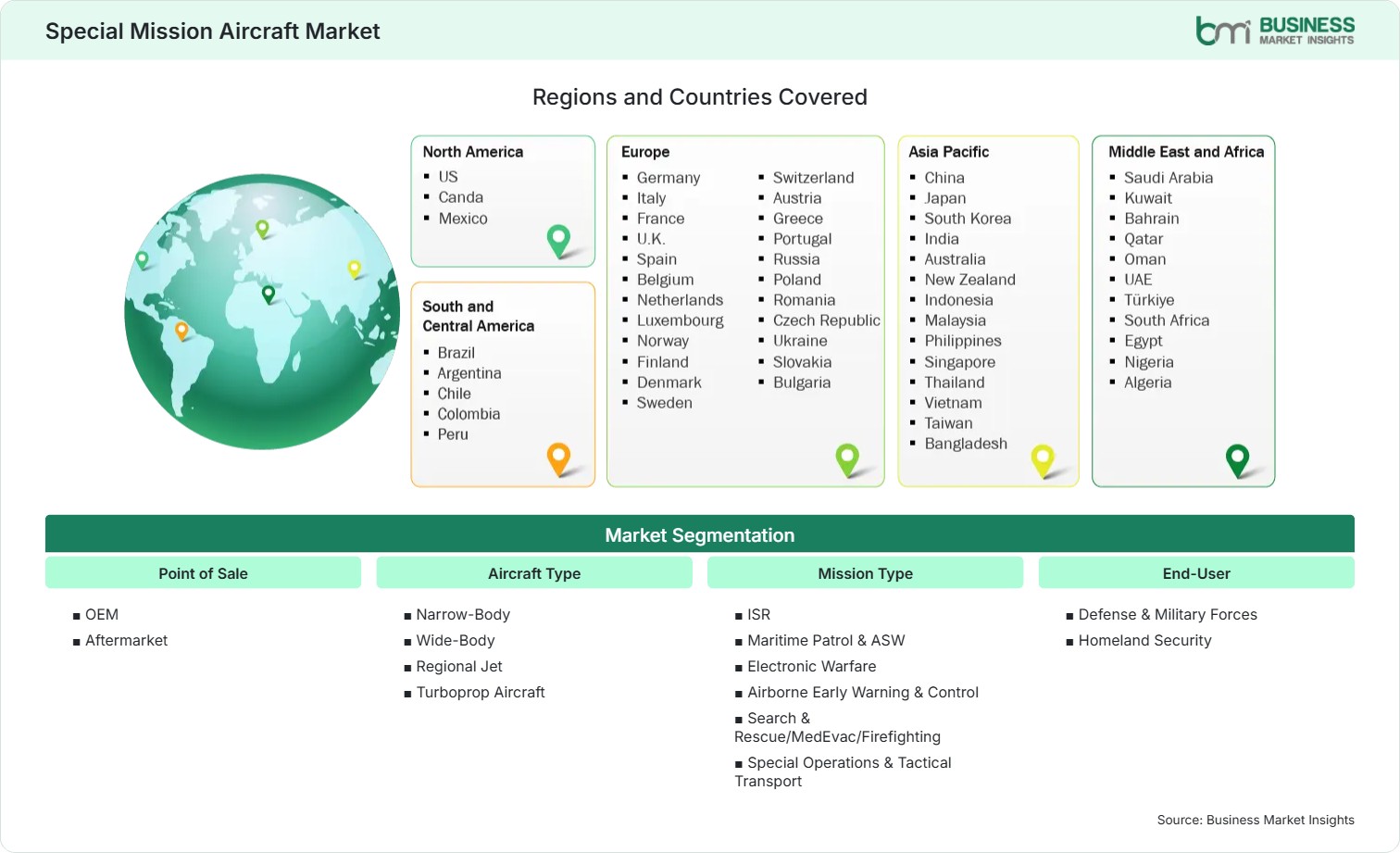
  • Point of Sale: OEM, Aftermarket
  • Aircraft Type: Narrow-Body, Wide-Body, Regional Jet, Turboprop Aircraft
  • Mission Type: ISR, Maritime Patrol & ASW, Electronic Warfare, Airborne Early Warning & Control, Search & Rescue/MedEvac/Firefighting, Special Operations & Tactical Transport
  • End-User: Defense & Military Forces, Homeland Security
US$ 7.74 Bn Market size in 2025
US$ 14.14 Bn Market Size by 2033
7.82% CAGR, 2026 - 2033
2026-2033 Forecast Period

AI Overview

Special Mission Aircraft Market Summary

  • North America Region: North America accounts for 37%–40% market share in 2025 and is expected to register a CAGR of 7.4%–7.9% during 2026–2033. Strong defense budgets, continuous fleet modernization, and investments in ISR and electronic warfare capabilities continue supporting regional demand. The U.S. remains the largest contributor with a CAGR of 7.5%–8.0%, supported by ongoing procurement and aircraft upgrade programs.
  • Fastest Growing Region: Asia Pacific holds 25%–28% market share in 2025 and is forecast to expand at a CAGR of 8.5%–9.1%, driven by regional security concerns, defense modernization initiatives, and increasing procurement of surveillance and maritime patrol aircraft.
  • Leading Segment: Defense & Military Forces account for 73%–76% market share in 2025 and are projected to grow at a CAGR of 7.8%–8.3%, supported by expanding intelligence operations, border monitoring, and mission readiness requirements.
  • High Growth Segment: ISR (Intelligence, Surveillance, Reconnaissance) represents 29%–32% market share in 2025 and is anticipated to register a CAGR of 8.4%–9.0%, reflecting increasing demand for persistent surveillance, real-time intelligence, and network-centric military operations.
  • Key Market Opportunity: Growing investments in multi-role aircraft, digital mission systems, and next-generation surveillance technologies are creating opportunities for OEMs and defense integrators delivering flexible mission-specific aviation platforms.
  • Major Market Players: Boeing Company, Lockheed Martin Corporation, Northrop Grumman Corporation, Airbus SE, L3Harris Technologies, Inc., Textron Inc., Leonardo S.p.A., Saab AB, Embraer S.A., and General Dynamics Corporation.
Strategic Insights

Special Mission Aircraft Market: Strategic Insights

Special Mission Aircraft Market Strategic Framework
FREE PDF
Request your free sample
Request free sample
Stakeholder View

Key Takeaways

  • Demand is increasingly shifting toward multi-role aircraft capable of performing intelligence, surveillance, reconnaissance, maritime patrol, and electronic warfare missions using common airframes.
  • Retrofit programs represent an attractive revenue opportunity as governments modernize existing aircraft instead of replacing entire fleets with new platforms.
  • Advanced mission systems integrating artificial intelligence, secure communications, and sensor fusion are becoming major competitive differentiators among defense contractors.
  • Asia Pacific continues to present the strongest long-term procurement opportunity due to rising defense expenditure, territorial security concerns, and fleet modernization initiatives.
  • Strategic partnerships between aircraft manufacturers, avionics suppliers, and defense electronics companies are accelerating development of integrated mission-ready aircraft platforms.
  • Lifecycle support, maintenance, software upgrades, and mission system integration services are becoming increasingly important revenue sources beyond initial aircraft procurement.
Geographic Outlook

Special Mission Aircraft Market Regional Highlights

North America Special Mission Aircraft Market

North America represents 37%–40% Special Mission Aircraft Market share in 2025 and is expected to record a CAGR of 7.4%–7.9% during 2026–2033. The region benefits from sustained defense spending, strong aerospace manufacturing capabilities, and continuous investment in intelligence, surveillance, reconnaissance, and electronic warfare programs. Procurement of advanced airborne platforms and modernization of existing fleets continue supporting long-term market expansion.

  • Defense agencies continue investing in advanced airborne ISR, AEW&C, and maritime surveillance aircraft to improve operational readiness and strategic intelligence capabilities.
  • Modernization programs increasingly integrate artificial intelligence, secure communications, and advanced radar technologies into existing mission aircraft fleets.
  • Aerospace manufacturers continue collaborating with defense organizations to accelerate delivery of mission-specific aircraft platforms.
  • Expansion of homeland security programs supports demand for surveillance aircraft dedicated to border protection and disaster response operations.

US Special Mission Aircraft Market

The United States contributes 82%–85% of North American revenue and is projected to expand at a CAGR of 7.5%–8.0% during 2026–2033. Ongoing military modernization, strong aerospace capabilities, and investment in advanced airborne intelligence systems continue strengthening domestic demand.

  • Continuous procurement of ISR and electronic warfare aircraft supports defense modernization objectives.
  • Investments in digital mission systems improve operational effectiveness and mission flexibility.
  • Defense contractors continue developing next-generation surveillance and reconnaissance platforms.
  • Long-term maintenance and aircraft upgrade contracts remain an important source of industry revenue.

Europe Special Mission Aircraft Market

Europe accounts for 24%–27% market share in 2025 and is forecast to grow at a CAGR of 7.3%–7.8% throughout the forecast period. Rising defense cooperation, modernization of airborne surveillance capabilities, and increasing investment in NATO interoperability continue supporting regional growth. The United Kingdom leads procurement activity, while Poland records the fastest expansion through accelerated defense modernization programs.

  • NATO capability enhancement programs encourage procurement of interoperable airborne surveillance platforms.
  • Governments continue investing in maritime patrol and border security aircraft.
  • Collaborative defense projects strengthen regional aerospace manufacturing capabilities.
  • Electronic warfare modernization remains a strategic priority across several European defense programs.

Asia Pacific Special Mission Aircraft Market

Asia Pacific holds 25%–28% market share in 2025 and is projected to register the fastest 8.5%–9.1% CAGR during 2026–2033. Growing geopolitical tensions, increasing maritime surveillance requirements, and expanding defense budgets continue driving procurement of specialized aircraft. China represents the largest regional market, while India records the fastest growth owing to ongoing military modernization initiatives.

  • Border security and maritime surveillance remain major procurement priorities across the region.
  • Indigenous aerospace manufacturing programs continue supporting domestic aircraft development.
  • Governments increasingly acquire multi-role aircraft capable of performing diverse operational missions.
  • Investments in airborne early warning and reconnaissance systems continue expanding regional capabilities.

Rest of World Special Mission Aircraft Market

The Rest of World region represents 8%–11% market share in 2025 and is anticipated to grow at a CAGR of 7.6%–8.2% during 2026–2033. Demand is supported by defense modernization initiatives, maritime security requirements, and expanding border surveillance capabilities across Latin America, the Middle East, and Africa.

  • Saudi Arabia continues investing in airborne surveillance and defense modernization programs.
  • Brazil strengthens regional capabilities through procurement of multi-role mission aircraft.
  • Maritime patrol aircraft remain a procurement priority for coastal security operations.
  • Governments increasingly prioritize aircraft upgrades that extend fleet service life while reducing procurement costs.
Global Market Geography
FREE PDF
Request your free sample
Request free sample
Segment Analysis

Special Mission Aircraft Market Segmentation

Point of Sale

The point of sale segment reflects increasing investments in both new aircraft procurement and long-term fleet sustainment programs. It accounted for 58%–61% market share in 2025 and is projected to expand at a CAGR of 7.6%–8.1% during 2026–2033. Rising defense modernization programs and lifecycle support requirements continue to broaden the Special Mission Aircraft Market scope, encouraging manufacturers to strengthen production capabilities alongside comprehensive aftermarket service networks.

  • OEM: Remains the dominant channel as governments procure newly manufactured mission aircraft equipped with advanced sensors, integrated avionics, secure communications, and mission-specific systems supporting evolving operational requirements.
  • Aftermarket: Continues expanding through aircraft upgrades, mission system integration, maintenance, component replacement, software modernization, and lifecycle support programs that extend operational capability while reducing fleet replacement costs.

Aircraft Type

Aircraft selection depends on operational range, payload capacity, mission endurance, and deployment flexibility. This segment represented 34%–37% market share in 2025 and is expected to register a CAGR of 7.7%–8.2% during 2026–2033. Continued procurement of adaptable aircraft platforms capable of supporting multiple operational missions remains a major factor driving market expansion.

  • Narrow-Body: Widely utilized for airborne surveillance, maritime patrol, intelligence gathering, and command missions because they provide favorable operating economics, flexible configurations, and extended operational capability.
  • Wide-Body: Preferred for long-range surveillance, airborne command centers, strategic transport, and missions requiring greater payload capacity, mission endurance, and advanced onboard systems integration.
  • Regional Jet: Increasingly selected for homeland security, border surveillance, electronic intelligence, and rapid-response operations owing to operational flexibility and lower acquisition costs.
  • Turboprop Aircraft: Frequently deployed for maritime patrol, search and rescue, environmental monitoring, and border surveillance due to excellent fuel efficiency, lower operating expenses, and extended low-speed mission performance.

Mission Type

Mission-specific aircraft continue evolving as defense organizations seek flexible platforms capable of supporting increasingly complex operational environments. This segment accounted for 29%–32% market share in 2025 and is forecast to register a CAGR of 8.4%–9.0% through 2026–2033. Current Special Mission Aircraft Market trends indicate growing investment in advanced intelligence systems, electronic warfare capabilities, and integrated command platforms.

  • ISR (Intelligence, Surveillance, Reconnaissance): Represents the largest application, providing persistent intelligence collection, target monitoring, border surveillance, and real-time battlefield awareness using advanced sensors and communication systems.
  • Maritime Patrol & ASW (Anti-Submarine Warfare): Supports coastal surveillance, submarine detection, maritime security, and protection of strategic sea lanes through specialized radar, sonar, and mission equipment.
  • Electronic Warfare (SIGINT/ELINT/COMINT): Enables interception, monitoring, analysis, and disruption of electronic communications while supporting intelligence gathering and electromagnetic spectrum dominance during military operations.
  • Airborne Early Warning & Control (AEW&C): Provides long-range airspace surveillance, command coordination, threat detection, and integrated battlefield management through sophisticated radar and mission control systems.
  • Search & Rescue/MedEvac/Firefighting: Supports humanitarian assistance, emergency medical evacuation, disaster response, wildfire suppression, and civilian rescue operations under demanding operational conditions.
  • Special Operations & Tactical Transport: Facilitates rapid deployment of personnel, specialized equipment, and logistics while supporting covert missions, rapid response, and operational mobility across diverse environments.

End-User

End-user demand is primarily influenced by national security priorities, defense budgets, and modernization initiatives. The segment accounted for 73%–76% market share in 2025 and is anticipated to expand at a CAGR of 7.8%–8.3% during 2026–2033. Governments continue investing in advanced airborne capabilities to strengthen intelligence collection, border protection, and emergency response operations.

  • Defense & Military Forces: Remain the largest end users, investing in advanced surveillance, electronic warfare, reconnaissance, airborne command, and tactical transport aircraft to improve operational readiness and strategic defense capabilities.
  • Homeland Security: Continues increasing procurement of surveillance and patrol aircraft for border monitoring, disaster response, search and rescue, law enforcement support, and protection of critical national infrastructure.
Market Forces

Special Mission Aircraft Market Dynamics

Key Market Drivers

Rising investments in specialized aviation platforms

Defense agencies are increasingly allocating more budget for the purchase of specialized aircraft that would help in conducting surveillance missions, reconnaissance, maritime operations, and other tactical operations. The priority now is on aircraft that have mission systems that can be updated according to changing requirements and can increase the responsiveness of the system. This is helping to boost demand in military aviation. These investments are also encouraging aircraft manufacturers to develop flexible platforms that support multiple mission profiles, contributing to sustained Special Mission Aircraft Market growth.

Growing demand for surveillance capabilities

The need for continuous monitoring of borders, coastlines, strategic assets, and critical infrastructure is driving demand for advanced surveillance aircraft. Military and homeland security agencies need systems that can collect, process, and transmit intelligence data in real time. Advances in sensors, communication systems, and mission software are making mission performance better in various environments. This will help agencies to address emerging security threats in a more effective manner.

Increasing modernization of airborne mission systems

Aircraft modernization has become a strategic priority as operators seek to extend fleet life while improving operational capability. The use of modern avionics, digital mission management systems, communication systems, and sensor fusion technology makes it possible for aircrafts to undertake more sophisticated missions. In addition, modular architectures make the upgrade of the systems easy without having to change the entire platform. These advancements keep on affecting Special Mission Aircraft Market trends.

Key Market Opportunities

Intelligence platform upgrades encourage specialized aircraft demand

Many defense organizations are upgrading existing intelligence aircraft to improve operational performance while maximizing previous investments. Improved modern mission systems and sensing and communication technologies allow old aircraft to perform more extensive missions effectively. This leads to the emergence of upgrade solutions that can extend the service life of existing aircraft and provide an efficient increase in mission performance capability. The forecasts provided by the Special Mission Aircraft Market Forecasts show the need for such solutions.

Mission-specific retrofits generate long-term service contracts

Retrofit programs are becoming an increasingly attractive alternative to complete fleet replacement. Radar, surveillance, and electronic warfare systems are being retrofitted in order to meet changing needs. Such projects provide regular revenue opportunities in the form of engineering, installation, maintenance, software updates, and lifecycle management. Businesses which are able to provide custom retrofit packages are likely to benefit from improved competitive standing around the world.

Multi-role fleet capabilities support procurement diversification

Military organizations are increasingly investing in aircraft capable of performing multiple operational roles using a common platform. Multirole aircraft increase the efficiency of operations, facilitate planning of the maintenance schedule, and decrease the total cost of ownership. Modular design of aircraft enables fast adaptation from one role such as surveillance and reconnaissance to others including transportation and search-and-rescue operations. This approach to the purchase of new military aircraft continues driving manufacturers to develop flexible aircraft platforms.

Market Restraints and Challenges

High acquisition costs limit procurement capacity

Factor: Specialized mission aircraft are required to have mission equipment, state-of-the-art avionics, specialized mission integration systems, and specialized certification, leading to high procurement cost.

Impact: Limited budgets lead to delayed acquisitions, limited procurements, and also motivate governments to focus more on upgrading their existing aircraft rather than buying new mission aircraft.

Long development timelines delay deployments

Factor: Designing, integrating, testing, and certifying specialized mission aircraft involves complex engineering processes that require extensive coordination among aircraft manufacturers, defense agencies, and technology suppliers.

Impact: Extended development schedules postpone operational deployment, delay capability improvements, increase project uncertainty, and create planning challenges for both defense organizations and aerospace manufacturers.

Company Analysis

Competitive Landscape

The competitive environment is characterized by long-term defense contracts, continuous mission system modernization, and strategic partnerships between aircraft manufacturers and defense technology providers. Special Mission Aircraft Market analysis indicates that companies are focusing on multi-role platforms, advanced surveillance technologies, electronic warfare integration, and lifecycle support services to strengthen their market position.

Company Name

Overview

Products and Services Relevant to this Market

Boeing Company

Leading aerospace and defense manufacturer supplying military aircraft, surveillance platforms, and integrated defense systems worldwide.

AEW&C aircraft, maritime patrol aircraft, ISR platforms, military aircraft modernization, mission integration, and lifecycle support services.

Lockheed Martin Corporation

Global defense contractor specializing in advanced military aircraft, mission systems, and intelligence solutions.

Surveillance aircraft, electronic warfare systems, ISR technologies, mission avionics, aircraft upgrades, and defense integration services.

Northrop Grumman Corporation

Major supplier of airborne surveillance, command and control, and electronic warfare technologies for defense organizations.

ISR systems, airborne early warning technologies, mission sensors, radar systems, electronic warfare solutions, and aircraft modernization.

Airbus SE

International aerospace company providing military transport, surveillance aircraft, and mission-specific aviation platforms.

Maritime patrol aircraft, ISR aircraft, military transport platforms, mission system integration, and aircraft support services.

L3Harris Technologies, Inc.

Defense technology company delivering integrated mission systems, avionics, and communication solutions.

Intelligence systems, surveillance payloads, mission avionics, secure communications, electronic systems, and aircraft upgrades.

Textron Inc.

Manufactures defense aircraft and special mission platforms for surveillance, reconnaissance, and tactical operations.

Turboprop surveillance aircraft, ISR platforms, tactical aviation systems, mission customization, and maintenance services.

Leonardo S.p.A.

European aerospace and defense company specializing in multi-role aircraft and advanced electronic systems.

Maritime patrol aircraft, airborne surveillance systems, mission electronics, radar technologies, and defense support services.

Saab AB

Develops advanced airborne surveillance and defense platforms supporting national security operations.

AEW&C aircraft, surveillance radar, electronic warfare systems, mission management technologies, and defense integration services.

Embraer S.A.

Aircraft manufacturer offering adaptable platforms for defense, surveillance, and transport missions.

Multi-mission aircraft, surveillance platforms, tactical transport aircraft, mission modifications, and aftermarket support.

General Dynamics Corporation

Global defense contractor providing integrated mission technologies and aerospace support capabilities.

Mission electronics, communication systems, intelligence technologies, aircraft modernization, and defense support solutions.

Trust & Transparency

Research Methodology

The market analysis combines proprietary research with secondary data from government agencies, company disclosures, regulatory filings, industry databases and expert interviews. Market estimates are validated through data triangulation, cross-market benchmarking and analyst review.

View Full Research Methodology

Questions Answered

Frequently Asked Questions

What does the Special Mission Aircraft Market Report provide?

The Market Report delivers comprehensive insights into market dynamics, competitive landscape, technology developments, regional opportunities, procurement trends, segmentation analysis, and future industry outlook supporting strategic decision-making.

Why are aircraft modernization programs becoming increasingly important?

Modernization programs allow operators to integrate advanced mission systems, radar, communication technologies, and electronic warfare capabilities into existing aircraft while reducing procurement costs compared with acquiring entirely new fleets.

Why is Asia Pacific the fastest-growing regional market?

Increasing defense expenditure, maritime security concerns, border surveillance requirements, and military modernization initiatives across countries such as India, China, Japan, and Australia continue accelerating procurement of specialized aircraft.

Which mission type generates the highest market demand?

ISR (Intelligence, Surveillance, Reconnaissance) remains the leading mission category because defense organizations increasingly require persistent monitoring, real-time intelligence gathering, and enhanced situational awareness across diverse operational environments.

What is driving demand in the Special Mission Aircraft Market?

Rising defense modernization programs, growing surveillance requirements, increasing geopolitical tensions, and investments in airborne intelligence, reconnaissance, and electronic warfare platforms continue driving procurement of specialized mission aircraft globally.

Access the Full Special Mission Aircraft Market Report

Get segment-level forecasts, regional estimates, competitive benchmarking, company profiles and downloadable Excel datasets.

Access the full Special Mission Aircraft Market Report
350 pages PDF & Excel | 2026-08-07