
Soft Drink Concentrates Market Outlook: Size, Share, Trends, Growth Analysis, Competitive Landscape & Forecast, 2026-2033

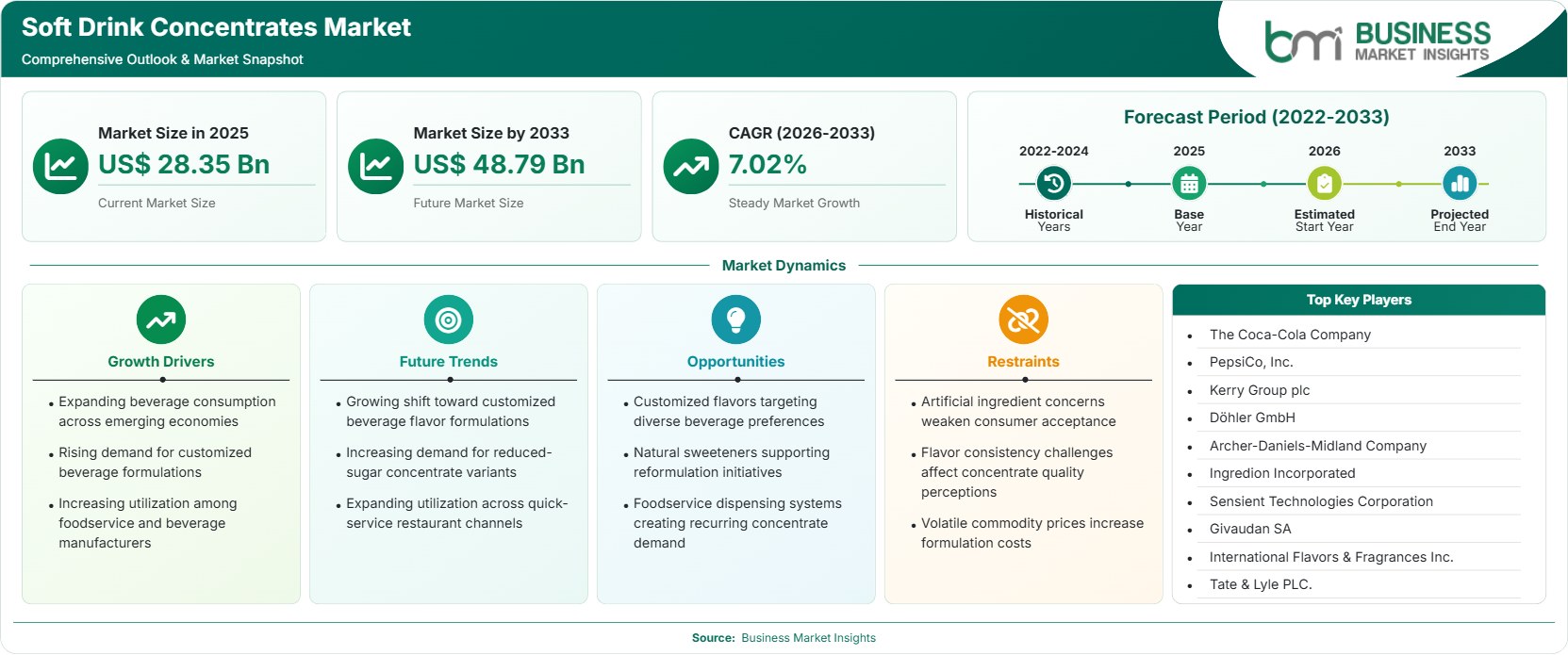
The Soft Drink Concentrates Market size was valued at US$ 28.35 Billion in 2025 and is projected to reach US$ 48.79 Billion by 2033, growing at a CAGR of 7.02% during 2026–2033. Growth is supported by flavor innovation, sugar-reduction technologies, foodservice expansion, beverage customization, functional drink development, emerging-market consumption, premium formulations, and investments in efficient concentrate production and distribution networks.

Report Coverage
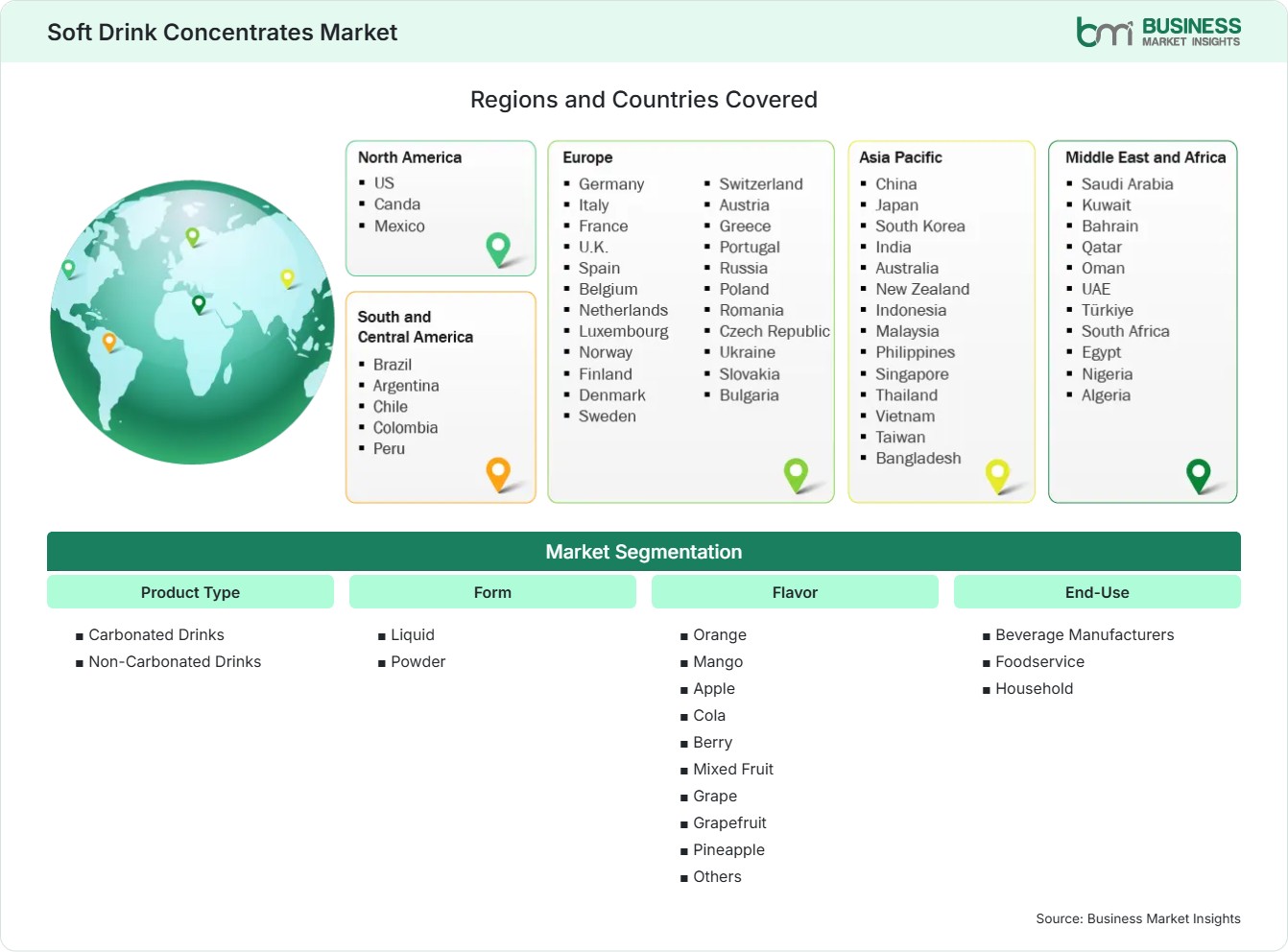
  • Product Type: Carbonated Drinks, Non-Carbonated Drinks
  • Form: Liquid, Powder
  • Flavor: Orange, Mango, Apple, Cola, Berry, Mixed Fruit, Grape, Grapefruit, Pineapple, Others
  • End-Use: Beverage Manufacturers, Foodservice, Household
US$ 28.35 Bn Market size in 2025
US$ 48.79 Bn Market Size by 2033
7.02% CAGR, 2026 - 2033
2026-2033 Forecast Period

AI Overview

Soft Drink Concentrates Market Summary

  • North America Region: North America holds a market share of 34%–37% in 2025, growing at a CAGR of 6.2%–6.8% during 2026–2033. Key drivers include fountain beverage demand, product reformulation, and foodservice expansion. Opportunities arise from low-sugar concentrates, functional beverage systems, and advanced dispensing technologies across commercial channels globally. The U.S. represents the largest regional market, supported by beverage innovation and an estimated CAGR of 6.3%–6.9%.
  • Fastest Growing Region: Asia Pacific holds a market share of 26%–29% in 2025 and advances at a CAGR of 8.2%–8.8%. Rising urbanization, increasing disposable income, modern retail penetration, quick-service restaurant growth, and localized flavor development continue creating strong opportunities across emerging economies.
  • Leading Segment: Carbonated Drinks account for a 56%–60% Soft Drink Concentrates Market share in 2025 and expand at a CAGR of 6.5%–7.1%. Strong consumer familiarity, fountain beverage demand, extensive distribution, and global brand investment support sustained demand and innovation opportunities worldwide.
  • High Growth Segment: Non-Carbonated Drinks represent a 40%–44% share in 2025 and record a CAGR of 8.0%–8.7%. Demand for juice-based beverages, functional drinks, wellness positioning, natural ingredients, and reduced-sugar offerings supports accelerated segment expansion.
  • Key Market Opportunity: Beverage manufacturers are investing in clean-label concentrates, natural sweeteners, customized flavor systems, and digitally enabled dispensing platforms to improve margins while addressing evolving health-conscious consumer preferences and regional taste requirements.
  • Major Market Players: The Coca-Cola Company, PepsiCo, Inc., Kerry Group plc, Döhler GmbH, Archer-Daniels-Midland Company, Ingredion Incorporated, Sensient Technologies Corporation, Givaudan SA, International Flavors & Fragrances Inc., and Tate & Lyle PLC.
Strategic Insights

Soft Drink Concentrates Market: Strategic Insights

Soft Drink Concentrates Market Strategic Framework
FREE PDF
Request your free sample
Request free sample
Stakeholder View

Key Takeaways

  • The value chain is increasingly integrating ingredient suppliers, flavor houses, concentrate processors, and dispensing-system providers to improve efficiency and product differentiation.
  • Non-carbonated beverage applications offer significant upside due to escalating demand for health-oriented, fruit-based, and functional drink formulations.
  • Innovation is shifting toward natural sweeteners, botanical extracts, clean-label ingredients, and digitally managed beverage dispensing systems.
  • India, Indonesia, Vietnam, and Gulf countries provide strong investment potential due to rising urban populations and expanding foodservice sectors.
  • Strategic acquisitions among flavor specialists and ingredient suppliers are strengthening formulation capabilities and geographic reach.
  • Flexible manufacturing models and regional flavor customization are becoming critical competitive differentiators across global beverage markets.
Geographic Outlook

Soft Drink Concentrates Market Regional Highlights

North America Soft Drink Concentrates Market

North America accounted for 34%–37% share in 2025 and is projected to register 6.2%–6.8% CAGR through 2033. The region remains a global center for beverage innovation, foodservice expansion, and concentrate consumption. Consumer interest in reduced-sugar drinks encourages reformulation investments. The region's Soft Drink Concentrates Market share benefits from established beverage brands, advanced supply chains, and extensive fountain beverage installations. Premium concentrate demand within restaurants and convenience retail formats continues supporting regional expansion.

  • Sugar-reduction initiatives accelerate adoption of alternative sweeteners and reformulated concentrate products.
  • Quick-service restaurant expansion increases deployment of concentrate-based dispensing systems.
  • Functional beverage development drives diversification beyond traditional carbonated offerings.
  • Major beverage brand investments strengthen product innovation and production efficiency.

US Soft Drink Concentrates Market

The United States represents 74%–78% of North American demand and records a CAGR of 6.3%–6.9%. Strong restaurant penetration, beverage innovation, advanced logistics networks, and consumer demand for customized beverages support sustained investment. Local producers focus on flavor enhancement, low-calorie formulations, and intelligent dispensing systems. Commercial beverage channels remain the primary consumers of concentrate solutions, while household applications continue gaining visibility through convenience-focused product offerings.

  • Large foodservice networks maintain steady demand for beverage concentrates.
  • Premium and zero-sugar beverage launches support category value expansion.
  • Digital beverage dispensing technologies improve operational efficiency.
  • Brand investment continues emphasizing flavor innovation and consumer engagement.

Europe Soft Drink Concentrates Market

Europe holds 24%–27% market share in 2025 and is expected to grow at 6.5%–7.1% CAGR in the Soft Drink Concentrates Market. Regulatory focus on sugar reduction is reshaping formulation strategies throughout the region. Germany leads regional consumption, while Eastern European markets demonstrate faster expansion. Consumer preference for natural ingredients encourages product reformulation and clean-label development. Strong retail networks and advanced manufacturing capabilities support competitiveness across beverage categories.

  • Germany remains a leading market supported by extensive beverage production infrastructure.
  • Poland and Romania exhibit higher growth rates due to rising disposable incomes.
  • Clean-label positioning increasingly influences purchasing decisions.
  • Sustainability initiatives encourage packaging and ingredient innovation.

Asia Pacific Soft Drink Concentrates Market

Asia Pacific accounts for 26%–29% and is growing at an 8.2%–8.8% CAGR, making it the fastest-growing region. Urbanization, the rising middle-class population, and food service drive demand for concentrates. China dominates the regional revenues; India has a robust growth outlook. Flavors, convenience consumption, and wide distribution support market growth in the region.

  • India benefits from expanding restaurant chains and increasing packaged beverage demand.
  • China leads volume consumption through extensive beverage manufacturing activity.
  • Fruit-flavored and wellness-oriented drinks gain consumer acceptance.
  • International and domestic producers continue expanding production capacities.
  • Modern trade channels improve product access across urban markets.

Rest of World Soft Drink Concentrates Market

The Rest of World region accounts for a 12%–15% share in 2025 and grows at 7.0%–7.8% CAGR in the Soft Drink Concentrates Market. South and Central America benefit from strong flavored beverage consumption and expanding retail networks. The Middle East and Africa experience increasing demand through tourism, hospitality, and quick-service restaurant growth. Brazil leads regional demand, while Saudi Arabia and the UAE represent high-growth opportunities for premium concentrate products.

  • Brazil remains a key consumer market with extensive beverage manufacturing.
  • Gulf countries support growth through hospitality sector expansion.
  • Young populations contribute to increasing beverage consumption volumes.
  • International brands continue expanding regional distribution networks.
Global Market Geography
FREE PDF
Request your free sample
Request free sample
Segment Analysis

Soft Drink Concentrates Market Segmentation

Product Type

This section outlines the basis of the demand framework, with Carbonated Drinks having a 56%-60% share by 2025 and a 6.5%-7.1% CAGR. The range of products in the Soft Drink Concentrates Market is expanding, with manufacturers launching superior carbonated drinks and wellness-focused non-carbonated beverages.

  • Carbonated Drinks: Driven by fountain beverage distribution, brand recognition, taste consistency requirements, and broad foodservice adoption across restaurants, cinemas, convenience outlets, and hospitality establishments.
  • Non-Carbonated Drinks: Growth is supported by fruit-based beverages, wellness positioning, reduced-sugar products, and rising demand for customizable drink solutions across commercial and household settings.

Form

Liquid concentrates account for about 62% to 66% of sales revenue and are growing at a CAGR of 6.8% to 7.4%. Liquid products offer convenience, while powder products thrive due to their ease of storage and e-commerce delivery.

  • Liquid: Preferred among large beverage manufacturers because of process compatibility, formulation precision, and dependable quality management across high-volume production environments.
  • Powder: Growing adoption reflects longer shelf life, lower transportation requirements, and increasing acceptance in household and institutional beverage preparation applications.

Flavor

Flavor diversification remains critical to product innovation. Cola still leads the market with around 22%–26% market share in 2025, while the flavor segment grows with 7.0%–7.6% CAGR. Consumer experimentation and regional taste preferences will continue to influence formula selection and portfolio creation. Soft Drink Concentrates Market Trends are now moving towards fruits and premium flavor combinations.

  • Orange: Popular across demographics due to refreshing taste profile and versatility.
  • Mango: Supported by strong demand in Asia and Middle Eastern markets.
  • Apple: Benefits from broad consumer acceptance and balanced sweetness characteristics.
  • Cola: Retains leadership through established brand ecosystems and foodservice demand.
  • Berry: Gains traction via premium positioning and flavor innovation programs.
  • Mixed Fruit: Appeals to consumers seeking variety and differentiated beverage experiences.
  • Grape: Maintains steady demand across retail and fountain beverage applications.
  • Grapefruit: Supported by premium beverage and wellness-oriented product concepts.
  • Pineapple: Rising popularity in tropical beverage formulations and hospitality channels.

End-Use

Beverage Manufacturers hold 58%-62% share in 2025 and grow at 7.1%-7.7% CAGR. Mass-manufacturing needs, the need for taste uniformity, and an expanding beverage portfolio justify the segment’s dominance. Commercial clients need concentrated blends customized based on local consumer tastes.

  • Beverage Manufacturers: Largest consumption category due to industrial-scale processing requirements and product standardization needs.
  • Foodservice: Restaurant, hospitality, and entertainment venues utilize concentrates to deliver operational efficiency and menu flexibility.
  • Household: Convenience, customization, and affordable beverage preparation support increasing consumer adoption.
Market Forces

Soft Drink Concentrates Market Dynamics

Key Market Drivers

Expansion of Global Foodservice Beverage Networks

The growth of the foodservice channel is still a primary driver of demand. Fast food chains, convenience stores, hotel and catering outlets, and entertainment centers are opting for concentrate dispensing systems due to their greater storage efficiency and lower transportation costs. According to industry insights, beverage fountains are among the largest commercial applications of concentrate systems. The growing reach of foodservice networks in Asia-Pacific, North America, and the Middle East has been propelling the demand for concentrates. Increasing restaurant footfall, the need for menu customization, and cost optimization have all been reinforcing the same trend.

Demand for Reduced-Sugar and Functional Formulations

Health-conscious consumers have begun seeking beverages with less sugar and additional health benefits. The WHO guidelines on sugar reduction motivate brands to find alternatives. Suppliers of concentrates are using natural sugars, botanical extracts, vitamins, and other functional ingredients. Such an evolution provides value-added benefits and enables companies to comply with new guidelines. Brands are adding health-focused beverages to their range that are tasty even without any sugar. Continuous innovation supports category expansion and competitive differentiation across multiple consumer segments.

Flavor Innovation and Customization Capabilities

Flavor variety still plays an important role in differentiating brands. More and more beverage makers are using limited-edition, regional, and specialty flavors to attract consumers. Modern technology enables faster product formulation, making it possible to respond promptly to changes in consumer tastes. Concentrated solutions make it easier for producers to implement innovations on a larger scale. Growing demand for customized beverages is stimulating investment in flexible flavor systems and dispensers. These developments strengthen product appeal while creating recurring opportunities for ingredient suppliers and flavor specialists.

Key Market Opportunities

Premium Natural Ingredient Concentrates

More investment opportunities arise from beverages labeled clean that use natural ingredients, fruit concentrates, and plant-based flavors. Consumers are looking at ingredient lists, compelling companies to remove any artificial ingredients. Companies that manufacture premium concentrated products can achieve higher profits while meeting consumer demand. Premiumization can help with differentiation in competitive markets and create opportunities for long-term brand value creation.

Growth of Emerging Market Beverage Consumption

A large number of developing nations still experience rising levels of disposable income, urbanization, and accessibility of retail outlets. This makes conditions favorable for the adoption of packaged beverages and creates considerable opportunities for growth in demand for concentrates. Manufacturers that specialize in localized flavor development, regional production, and distribution arrangements can take advantage of this situation. Soft Drink Concentrates Market Forecasts have begun to pay greater attention to emerging economies as key contributors to future revenue growth and capacity investment.

Smart Dispensing and Digital Beverage Platforms

The incorporation of technology into beverage dispensing systems is another area with considerable growth opportunities. Technological platforms enable inventory management, flavor modification, preventive maintenance, and efficiency improvement. Beverage dispensers must be flexible to meet consumers' dynamic needs. Concentrate producers who partner with dispensing systems vendors will benefit from developing unique value propositions while increasing customer retention and recurring sales opportunities.

Market Restraints and Challenges

Volatility in Ingredient and Sweetener Costs

Factor: Price variations associated with sugar, fruit concentrate, natural extract, and other ingredient costs cause uncertainty in terms of costs for beverage producers. Impact: Margins may become tight, making it difficult to remain profitable and manage pricing in a competitive beverage market. Supply risks related to weather changes, production uncertainties, and political changes may also affect the procurement planning process. Beverage producers have to change their formulas or enter into new contracts to stay profitable. These cost pressures can slow innovation initiatives and influence purchasing decisions by beverage manufacturers operating within narrow profitability thresholds.

Regulatory Pressure on Sweetened Beverage Categories

Factor: Many governments are embracing the trend of imposing sugar taxes and beverage-labeling regulations. Impact: Increased costs and reformulations make the task more difficult for firms. Research must be done, alternative sweeteners need to be sourced, testing is involved, and the manufacturing process needs to be altered. While such regulation fosters innovation, it may lead to delays and additional costs in developing and marketing their products. Businesses that do not effectively adapt may find themselves losing competitiveness in health-conscious beverage markets.

Company Analysis

Competitive Landscape

The competitive environment is characterized by strong brand ownership, flavor innovation, and ingredient specialization. Current Soft Drink Concentrates Market analysis indicates increased focus on natural ingredients, low-sugar formulations, and regional customization.

Company Name

Overview

Products and Services relevant to this market

The Coca-Cola Company

Global beverage leader operating extensive concentrate production and franchise networks.

Cola concentrates, fountain syrups, flavored beverage bases, dispensing solutions.

PepsiCo, Inc.

Diversified beverage company with substantial concentrate and flavor portfolio capabilities.

Carbonated beverage concentrates, foodservice syrups, customized formulations.

Kerry Group plc

Ingredient and taste solutions specialist serving beverage manufacturers globally.

Beverage concentrates, taste modulation technologies, functional ingredients.

Döhler GmbH

Natural ingredient and beverage solutions provider with broad international presence.

Fruit concentrates, beverage compounds, natural flavor systems.

Archer-Daniels-Midland Company

Major agricultural processor supporting beverage ingredient innovation.

Sweeteners, flavor systems, beverage concentrates, formulation support.

Ingredion Incorporated

Global ingredient company focused on texture and sweetening technologies.

Sweeteners, beverage ingredients, concentrate application solutions.

Sensient Technologies Corporation

Flavor and color specialist serving beverage formulation requirements.

Flavor concentrates, color systems, beverage customization solutions.

Givaudan SA

Leading flavor and fragrance company with advanced beverage expertise.

Beverage flavor concentrates, natural extracts, innovation services.

International Flavors & Fragrances Inc.

Global ingredient innovator serving multinational beverage producers.

Flavor systems, beverage compounds, sweetness enhancement technologies.

Tate & Lyle PLC

Ingredient supplier emphasizing reduced-sugar beverage innovation.

Sweetener systems, formulation support, beverage concentrate ingredients.

Trust & Transparency

Research Methodology

The market analysis combines proprietary research with secondary data from government agencies, company disclosures, regulatory filings, industry databases and expert interviews. Market estimates are validated through data triangulation, cross-market benchmarking and analyst review.

View Full Research Methodology

Questions Answered

Frequently Asked Questions

What does a Soft Drink Concentrates Market Report typically evaluate?

It examines industry size, competitive positioning, segment performance, regional dynamics, regulatory impacts, innovation trends, growth opportunities, and future market potential.

How are health regulations affecting industry strategies?

Companies are reformulating products with alternative sweeteners, natural ingredients, and functional additives to comply with evolving nutritional policies and consumer expectations.

Which end-use segment generates the highest revenue?

Beverage manufacturers represent the largest end-use category because industrial beverage production requires consistent flavor delivery, quality control, and scalable concentrate supply.

What is the fastest-growing regional market?

Asia Pacific is the fastest-growing region due to urbanization, beverage consumption growth, retail expansion, and increasing investment in local manufacturing capacity.

What factors are increasing demand for beverage concentrates?

Growing foodservice networks, flavor customization requirements, lower logistics costs, and demand for reduced-sugar beverage formulations are supporting wider adoption across commercial and household markets.

Access the Full Soft Drink Concentrates Market Report

Get segment-level forecasts, regional estimates, competitive benchmarking, company profiles and downloadable Excel datasets.

Access the full Soft Drink Concentrates Market Report
350 pages PDF & Excel | 2026-09-10
Similar Research

Related Market Reports