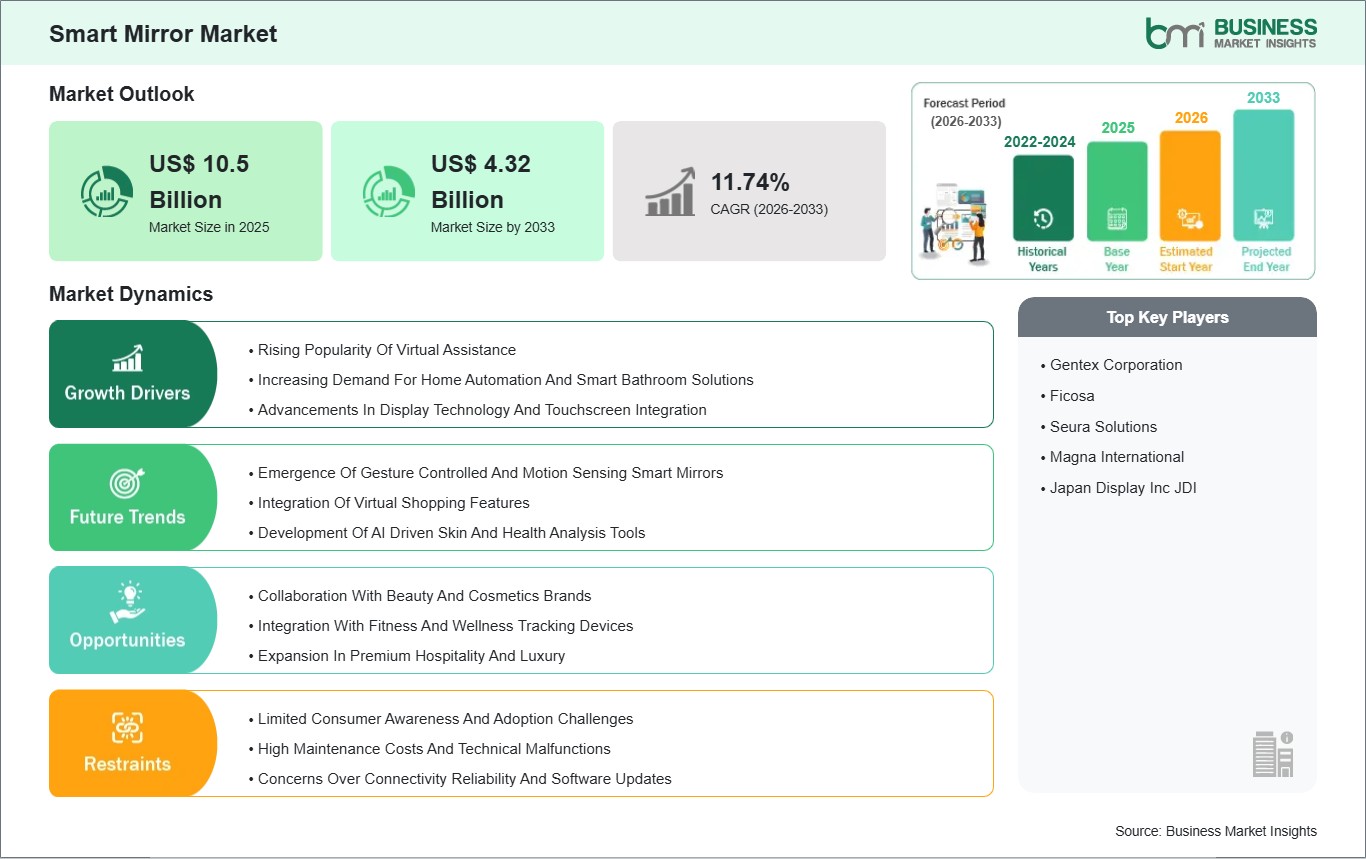
The Smart Mirror Market size is expected to reach US$ 10.5 billion by 2033 from US$ 4.32 billion in 2025. The market is estimated to record a CAGR of 11.74% from 2026 to 2033.
The global smart mirror market is changing how people use technology for personal grooming, wellness, and at home. Smart mirrors combine regular mirrors with digital displays, touch or gesture controls, voice assistants, and connectivity. They can show weather, news, fitness data, or let users try on looks virtually. More people are interested in home automation, wellness tracking, and personalized tech, which is helping smart mirrors become popular in homes, stores, and hotels. These mirrors are not just practical, they also make daily routines easier and more engaging. However, high prices and worries about privacy and data security can slow down adoption, especially in places where people are careful about connected devices in their homes. It can also be tricky to connect smart mirrors with other smart home devices. Improvements in AI, voice recognition, augmented reality, and wireless tech are making smart mirrors easier to use and more attractive. The market is moving from being a novelty to becoming mainstream, with products that mix technology, design, and function to fit modern lifestyles that value convenience, style, and self-monitoring.

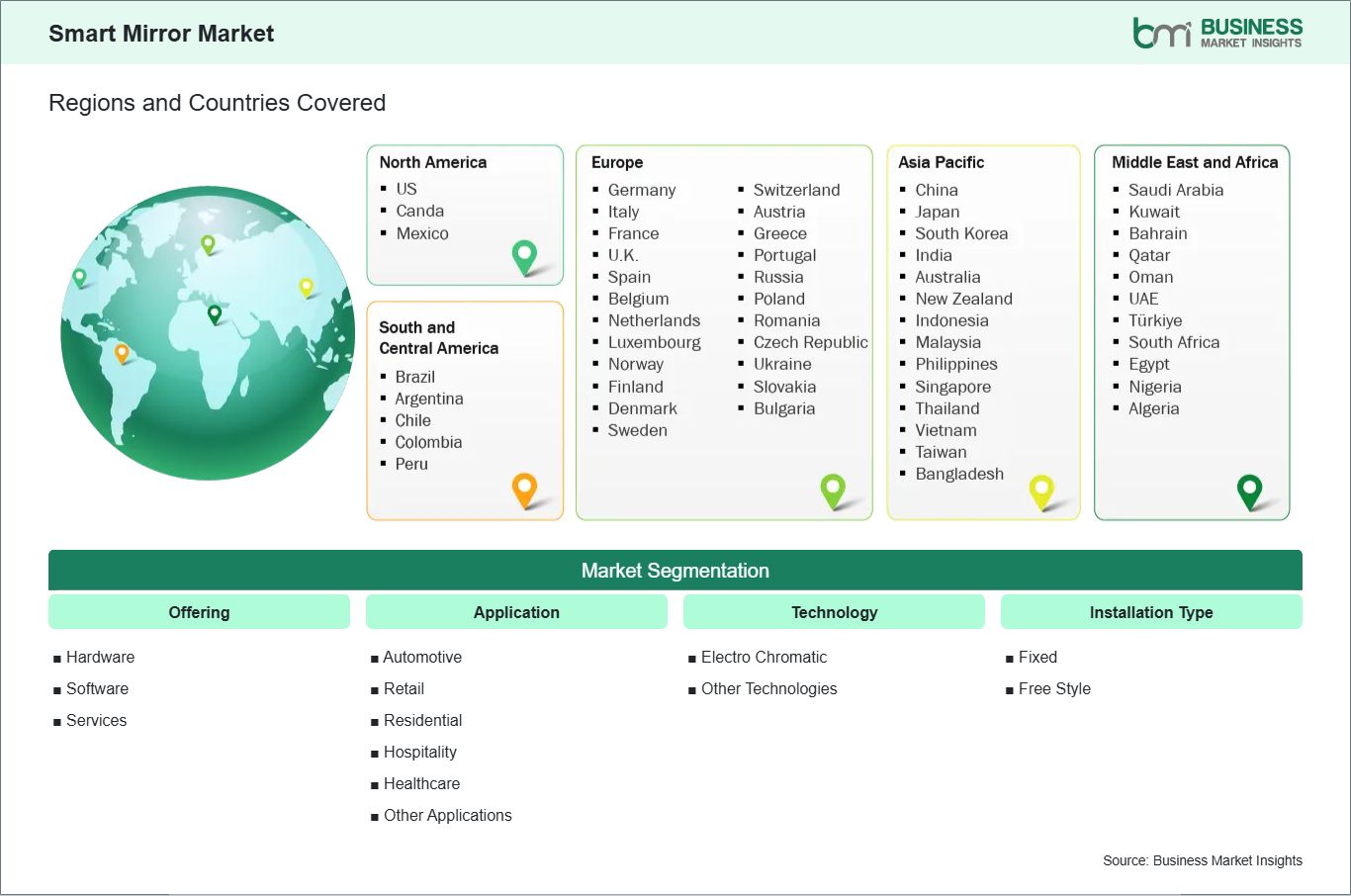
Key segments that contributed to the derivation of the smart mirror market analysis are offering, application, technology, installation type, and sales channel.
Smart mirrors are slowly becoming the hub of the connected home, especially as the use of virtual assistants is on the rise. These mirrors are no longer just for reflecting images; they are now interactive, giving the user real-time information on the weather, calendar events, traffic, news, and more, all while getting ready in the morning. For the busy home, this is a great feature, allowing them to keep track of tasks, check notifications, or even control the rest of the smart home devices without the need for a phone or tablet.
In Asia, smart mirrors with virtual assistant technology are used to analyze the skin, give beauty tips, and even monitor the user’s fitness goals on a daily basis. In Europe and North America, these are now being used as part of the morning routine, giving the user workouts, allowing them to adjust the lighting in the room, or even reminding them of tasks, among others.
This includes smart mirrors with virtual assistants that can be found in business settings such as fitness centers, hotels, and offices. In these locations, smart mirrors have the ability to offer unique information to those using them, such as those needing to use a fitness center or hotel, thus creating a seamless experience. Based on their ability to anticipate needs and provide timely responses, smart mirrors have transformed from being mere household items to becoming virtual assistants, thus propelling their use around the world.
Smart mirrors are also providing opportunities for beauty and cosmetics companies to collaborate with them. This is helping them become interactive tools for consumers. Many companies are using smart mirrors as a platform to deliver virtual try-on for makeup and beauty products. This is helping them not only deliver a better consumer experience but also build brand engagement.
Many luxury beauty and cosmetic brands are using smart mirrors as a platform to connect with consumers at a deeper level. Smart mirrors have the ability to sense the skin tone and analyze the change in the complexion over time. This is proving to be an attractive feature for consumers in the urban market as they seek a unique experience in a competitive environment.
Outside of retail, smart mirror partnerships with beauty brands are extending their reach to home environments. Subscription-based services, such as virtual consultations, product tips, and reminders, are available through smart mirrors, enabling users to access professional advice while engaging in their skincare routines back at their homes. This is creating a global market potential for smart mirrors, especially in their role as a lifestyle and wellness product.

The smart mirror market is experiencing steady growth, with market size and share analysis reflecting evolving treatment preferences and competitive dynamics among key players. The report evaluates important subsegments categorized within offering, application, technology, installation type, and sales channel, highlighting their respective contributions to overall market performance.
By offering, the hardware subsegment dominated the Smart Mirror market in 2025. Hardware components, including display panels, sensors, and embedded electronics, are essential for the functionality and performance of smart mirrors, driving their strong demand.
Based on application, the residential subsegment dominated the Smart Mirror market in 2025. Homeowners increasingly adopt smart mirrors for convenience, personalization, and integration with smart home ecosystems, supporting widespread adoption in residential settings.
In terms of technology, the Electro Chromatic subsegment dominated the Smart Mirror market in 2025. Electro Chromatic technology provides adaptive tinting, energy efficiency, and enhanced user experience, making it the preferred choice for modern smart mirror designs.
On the basis of installation type, the fixed subsegment dominated the Smart Mirror market in 2025. Fixed installations offer stability, optimal positioning, and integration with home or commercial interiors, driving their popularity over free-style designs.
By sales channel, the indirect sales subsegment dominated the Smart Mirror market in 2025. Indirect channels, including retailers, distributors, and online marketplaces, provide broader market reach and convenient access for consumers, reinforcing their leading position.
| Report Attribute | Details |
|---|---|
| Market size in 2025 | US$ 10.5 Billion |
| Market Size by 2033 | US$ 4.32 Billion |
| Global CAGR (2026 - 2033) | 11.74% |
| Historical Data | 2022-2024 |
| Forecast period | 2026-2033 |
| Segments Covered | By Offering
|
|
Regions and Countries Covered
| |
| North America | US, Canada, Mexico |
| Europe | Belgium, Austria, Finland, Denmark, Greece, Poland, Romania, Russia, Ukraine, Czech Republic, Slovakia, Bulgaria, Italy, Luxembourg, Germany, Switzerland, France, Netherlands, Norway, Portugal, Spain, Sweden, United Kingdom |
| Asia-Pacific | Australia, China, India, Japan, South Korea, Indonesia, Malaysia, Philippines, Singapore, Thailand, Vietnam, Bangladesh, New Zealand, Taiwan |
| South and Central America | Brazil, Argentina, Peru, Chile, Colombia |
| Middle East and Africa | Bahrain, Kuwait, Oman, Qatar, Saudi Arabia, United Arab Emirates, Turkiye, South Africa, Egypt, Algeria, Nigeria |
| Market leaders and key company profiles |
|
The "Smart Mirror Market Size and Forecast (2022 - 2033)" report provides a detailed analysis of the market covering below areas:
The geographical scope of the Smart Mirror market report is divided into five regions: North America, Asia Pacific, Europe, Middle East & Africa, and South & Central America. The Smart Mirror market in North America is expected to grow during the forecast period.
North America leads the smart mirror market thanks to high consumer awareness, quick adoption of new technology, and a strong interest in connected home experiences. In the US and Canada, smart mirrors are showing up more often in upscale bathrooms, fitness studios, beauty salons, and luxury hotels. These mirrors offer features like health monitoring, virtual makeup trials, personalized suggestions, and voice assistant integration. The region’s reliable broadband and established smart home systems make it easy for smart mirrors to connect with other devices, such as smart lighting, HVAC controls, and mobile apps. Retailers and hotels in North America use smart mirrors to improve customer experiences, from virtual try-ons in stores to interactive wellness advice in hotels and gyms.
Many consumers are drawn to these mirrors for home wellness, as they provide real-time feedback on fitness, posture, and skin health. While high prices, cybersecurity risks, and the need for better compatibility with other smart devices are still challenges, North America continues to set the pace for the global market. The region shows how smart mirrors can blend style, technology, and convenience to create personalized, interactive, and connected spaces in both homes and businesses.

The smart mirror market is evaluated by gathering qualitative and quantitative data post primary and secondary research, which includes important corporate publications, association data, and databases. A few of the key developments in the smart mirror market are:
The Smart Mirror Market is valued at US$ 10.5 Billion in 2025, it is projected to reach US$ 4.32 Billion by 2033.
As per our report Smart Mirror Market, the market size is valued at US$ 10.5 Billion in 2025, projecting it to reach US$ 4.32 Billion by 2033. This translates to a CAGR of approximately 11.74% during the forecast period.
The Smart Mirror Market report typically cover these key segments-
The historic period, base year, and forecast period can vary slightly depending on the specific market research report. However, for the Smart Mirror Market report:
The Smart Mirror Market is populated by several key players, each contributing to its growth and innovation. Some of the major players include:
The Smart Mirror Market report is valuable for diverse stakeholders, including:
Essentially, anyone involved in or considering involvement in the Smart Mirror Market value chain can benefit from the information contained in a comprehensive market report.
Please tell us your area of interest
(Market Segments/ Regions and Countries/ Companies)