
Remote Weapon Station Market Outlook (2022-2033)

Historic Data: 2022-2024   |   Base Year: 2025   |   Forecast Period: 2026-2033
Report Content: Market Scope, Market Segmentation, Market Dynamics, and Competitive Analysis

Report Coverage:
  • Weapon Type (Lethal, Non-lethal)
  • Mobility (Stationary, Moving)
  • Application (Military, Homeland Security)
  • Platform (Land, Airborne, Naval)

No. of Pages: 422
Report Code: BMIPUB00034270
Category: Electronics and Semiconductor
Remote Weapon Station Market

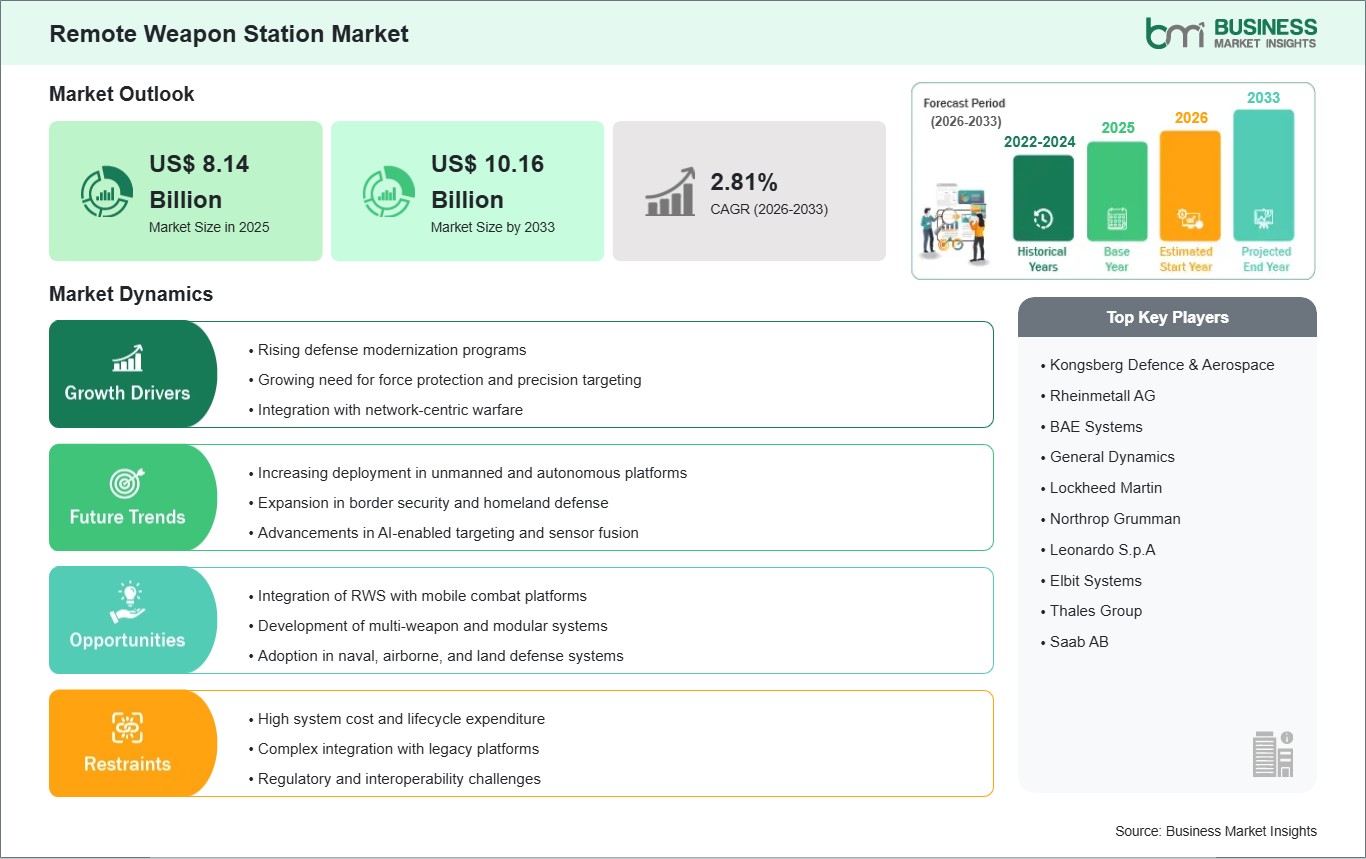
The Remote Weapon Station Market size is expected to reach US$ 10.16 billion by 2033 from US$ 8.14 billion in 2025. The market is estimated to record a CAGR of 2.81% from 2026 to 2033.

Executive Summary and Global Market Analysis:

The global remote weapon station (RWS) market is expanding as defense organizations prioritize force protection, precision targeting, and battlefield automation. RWS enables operators to control weapons from protected locations, reducing exposure while maintaining engagement capability. Systems integrate sensors, stabilization units, fire-control technologies, and advanced optics for accurate targeting in dynamic conditions.

Urban combat, asymmetric warfare, and border security operations drive demand for RWS. Legacy manned turrets are being replaced with remotely operated alternatives that enhance situational awareness and reduce personnel risk. Integration with network-centric warfare frameworks allows real-time data sharing across armored vehicles, unmanned systems, and command centers.

Competitive differentiation focuses on advanced targeting, multi-weapon compatibility, modular architectures, and AI-enabled fire control. Governments are investing in modernization programs for vehicles, naval vessels, and border security infrastructure, making RWS integral to modern defense strategies emphasizing safety, precision, and remote management.

Remote Weapon Station Market - Strategic Insights:

global-market-strategic-framework
Get more information on this report

Remote Weapon Station Market Segmentation Analysis:

Key segments that contributed to the derivation of the remote weapon station market analysis are weapon type, mobility, application, platform, technology, and component.

  • By weapon type, the remote weapon station market is segmented into lethal and non-lethal systems. The lethal segment dominated the market in 2025.
  • Based on mobility, the remote weapon station market is segmented into stationary and moving systems. The moving segment dominated the market in 2025.
  • In terms of application, the remote weapon station market is segmented into military and homeland security. The military segment dominated the market in 2025.
  • By platform, the remote weapon station market is segmented into land platforms, airborne platforms, and naval platforms. The land platforms segment dominated the market in 2025.
  • Based on technology, the remote weapon station market is segmented into close-in weapon systems and common remotely operated weapon station (CROWS) technologies. The CROWS segment dominated the market in 2025.
  • By component, the remote weapon station market is segmented into human machine interface, stabilization unit, control system, sensors, and weapons & armaments. The sensors segment dominated the market in 2025.
Remote Weapon Station Market Drivers and Opportunities:

Rising Defense Modernization Programs

Global military modernization increases demand for RWS, replacing manually operated mounts to protect operators and improve accuracy. Integrated electro-optical sensors, thermal imaging, and laser rangefinders enhance targeting, enabling operations day and night. Digital fire control systems and automated targeting algorithms allow accurate engagement even on moving platforms. Growing defense budgets and modernization focus sustain steady demand.

Increasing Demand for Border Security and Unmanned Defense Systems

Governments require enhanced border protection and surveillance, driving RWS deployment in border zones, critical infrastructure, and checkpoints. Integration with cameras, drones, and command centers enables real-time situational awareness and coordinated response. Growth of UGVs, UAVs, and autonomous naval vessels expands RWS applications in unmanned combat operations. AI, automated targeting, and sensor fusion improve system effectiveness, supporting remote operations and intelligent surveillance.

Remote Weapon Station Market Size and Share Analysis:

The Remote Weapon Station Market demonstrates steady growth, with size and share analysis highlighting evolving trends and competitive dynamics among key players. The report examines subsegments categorized within weapon type, mobility, application, platform, technology, and component, offering insights into their contribution to overall market performance.

By weapon type, the lethal segment dominated the market in 2025, driven by extensive deployment of remotely operated weapon systems equipped with machine guns, automatic cannons, and grenade launchers across military combat platforms.

Based on mobility, the moving segment dominated the market in 2025, primarily due to the growing integration of remote weapon stations in mobile combat platforms such as armored personnel carriers, infantry fighting vehicles, and tactical patrol vehicles.

In terms of application, the military segment dominated the market in 2025, supported by increasing investments in defense modernization programs and the adoption of advanced remote weapon technologies for battlefield operations.

By platform, the land segment accounted for the largest share in 2025, owing to the widespread installation of remote weapon stations on armored vehicles, light tactical vehicles, and ground-based defense systems.

Based on technology, the Common Remotely Operated Weapon Station (CROWS) segment dominated the market in 2025, driven by its extensive deployment in armored combat vehicles and its ability to integrate advanced fire-control systems, stabilized targeting, and electro-optical sensors.

In terms of component, the sensors segment held a significant share of the market in 2025, as advanced electro-optical sensors, thermal imaging systems, and laser rangefinders are critical for target acquisition, tracking, and engagement in remote weapon station platforms.

Remote Weapon Station Market Report Highlights:

Report Attribute Details
Market size in 2025 US$ 8.14 Billion
Market Size by 2033 US$ 10.16 Billion
Global CAGR (2026 - 2033)2.81%
Historical Data 2022-2024
Forecast period 2026-2033
Segments Covered By Weapon Type
  • Lethal
  • Non-lethal
By Mobility
  • Stationary
  • Moving
By Application
  • Military
  • Homeland Security
By Platform
  • Land
  • Airborne
  • Naval
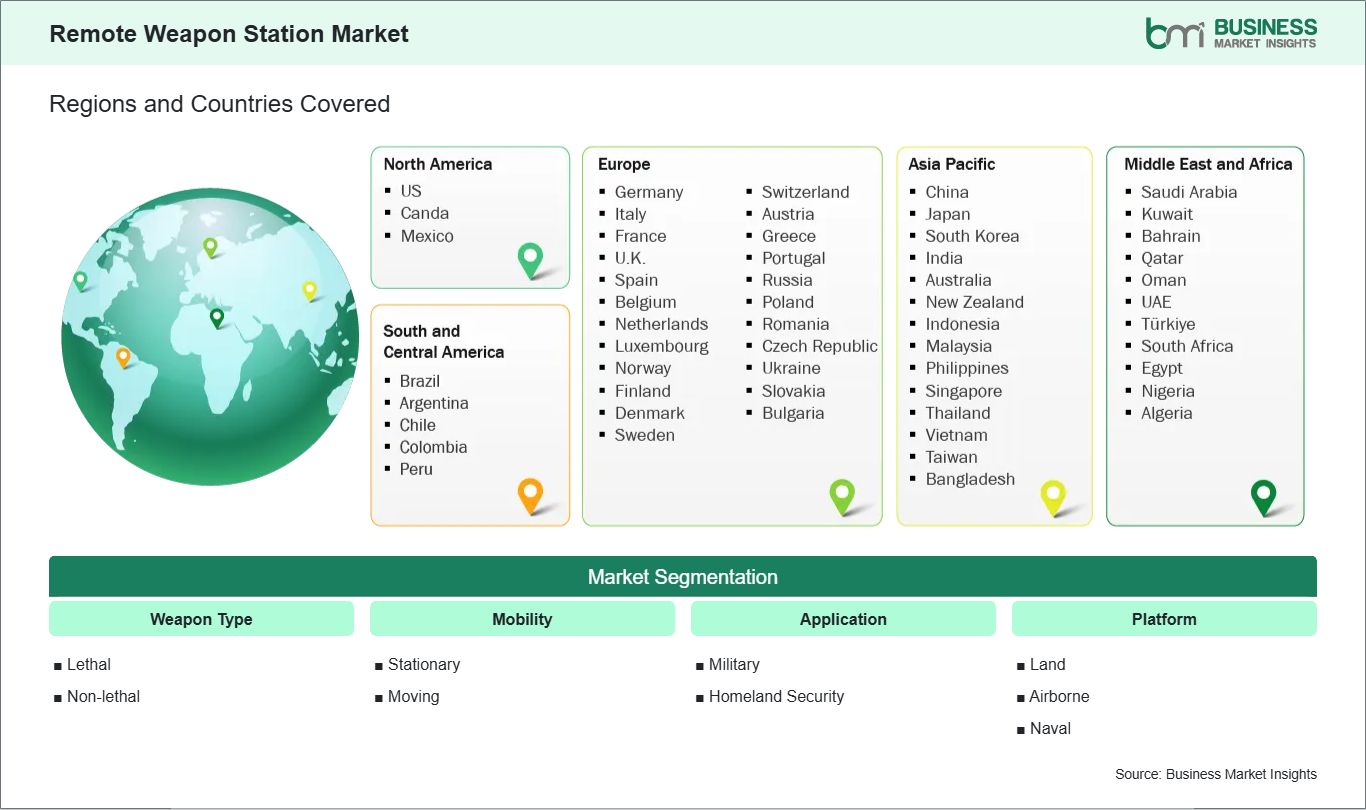
Regions and Countries Covered
North America US, Canada, Mexico
Europe Belgium, Austria, Finland, Denmark, Greece, Poland, Romania, Russia, Ukraine, Czech Republic, Slovakia, Bulgaria, Italy, Luxembourg, Germany, Switzerland, France, Netherlands, Norway, Portugal, Spain, Sweden, United Kingdom
Asia-Pacific Australia, China, India, Japan, South Korea, Indonesia, Malaysia, Philippines, Singapore, Thailand, Vietnam, Bangladesh, New Zealand, Taiwan
South and Central America Brazil, Argentina, Peru, Chile, Colombia
Middle East and Africa Bahrain, Kuwait, Oman, Qatar, Saudi Arabia, United Arab Emirates, Turkiye, South Africa, Egypt, Algeria, Nigeria
Market leaders and key company profiles
  • Kongsberg Defence & Aerospace
  • Rheinmetall AG
  • BAE Systems
  • General Dynamics
  • Lockheed Martin
  • Northrop Grumman
  • Leonardo S.p.A
  • Elbit Systems
  • Thales Group
  • Saab AB
Get more information on this report

Remote Weapon Station Market Report Coverage and Deliverables:

The "Remote Weapon Station Market Size and Forecast (2022 - 2033)" report provides a detailed analysis of the market covering below areas:

  • Remote Weapon Station Market size and forecast at global, regional, and country levels for all the key market segments covered under the scope
  • Remote Weapon Station Market trends, as well as drivers, restraints, and opportunities
  • Remote Weapon Station Market analysis covering key trends, global and regional framework, major players, regulations, and recent developments
  • Industry landscape and competition analysis covering market concentration, heat map analysis, prominent players, and recent developments for the Remote Weapon Station Market
  • Detailed company profiles, including SWOT analysis

Remote Weapon Station Market Geographic Insights:

The geographical scope of the Remote Weapon Station Market report is divided into North America, Asia Pacific, Europe, Middle East & Africa, and South & Central America. North America held the largest share in 2025.

In North America, strong defense spending and ongoing modernization programs have positioned the region as a leading adopter of remote weapon station technologies. The United States in particular has deployed remote weapon stations extensively across armored vehicles, naval vessels, and border security systems. The presence of major defense contractors and continuous investment in advanced military technologies further supports market growth.

Europe represents another significant market driven by increasing defense budgets and growing emphasis on NATO interoperability and battlefield automation. Countries such as Germany, the United Kingdom, and France are actively upgrading their armored vehicle fleets and naval platforms with remote weapon stations to enhance combat effectiveness and crew safety.

The Asia Pacific region is expected to experience substantial growth due to rising geopolitical tensions and expanding military modernization programs. Countries including China, India, South Korea, and Japan are investing heavily in advanced defense technologies, including remotely operated weapon systems. The region’s growing defense manufacturing capabilities and government initiatives aimed at strengthening domestic military infrastructure are further accelerating market expansion.

Meanwhile, Middle East & Africa and South & Central America are witnessing gradual adoption of remote weapon station technologies, primarily driven by border security requirements and defense modernization initiatives. Increasing focus on counter-terrorism operations, maritime security, and critical infrastructure protection is expected to create additional demand for these systems in the coming years.

Across all regions, procurement decisions are heavily influenced by operational requirements, platform compatibility, technological reliability, and lifecycle cost considerations, shaping the competitive strategies of manufacturers operating in the remote weapon station market.

global-market-geography
Get more information on this report

Remote Weapon Station Market Research Report Guidance:

  • The report includes qualitative and quantitative data in the Remote Weapon Station Market across type, application, industry, and geography.
  • The report starts with key takeaways (chapter 2), highlighting key trends and outlook of the Remote Weapon Station Market.
  • Chapter 3 focuses on research methodology.
  • Chapter 4 includes ecosystem analysis.
  • Chapter 5 highlights major industry dynamics, including drivers, restraints, and opportunities.
  • Chapter 6 discusses historical revenues and forecast till 2033.
  • Chapters 7 to 10 cover segment analysis across regions.
  • Chapter 11 describes competitive analysis.
  • Chapter 12 describes industry landscape analysis.
  • Chapter 13 provides company profiles.
  • Chapter 14 includes appendix and disclaimer.

Remote Weapon Station Market News and Key Development:

The Remote Weapon Station Market is evaluated by gathering qualitative and quantitative data post primary and secondary research, which includes important corporate publications, association data, and databases. A few of the key developments in the remote weapon station market are:

  • In October 2025, Kongsberg Defence & Aerospace showcased its PROTECTOR Remote Weapon Station (RWS) with counter‑UAS capability at AUSA 2025 in Washington, DC. The system featured enhanced stabilization and sensor integration, aimed at improving targeting accuracy for mobile platforms.
  • In December 2025, Kongsberg Defence & Aerospace signed a SEK 400 million contract with Sweden to deliver upgraded PROTECTOR RS4 RWS units for CV90 vehicles. The upgrades included advanced sensor packages and improved stabilization systems to boost precision and operational effectiveness.

Key Sources Referred:

  • NATO (North Atlantic Treaty Organization)
  • Stockholm International Peace Research Institute (SIPRI)
  • International Institute for Strategic Studies (IISS)
  • Defense Advanced Research Projects Agency (DARPA)
  • World Bank Group
The List of Companies - Remote Weapon Station Market
  • Kongsberg Defence & Aerospace
  • Rheinmetall AG
  • BAE Systems
  • General Dynamics
  • Lockheed Martin
  • Northrop Grumman
  • Leonardo S.p.A
  • Elbit Systems
  • Thales Group
  • Saab AB
Frequently Asked Questions
How big is the Remote Weapon Station Market?

The Remote Weapon Station Market is valued at US$ 8.14 Billion in 2025, it is projected to reach US$ 10.16 Billion by 2033.

What is the CAGR for Remote Weapon Station Market by (2026 - 2033)?

As per our report Remote Weapon Station Market, the market size is valued at US$ 8.14 Billion in 2025, projecting it to reach US$ 10.16 Billion by 2033. This translates to a CAGR of approximately 2.81% during the forecast period.

What segments are covered in this report?

The Remote Weapon Station Market report typically cover these key segments-

  • Weapon Type (Lethal, Non-lethal)
  • Mobility (Stationary, Moving)
  • Application (Military, Homeland Security)
  • Platform (Land, Airborne, Naval)

What is the historic period, base year, and forecast period taken for Remote Weapon Station Market?

The historic period, base year, and forecast period can vary slightly depending on the specific market research report. However, for the Remote Weapon Station Market report:

  • Historic Period : 2022-2024
  • Base Year : 2025
  • Forecast Period : 2026-2033
  • Who are the major players in Remote Weapon Station Market?

    The Remote Weapon Station Market is populated by several key players, each contributing to its growth and innovation. Some of the major players include:

  • Kongsberg Defence & Aerospace
  • Rheinmetall AG
  • BAE Systems
  • General Dynamics
  • Lockheed Martin
  • Northrop Grumman
  • Leonardo S.p.A
  • Elbit Systems
  • Thales Group
  • Saab AB
  • Who should buy this report?

    The Remote Weapon Station Market report is valuable for diverse stakeholders, including:

    • Investors: Provides insights for investment decisions pertaining to market growth, companies, or industry insights. Helps assess market attractiveness and potential returns.
    • Industry Players: Offers competitive intelligence, market sizing, and trend analysis to inform strategic planning, product development, and sales strategies.
    • Suppliers and Manufacturers: Helps understand market demand for components, materials, and services related to concerned industry.
    • Researchers and Consultants: Provides data and analysis for academic research, consulting projects, and market studies.
    • Financial Institutions: Helps assess risks and opportunities associated with financing or investing in the concerned market.

    Essentially, anyone involved in or considering involvement in the Remote Weapon Station Market value chain can benefit from the information contained in a comprehensive market report.

    Available Report Formats

    pdf-format excel-format pptx-format
    Buy Now
    Sales Assistance
    +1 646 791 7070 (US & UK)
    Customization Form

    Please tell us your area of interest
    (Market Segments/ Regions and Countries/ Companies)