Market Summary
Executive Summary and Global Market Analysis
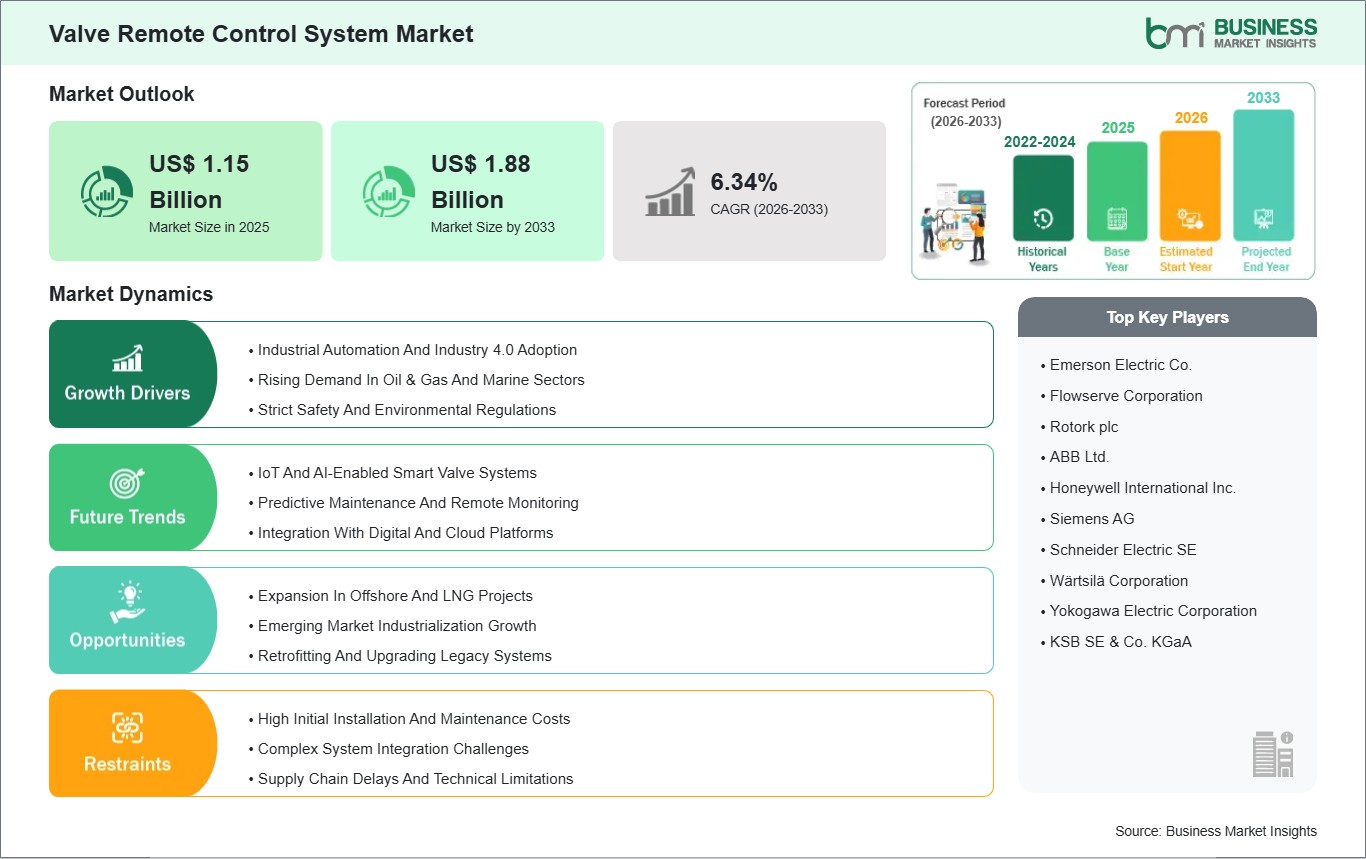
A Valve Remote Control System (VRCS) serves as a sophisticated engineering nerve center, essential for the centralized management of liquid and gas flow across sprawling industrial networks. These systems integrate advanced actuators, hydraulic power units, and digital control consoles to operate critical valves—such as butterfly, ball, and globe types—from a remote, safe location. In the maritime and offshore sectors, a VRCS is indispensable for the automated handling of ballast, bilge, and cargo operations, ensuring that complex fluid matrices are managed with millisecond precision to maintain vessel stability and operational safety. By replacing manual local operation with automated feedback loops, these systems enhance high-frequency processing of sensor data, which is vital for modern, data-driven industrial environments.
However, the market faces significant structural challenges, most notably the high capital expenditure associated with the deployment of advanced semiconductor-based controllers and the logistical complexity of retrofitting older infrastructure with modern automation. Technical hurdles also persist, particularly regarding the power consumption of multi-node systems and the maintenance of signal integrity in corrosive, high-pressure environments. Furthermore, global supply chain fluctuations frequently impact the availability of high-grade actuators and specialized chipsets, potentially delaying large-scale projects.
Despite these restraints, the market is entering a transformative era of opportunity driven by the "Smart Shipping" revolution and the global transition toward autonomous industrial operations. The surge in AI-driven edge computing allows for the integration of data converters into System-on-Chip (SoC) architectures within the VRCS, enabling real-time predictive maintenance and reduced operational downtime. As industries pivot toward energy-efficient, low-emission frameworks, the demand for electrified and intelligent valve control solutions is expected to open significant new avenues for market expansion through 2033.
Segment Analysis
Valve Remote Control System Market Segmentation
Key segments that contributed to the derivation of the Valve Remote Control System market analysis are type and application.
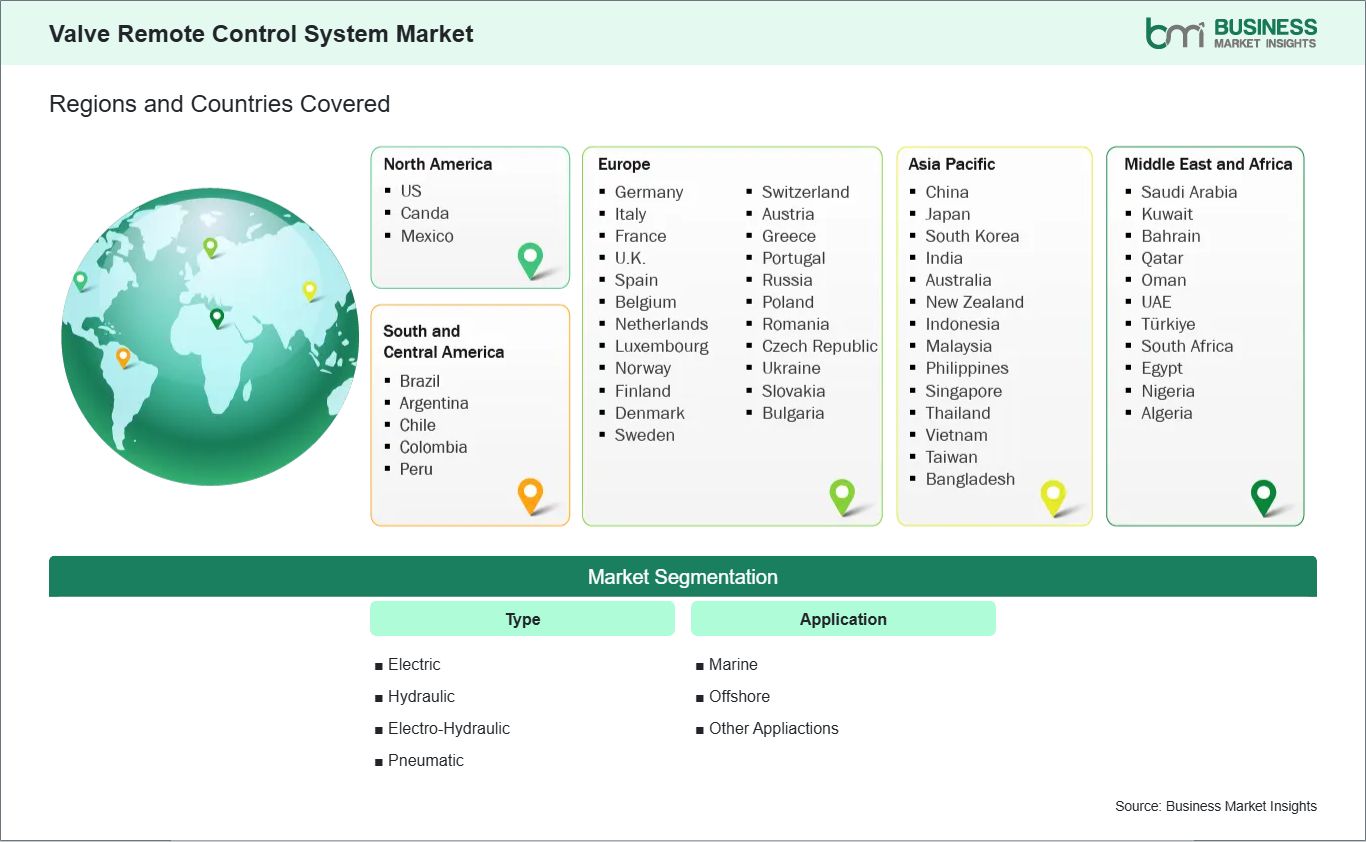
- By Type, the market is segmented into Electric, Hydraulic, Electro-Hydraulic, and Pneumatic.
- By Application, the market is categorized into Marine, Offshore, and Others.
Market Forces
Valve Remote Control System Market Drivers and Opportunities
Acceleration of Maritime Decarbonization and Alternative Fuel Integration
The global maritime industry is currently undergoing a structural shift toward decarbonization, serving as a powerful driver for the Valve Remote Control System (VRCS) market. As international regulatory bodies mandate significant reductions in greenhouse gas emissions, shipbuilders are moving away from traditional heavy fuel oils in favor of complex alternative energy sources such as liquefied natural gas, ammonia, and hydrogen. These next-generation fuels possess unique thermodynamic properties and higher volatility, requiring an unprecedented level of precision in fluid management. Modern remote control systems provide the necessary centralized oversight to manage these delicate fuel-handling processes, ensuring that flow rates and pressures are maintained within strict safety margins.
Beyond fuel systems, the drive for energy efficiency has led to the adoption of advanced waste heat recovery and air lubrication technologies, both of which rely on integrated valve matrices to optimize performance. High-speed data processing within these control systems allows for real-time adjustments to environmental changes, such as shifting sea states or fluctuating engine loads. By automating these once-manual tasks, ship operators can achieve superior fuel economy and ensure compliance with evolving environmental standards. Consequently, the demand for sophisticated, high-reliability VRCS units is increasing as they become a fundamental component of the "green" vessel architecture required for the future of global trade.
Integration of AI-Driven Predictive Maintenance and Digital Twin Technology
A transformative opportunity within the market is the convergence of Artificial Intelligence (AI) and Digital Twin technology. Historically, valve maintenance was a reactive process, often occurring only after a component failure led to costly operational downtime. However, the emergence of intelligent edge computing allows for the creation of a "sensing-to-inference" pipeline directly within the remote control architecture. By embedding smart sensors and digital signal processing capabilities into the valve control units, manufacturers can develop systems that continuously monitor for minute anomalies in actuator torque, vibration, or travel time. This data is used to populate a virtual replica, or digital twin, of the entire system, allowing shore-based engineers to simulate various scenarios and predict exactly when a component will require servicing.
This shift from scheduled to condition-based maintenance offers immense value, particularly for offshore energy platforms and deep-sea vessels where manual inspection is difficult and hazardous. Furthermore, as autonomous shipping gains traction, these intelligent systems will be required to operate independently for long durations without human intervention. The integration of AI not only reduces the total cost of ownership for end-users by preventing catastrophic failures but also creates a specialized market for high-performance, low-power conversion hardware tailored for the next era of intelligent mobility. This evolution empowers operators to transition toward a fully digitized and resilient infrastructure, turning raw data into a strategic asset for long-term operational success.
Size and Share Analysis
Valve Remote Control System Market Size and Share Analysis
The Valve Remote Control System market demonstrates steady growth, with size and share analysis revealing evolving trends and competitive positioning among key players. The report further examines subsegments categorized within type and application, offering insights into their contribution to overall market performance.
In the type category, the Electric sub-segment is rapidly gaining traction due to its ease of integration with digital automation platforms.
In the applications category, the Marine sub-segment remains a dominant contributor as shipowners upgrade fleets to meet new efficiency standards.
Report Coverage
Valve Remote Control System Market Report Coverage and Deliverables
The "Valve Remote Control System Market Size and Forecast (2022 - 2033)" report provides a detailed analysis of the market covering below areas:
- Valve Remote Control System market size and forecast at global, regional, and country levels for all the key market segments covered under the scope
- Valve Remote Control System market trends, as well as market dynamics such as drivers, restraints, and key opportunities
- Valve Remote Control System market analysis covering key market trends, global and regional framework, major players, regulations, and recent market developments
- Industry landscape and competition analysis covering market concentration, heat map analysis, prominent players, and recent developments for the Valve Remote Control System market
- Detailed company profiles, including SWOT analysis
Geographic Insights
Valve Remote Control System Market Geographic Insights
The geographical scope of the Valve Remote Control System market report is divided into five regions: North America, Asia Pacific, Europe, the Middle East and Africa, and South and Central America.
In North America, the market is sustained by a robust emphasis on advanced industrial automation and the rigorous modernization of offshore energy infrastructure, where safety-critical systems and digital integration are paramount. Europe maintains its position through a specialized focus on the maritime sector, specifically integrating high-precision control solutions within complex passenger vessels and specialized chemical tankers to meet stringent environmental mandates. The Asia Pacific region acts as a primary center for both production and deployment, propelled by its massive shipbuilding ecosystem and aggressive investments in smart manufacturing across major industrial hubs.
In the Middle East and Africa, market activity is increasingly linked to the large-scale development of smart city projects and the modernization of water management facilities, reflecting a broader shift toward centralized urban infrastructure. Meanwhile, South and Central America are witnessing a steady transformation as regional industrial sectors digitize their fluid processing operations and upgrade legacy assets to improve safety and operational efficiency. This diversified regional growth ensures a resilient global market as local economies continue to align their industrial frameworks with international automation standards.
Industry Activity
Recent Developments
The Valve Remote Control System market is evaluated by gathering qualitative and quantitative data post primary and secondary research, which includes important corporate publications, association data, and databases. A few of the key developments in the Valve Remote Control System market are:
- In October 2025, Rotork announced the launch of the RTP-4000 range, which introduced a new generation of intelligent valve positioners designed to provide optimized control solutions for single- and double-acting actuators. This innovation significantly enhanced the precision of the broader Valve Remote Control System by supporting seamless digital integration and real-time diagnostics for both rotary and linear valves.
- In August 2025, Emerson announced the release of its new Fisher™ FIELDVUE™ DPC2K Digital Process Controller (DPC2K). The DPC2K could be retrofitted to Fisher Wizard pneumatic controllers, as well as pneumatic controllers from other manufacturers. By integrating the device with a plant's existing Valve Remote Control System, users achieved greatly improved closed-loop control and reliability, significantly reduced maintenance, enhanced safety, and stronger environmental compliance. The device has been further recognized as the 2025 Product of the Year in the Actuators, Motors, Drives, Motion Control category. The award honored the product for its technological advancements, service to the industry, and overall market impact.
Trust & Transparency
Research Methodology
The market analysis combines proprietary research with secondary data from government agencies, company disclosures, regulatory filings, industry databases and expert interviews. Market estimates are validated through data triangulation, cross-market benchmarking and analyst
review.
View Full Research Methodology
Key Sources Referred:
World Bank - Global Trade IndicatorsWorld Trade Organization (WTO)International Monetary Fund (IMF)International Trade Administration (ITA)Company websiteCompany annual reportsCompany investor presentations