
Polyvinylidene Fluoride Market Outlook: Size, Share, Trends, Growth Analysis, Competitive Landscape & Forecast, 2026-2033

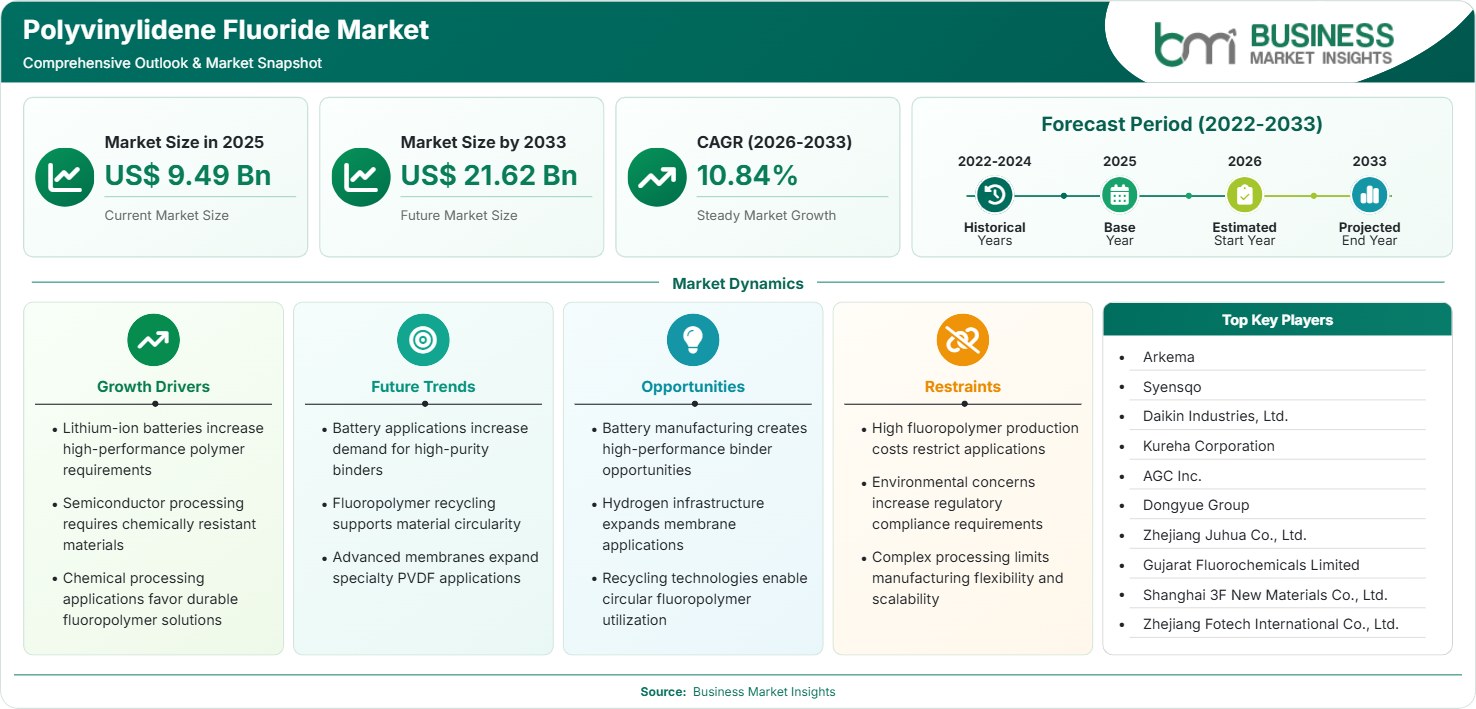
The Polyvinylidene Fluoride Market size was valued at US$ 9.49 Billion in 2025 and is projected to reach US$ 21.62 Billion by 2033, growing at a CAGR of 10.84% during 2026–2033, driven by battery manufacturing, semiconductor applications, membranes, coatings, and resilient chemical infrastructure.

Report Coverage
  • Type: Homopolymer PVDF, Copolymer PVDF, Others
  • Application: Battery, Coatings, Films & Sheets, Pipes & Fittings, Wire & Cable, Membranes, Others
  • End Use Industry: Automotive & Transportation, Chemical, Building & Construction, Electrical & Electronics, Energy, Others
US$ 9.49 Bn Market size in 2025
US$ 21.62 Bn Market Size by 2033
10.84% CAGR, 2026 - 2033
2026-2033 Forecast Period

AI Overview

Polyvinylidene Fluoride Market Summary

  • North America Region: North America holds a Polyvinylidene Fluoride Market share of 27%–30% in 2025, growing at a CAGR of 9.6%–10.4% during 2026–2033, driven by battery localization, semiconductor investment, water infrastructure, specialty coatings, and supply-chain diversification.
  • The US accounts for 72%–76% of North American demand, with CAGR of 9.2%–10.0% through 2033, supported by batteries, semiconductors, energy storage, water treatment, and chemical processing.
  • Fastest Growing Region: Asia Pacific holds a Market share of 39%–43% in 2025, expanding at a CAGR of 12.1%–13.0% through 2033, supported by batteries, electronics, electric mobility, solar infrastructure, localized fluoropolymer production, and filtration investment.
  • Leading Segment: Homopolymer PVDF holds a Market share of 58%–62% in 2025, growing at a CAGR of 10.2%–10.9% through 2033, supported by chemical resistance, established processing, industrial piping, membranes, coatings, and battery applications.
  • High Growth Segment: Battery applications hold a Market share of 34%–38% in 2025, growing at a CAGR of 13.0%–14.0% through 2033, supported by lithium-ion cells, electric vehicles, stationary storage, electrode engineering, and binder qualification.
  • Key Market Opportunity: Battery-grade polymers, high-purity semiconductor components, advanced membranes, and regional production provide attractive opportunities for capacity expansion, product differentiation, customer qualification, and application-specific technical services.
  • Major Market Players: Arkema, Syensqo, Daikin Industries, Ltd., Kureha Corporation, AGC Inc., Dongyue Group, Zhejiang Juhua Co., Ltd., Gujarat Fluorochemicals Limited, Shanghai 3F New Materials Co., Ltd., and Zhejiang Fotech International Co., Ltd.
Strategic Insights

Polyvinylidene Fluoride Market: Strategic Insights

Polyvinylidene Fluoride Market Strategic Framework
FREE PDF
Request your free sample
Request free sample
Stakeholder View

Key Takeaways

  • The value chain is becoming more integrated as producers combine fluorochemical feedstocks, polymerization, compounding, grade development, application engineering, and regional distribution to improve supply reliability.
  • Battery binders provide the strongest incremental opportunity, while semiconductor fluid handling, membranes, chemical processing, and advanced coatings diversify demand and reduce dependence on any single downstream industry.
  • Product development is shifting toward higher purity, controlled molecular architecture, improved adhesion, lower-defect films, specialty copolymers, and processing approaches that reduce environmental and manufacturing constraints.
  • India offers a compelling investment case because battery materials, electronics, electric mobility, renewable power, and domestic fluorochemical capabilities are developing simultaneously, creating opportunities for local qualification and import substitution.
  • Competitive investment is increasingly focused on capacity debottlenecking, regional plants, specialty-grade development, and battery-material integration. Customer qualification is becoming an important strategic barrier to entry.
  • Buyers increasingly evaluate supply continuity alongside cost, making dual sourcing, regional inventories, technical support, qualification history, and batch consistency important procurement criteria.
Geographic Outlook

Polyvinylidene Fluoride Market Regional Highlights

North America Polyvinylidene Fluoride Market

North America represented 27%–30% share of the Polyvinylidene Fluoride Market in 2025 and is projected to grow at a CAGR of 9.6%–10.4% through 2033. The United States dominates regional consumption, while Canada contributes through mining, energy, battery materials, and industrial processing. Demand spans batteries, semiconductors, chemical equipment, membranes, coatings, and electrical applications. Domestic manufacturing initiatives are strengthening demand for dependable specialty-polymer supply, while customers increasingly favor shorter lead times, technical support, regional inventories, and qualified alternative suppliers.

  • Battery localization is expanding demand for electrode binders and related components, while stationary storage creates an additional application channel as renewable generation increases requirements for flexible grid capacity.
  • Semiconductor investment supports high-purity PVDF components because chemical resistance, dimensional stability, filtration performance, and controlled contamination levels are important in advanced manufacturing environments.
  • Water infrastructure modernization supports membrane, piping, and filtration applications, creating opportunities for durable grades that can withstand aggressive chemicals and demanding operating conditions.
  • Architectural and industrial coatings remain relevant because PVDF provides weatherability, ultraviolet resistance, corrosion protection, and long surface life for exposed structures.

US Polyvinylidene Fluoride Market

The United States accounted for 72%–76% of North American Polyvinylidene Fluoride Market demand in 2025, expanding at a CAGR of 9.2%–10.0% through 2033. Demand is supported by battery plants, semiconductor fabrication, energy-storage systems, water treatment, chemical processing, and infrastructure modernization. Regional sourcing is gaining importance because specialty grades require customer qualification and consistent quality. Producers with domestic capacity, technical laboratories, application expertise, and dependable inventories can reduce customer risk and strengthen long-term contracts across high-value applications.

  • Battery manufacturing creates opportunities for suppliers that can qualify binders across different electrode architectures, chemistries, particle systems, and production processes while maintaining consistent adhesion and processing characteristics.
  • Semiconductor expansion increases demand for high-purity polymer components, favoring suppliers with traceability, controlled manufacturing environments, stringent quality systems, and application-specific technical support.
  • Stationary storage expands demand beyond electric vehicles and creates additional opportunities for binder and component suppliers as utilities and commercial users deploy larger battery systems.

Europe Polyvinylidene Fluoride Market

Europe Polyvinylidene Fluoride Market held 23%–26% share in 2025, with a CAGR of 9.7%–10.5% projected through 2033. Germany and France remain leading markets, while Poland, Italy, Spain, and the United Kingdom provide higher-growth opportunities. Battery localization, industrial modernization, electronics, chemical processing, and water treatment support diversified demand. European buyers place greater emphasis on environmental compliance, traceability, manufacturing efficiency, and supply-chain transparency. Suppliers that combine specialty-grade performance with documented product stewardship can strengthen qualification prospects and defend premium applications.

  • Germany benefits from automotive production, battery investment, industrial equipment manufacturing, and semiconductor-related activity, creating multiple demand channels for high-performance fluoropolymers.
  • France combines chemical processing, advanced manufacturing, infrastructure, aerospace, and energy applications, supporting specialty grades where reliability and technical performance outweigh commodity pricing.
  • Poland provides a high-growth battery manufacturing base, increasing demand for binder materials, separator-related technologies, and high-performance polymers used throughout cell-production equipment.
  • The United Kingdom offers opportunities in water treatment, energy storage, advanced manufacturing, and electronics, creating diversified demand beyond automotive applications.

Asia Pacific Polyvinylidene Fluoride Market

Asia Pacific Polyvinylidene Fluoride Market represented 39%–43% share in 2025 and is projected to grow at a CAGR of 12.1%–13.0% through 2033. China remains the leading market, while India, South Korea, Japan, and Southeast Asia offer high-growth opportunities. Concentrated battery manufacturing, electronics production, electric mobility, chemical processing, solar equipment, and water treatment provide broad application support. Regional producers benefit from proximity to major cell manufacturers, while multinational suppliers increasingly expand local capacity and technical support to protect access to rapidly growing customers.

  • China remains the largest regional production and consumption hub, supported by batteries, electronics, coatings, membranes, solar equipment, chemical processing, and extensive domestic fluorochemical manufacturing.
  • India is a high-growth market as battery materials, electric mobility, electronics, renewable energy, and domestic chemical manufacturing develop simultaneously, encouraging local sourcing and customer qualification.
  • South Korea remains strategically important because advanced battery and electronics manufacturers require consistent binder performance, specialty polymers, separator materials, and high-purity chemical-handling components.
  • Japan combines mature battery technology, electronics manufacturing, chemical engineering, and advanced-material expertise, supporting engineered PVDF grades requiring precise processing and long-term reliability.
  • Southeast Asia is developing as a complementary manufacturing base for batteries and electronics, creating additional demand for locally stocked specialty polymers and regional technical services.

Rest of World Polyvinylidene Fluoride Market

South and Central America Polyvinylidene Fluoride Market represented approximately 5%–7% of global demand in 2025, with Brazil and Mexico leading opportunities and a modeled CAGR of 9.8%–10.8% through 2033. Automotive manufacturing, mining, chemical processing, water treatment, and renewable-energy infrastructure support demand. The Middle East and Africa represented approximately 3%–4%, led by Saudi Arabia, the United Arab Emirates, and South Africa, with a CAGR of 10.2%–11.2% through 2033. Desalination, infrastructure, oil and gas, and chemical projects support specialty applications.

  • Brazil offers opportunities in water treatment, electric mobility, renewable energy, mining, and industrial processing, supporting membranes, piping, coatings, and chemical-resistant components.
  • Mexico benefits from automotive manufacturing and industrial relocation, increasing demand for electrical insulation, chemical equipment, wire and cable, and engineering polymer components.
  • Saudi Arabia and the United Arab Emirates provide opportunities through desalination, petrochemicals, infrastructure, and industrial diversification requiring corrosion-resistant piping, membranes, coatings, and linings.
  • South Africa supports regional demand through mining, water treatment, chemical processing, and industrial equipment where chemical resistance can improve service life.
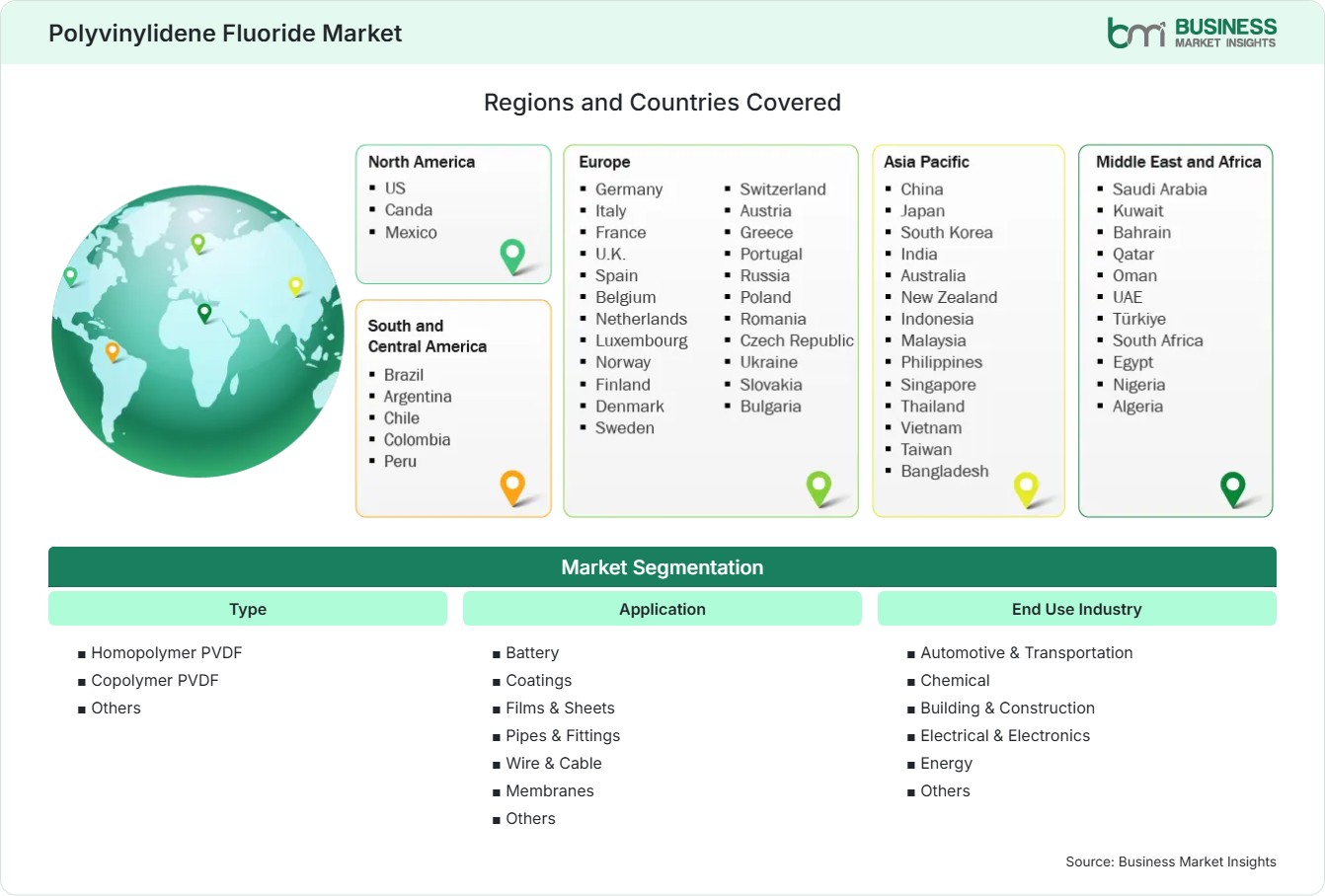
Global Market Geography
FREE PDF
Request your free sample
Request free sample
Segment Analysis

Polyvinylidene Fluoride Market Segmentation

Type

Homopolymer PVDF represented 58%–62% of the Polyvinylidene Fluoride Market in 2025 and is projected to grow at 10.2%–10.9% CAGR through 2033. Its established mechanical strength, crystallinity, chemical resistance, and processing characteristics sustain adoption across industrial and emerging applications.

  • Homopolymer PVDF: Established performance supports membranes, piping, coatings, films, electrical components, and battery binders where mechanical strength, chemical resistance, and processing consistency are important.
  • Copolymer PVDF: Improved flexibility, adhesion, impact performance, and processing latitude support specialized coatings, films, tubing, battery components, and demanding chemical-handling applications.

Application

Application demand is increasingly influenced by energy storage, advanced manufacturing, and water treatment. Polyvinylidene Fluoride Market scope is broadening as suppliers develop grades for electrode binders, membranes, semiconductor components, coatings, and chemical-resistant infrastructure with tighter performance requirements.

  • Battery: Lithium-ion cell production drives demand for binders through electrode adhesion, chemical stability, processing consistency, and durability requirements across automotive and stationary storage applications.
  • Coatings: Architectural and industrial coatings use PVDF for weatherability, corrosion resistance, ultraviolet stability, color retention, and extended surface performance in exposed environments.
  • Films & Sheets: Films and sheets serve electrical insulation, chemical protection, solar-related components, and specialty fabrication where dimensional stability and dielectric performance are essential.
  • Pipes & Fittings: Chemical processing, semiconductor facilities, and water treatment favor PVDF piping because corrosion resistance and long service life can offset higher material costs.
  • Wire & Cable: PVDF supports insulation and jacketing where flame resistance, dielectric properties, chemical durability, temperature stability, and compact construction are required.
  • Membranes: Water purification, wastewater treatment, industrial filtration, and biopharmaceutical processing use PVDF membranes because durability and controllable pore structures support demanding separation processes.

End Use Industry

Automotive, chemical, construction, electrical, electronics, and energy industries collectively sustain demand. Energy and electrical applications provide the strongest incremental upside as batteries, renewable generation, electronics production, and grid modernization increase requirements for durable and electrically functional fluoropolymer components.

  • Automotive & Transportation: Electric and hybrid vehicles increase demand for battery binders, electrical insulation, sensors, fluid systems, and chemical-resistant components.
  • Chemical: PVDF supports piping, valves, fittings, pumps, linings, and membranes because resistance to aggressive chemicals can extend equipment life and reduce maintenance requirements.
  • Building & Construction: Architectural coatings and protective systems benefit from weather resistance, ultraviolet stability, corrosion protection, color retention, and long-term outdoor performance.
  • Electrical & Electronics: Electrical systems and electronics require dielectric stability, thermal resistance, purity, and chemical compatibility, supporting applications in wires, cables, sensors, and semiconductor equipment.
  • Energy: Batteries, energy storage, renewable-power equipment, and related infrastructure provide the strongest structural opportunity as electrification expands the need for durable high-performance materials.
Market Forces

Polyvinylidene Fluoride Market Dynamics

Key Market Drivers

Battery Manufacturing and Energy Storage Expansion

The strongest structural driver is expanding battery production. Global EV battery deployment reached 1.2 TWh in 2025, increasing almost 30% from 2024. PVDF is used as a binder where adhesion, chemical stability, processing consistency, and electrode integrity influence manufacturing performance. Polyvinylidene Fluoride Market growth is therefore becoming increasingly connected to battery-material qualification rather than vehicle production alone. Stationary energy storage adds another demand pathway as grids integrate more renewable generation. Producers are responding with specialized binder grades, regional manufacturing, controlled molecular characteristics, and closer technical relationships with cell manufacturers. These developments support higher-value applications and strengthen qualification barriers.

Semiconductor and High-Purity Manufacturing Requirements

Semiconductor fabrication requires materials capable of handling aggressive chemicals while maintaining dimensional integrity and low contamination. PVDF is used in piping, valves, pumps, filtration, tubing, and fluid-management components serving high-purity processes. Semiconductor capital investment across North America, East Asia, and Europe is increasing opportunities for specialized polymer suppliers. Polyvinylidene Fluoride Market trends are therefore shifting toward higher-purity grades, controlled production environments, traceability, and tighter batch specifications. Suppliers able to satisfy stringent cleanliness requirements can defend premium applications more effectively than commodity producers. This driver also supports membrane demand because advanced filtration is integral to high-purity water and chemical-management systems.

Infrastructure, Water Treatment, and Chemical Resistance

Water treatment, chemical processing, and industrial infrastructure provide a durable demand foundation because PVDF withstands many corrosive environments while supporting membranes, pipes, fittings, valves, sheets, and coatings. Industrial wastewater treatment and water reuse increase opportunities for membrane materials, while chemical producers require reliable equipment for aggressive process streams. This creates recurring replacement demand alongside project-driven consumption. Polyvinylidene Fluoride Market analysis increasingly needs to account for infrastructure durability, maintenance reduction, and lifecycle performance. Suppliers combining resin production with processing guidance, membrane technology, and application engineering can capture more value from customers seeking longer service intervals and predictable operating performance.

Key Market Opportunities

Battery-Grade and Next-Generation Polymer Development

Battery-grade PVDF offers attractive opportunities because qualification requirements can limit direct price competition. Future demand will depend on binder performance across cathode chemistries, electrode architectures, solvent systems, and emerging manufacturing approaches. Dry-electrode development could alter binder requirements by changing polymer distribution and reducing solvent dependence. Producers investing in molecular control, adhesion optimization, low-defect production, and application testing can improve customer retention. Polyvinylidene Fluoride Market Forecasts should therefore consider product-mix improvement alongside volume expansion. Partnerships with cell manufacturers, separator companies, and cathode-material suppliers can accelerate qualification and provide earlier visibility into changing material requirements.

Regional Capacity and Supply-Chain Localization

Local production presents an opportunity for serving customers such as battery, semiconductor, and chemical producers more locally. Local production facilities can enable reduced lead times, lower logistics risk exposure, better technical service, and an easier qualification process. India, Southeast Asia, North America, and certain European countries present attractive investment opportunities due to the expansion of downstream production and the limited availability of specialty materials. Polymerization facilities that can utilize local fluorochemicals will make the business case more convincing. Product adaptation at technical centers will be an additional benefit of localization, given the growing importance of continuity and fast technical service for customers.

High-Purity Membranes and Sustainable Processing

Another avenue to expand into specialty-grade products is advanced filtration. Water treatment plants for municipalities, wastewater recycling for industries, pharmaceutical processing, and ultra-pure water systems for semiconductors need membranes that resist chemicals, have controllable pore sizes, and are durable. The differentiation among manufacturers will come through consistency in membrane grades, application knowledge, material recovery, and minimal processing impact. Another possibility would be manufacturing techniques that depend less on processing aids. As reuse of water increases, membranes can help broaden demand outside the cyclical markets of automotive and construction.

Market Restraints and Challenges

Raw-Material and Production Cost Volatility

Factor: The manufacturing process of PVDF relies on fluorochemical feedstocks, specialized plant equipment, polymerization process management, energy, and logistics. Any change in the availability of feedstock material, operating costs, freight costs, or usage levels could affect both the producer and his customers financially. Impact: Cost volatility can affect margins, delay purchases, drive resin optimization, and increase interest in alternative materials, provided performance demands allow. Small producers may be more vulnerable since they do not have the ability to integrate themselves into feedstock sources and are not geographically diversified. Large producers can manage volatility through backward integration, sourcing, regional inventory management, economies of scale, and premium products.

Regulatory Uncertainty Around Fluorinated Materials

Factor: Regulatory scrutiny of fluorinated materials is rising in many key markets regarding product stewardship, process aids, emissions, waste, and end-of-life issues. Impact: Regulatory uncertainty could lead to increased compliance costs, extended qualification times, manufacturing changes, and substitution wherever possible. PVDF material properties differ from those of many other fluorinated materials, although the regulatory approach remains commercially important to manufacturers and buyers. Manufacturers must improve documentation, process control, product stewardship, and process technology. Those suppliers that handle regulatory requirements in advance will reduce their customers’ uncertainty.

Company Analysis

Competitive Landscape

The Polyvinylidene Fluoride Market analysis indicates competition among diversified fluorochemical producers, specialty polymer companies, and integrated Asian manufacturers. Competitive differentiation centers on production scale, grade consistency, battery qualification, high-purity capability, regional availability, technical support, and application engineering.

Company Name

Overview

Products and Services relevant to this market

Arkema

Global specialty-material producer with established fluoropolymer manufacturing and broad application expertise.

Kynar PVDF resins for batteries, coatings, membranes, chemical processing, semiconductor systems, and wire and cable.

Syensqo

Advanced-materials producer with strong specialty-polymer capabilities and established battery applications.

Solef PVDF grades for batteries, filtration, electronics, chemical processing, healthcare, and high-performance applications.

Daikin Industries, Ltd.

Japanese fluorochemical producer serving industrial, electronics, automotive, and energy markets.

Neoflon PVDF and related fluoropolymer materials for electrical, industrial, coating, and specialty applications.

Kureha Corporation

Japanese materials specialist with long-standing PVDF technology and battery-binder expertise.

KF Polymer PVDF for lithium-ion batteries, engineering, water treatment, electronics, piping, and industrial uses.

AGC Inc.

Diversified Japanese technology company with established fluorochemical and advanced-material capabilities.

Fluoropolymer materials for electronics, chemical processing, industrial equipment, coatings, and specialty applications.

Dongyue Group

Major Chinese fluorochemical and fluoropolymer producer with integrated manufacturing capabilities.

PVDF resins for batteries, coatings, solar applications, membranes, electronics, and chemical equipment.

Zhejiang Juhua Co., Ltd.

Chinese fluorochemical producer with integrated manufacturing and specialty-material capabilities.

Fluoropolymer materials serving industrial, electronic, chemical, energy, and engineered applications.

Gujarat Fluorochemicals Limited

Indian integrated fluorochemical producer with international distribution and expanding battery-material capabilities.

PVDF homopolymers and copolymers for batteries, membranes, coatings, pipes, semiconductors, wire, and cable.

Shanghai 3F New Materials Co., Ltd.

Chinese fluoropolymer specialist serving industrial and advanced-material applications.

PVDF resin for coatings, membranes, films, chemical equipment, electrical components, and engineering applications.

Zhejiang Fotech International Co., Ltd.

Chinese specialty fluoropolymer supplier serving international industrial customers.

PVDF and related fluoropolymer materials for batteries, coatings, membranes, chemical processing, and components.

Trust & Transparency

Research Methodology

The market analysis combines proprietary research with secondary data from government agencies, company disclosures, regulatory filings, industry databases and expert interviews. Market estimates are validated through data triangulation, cross-market benchmarking and analyst review.

View Full Research Methodology

Questions Answered

Frequently Asked Questions

What role will India play in future demand?

India is positioned as a growth market because electric mobility, battery materials, electronics, renewable energy, chemical manufacturing, and infrastructure investment are developing together. Domestic fluoropolymer capacity can also support supply diversification and import substitution.

How can suppliers improve competitive positioning?

Suppliers can combine regional capacity, consistent quality, specialty grades, technical service, customer laboratories, application engineering, and supply-chain redundancy. Battery and semiconductor customers increasingly value technical collaboration alongside material availability.

Why does customer qualification matter so much?

PVDF can directly influence processing efficiency and component performance. Qualification requires application testing, process validation, and reliability assessment, creating switching costs that can protect established suppliers once a grade is approved.

Which non-battery applications provide the strongest diversification?

As per the Polyvinylidene Fluoride Market report, Semiconductor fluid handling, membranes, chemical processing, architectural coatings, wire and cable, and industrial piping provide diversified demand. These applications depend on chemical resistance, purity, weatherability, dielectric performance, or long service life.

What determines PVDF grade selection for batteries?

Grade selection depends on electrode chemistry, molecular characteristics, particle morphology, binder concentration, processing route, adhesion requirements, and targeted cell performance. Manufacturers typically qualify materials through process trials before approving commercial volumes.

Access the Full Polyvinylidene Fluoride Market Report

Get segment-level forecasts, regional estimates, competitive benchmarking, company profiles and downloadable Excel datasets.

Access the full Polyvinylidene Fluoride Market Report
350 pages PDF & Excel | 2026-10-05
Similar Research

Related Market Reports