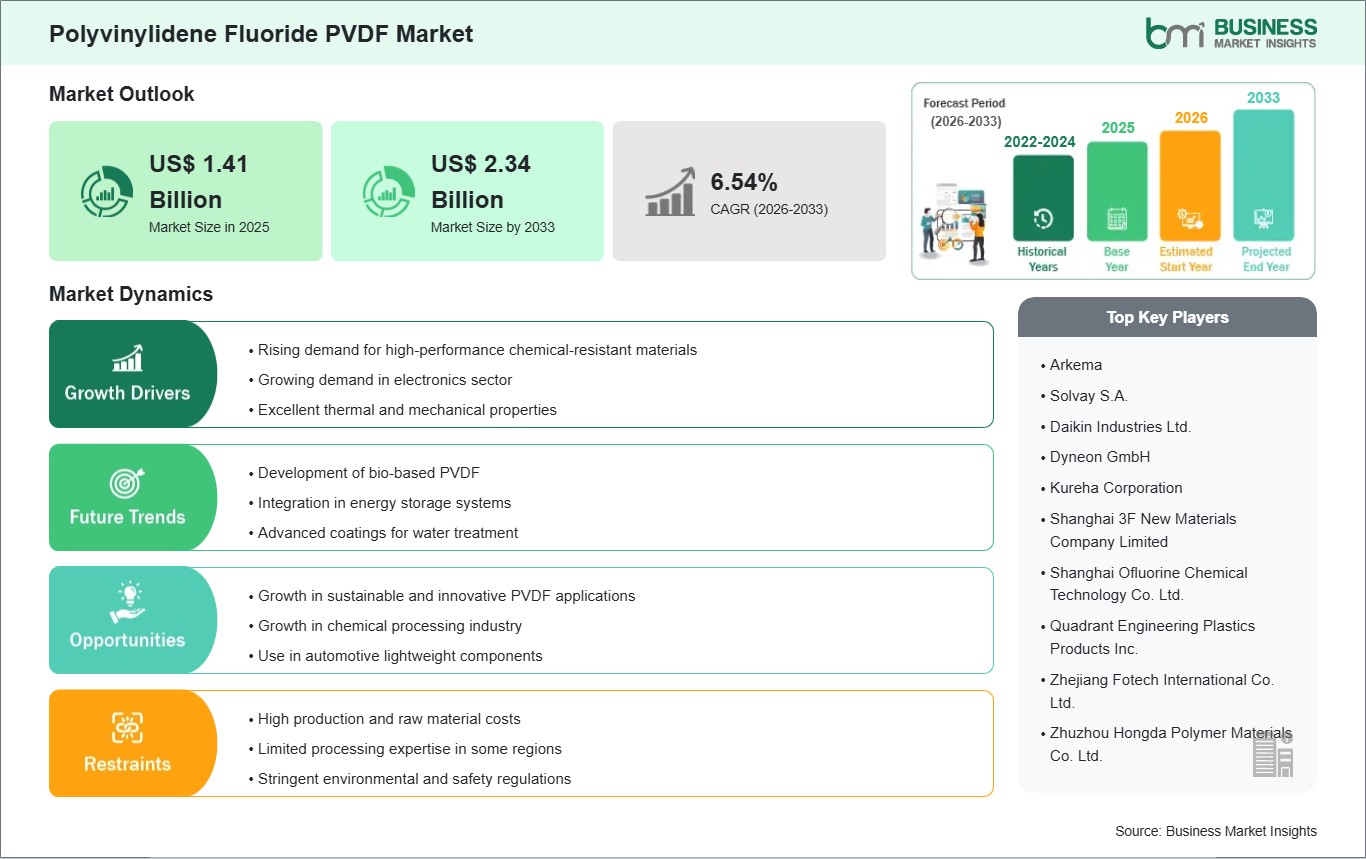
The Polyvinylidene Fluoride PVDF Market size is expected to reach US$ 2.34 billion by 2033 from US$ 1.41 billion in 2025. The market is estimated to record a CAGR of 6.54% from 2026 to 2033.
The polyvinylidene fluoride (PVDF) market is presently undergoing an accelerated transition towards high-performance polymer solutions with end-user industries increasingly focusing on the reliability, chemical stability, and long-term operational efficiency of materials. PVDF is further consolidating its presence in key markets including electrical/electronics, energy storage, industrial filtration, chemical processing, and automotive segments, driven by its superior dielectric properties, solvent resistance, and high-temperature stability. The increasing focus on clean energy technologies including lithium-ion batteries, solar panels, and fuel cell components is also creating significant demand for PVDF materials, given their importance in enhancing efficiencies in energy storage solutions.
At the same time, membrane-based technologies for water/wastewater treatment are also creating opportunities for PVDF materials, driven by their high fouling resistance and mechanical stability in aggressive operational environments. The strategic investment in capacity additions, production process optimization, and the development of new polymers is critical in maintaining competitive advantage, especially against the backdrop of changing raw material costs related to fluorochemical-based materials. From the perspective of the competitive landscape, the relationship between the manufacturer of fluoropolymers and the OEM is becoming more common, especially with the establishment of supply agreements. Sustainability initiatives are becoming more critical to the players in the market, with many focusing on the development of bio-based feedstocks, low-carbon manufacturing processes, and the recyclability of PVDF-based materials. However, the challenge remains in balancing the need to reduce costs with the need to innovate, especially in developing markets where infrastructure is still in its infancy.
Furthermore, regulatory scrutiny surrounding fluorinated compounds is guiding material substitution strategies, prompting the industry to invest in next‑generation variants that deliver performance without compromising environmental compliance. Despite these challenges, the PVDF market’s multi‑sector relevance and expanding technology applications position it as a strategically significant polymer segment with robust medium‑ to long‑term growth prospects.

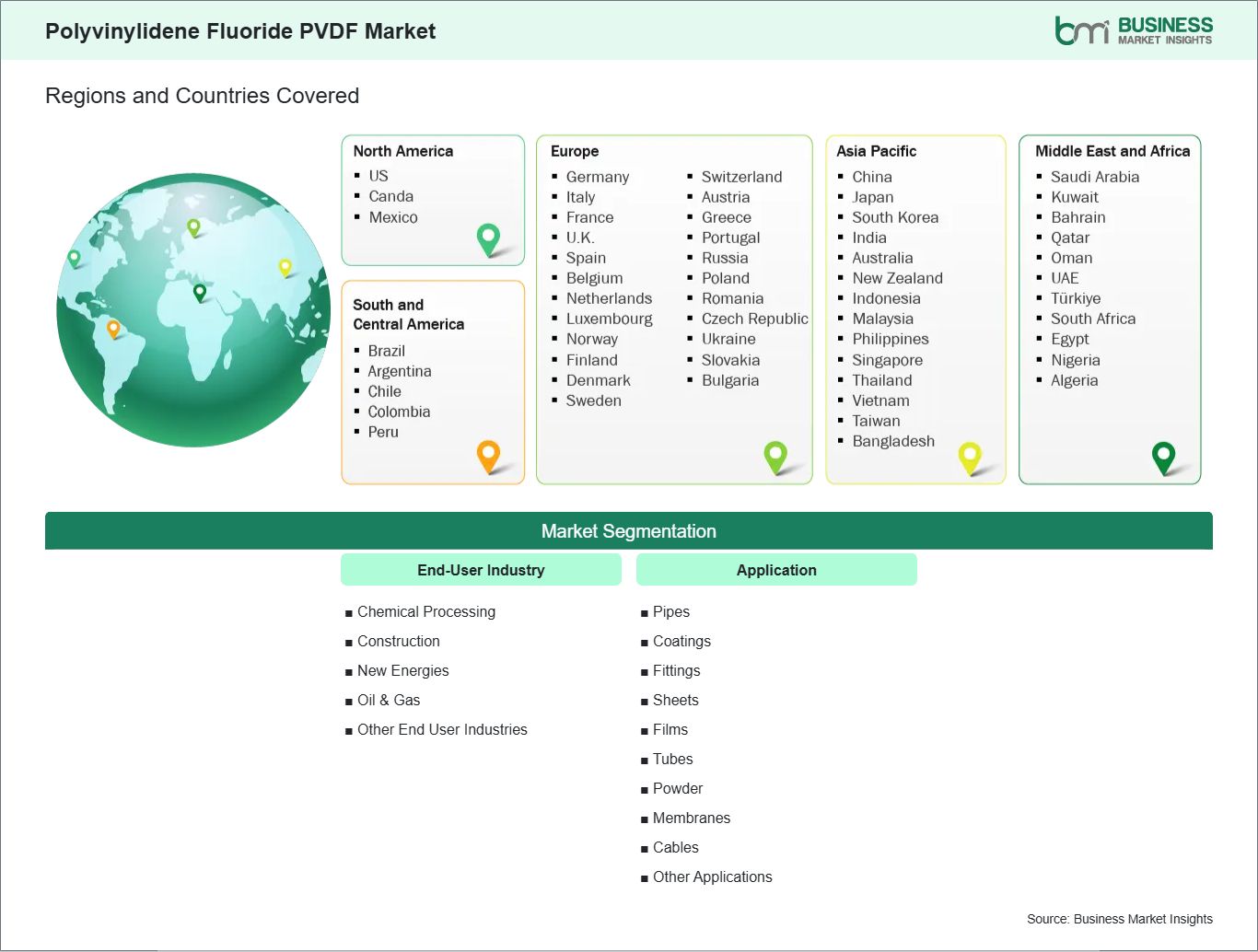
Key segments that contributed to the derivation of the PVDF market analysis are end‑user industry and application.
The polyvinylidene fluoride (PVDF) market is growing significantly, and this growth is attributed to the need for a material that possesses excellent properties of chemical resistance, thermal stability, and mechanical properties. PVDF is a well-recognized polymer that maintains its integrity even in harsh and corrosive conditions. It is a very important polymer for industrial applications, including piping, pumps, valves, and chemical plant equipment. Its exposure to continuous corrosive chemicals and high-temperature conditions makes it a highly sought-after option for replacing metals and conventional plastics, as they are prone to corrosion and may deteriorate after a certain period of time.
Various industries are focusing on utilizing a material that helps reduce the maintenance of equipment and increase the life of the equipment. PVDF is being used for equipment where reliability is of primary concern. It is used as a membrane for water treatment, tank linings, and coatings. Its light weight and durability help optimize efficiency and safety in industrial operations. Its ability to perform well even in harsh and corrosive conditions helps maintain minimum downtime, and this is a significant factor for the growth of this industry.
Moreover, as advanced manufacturing and automation technologies continue to grow and develop, there is an increasing need to develop materials that can withstand extreme pressure, temperature, and chemical exposure. The mechanical and thermal properties of PVDF make it suitable for use in areas where other materials are not effective, further emphasizing its significance in the future. The wide range of uses of the material in different industries makes it essential in the future, especially in those sectors aiming to improve their operations and product longevity, ensuring its demand in the future.
The PVDF industry is gaining traction as there is a growing need for sustainable and innovative products. Manufacturers are focusing on innovations that result in eco-friendly PVDF products, ensuring that the environment is not compromised while maintaining the high-performance characteristics of the polymer. The industry is witnessing innovations in manufacturing processes that are not only efficient but also result in products that are recyclable and sustainable. The innovations are allowing companies to meet the sustainability demands of the industry, ensuring that PVDF products are used in applications that require sustainability.
PVDF products are no longer confined to traditional applications. The industry is witnessing a shift toward the use of PVDF products in innovative and sustainable applications. The products are being used in the manufacturing of products that require high-performance characteristics, such as electrical insulation and sustainability. The products are being used in the manufacturing of lithium-ion battery components, electronics, and water treatment products. The versatility of PVDF products allows companies to innovate and create products that are safe and reliable. The innovations are broadening the scope of the industry, resulting in new investment opportunities.
The increasing demand for sustainable materials is also contributing to shaping the future of PVDF. Industries are demanding materials that not only have a positive impact on the environment but also have longevity. This is creating an opportunity for PVDF-based solutions that have reduced environmental impacts. This is further contributing to the increased demand for PVDF in industries that value durability, reliability, and sustainability. As businesses become more environmentally friendly, PVDF is also set to thrive in the market due to its ability to meet environmental demands.
The polymer/fiber materials market demonstrates steady growth, with size and share analysis highlighting evolving trends and competitive dynamics among key players. The report examines subsegments categorized within end‑user industry and application, offering insights into their contribution to overall market performance.
By End‑User Industry, the chemical processing subsegment dominated the market in 2025, driven by its extensive use in industrial manufacturing and processing operations.
Based on Application, the coatings subsegment dominated the market in 2025, owing to its critical role in surface protection, durability, and aesthetic finishes across industries.
| Report Attribute | Details |
|---|---|
| Market size in 2025 | US$ 1.41 Billion |
| Market Size by 2033 | US$ 2.34 Billion |
| Global CAGR (2026 - 2033) | 6.54% |
| Historical Data | 2022-2024 |
| Forecast period | 2026-2033 |
| Segments Covered | By End-User Industry
|
|
Regions and Countries Covered
| |
| North America | US, Canada, Mexico |
| Europe | Belgium, Austria, Finland, Denmark, Greece, Poland, Romania, Russia, Ukraine, Czech Republic, Slovakia, Bulgaria, Italy, Luxembourg, Germany, Switzerland, France, Netherlands, Norway, Portugal, Spain, Sweden, United Kingdom |
| Asia-Pacific | Australia, China, India, Japan, South Korea, Indonesia, Malaysia, Philippines, Singapore, Thailand, Vietnam, Bangladesh, New Zealand, Taiwan |
| South and Central America | Brazil, Argentina, Peru, Chile, Colombia |
| Middle East and Africa | Bahrain, Kuwait, Oman, Qatar, Saudi Arabia, United Arab Emirates, Turkiye, South Africa, Egypt, Algeria, Nigeria |
| Market leaders and key company profiles |
|
The "Polyvinylidene Fluoride PVDF Market Size and Forecast (2022 - 2033)" report provides a detailed analysis of the market covering below areas:
The geographical scope of the Polyvinylidene Fluoride PVDF Market report is divided into North America, Asia Pacific, Europe, Middle East & Africa, and South & Central America. North America held the largest share in 2025.
Regional‑level dynamics in the PVDF market reveal differentiated growth pathways shaped by localized industrial demand, policy frameworks, and investment priorities. In North America, the market is dominant, anchored by the United States and Canada, where robust demand from automotive electrification, aerospace, and high‑performance electrical applications drives PVDF adoption. The region’s focus on advanced energy storage systems, stringent quality and safety standards, and strong R&D ecosystem enhances technological differentiation and supply chain integration.
Europe shows steady expansion, led by Germany, France, and Italy, with regulatory emphasis on environmental safety, energy efficiency, and chemical processing boosting the use of PVDF in membrane filtration, sustainable construction materials, and renewable energy technologies. The maturity of European markets and active public‑private partnerships support innovation in fluoropolymer blends and manufacturing processes that align with EU sustainability mandates.
In the Asia Pacific, rapid industrialization, large‑scale infrastructure development, and expanding electronics and energy equipment manufacturing in China, India, Japan, and South Korea are key growth engines. Government initiatives promoting electrification, semiconductor production, and renewable energy deployment position the region as a strategic focal point for PVDF demand.
Middle East & Africa regions are gradually emerging, leveraging petrochemical strengths to build downstream fluoropolymer capabilities while targeting water desalination, petrochemical processing, and industrial facility upgrades. Although advanced applications are still nascent, capacity enhancements and strategic partnerships reflect growing market interest. South & Central America, led by Brazil, Mexico, and Argentina, reflects moderate growth with demand arising mainly from construction, automotive components, and filtration applications. Economic variability, currency fluctuations, and evolving regulatory landscapes influence short‑term investment decisions, yet ongoing infrastructure modernization initiatives provide continuous opportunities for PVDF integration across key sectors.

The Polyvinylidene Fluoride PVDF Market is evaluated by gathering qualitative and quantitative data post primary and secondary research, which includes important corporate publications, association data, and databases. A few of the key developments in the polyvinylidene fluoride PVDF market are:
The Polyvinylidene Fluoride PVDF Market is valued at US$ 1.41 Billion in 2025, it is projected to reach US$ 2.34 Billion by 2033.
As per our report Polyvinylidene Fluoride PVDF Market, the market size is valued at US$ 1.41 Billion in 2025, projecting it to reach US$ 2.34 Billion by 2033. This translates to a CAGR of approximately 6.54% during the forecast period.
The Polyvinylidene Fluoride PVDF Market report typically cover these key segments-
The historic period, base year, and forecast period can vary slightly depending on the specific market research report. However, for the Polyvinylidene Fluoride PVDF Market report:
The Polyvinylidene Fluoride PVDF Market is populated by several key players, each contributing to its growth and innovation. Some of the major players include:
The Polyvinylidene Fluoride PVDF Market report is valuable for diverse stakeholders, including:
Essentially, anyone involved in or considering involvement in the Polyvinylidene Fluoride PVDF Market value chain can benefit from the information contained in a comprehensive market report.
Please tell us your area of interest
(Market Segments/ Regions and Countries/ Companies)