Market Summary
Executive Summary and Global Market Analysis
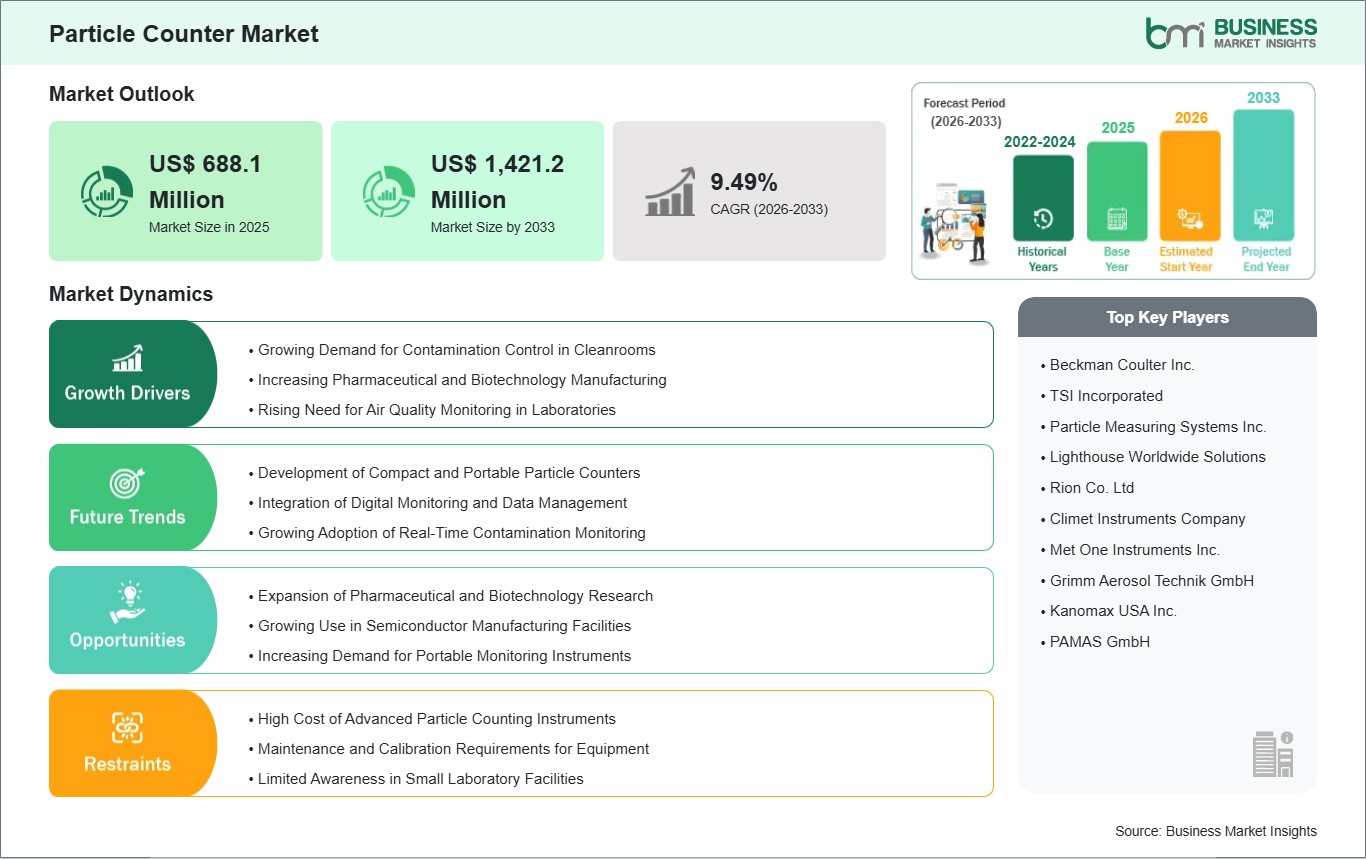
The particle counter market is growing as industries increasingly focus on maintaining clean and controlled environments. Particle counters are instruments used to measure the concentration of particles in air or liquids, helping organizations monitor contamination levels. These devices are widely used in pharmaceutical manufacturing, biotechnology laboratories, semiconductor production facilities, and environmental research centers. By providing accurate measurements of particle levels, these instruments help ensure product quality, safety, and compliance with industry standards.
Increasing demand for contamination control and cleanroom monitoring is supporting market growth. Pharmaceutical and biotechnology companies rely on particle counters to maintain sterile manufacturing conditions and ensure that production environments meet strict regulatory requirements. In addition, laboratories and research institutions use particle counters to support scientific studies and environmental monitoring activities. As industries continue to emphasize quality assurance and controlled production environments, the demand for reliable particle monitoring instruments is expected to increase steadily.
Segment Analysis
Particle Counter Market Segmentation
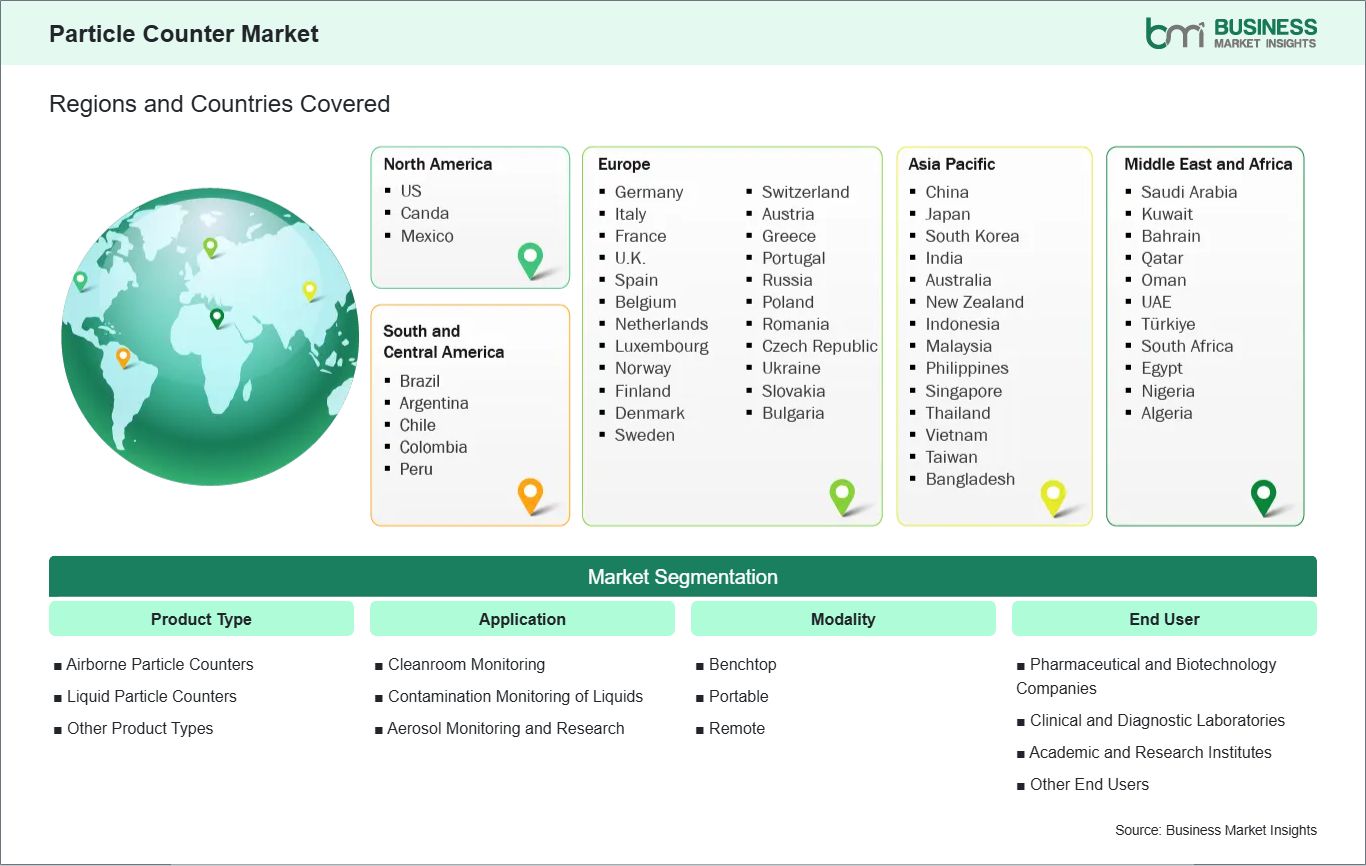
Key segments that contributed to the derivation of the particle counter market analysis are product type, application, modality, end user.
- By product type, the particle counter market is segmented into airborne particle counters, liquid particle counters, and other product types. The airborne particle counters segment dominated the market in 2025.
- By application, the market is classified into cleanroom monitoring, contamination monitoring of liquids, and aerosol monitoring and research. The cleanroom monitoring segment dominated the market in 2025.
- By modality, the market is segmented into benchtop, portable, and remote systems. The portable segment dominated the market in 2025.
- By end user, the market is segmented into pharmaceutical and biotechnology companies, clinical and diagnostic laboratories, academic and research institutes, and other end users. The pharmaceutical and biotechnology companies segment dominated the market in 2025.
Market Forces
Particle Counter Market Drivers and Opportunities
Growing Demand for Contamination Control in Cleanrooms
The growing demand for contamination control in cleanrooms is a major driver for the particle counter market. Many industries require highly controlled environments where airborne particles must be carefully monitored and managed. Particle counters help detect and measure the presence of microscopic particles in the air, allowing organizations to maintain strict cleanliness standards. These instruments play an essential role in ensuring product quality and safety in environments where even small levels of contamination can affect manufacturing processes.
Pharmaceutical and biotechnology companies rely on cleanroom environments to produce medicines, vaccines, and medical products. Particle counters are used to monitor air quality and ensure that manufacturing areas remain free from harmful particles. Similarly, semiconductor manufacturing facilities use cleanrooms to prevent contamination that could damage sensitive electronic components during production.
In addition, regulatory authorities require strict monitoring of contamination levels in controlled environments. Companies must maintain detailed records of air quality to demonstrate compliance with industry standards. As industries continue to focus on product quality, safety, and regulatory compliance, the demand for reliable particle counting instruments is expected to increase across laboratories and manufacturing facilities.
Expansion of Pharmaceutical and Biotechnology Research
The expansion of pharmaceutical and biotechnology research presents strong opportunities for the particle counter market. Research laboratories and biotechnology facilities require controlled environments where contamination must be carefully monitored. Particle counters help researchers measure airborne particles and maintain clean conditions that are necessary for accurate experimental results and safe product development.
Pharmaceutical companies are increasing their investment in research activities to develop new medicines, vaccines, and advanced therapies. These research processes often require cleanrooms and sterile environments where particle monitoring is essential. Particle counters allow laboratories to monitor air quality and ensure that research and manufacturing processes remain free from contamination.
In addition, biotechnology research institutions and academic laboratories are expanding their facilities to support new scientific studies. These organizations require reliable monitoring equipment to maintain controlled laboratory environments. As research activities in pharmaceutical and biotechnology sectors continue to grow, the demand for particle counters used in contamination monitoring and cleanroom management is expected to increase significantly.
Size and Share Analysis
Particle Counter Market Size and Share Analysis
The global particle counter market is experiencing steady growth, with market size and share analysis reflecting evolving treatment preferences and competitive dynamics among key players. The report evaluates important subsegments categorized within product type, application, modality, end user, highlighting their respective contributions to overall market performance.
By deployment model, the cloud-based subsegment dominated the market in 2025, due to its ability to support remote monitoring, real-time data access, and centralized management of parking facilities across multiple locations.
By parking site, the off-street subsegment dominated the market in 2025, driven by the widespread use of particle counter solutions in commercial complexes, shopping centers, airports, and private parking facilities.
By solution component, the software subsegment dominated the market in 2025, as parking operators increasingly rely on management platforms for automated ticketing, space monitoring, payment processing, and data analysis.
By vertical, the government subsegment dominated the market in 2025, due to increasing smart city initiatives and efforts to improve urban traffic flow and parking efficiency.
Report Coverage
Particle Counter Market Report Coverage and Deliverables
The "Particle Counter Market Size and Forecast (2022 - 2033)" report provides a detailed analysis of the market covering below areas:
- Particle Counter market size and forecast at the regional and country levels for segments covered under the scope
- Particle Counter market trends, as well as drivers, restraints, and opportunities
- Particle Counter market analysis covering key trends, regional framework, major players, regulations, and recent developments
- Industry landscape and competition analysis covering market concentration, heat map analysis, prominent players, and recent developments for the Particle Counter market
- Detailed company profiles, including SWOT analysis
Geographic Insights
Particle Counter Market Geographic Insights
The geographical scope of the particle counter market report is divided into: North America, Asia Pacific, Europe, Middle East & Africa, and South & Central America. North America held the largest share in 2025.
North America dominates the particle counter market due to the strong presence of pharmaceutical, biotechnology, and semiconductor industries in the region. These industries require strict contamination control and advanced monitoring technologies to maintain high-quality production environments. Particle counters are widely used in manufacturing facilities, laboratories, and research institutions to monitor air quality and maintain cleanroom standards.
The region also benefits from strong regulatory frameworks that require continuous monitoring of contamination levels in controlled environments. Pharmaceutical manufacturers and biotechnology companies must comply with strict industry guidelines, which encourages the adoption of advanced particle counting instruments. In addition, research organizations and academic institutions in North America conduct extensive scientific studies that require precise environmental monitoring.
Continuous investment in research infrastructure and advanced manufacturing technologies further supports the adoption of particle monitoring equipment in the region. The presence of leading technology providers and laboratory equipment manufacturers also contributes to innovation in particle counting solutions. These factors help North America maintain a leading position in the global particle counter market.
Industry Activity
Recent Developments
The particle counter market is evaluated by gathering qualitative and quantitative data post primary and secondary research, which includes important corporate publications, association data, and databases. A few of the key developments in the Particle Counter market are:
- In October 2023, Particle Measuring Systems announced that it launched the Lasair Pro airborne particle counter designed for cleanroom monitoring and classification applications, offering portable and remote configurations to support contamination control in pharmaceutical and semiconductor manufacturing environments.
- In June 2024, Plair SA announced that it launched the Rapid-C+ real-time microbial particle counter and active air sampler, integrating biofluorescent particle counting technology with traditional air sampling to detect viable contaminants in aseptic processing and cleanroom environments.
Trust & Transparency
Research Methodology
The market analysis combines proprietary research with secondary data from government agencies, company disclosures, regulatory filings, industry databases and expert interviews. Market estimates are validated through data triangulation, cross-market benchmarking and analyst
review.
View Full Research Methodology
Key Sources Referred:
World BankACGIH (American Conference of Governmental Industrial Hygienists)WHO (World Health Organization)US EPA (Environmental Protection Agency)JIS (Japanese Industrial Standards Committee)Academic JournalsCompany WebsitesCompany Annual ReportsCompany Investor Presentations