
Oleochemicals Market Outlook: Size, Share, Trends, Growth Analysis, Competitive Landscape & Forecast, 2026-2033

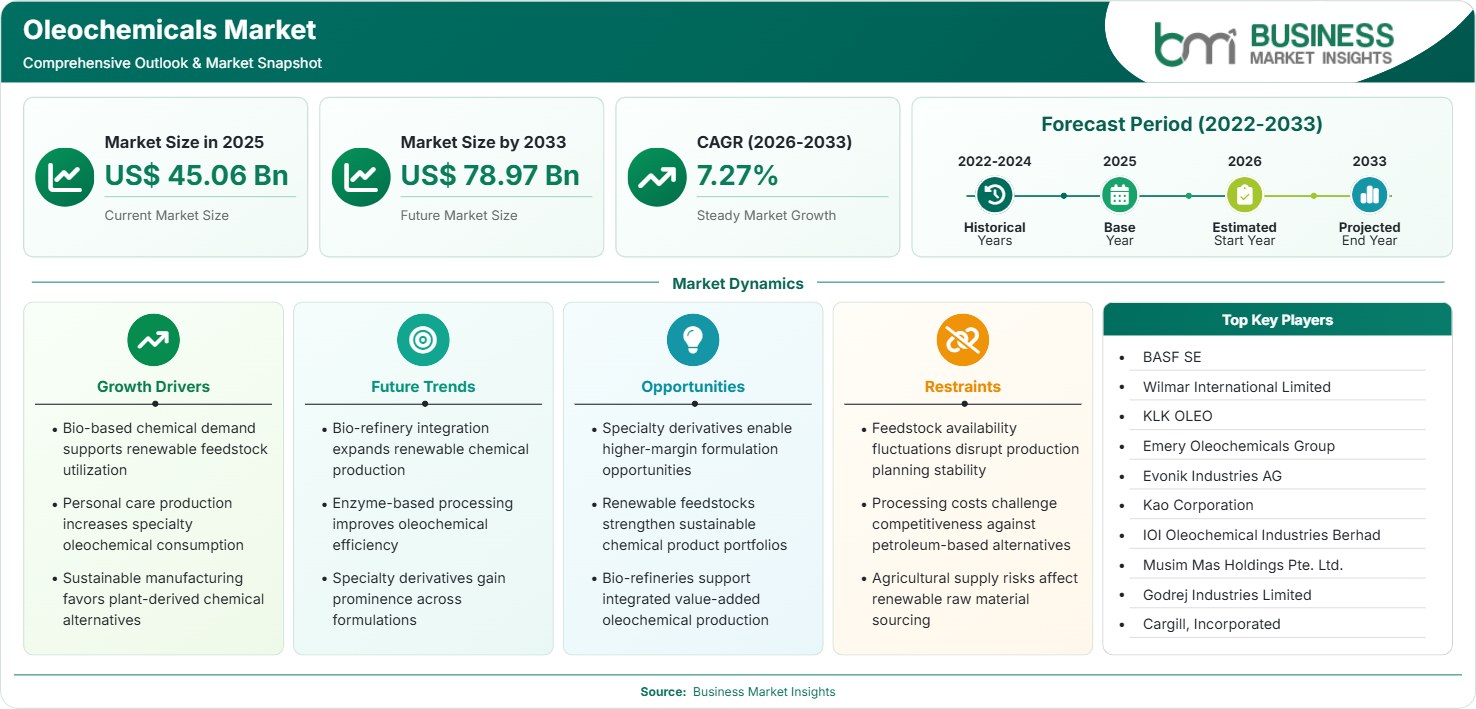
The Oleochemicals Market size was valued at US$ 45.06 Billion in 2025 and is projected to reach US$ 78.97 Billion by 2033, growing at a CAGR of 7.27% during 2026–2033. Rising demand for bio-based ingredients, expanding sustainable chemical production, increasing renewable feedstock utilization, and growing industrial decarbonization initiatives are creating new growth opportunities across diverse end-use sectors.

Report Coverage
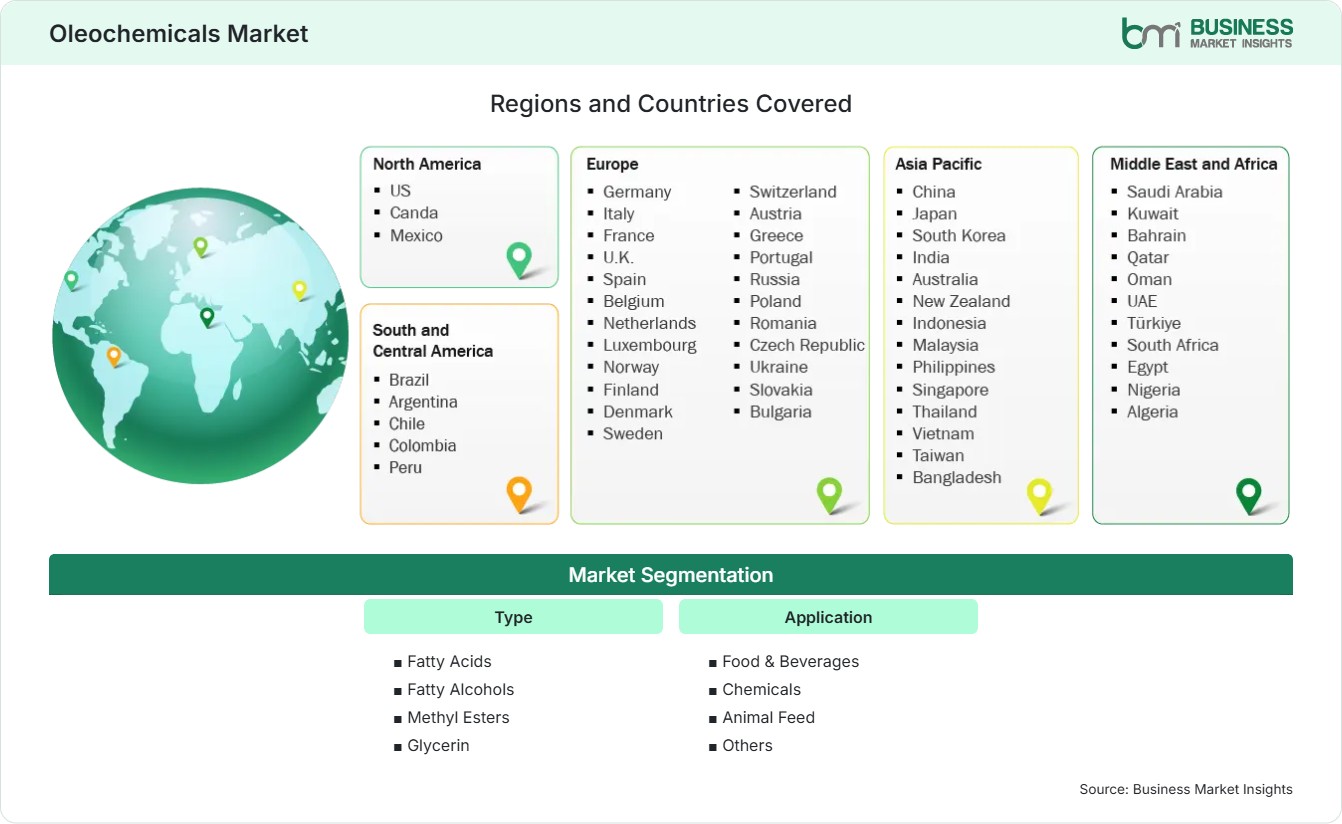
  • Type: Fatty Acids, Fatty Alcohols, Methyl Esters, Glycerin
  • Application: Food & Beverages, Chemicals, Animal Feed, Others
US$ 45.06 Bn Market size in 2025
US$ 78.97 Bn Market Size by 2033
7.27% CAGR, 2026 - 2033
2026-2033 Forecast Period

AI Overview

Oleochemicals Market Summary

  • North America Region: North America holds a market share of 22%–25% in 2025, growing with a CAGR of 6.2%–6.8% during 2026–2033, influenced by renewable chemical adoption, sustainable consumer products demand, advanced manufacturing capabilities, supportive environmental regulations, growing bio-lubricant applications, corporate decarbonization targets, feedstock diversification initiatives, industrial sustainability investments, specialty chemical innovation, and circular economy strategies. The U.S. market benefits from strong specialty chemicals demand and renewable product innovation, advancing at 6.3%–6.9% CAGR.
  • Fastest Growing Region: Asia Pacific holds a market share of 39%–42% in 2025, growing with a CAGR of 8.2%–8.8% during 2026–2033, supported by expanding palm-based production, rapid industrialization, rising personal care consumption, increasing investments in bio-based chemicals, manufacturing expansion, export competitiveness, sustainability commitments, feedstock availability, downstream integration strategies, and growing regional demand.
  • Leading Segment: Fatty Acids account for 38%–42% share in 2025 and grow at 7.0%–7.5% CAGR, supported by extensive use across soaps, detergents, cosmetics, lubricants, rubber processing, food additives, industrial intermediates, growing renewable material adoption, specialty formulations, and increasing demand for sustainable ingredient solutions worldwide.
  • High Growth Segment: Food & Beverages represents 24%–28% share in 2025 and advances at 8.0%–8.6% CAGR, driven by clean-label ingredient adoption, emulsifier demand, renewable sourcing preferences, expanding processed food production, nutritional formulations, regulatory support for sustainable ingredients, consumer awareness, product innovation, and premium food applications.
  • Key Market Opportunity: Expanding adoption of renewable carbon feedstocks in specialty chemicals, personal care formulations, food processing ingredients, and industrial lubricants is creating long-term value opportunities through sustainable product differentiation and compliance advantages globally.
  • Major Market Players: BASF SE, Wilmar International Limited, KLK OLEO, Emery Oleochemicals Group, Evonik Industries AG, Kao Corporation, IOI Oleochemical Industries Berhad, Musim Mas Holdings Pte. Ltd., Godrej Industries Limited, Cargill, Incorporated.
Strategic Insights

Oleochemicals Market: Strategic Insights

Oleochemicals Market Strategic Framework
FREE PDF
Request your free sample
Request free sample
Stakeholder View

Key Takeaways

  • The industry maintains a highly integrated value chain spanning agricultural feedstock suppliers, crushers, refiners, oleochemical processors, specialty formulators, and consumer goods manufacturers, creating significant advantages for vertically integrated companies.
  • Food and beverage applications present one of the strongest growth opportunities as manufacturers increasingly adopt plant-derived emulsifiers, stabilizers, and functional ingredients aligned with sustainability and clean-label preferences.
  • Product innovation is shifting toward high-purity fatty acid derivatives, bio-lubricants, specialty esters, green surfactants, and renewable chemical intermediates designed to replace petroleum-derived alternatives in premium applications.
  • Southeast Asia offers a compelling investment case due to abundant palm oil feedstocks, established refining infrastructure, export-oriented production networks, and increasing downstream value-addition investments.
  • Strategic partnerships, capacity expansions, and acquisitions are becoming common as producers seek feedstock security, higher-margin specialty portfolios, and stronger market positions in bio-based chemical segments.
  • Regulatory pressure to reduce carbon intensity is accelerating substitution of fossil-based raw materials, making renewable feedstocks a central competitive differentiator across industrial and consumer markets.
Geographic Outlook

Oleochemicals Market Regional Highlights

North America Oleochemicals Market

North America accounted for approximately 22%–25% of global revenue in 2025 and is projected to expand at a 6.2%–6.8% CAGR through 2033. Regional demand is supported by strong penetration of renewable chemicals in personal care, food processing, lubricants, and industrial formulations. The region benefits from advanced manufacturing capabilities and corporate sustainability targets. The Oleochemicals Market share remains supported by increasing adoption of bio-based ingredients among multinational consumer goods companies seeking lower-carbon alternatives and resilient raw material sourcing strategies.

  • Growing adoption of renewable surfactants in household cleaning products is strengthening demand across North American manufacturing facilities while supporting sustainability commitments among major consumer goods producers.
  • Expansion of bio-lubricants in industrial equipment and transportation applications is creating opportunities for higher-value specialty products throughout the region's chemical sector.
  • Corporate environmental targets are encouraging replacement of petroleum-derived ingredients with renewable alternatives, increasing procurement of plant-based chemical intermediates.
  • Regulatory emphasis on sustainable manufacturing and carbon reduction initiatives continues to encourage investment in renewable chemical production technologies.
  • Specialty personal care formulations incorporating naturally derived ingredients are driving demand for premium fatty acids and glycerin derivatives.

US Oleochemicals Market

The United States represents approximately 72%–76% of North American Oleochemicals Market revenue and is forecast to advance at 6.3%–6.9% CAGR through 2033. High levels of demand from the personal care, specialty chemicals, industrial lubricants, and food ingredients segments favor market growth. High investments in sustainable supply chain systems and green materials further improve the demand potential. Domestic players are increasingly targeting bio-sourced specialty products that deliver functionality while complying with changing environmental and regulatory standards.

  • Consumer preference for naturally sourced ingredients is supporting growth in personal care and cosmetic formulations utilizing plant-derived chemical intermediates.
  • Industrial manufacturers are incorporating renewable lubricants and esters to improve sustainability metrics and regulatory compliance performance.
  • Large consumer packaged goods companies continue increasing procurement of renewable raw materials to achieve science-based climate targets.
  • Research activities focused on high-performance specialty derivatives are expanding the application scope of renewable chemicals.

Europe Oleochemicals Market

Europe held approximately 24%–27% Oleochemicals Market share in 2025 and is expected to grow at a 6.5%–7.1% CAGR during 2026–2033. Supportive regulations regarding bio-based materials, circular economy, and sustainability further facilitate usage within the area. Germany still stands as the leader, but Eastern Europe demonstrates better growth momentum in terms of its CAGR being closer to the top of the region. Manufacturers are becoming more focused on using traceable raw materials and reducing the carbon footprint of their products.

  • The European Green Deal and sustainability-focused industrial policies are encouraging substitution of conventional petrochemical ingredients with renewable alternatives.
  • Germany leads regional consumption due to its extensive specialty chemical manufacturing base and established renewable materials ecosystem.
  • Poland and selected Eastern European countries are exhibiting accelerated investment activity driven by expanding industrial manufacturing capacity.
  • Demand for certified sustainable feedstocks is increasing throughout food, cosmetics, and household care supply chains.
  • Growth in bio-based surfactants and specialty esters continues to support premium product development across multiple sectors.

Asia Pacific Oleochemicals Market

Asia Pacific accounted for around 39%–42% of global revenue in 2025 and is projected to register the fastest growth at 8.2%–8.8% CAGR through 2033. The region benefits from abundant feedstock availability, integrated processing infrastructure, and expanding downstream manufacturing. China remains the largest consumption center, while Indonesia and Malaysia retain leadership in production. Strong Oleochemicals Market growth is supported by industrial expansion, rising consumer spending, export-oriented manufacturing, and sustained investments in renewable chemical value chains throughout the region.

  • Indonesia and Malaysia remain crucial global production hubs due to extensive palm-based feedstock availability and integrated refining infrastructure.
  • China leads regional demand across household care, industrial chemicals, food ingredients, and personal care applications.
  • India is emerging as a significant consumer market driven by urbanization, consumer goods manufacturing expansion, and sustainability awareness.
  • Export competitiveness and favorable production economics support continued capacity additions across Southeast Asia.
  • Downstream integration strategies are improving margins while expanding specialty product portfolios within regional manufacturing ecosystems.

Rest of World Oleochemicals Market

The Rest of World region accounted for approximately 10%–13% of global Oleochemicals Market revenue in 2025 and is anticipated to expand at a 7.0%–7.6% CAGR through 2033. South and Central America benefit from agricultural feedstock availability and increasing industrial adoption of renewable materials.

Middle East and Africa markets are witnessing gradual expansion due to investments in specialty chemicals, sustainable manufacturing, and industrial diversification initiatives. Brazil leads regional demand while Gulf economies exhibit stronger growth rates supported by industrial development and renewable product strategies.

  • Brazil continues strengthening its renewable chemicals industry through agricultural resource advantages and expanding downstream processing capacity.
  • Mexico remains an important manufacturing hub serving consumer goods and industrial sectors throughout the Americas.
  • Gulf countries are investing in specialty chemical production and value-added industrial diversification programs.
  • Growing awareness of sustainability benefits is encouraging adoption across food processing and personal care product manufacturing.
  • Improving trade connectivity is strengthening export opportunities for renewable chemical producers in developing regions.
Global Market Geography
FREE PDF
Request your free sample
Request free sample
Segment Analysis

Oleochemicals Market Segmentation

Type

The Type segment represents the foundation of industry demand and product differentiation. It accounted for nearly 100% of market revenue, with Fatty Acids emerging as the dominant category holding 38%–42% share in 2025 and advancing at 7.0%–7.5% CAGR through 2033. Growing demand from personal care, detergents, lubricants, and industrial chemicals continues supporting segment expansion. The Oleochemicals Market scope is broadening as producers increasingly focus on specialty derivatives, higher purity grades, and sustainable bio-based formulations across multiple industries.

  • Fatty Acids: Widely utilized in soaps, detergents, cosmetics, rubber processing, lubricants, and specialty chemicals. Rising preference for renewable raw materials and biodegradable ingredients continues supporting commercial adoption across developed and emerging economies.
  • Fatty Alcohols: Essential feedstocks for surfactants, detergents, emulsifiers, and personal care formulations. Demand benefits from growing household cleaning product consumption and increasing utilization in environmentally friendly manufacturing processes.
  • Methyl Esters: Increasingly used in biodiesel production, industrial solvents, and specialty formulations. Regulatory support for renewable fuels and growing emphasis on lower-emission products enhance long-term demand prospects.
  • Glycerin: Strongly supported by pharmaceutical, food processing, personal care, and industrial applications. Expanding demand for high-purity grades and multifunctional formulations contributes to sustainable growth across end-use industries.

Application

The Application segment reflects expanding penetration across consumer and industrial markets. Food & Beverages is the high-growth category, accounting for 24%–28% share in 2025 while growing at 8.0%–8.6% CAGR during 2026–2033. Increasing demand for bio-based additives, emulsifiers, stabilizers, and clean-label ingredients supports growth. The adoption of renewable raw materials aligns with evolving Oleochemicals Market trends and sustainability objectives across global manufacturing and consumer sectors.

  • Food & Beverages: Demand is driven by emulsifiers, stabilizers, flavor carriers, and processing aids derived from renewable feedstocks. Clean-label product development and consumer preference for sustainable ingredients remain key growth catalysts.
  • Chemicals: Extensive utilization in surfactants, coatings, lubricants, polymers, and specialty formulations supports consistent demand. Industrial sustainability initiatives encourage greater use of renewable chemical intermediates.
  • Animal Feed: Growing focus on feed efficiency, nutritional enhancement, and livestock productivity supports consumption of select bio-based ingredients and additives within modern feed formulations.
Market Forces

Oleochemicals Market Dynamics

Key Market Drivers

Growing Demand for Sustainable and Bio-Based Chemicals

Global sectors are replacing petrochemical-based components with renewable ones to minimize their environmental footprint and enhance sustainability performance. Consumer goods businesses are continuing to increase their adoption of plant-based components in household, cosmetic, and food applications. As per global sustainability goals and net-zero emissions pledges, the procurement of renewable feedstocks is increasing. This transition supports long-term Oleochemicals Market growth due to the availability of biodegradability and reduced carbon footprints from fatty acids, fatty alcohols, and glycerin, in contrast to many petroleum-based alternatives. Leading multinational companies are leaning towards sustainably sourced materials, resulting in more companies adopting improved traceability systems and production technologies.

Expansion of Personal Care and Home Care Industries

Rising disposable incomes, urbanization, and premium product consumption are supporting higher demand for personal care and household cleaning products worldwide. Many formulas contain surfactants, emollients, emulsifiers, and conditioning ingredients, all made from renewable raw materials. The rise in population in the Asia Pacific, Africa, and Latin America is leading to increased demand for hygiene products and specialty formulas. Manufacturers are meeting this increased demand by expanding their capacity and developing specialty ingredients. Increased consumption of cosmetics, skincare, hair care, and detergent products has been the reason behind the continued demand for renewable chemical intermediates.

Advancing Industrial Adoption of Renewable Feedstocks

Industrial manufacturers are increasingly integrating renewable raw materials into lubricants, coatings, polymers, metalworking fluids, and specialty chemicals. With sustainability regulations, carbon reductions, and corporate purchasing practices, there is an increased push for greater use of biobased substitutes. Improved refining processes have increased product quality, enabling their use in high-end industrial applications. This makes renewable chemical building blocks more competitive with traditional chemical building blocks derived from fossil fuels. Increased research and development activities further increase their commercial potential.

Key Market Opportunities

Specialty Oleochemical Derivatives for High-Value Applications

Growing demand for specialty esters, sophisticated surfactants, medicinal-grade products, and pure derivative compounds is being experienced by the industry. Such products are capable of earning higher margins than generic products. This trend toward using high-quality formulations in the cosmetic, healthcare, and performance chemical industries represents an investment opportunity. Organizations with the capability to develop customized products can derive immense benefits from this trend. Long-term Oleochemicals Market Forecasts indicate greater potential for growth in specialized applications, where sustainability, performance, and regulatory requirements jointly influence purchase decisions. Innovations and technological cooperation with end-users are anticipated to improve business prospects.

Emerging Demand from Renewable Lubricants and Green Solvents

Industrial operators are adopting environmentally favorable lubricants and solvents to improve sustainability metrics and comply with environmental standards. Renewable feedstock offers some promising attributes, such as biodegradability and low toxicity. This means there are opportunities for producers to venture into producing specialty industrial products with a bright future. Increased use of the products in transport, manufacturing, the marine industry, and agricultural machinery will further boost their demand. The producers can take advantage of the greater acceptance of renewable products among the industrial consumers.

Capacity Expansion in Feedstock-Rich Economies

Countries with abundant palm oil, coconut oil, and vegetable oil resources are attracting investments in downstream processing and specialty derivative production. The vertical integration approach increases the security of feedstock as well as ensures cost competitiveness. Southeast Asia still appears very appealing owing to the presence of infrastructure and manufacturing ecosystems geared toward exports. Higher investments that would enable companies to focus on increasing processing capabilities give an opportunity to venture into higher-value markets beyond just commodities.

Market Restraints and Challenges

Feedstock Price Volatility and Supply Chain Uncertainty

Factor: Prices of palm oil, coconut oil, soybean oil, and other feedstocks are influenced by weather conditions, geopolitical developments, trade policies, and agricultural production cycles. Impact: Production costs can vary greatly, which would affect companies' margin visibility and cause uncertainty in downstream prices. Supply disruptions could affect the planning process as well as contract completion. The use of a lot of risk management plans and diverse sources will help to reduce the volatility. The continued fluctuations in agricultural commodities would still pose a problem in ensuring profit stability.

Competition from Petrochemical Alternatives

Factor: Petroleum-derived chemicals benefit from established infrastructure, large-scale production networks, and extensive integration within industrial supply chains. Impact: Cost-conscious consumers might still choose traditional materials even if renewable materials command higher prices. While the benefits of sustainability can justify the use of renewables, cost considerations often play a role in purchase decisions. Competition is especially high in times when oil prices are relatively low. Efficiency and performance improvements are needed in order to keep the competitive edge. Cost performance remains key to driving adoption in industrial volume markets.

Company Analysis

Competitive Landscape

The competitive environment is characterized by vertical integration, global distribution networks, and increasing emphasis on specialty derivatives. Current Oleochemicals Market analysis indicates that producers are focusing on sustainable sourcing, downstream diversification, and higher-value product portfolios.

Company Name

Overview

Products and Services relevant to this market

BASF SE

Global chemical producer with extensive bio-based chemical capabilities and strong specialty ingredient portfolio.

Fatty alcohols, surfactants, specialty esters, personal care ingredients, industrial intermediates, and performance chemicals.

Wilmar International Limited

Leading agribusiness and integrated oleochemical manufacturer with strong feedstock access.

Fatty acids, glycerin, fatty alcohols, biodiesel feedstocks, surfactants, and specialty derivatives.

KLK OLEO

Major international producer with integrated palm-based operations and global manufacturing footprint.

Fatty acids, esters, fatty alcohols, glycerin, specialty oleochemicals, and personal care solutions.

Emery Oleochemicals Group

Specialist provider focused on natural-based performance chemicals and industrial markets.

Bio-lubricants, specialty esters, polymers, green chemicals, and industrial intermediates.

Evonik Industries AG

Global specialty chemicals company serving diverse consumer and industrial sectors.

Surfactants, cosmetic ingredients, specialty additives, and renewable chemical solutions.

Kao Corporation

Consumer and specialty chemical manufacturer with extensive surfactant expertise.

Fatty alcohol derivatives, surfactants, personal care ingredients, and cleaning formulations.

IOI Oleochemical Industries Berhad

Integrated producer serving global industrial and consumer goods markets.

Fatty acids, glycerin, esters, specialty ingredients, and industrial derivatives.

Musim Mas Holdings Pte. Ltd.

Significant integrated processor with strong sustainability-focused operations.

Fatty acids, biodiesel intermediates, glycerin, surfactants, and specialty products.

Godrej Industries Limited

Diversified industrial company with established oleochemical manufacturing capabilities.

Fatty acids, fatty alcohols, surfactants, specialty chemicals, and personal care ingredients.

Cargill, Incorporated

Global agribusiness player leveraging agricultural feedstocks for value-added products.

Renewable industrial ingredients, food applications, specialty derivatives, and chemical intermediates.

Trust & Transparency

Research Methodology

The market analysis combines proprietary research with secondary data from government agencies, company disclosures, regulatory filings, industry databases and expert interviews. Market estimates are validated through data triangulation, cross-market benchmarking and analyst review.

View Full Research Methodology

Questions Answered

Frequently Asked Questions

Which end-user industries create the strongest demand?

Personal care, household cleaning, food processing, specialty chemicals, pharmaceuticals, industrial lubricants, and animal nutrition collectively account for the majority of demand due to their extensive use of renewable chemical ingredients and intermediates.

How does the Oleochemicals Market Report help stakeholders?

The report supports decision-making by evaluating growth opportunities, competitive positioning, segment performance, regional trends, demand drivers, investment prospects, and strategic developments shaping future industry expansion.

What makes Asia Pacific the leading production hub?

The region benefits from abundant feedstock supplies, integrated refining infrastructure, strong export capabilities, competitive manufacturing costs, and substantial investments in downstream processing, particularly across Indonesia and Malaysia.

Why are bio-based chemicals gaining traction across industries?

Manufacturers are pursuing lower-carbon alternatives that align with environmental commitments and regulatory requirements. Renewable chemicals also offer biodegradability, reduced toxicity, and improved sustainability credentials compared with several petroleum-derived alternatives.

Which feedstock is most important in oleochemical manufacturing?

Vegetable oils, especially palm oil, palm kernel oil, coconut oil, soybean oil, and sunflower oil, form the primary feedstocks. Their availability, sustainability certification, and pricing significantly influence industry competitiveness and production economics.

Access the Full Oleochemicals Market Report

Get segment-level forecasts, regional estimates, competitive benchmarking, company profiles and downloadable Excel datasets.

Access the full Oleochemicals Market Report
350 pages PDF & Excel | 2026-09-16
Similar Research

Related Market Reports