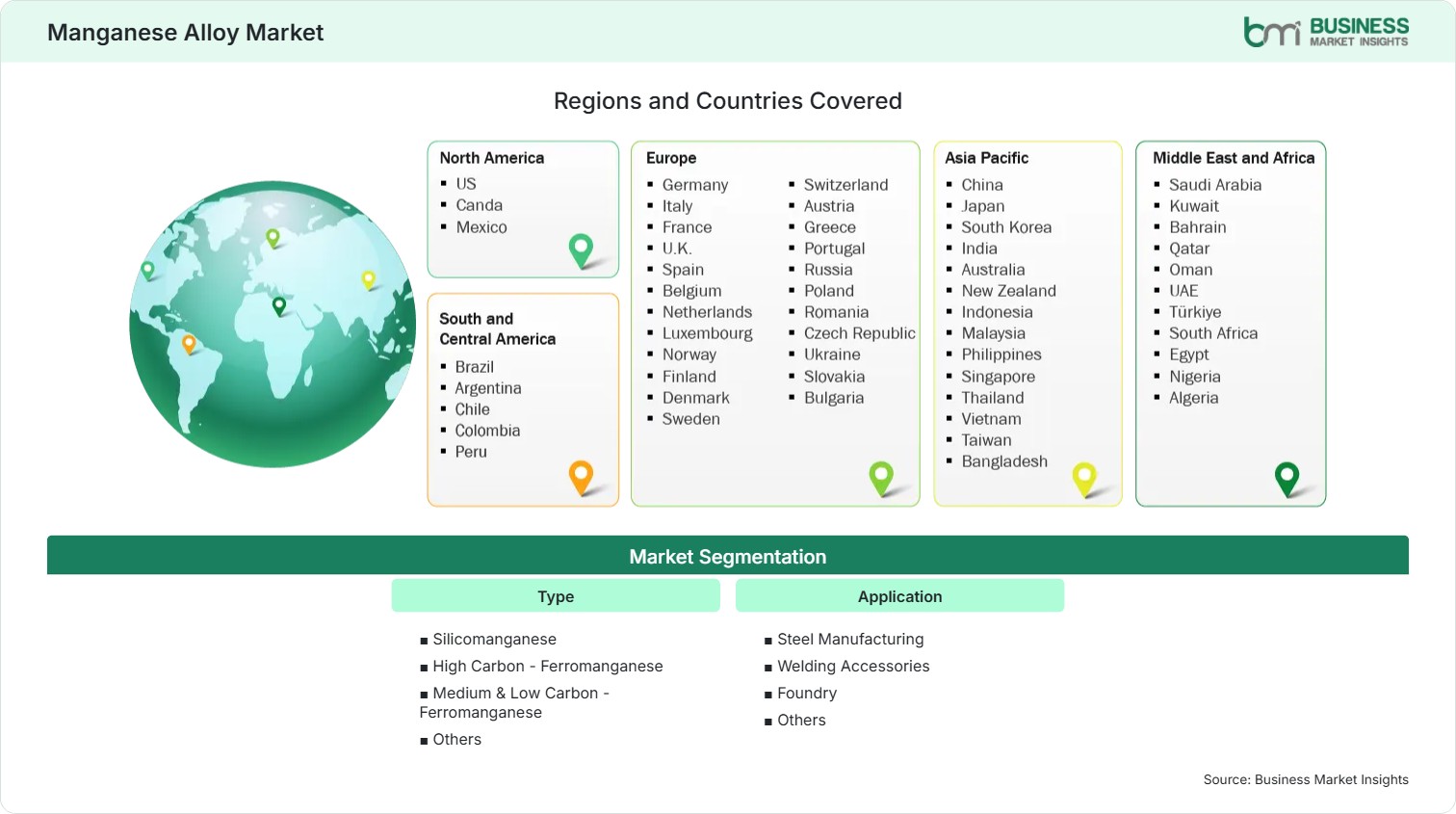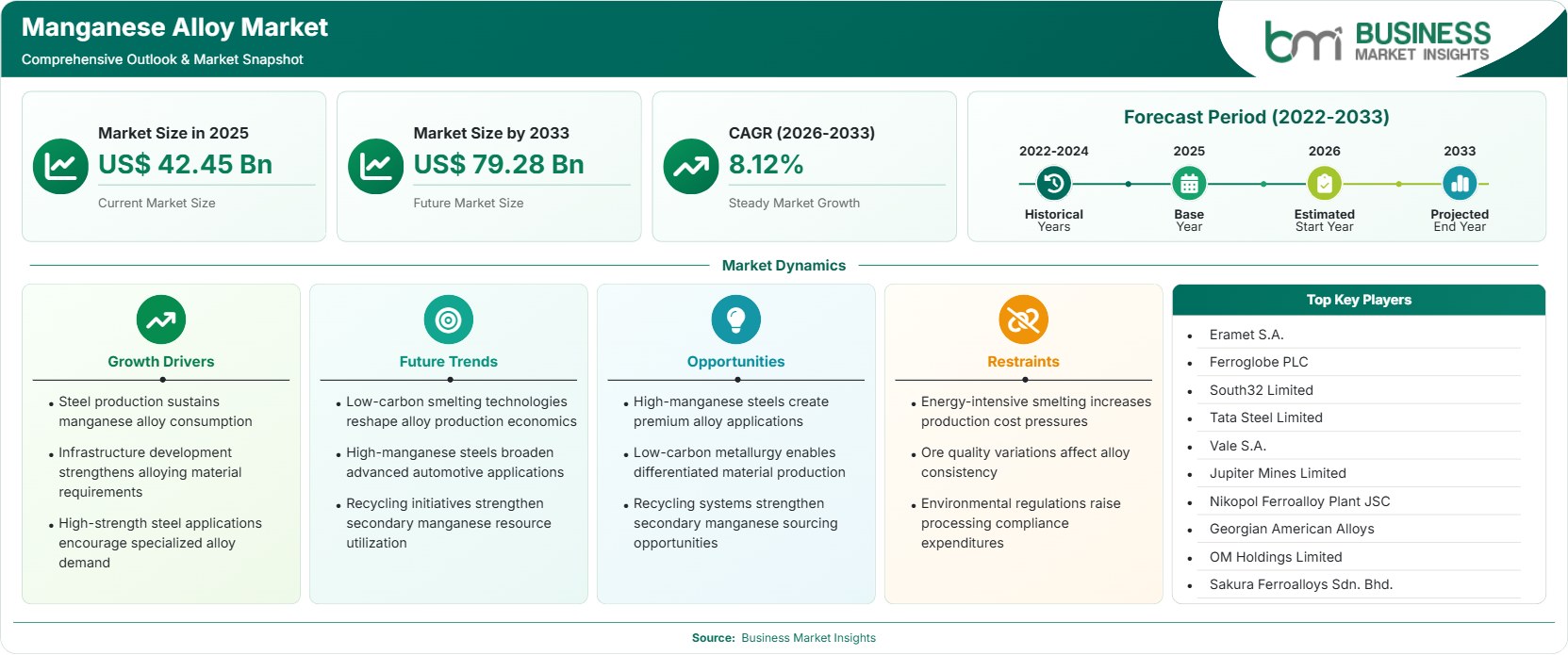
Manganese Alloy Market Regional Highlights
North America Manganese Alloy Market
North America accounts for 20%–23% of global revenue in 2025 and is projected to grow at a CAGR of 7.2%–7.8% through 2033. The region benefits from infrastructure renewal, industrial reshoring, and stable steel demand. The Manganese Alloy Market share remains supported by construction, machinery manufacturing, and pipeline investments. Producers are increasingly emphasizing supply security and sustainability, while electric-arc furnace adoption supports alloy consumption across modern steelmaking facilities.
- Infrastructure modernization programs increase demand for alloy-enhanced structural steel across transportation, industrial, and public-utility projects.
- Local sourcing initiatives encourage domestic ferroalloy procurement and improve supply resilience.
- Automotive manufacturing continues requiring advanced high-strength steel grades that incorporate manganese-rich alloys.
- Energy, defense, and heavy-equipment industries contribute stable metallurgical demand profiles.
US Manganese Alloy Market
The US represents approximately 74%–78% of North American Manganese Alloy Market demand and is expected to record a CAGR of 7.4%–8.0%. Strong construction activity, manufacturing revitalization, and federal infrastructure funding support consumption. Domestic steelmakers increasingly pursue efficiency improvements and cleaner production routes, strengthening demand for consistent alloy inputs.
- Large-scale infrastructure investments sustain long-term procurement requirements for alloy-containing steel products.
- Expansion of electric-arc furnace operations increases demand for metallurgical additives and deoxidizers.
- Supply-chain security initiatives encourage diversification beyond traditional import channels.
- Industrial automation and machinery production support specialty steel demand.
Europe Manganese Alloy Market
Europe holds 21%–24% Manganese Alloy Market share in 2025 and is projected to expand at a CAGR of 7.5%–8.2%. Germany remains the leading market, while Eastern European countries show relatively faster growth. Sustainability regulations and decarbonization targets influence production investments. Regional manufacturers continue focusing on premium-grade steels and low-emission alloy manufacturing technologies.
- Germany leads regional consumption due to automotive and engineering industries.
- Poland and Romania emerge as faster-growing industrial markets with CAGR near regional averages.
- Green-steel initiatives stimulate demand for lower-carbon alloys.
- Modernization of metallurgical facilities improves production efficiency and competitiveness.
Asia Pacific Manganese Alloy Market
Asia Pacific commands 42%–46% revenue share in 2025 and records the highest CAGR of 8.8%–9.5%. China leads consumption, while India exhibits the strongest expansion momentum. The region drives overall Manganese Alloy Market growth through steel capacity additions, urbanization, and manufacturing development. Strong infrastructure pipelines keep alloy usage elevated.
- China remains the largest consumer because of dominant steel production capacity.
- India benefits from infrastructure investment and rapid industrialization.
- Southeast Asia experiences increasing alloy demand from manufacturing diversification.
- Export-oriented steel industries support sustained ferroalloy procurement.
- Capacity expansions strengthen regional supply availability.
Rest of World Manganese Alloy Market
Rest of World represents 11%–14% Manganese Alloy Market share in 2025 and grows at 7.8%–8.5% CAGR. South & Central America benefit from mining and industrial development, while Middle East & Africa gain from infrastructure projects and steel-sector investment. Brazil leads regional demand, whereas Gulf economies present attractive growth prospects.
- Mining-rich economies benefit from integrated resource and metallurgical operations.
- GCC countries invest in industrial diversification and domestic steel production.
- Brazil remains a significant consumer due to manufacturing and construction activities.
- Infrastructure development stimulates regional alloy demand.
- Strategic investment supports long-term market expansion.