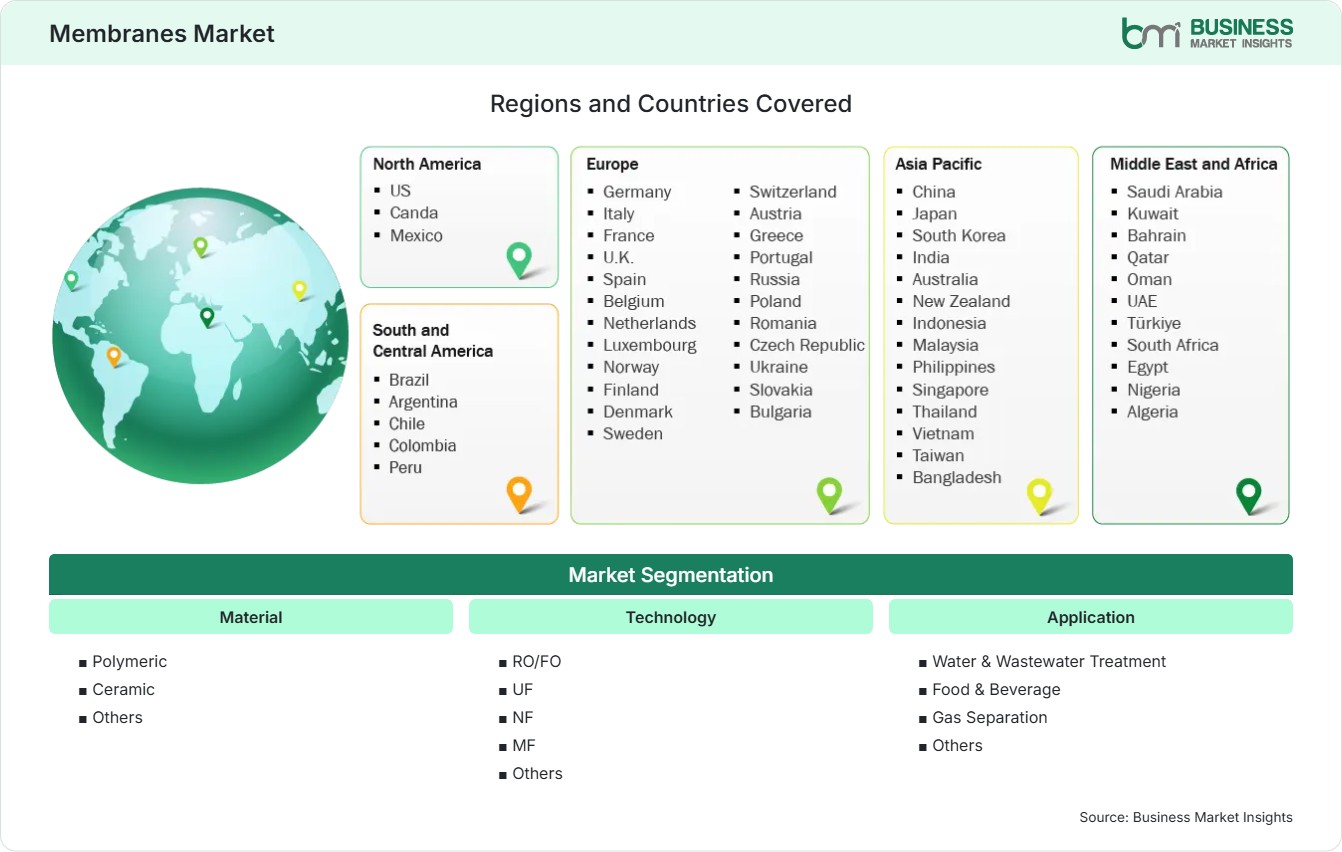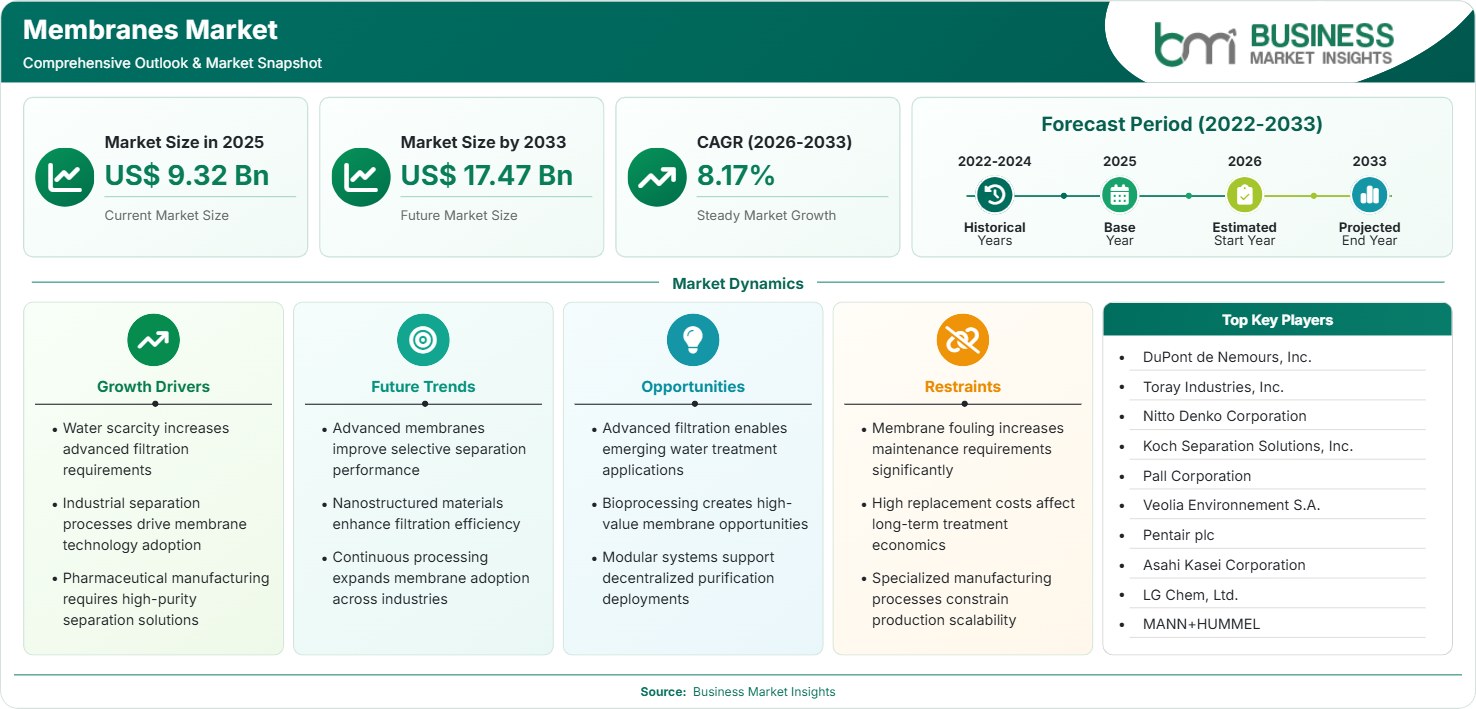
Membranes Market Regional Highlights
North America Membranes Market
North America Membranes Market accounts for a 24%–26% share in 2025 and records a 7.4%–8.0% CAGR through 2033. The United States represents the regional demand center, supported by wastewater reuse, PFAS treatment, desalination pilots, and industrial recycling. Canada contributes municipal and resource-sector requirements, while Mexico adds manufacturing-related demand. MANN+HUMMEL identifies continued water infrastructure investment and PFAS regulation as important regional factors. Regional buyers increasingly evaluate membranes through lifecycle energy, cleaning frequency, contaminant rejection, and compliance performance rather than initial equipment price.
- Municipal utilities are expanding advanced filtration to address aging infrastructure, emerging contaminants, water reuse requirements, and tighter treatment-performance expectations.
- Industrial facilities are increasing closed-loop water systems where freshwater availability, discharge costs, and production continuity justify membrane investment.
- Semiconductor and advanced manufacturing projects require increasingly sophisticated RO and UF trains for ultrapure-water production and wastewater recovery.
- Digital monitoring is becoming more relevant as operators seek predictive cleaning, membrane-life optimization, and reduced unplanned downtime.
US Membranes Market
The U.S. Membranes Market represents approximately 20%–22% of global demand and records a 7.5%–8.1% CAGR through 2033. Municipal modernization, industrial reuse, PFAS remediation, semiconductor expansion, and drought resilience support adoption. The Environmental Protection Agency’s PFAS regulatory activity is reinforcing treatment investment, although implementation timelines have evolved. Water utilities increasingly combine UF, RO, ion exchange, activated carbon, and monitoring technologies. Industrial users are also prioritizing recovery systems that reduce discharge volumes and strengthen operating resilience across high-water-consumption facilities.
- PFAS treatment is broadening technology evaluation toward membrane combinations capable of concentrating contaminants for downstream destruction or management.
- Semiconductor investments are increasing demand for high-purity RO membranes and integrated wastewater-recovery systems with stringent contaminant control.
- Drought-prone western states provide opportunities for municipal reuse, indirect potable reuse, industrial recycling, and decentralized treatment systems.
Europe Membranes Market
Europe Membranes Market holds a 19%–21% share in 2025 and grows at 7.1%–7.8% through 2033. Germany, France, the United Kingdom, Italy, and the Netherlands represent established demand centers, while Spain and Italy provide stronger desalination and water-reuse opportunities. EU circular-economy priorities, industrial discharge controls, energy efficiency, and water resilience support membrane adoption. High-value applications include food processing, pharmaceuticals, municipal reuse, bioprocessing, and gas separation. The region’s mature engineering base favors advanced membranes with measurable energy, chemical, and lifecycle advantages.
- Germany and the Netherlands emphasize industrial water efficiency, advanced wastewater treatment, and process-water recycling across established manufacturing clusters.
- Spain and Italy offer comparatively faster desalination and reuse opportunities because recurring water stress encourages infrastructure investment and technology adoption.
- France and the United Kingdom provide mature municipal and industrial markets where replacement cycles increasingly favor higher-efficiency membrane systems.
- European buyers increasingly consider environmental footprint, chemical consumption, durability, and end-of-life management when evaluating membrane technologies.
Asia Pacific Membranes Market
Asia Pacific Membranes Market takes a 41% – 43% market share in 2025 and grows at a CAGR of 8.5% – 9.2% until 2033. The region is led by China as the largest consumer region, while India, Japan, South Korea, Taiwan, and Southeast Asia dominate manufacturing, municipal, and semiconductor applications. Research and Markets pegs the number at 42.27% in 2025, validating the above numbers. China has large-scale manufacturing and wastewater treatment needs, while India’s growth in water infrastructure offers significant scope for RO, UF, NF, and membrane technologies.
- China benefits from industrial wastewater treatment, municipal modernization, desalination capacity, and a substantial domestic membrane manufacturing ecosystem.
- India combines urban water requirements, industrial discharge controls, desalination projects, and local manufacturing initiatives, supporting sustained technology adoption.
- Japan and South Korea emphasize high-purity separation, semiconductor water treatment, industrial reuse, and specialized membrane applications requiring stringent performance specifications.
- Southeast Asian manufacturing expansion is creating additional demand for compact wastewater treatment, process-water recycling, and industrial filtration systems.
Rest of World Membranes Market
The Rest of World Membranes Market holds a share of about 10%–14% in 2025 and is projected to expand at a CAGR of 7.8%–9.0% through 2033. South and Central America markets are driven by Brazil, Mexico, Chile, and Argentina, owing to mining, food processing, municipal wastewater treatment, and water shortages. There exists a very interesting case of desalination in Chile. The Middle East and Africa region is characterized by high demand from Saudi Arabia, the United Arab Emirates, Israel, Egypt, and South Africa for desalination, water reuse, and water security.
The structural importance of the Middle East lies in the need for RO membranes that can be reliably replaced during desalination projects. Decentralized treatment will become possible by leveraging Africa’s potential. Industrial wastewater needs of Latin America, along with the development of its infrastructure, represent another important region-specific characteristic.
- Saudi Arabia and the United Arab Emirates remain important desalination markets, with large-scale RO infrastructure creating long-duration membrane replacement demand.
- Chile and Brazil offer opportunities in mining, food processing, industrial reuse, and municipal treatment, particularly where freshwater constraints affect production economics.
- Israel continues to provide a technology-intensive desalination and water-reuse environment, supporting demand for high-performance separation systems.
- South Africa and Egypt offer municipal, industrial, and water-security opportunities where membrane systems can address constrained freshwater resources.