
Lipid Nanoparticles Market Outlook: Size, Share, Trends, Growth Analysis, Competitive Landscape & Forecast, 2026-2033

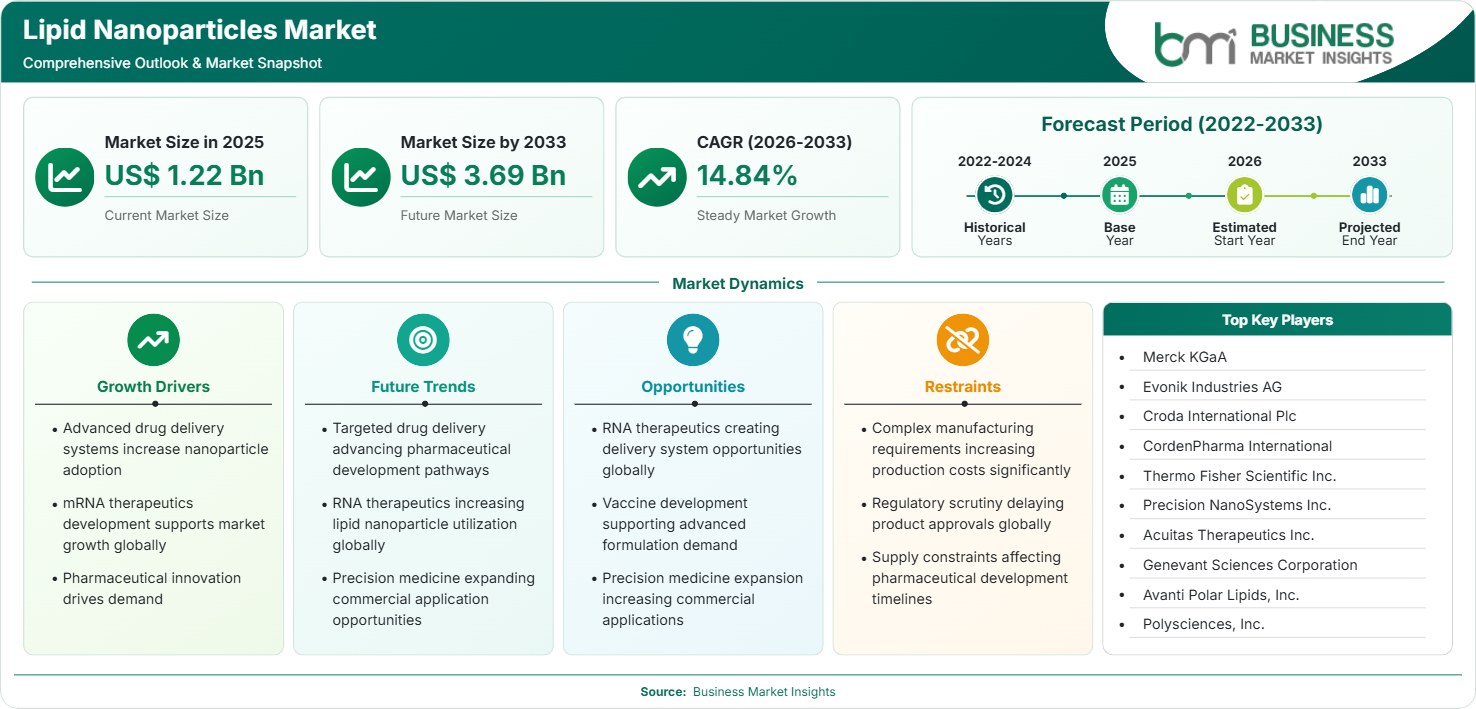
The Lipid Nanoparticles Market size was valued at US$ 1.22 Billion in 2025 and is projected to reach US$ 3.69 Billion by 2033, growing at a CAGR of 14.84% during 2026–2033, driven by mRNA therapeutics, advanced drug delivery, vaccine innovation, and targeted treatment development.

Report Coverage
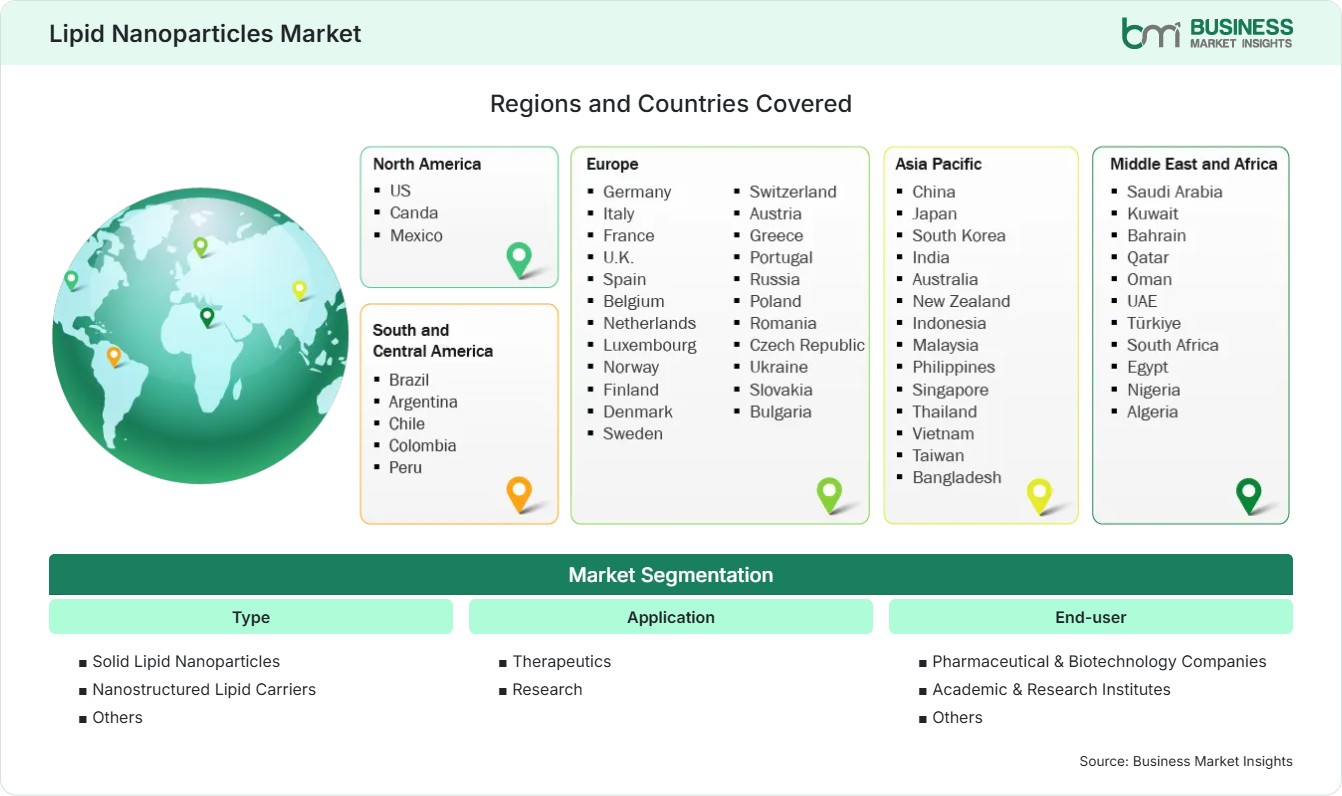
  • Type: Solid Lipid Nanoparticles , Nanostructured Lipid Carriers , Others
  • Application: Therapeutics, Research
  • End-user: Pharmaceutical & Biotechnology Companies, Academic & Research Institutes, Others
US$ 1.22 Bn Market size in 2025
US$ 3.69 Bn Market Size by 2033
14.84% CAGR, 2026 - 2033
2026-2033 Forecast Period

AI Overview

Lipid Nanoparticles Market Summary

  • North America Region: North America holds an estimated 38%–42% Lipid Nanoparticles Market share in 2025, with a projected CAGR of 13%–15% during 2026–2033, supported by biotechnology funding, advanced pharmaceutical manufacturing, mRNA research, and established clinical development infrastructure.
  • Fastest Growing Region: Asia Pacific accounts for an estimated 23%–27% share in 2025 and is projected to expand at a CAGR of 16%–19% during 2026–2033, supported by expanding biopharmaceutical manufacturing, government-backed biotechnology programs, clinical research investment, and growing demand for advanced drug delivery platforms.
  • Leading Segment: Therapeutics within the application category represents an estimated 65%–70% share in 2025, with a projected CAGR of 14%–16% during 2026–2033, reflecting clinical adoption of nucleic acid medicines, lipid-based delivery systems, and specialized formulations for complex therapeutic molecules.
  • High Growth Segment: Nanostructured Lipid Carriers (NLCs) within the type category hold an estimated 25%–30% share in 2025, with a projected CAGR of 16%–19% during 2026–2033, supported by formulation flexibility, improved drug-loading potential, and sustained-release development.
  • Key Market Opportunity: Investment in scalable lipid formulation, specialized contract development, and delivery systems for emerging RNA medicines creates opportunities for manufacturers to serve pharmaceutical developers seeking reproducible production and reliable clinical translation.
  • Major Market Players: Merck KGaA, Evonik Industries AG, Croda International Plc, CordenPharma International, Thermo Fisher Scientific Inc., Precision NanoSystems Inc., Acuitas Therapeutics Inc., Genevant Sciences Corporation, Avanti Polar Lipids, Inc., and Polysciences, Inc.
Strategic Insights

Lipid Nanoparticles Market: Strategic Insights

Lipid Nanoparticles Market Strategic Framework
FREE PDF
Request your free sample
Request free sample
Stakeholder View

Key Takeaways

  • Supply-chain integration will influence competitiveness. Access to specialized lipids, controlled raw-material specifications, formulation equipment, purification systems, and analytical testing determines whether developers can scale a promising laboratory formulation into a consistent clinical product. Buyers should assess the entire production chain rather than compare lipid prices alone.
  • Therapeutic delivery offers the strongest commercial pathway. Pharmaceutical and biotechnology companies can create demand through RNA medicines, vaccine candidates, gene-editing programs, and therapies requiring intracellular delivery. Suppliers should prioritize platforms that can support multiple payloads while retaining consistent performance across different formulations.
  • Formulation innovation is shifting toward precision. Developers are investigating ionizable lipid chemistry, tissue-selective delivery, particle uniformity, and release characteristics. Future differentiation will depend on demonstrating measurable improvements in delivery efficiency, tolerability, stability, and manufacturing reproducibility rather than relying on particle size alone.
  • Asia Pacific presents a capacity-building opportunity. China, South Korea, Japan, India, and Singapore offer different combinations of pharmaceutical production, research infrastructure, technical talent, and biotechnology investment. Regional entrants can strengthen their position by developing quality systems compatible with international clinical and commercial requirements.
  • Partnerships can accelerate market entry. Collaborations between lipid suppliers, technology developers, biotechnology companies, and contract manufacturers can reduce duplicated development work. Investors should evaluate intellectual property rights, manufacturing readiness, customer concentration, and the ability to transfer processes between facilities.
  • Quality assurance is a commercial differentiator. Consistent lipid composition, validated analytical methods, impurity control, and documented batch performance help reduce development uncertainty. Suppliers that demonstrate reliable quality across development stages can become embedded in customer programs, supporting longer commercial relationships.
Geographic Outlook

Lipid Nanoparticles Market Regional Highlights

North America Lipid Nanoparticles Market

North America is estimated to account for 38%–42% of global revenue in 2025, with a projected CAGR of 13%–15% during 2026–2033. The Lipid Nanoparticles Market benefits from established biotechnology clusters, specialist lipid suppliers, experienced contract manufacturers, and substantial investment in advanced therapeutics. The United States anchors commercial demand, while Canada is strengthening its manufacturing position. Regional competitiveness depends on translating research into regulated production, maintaining pharmaceutical quality standards, and supporting increasingly complex clinical pipelines through reliable supply partnerships and specialized formulation capabilities.

  • Established biotechnology companies and academic research centers support continuous demand for lipid formulation materials, analytical instruments, and delivery technologies across clinical development programs.
  • Specialist contract manufacturers can capture business from developers seeking GMP-compliant production, process optimization, and technology transfer without constructing dedicated facilities for every experimental formulation.
  • Oncology, rare diseases, infectious disease prevention, and genetic medicine programs broaden the potential application base, although commercial uptake remains dependent on clinical evidence and regulatory authorization.
  • Investment in Canadian manufacturing infrastructure can strengthen regional supply resilience, particularly where developers seek North American production capacity for complex lipids and injectable drug products.

US Lipid Nanoparticles Market

The United States Lipid Nanoparticles Market is anticipated to account for 70%-75% of North America’s market revenues in 2025, with a CAGR of 12%-14% from 2026 to 2033. The market's positioning is driven by a mature biotech environment, capabilities in clinical development, and connections among drug developers, lipid providers, and contract manufacturers. Market opportunities are driven by nucleic acid drugs and research on targeted delivery systems. The commercialization of the market will depend on clinical success, reimbursement, manufacturing costs, and the quality of production batches.

  • Biotechnology clusters in Massachusetts, California, and other established research centers support collaboration between drug developers, academic laboratories, and specialized formulation providers.
  • Federal research funding and private investment can support early-stage delivery technologies, but funding availability does not guarantee clinical validation or eventual commercial demand.
  • Domestic manufacturing expansion offers opportunities for suppliers of pharmaceutical-grade lipids, mixing systems, purification technologies, and quality-control services serving regulated production environments.

Europe Lipid Nanoparticles Market

Europe Lipid Nanoparticles Market share is projected to account for 25%-29% of the total Lipid Nanoparticles Market revenue by 2025, with a CAGR growth of 13%-15% from 2026 to 2033. This region consists of developed life sciences centers such as Germany, the UK, France, and Switzerland, among others, where contributions are made through pharmaceutical R&D, manufacturing, and chemical production. Germany is a key manufacturing and supply center, whereas the UK is a biotech research center. Growth in this region will be driven by clinical translation, cross-border collaboration, regulatory compliance, and investment in production technologies.

  • Germany is positioned to benefit from specialist chemical manufacturing, pharmaceutical engineering, and established supplier networks. Its projected country-level CAGR is modelled at 13%–15%, reflecting these industrial advantages.
  • The United Kingdom supports discovery research, translational medicine, and biotechnology entrepreneurship. Its projected CAGR of 14%–16% reflects opportunities to convert research programs into specialized delivery platforms.
  • France offers opportunities through pharmaceutical manufacturing, academic research, and partnerships between biotechnology developers and established industrial suppliers.
  • Switzerland benefits from a concentrated pharmaceutical ecosystem and advanced life sciences capabilities, supporting demand for high-quality ingredients and formulation services.

Asia Pacific Lipid Nanoparticles Market

Asia Pacific is predicted to account for around 23%–27% of total market share in 2025, with a CAGR of 16%–19% in 2026–2033. This region is characterized by an expansion in pharmaceutical manufacturing, biotechnology investment, research capabilities, and advanced drug delivery. Scientific and industrial expertise can be drawn from China and Japan, whereas South Korea is focusing on building its biopharmaceutical manufacturing ecosystem. India and Singapore have prospects for research collaboration, pharmaceutical services, and biotechnology initiatives. Lipid Nanoparticles Market growth will depend on quality harmonization, clinical progress, and investment in specialized production.

  • China benefits from pharmaceutical manufacturing capacity and domestic biotechnology investment. Its modelled CAGR of 17%–20% reflects opportunities in RNA research, formulation development, and specialized production services.
  • Japan offers an established pharmaceutical research environment and demand for advanced delivery systems. Its modelled CAGR of 14%–17% reflects clinical translation and the development of complex medicines.
  • South Korea combines biotechnology innovation with advanced biomanufacturing. Its modelled CAGR of 16%–19% reflects opportunities for integrated production, research collaboration, and technology development.
  • India provides opportunities through pharmaceutical services, research institutions, and manufacturing expertise. Its modelled CAGR of 17%–20% reflects potential investment in specialized formulation capabilities and regional supply networks.

Rest of World Lipid Nanoparticles Market

South and Central America Lipid Nanoparticles Market is developing opportunities through pharmaceutical partnerships, clinical research, and demand for advanced medicines. Brazil and Mexico offer relatively established pharmaceutical markets, although specialized lipid production and local technical capabilities remain uneven. The regional market benefits when international suppliers establish distribution relationships and provide technical support.

The Middle East and Africa offer opportunities for investment in health care, biotechnology development, and pharmaceutical production. The countries of the UAE, Saudi Arabia, and South Africa offer potential avenues of entry, but utilization will depend on specialized facilities, financing, regulatory frameworks, and supply capabilities.

  • Brazil is positioned to lead regional demand through its pharmaceutical sector and research institutions. Its modelled CAGR of 14%–17% reflects potential partnerships and broader access to advanced therapeutic technologies.
  • Mexico can benefit from pharmaceutical manufacturing and cross-border supply relationships. Its modelled CAGR of 13%–16% reflects opportunities for regional distribution and participation in international production networks.
  • Saudi Arabia offers investment potential through healthcare development and pharmaceutical localization initiatives. Its modelled CAGR of 15%–18% reflects the opportunity to establish specialist manufacturing and research partnerships.
  • The United Arab Emirates can serve as a regional commercial and logistics hub. Its modelled CAGR of 14%–17% reflects investment in healthcare innovation and access to international suppliers.
  • South Africa provides a base for pharmaceutical research and selected regional distribution activities. Its modelled CAGR of 12%–15% reflects gradual infrastructure development and growing technical collaboration.
Global Market Geography
FREE PDF
Request your free sample
Request free sample
Segment Analysis

Lipid Nanoparticles Market Segmentation

Type

The type segment comprises Solid Lipid Nanoparticles (SLNs), Nanostructured Lipid Carriers (NLCs), and Other Lipid Nanoparticles in the Lipid Nanoparticles market. Solid lipids benefit from established research techniques, while NLCs offer greater flexibility in drug loading and controlled release. The scope of the type segment covers formulation, characterization, and application-specific optimization. The uptake is based on payload compatibility, stability, reproducibility, and evidence of performance during delivery.

  • Solid Lipid Nanoparticles (SLNs): SLNs use solid lipid matrices to encapsulate active compounds and support controlled delivery. Research focuses on stability, biocompatibility, reproducible particle formation, and suitability for pharmaceutical formulations.
  • Nanostructured Lipid Carriers (NLCs): NLCs combine solid and liquid lipids to create less-ordered matrices that can accommodate different payloads. Formulation flexibility supports research into drug loading, stability, and release profiles.

Application

Application sectors are categorized into Therapeutics and Research. The need for therapeutic agents drives the development of formulations that protect molecules and facilitate cell entry. Research-based applications assist in formulation screening, biological studies, and preclinical testing. The Lipid Nanoparticles Market trends in these applications are influenced by the successful implementation of discoveries in the lab into manufacturing practices.

  • Therapeutics: Therapeutic applications include RNA medicines, vaccines, and other drug candidates requiring specialized delivery. Adoption depends on clinical evidence, formulation stability, target-cell delivery, safety, and scalable manufacturing.
  • Research: Research applications include laboratory experiments, preclinical studies, formulation screening, and delivery-mechanism investigations. Demand benefits from academic funding, biotechnology innovation, and access to specialized lipid materials.

End-user

The end-user categories include Pharmaceutical and Biotechnology Companies, Academic and Research Institutions, and Others. Pharmaceutical developers generate demand for raw materials driven by clinical and manufacturing needs, whereas research institutions help develop and validate formulations. Other end-users help in testing and formulating. The purchase decision is based on technical support, quality documentation, material availability, and formulation reproducibility.

  • Pharmaceutical & Biotechnology Companies: These organizations use lipid formulations in therapeutic research, clinical development, and commercial production. Demand depends on pipeline maturity, regulatory requirements, manufacturing capacity, and delivery performance.
  • Academic & Research Institutes: Universities and research organizations use lipid systems to investigate intracellular delivery, formulation chemistry, and emerging therapeutic applications. The availability of funding and access to specialist equipment influence adoption.
Market Forces

Lipid Nanoparticles Market Dynamics

Key Market Drivers

Expanding RNA Therapeutics and Advanced Medicine Pipelines

The delivery of RNA therapeutics necessitates solutions that offer protection and ensure intracellular delivery. This is provided by lipid nanoparticles formulated with ionizable lipids, structural lipids, cholesterol, and stabilizers. Clinical success with lipid-based RNA drugs has laid the groundwork for further investigation of such products, even though each payload must be evaluated for its applicability. Thus, the Lipid Nanoparticles Market growth depends on the pipeline of therapies, clinical success, and proof of delivery efficiency. Different areas, including oncology, rare diseases, genetic conditions, and infections, create specific development opportunities. Companies are improving lipid and formulation chemistry to enhance delivery and manage toxicity and immunogenicity.

Advances in Formulation Engineering and Process Control

Advances in mixing technology, purification steps, and analytical methods have helped build the technical foundation for reproducible nanoparticle manufacturing. Controlled mixing is known to affect particle size, encapsulation, and consistency, thereby making process engineering essential from a business perspective. Companies are increasingly considering microfluidic devices, scalable mixing tools, and tangential flow filtration to facilitate process development. Lipid Nanoparticles Market trends also indicate the need for analysis methods to determine particles' properties, purity, stability, and product performance. They enable developers to define reliable manufacturing specifications before clinical manufacture. Yet, equipment should be chosen based on formulation properties, manufacturing volumes, and quality criteria. Companies that combine formulation and engineering expertise may help their clients reduce process variability and transfer technology from development labs to manufacturing facilities.

Growing Demand for Specialized Pharmaceutical Manufacturing

Complicated drug formulations demand high-quality raw materials, well-proven production processes, and controlled facilities. Contract development and manufacturing service providers are ideal for biotechnology firms because they can provide these resources without requiring the firm to develop every specific process in-house. This situation is particularly applicable to small biotech organizations in which products require small clinical trials to establish their marketability. Outsourcing is influenced by factors such as expertise, facility availability, intellectual property protection, quality assurance, and supply chain. The ability to scale up processes while retaining product characteristics is required of the outsourcing service provider. The provision of integrated solutions, including lipid sourcing, drug formulation and purification, and sterilization, may simplify the outsourcing process.

Key Market Opportunities

Development of Tissue-Selective Delivery Platforms

Tissue-specific delivery is a means of increasing the effectiveness of nucleic acid therapies. Existing delivery formulations target specific organs; thus, there is a need to design formulations that target different organs. Research in this field seeks alternative ionizable lipids, surface properties, and formulation options to influence distribution and cellular entry. For any delivery technology to become commercially viable, it must demonstrate therapeutic efficacy without posing toxicity concerns. Pharmaceutical firms with well-stocked formulation libraries and screening technologies can partner with biotech companies to identify formulations for specific indications. The intellectual property and production methods will play important roles in valuation.

Expansion of Contract Development and Manufacturing Services

Specialized manufacturing services offer opportunities to support developers that lack in-house lipid formulation expertise. Customers may require small research batches, clinical-grade production, process optimization, or commercial manufacturing support. A provider that can manage multiple stages of development may minimize the effort required to transfer processes between suppliers. Investing in GMP capabilities, analysis tools, and personnel may make the service offering more robust. The Lipid Nanoparticles Market Forecasts will be influenced in part by the number of drug candidates in clinical trials and the resulting manufacturing capacity requirements. Providers must consider how well they are utilized, how concentrated their customer base is, and their risk of technology transfer before investing.

Broader Research Applications and Collaborative Development

Opportunities can arise for academics and biotech companies through collaborations involving the development of formulation chemistry, delivery technologies, and novel payloads. There will be research needs not only in product development but also in comparative testing, stability studies, and preclinical evaluation. Suppliers can contribute to the industry by providing standardized lipids, technical documents, formulation kits, and analysis services. Opportunities for collaboration in developing novel applications of known lipid technologies may arise, even though discoveries will need proper validation before commercialization. Models can involve research supply deals, joint development, and licenses of proprietary formulations. Potential investors need to assess whether the research collaboration yields valid intellectual property and development outcomes.

Market Restraints and Challenges

High Development Costs and Manufacturing Complexity

Factor: Specialized lipid manufacturing, formulation optimization, purification, analytical characterization, and cGMP manufacturing necessitate capital expenditures on appropriate equipment and skilled technical staff. Impact: High initial capital costs may act as barriers for smaller companies in the biotech sector. Batch-to-batch variability is an issue, as any alterations in the starting material, mixing, and purification will affect critical quality parameters. Manufacturers need to have a validated manufacturing process and appropriate specifications before entering regulated manufacturing. Scaling up the process may lead to unexpected behavior in the formulation that differs from that observed in laboratory experiments. Outsourcing may help reduce capital costs but poses technology-transfer risks.

Regulatory Uncertainty and Formulation-Specific Safety Risks

Factor: Different formulations contain different lipids with different compositions, physicochemical properties, biodistribution, breakdown, and interactions with biological systems. Impact: There may be a need for additional studies, longer development periods, or even a redesign of the formulation if there is insufficient data on its safety and efficacy. The regulatory analysis cannot be based on assumptions about the safety of all lipid-based formulations, given the presence of known lipids. There may be different characterization and evidence methods that would need to be developed, depending on the payload and delivery methods.

Company Analysis

Competitive Landscape

The Lipid Nanoparticles Market analysis covers suppliers of pharmaceutical-grade lipids, specialized delivery platforms, formulation technologies, and contract manufacturing services. Competitive differentiation depends on material quality, intellectual property, formulation expertise, production scale, and customer support across development stages. The following companies represent relevant participants across the value chain.

Company Name

Overview

Products and Services relevant to this market

Merck KGaA

A global science and technology company serving pharmaceutical, biotechnology, and research customers through life science products and services.

Lipids, laboratory materials, analytical tools, and formulation-related products supporting nanoparticle research and pharmaceutical development.

Evonik Industries AG

A specialty chemicals company with pharmaceutical development and manufacturing capabilities for advanced drug delivery systems.

Complex lipids, lipid nanoparticle formulation development, process optimization, and GMP manufacturing services for advanced medicines.

Croda International Plc

A specialty ingredients company supplying high-performance materials to pharmaceutical and life science customers.

Pharmaceutical excipients and lipid ingredients supporting formulation development, drug delivery, and specialized pharmaceutical applications.

CordenPharma International

A contract development and manufacturing organization serving pharmaceutical and biotechnology developers.

Lipid-based drug delivery development, lipid nanoparticle manufacturing, purification, and GMP production for advanced therapeutics.

Thermo Fisher Scientific Inc.

A life sciences company supplying research instruments, reagents, and pharmaceutical development services.

Laboratory reagents, analytical technologies, development services, and manufacturing support relevant to nanoparticle research and characterization.

Precision NanoSystems Inc.

A biotechnology technology provider specializing in lipid nanoparticle formulation and nucleic acid delivery research.

NanoAssemblr formulation systems, nanoparticle development tools, and process technologies supporting RNA delivery research and scale-up.

Acuitas Therapeutics Inc.

A biotechnology company specializing in lipid nanoparticle delivery technologies for nucleic acid medicines.

Proprietary lipid nanoparticle delivery platforms and formulation expertise supporting the development of RNA-based therapeutics.

Genevant Sciences Corporation

A biotechnology company developing nucleic acid medicines using proprietary delivery technologies.

Lipid nanoparticle delivery systems and intellectual property supporting RNA therapeutic development and targeted delivery research.

Avanti Polar Lipids, Inc.

A specialist lipid supplier serving pharmaceutical research, biotechnology, and academic laboratories.

High-purity lipids, lipid standards, and formulation materials for membrane research and nanoparticle development.

Polysciences, Inc.

A specialty chemicals and life sciences supplier serving research and industrial customers.

Research chemicals, specialty materials, and laboratory products supporting formulation studies and nanoparticle characterization workflows.

Trust & Transparency

Research Methodology

The market analysis combines proprietary research with secondary data from government agencies, company disclosures, regulatory filings, industry databases and expert interviews. Market estimates are validated through data triangulation, cross-market benchmarking and analyst review.

View Full Research Methodology

Questions Answered

Frequently Asked Questions

What should buyers evaluate before purchasing a Lipid Nanoparticles Market Report?

Buyers should assess whether the Market Report clearly defines its segmentation, geographic coverage, forecast assumptions, competitive landscape, and methodology. They should also verify that market estimates distinguish research materials, formulation technologies, and manufacturing services where relevant, and that the analysis addresses regulatory, technical, and commercialization risks.

Why are contract manufacturers important to this industry?

Contract manufacturers provide specialized formulation, purification, analytical testing, and GMP production capabilities. Their services help developers access technical expertise without building every manufacturing capability internally. They can also support technology transfer and production scale-up, although customers must assess quality systems, capacity availability, confidentiality, and continuity of supply.

Which factors influence the commercial adoption of lipid delivery technologies?

Clinical performance, safety, manufacturing scalability, regulatory requirements, and cost influence adoption. Developers also consider intellectual property rights, access to specialized lipids, supplier reliability, and compatibility with existing production infrastructure. Successful clinical outcomes can improve commercial prospects, but each formulation still requires appropriate product-specific evaluation.

How do manufacturers assess the quality of lipid nanoparticle formulations?

Manufacturers evaluate particle size distribution, encapsulation efficiency, lipid composition, impurities, stability, and payload integrity. Depending on the product, additional tests assess biological activity, sterility, and other critical quality attributes. Validated analytical methods and reproducible manufacturing processes are essential for consistent clinical and commercial production.

What distinguishes solid lipid nanoparticles from nanostructured lipid carriers?

Solid lipid nanoparticles use a solid lipid matrix, whereas nanostructured lipid carriers combine solid and liquid lipids. This compositional difference can influence drug loading, matrix organization, stability, and release behavior. The appropriate system depends on the active compound, formulation objectives, and evidence from development studies.

Access the Full Lipid Nanoparticles Market Report

Get segment-level forecasts, regional estimates, competitive benchmarking, company profiles and downloadable Excel datasets.

Access the full Lipid Nanoparticles Market Report
350 pages PDF & Excel | 2026-11-10
Similar Research

Related Market Reports