
Laminating Adhesives Market Outlook: Size, Share, Trends, Growth Analysis, Competitive Landscape & Forecast, 2026-2033

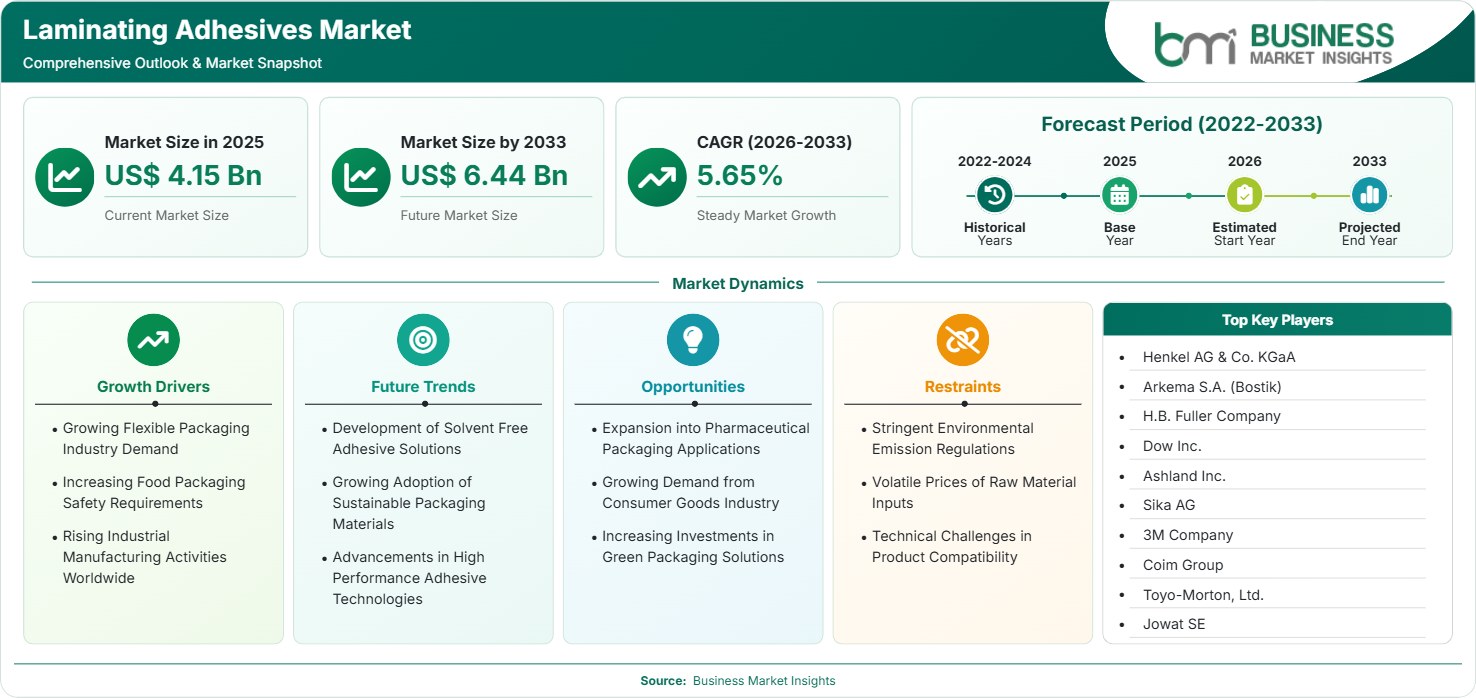
The Laminating Adhesives Market size was valued at US$ 4.15 Billion in 2025 and is projected to reach US$ 6.44 Billion by 2033, growing at a CAGR of 5.65% during 2026–2033, driven by flexible packaging expansion, sustainability initiatives, and rising demand for high-performance bonding solutions across food, pharmaceutical, industrial, and transportation applications.

Report Coverage
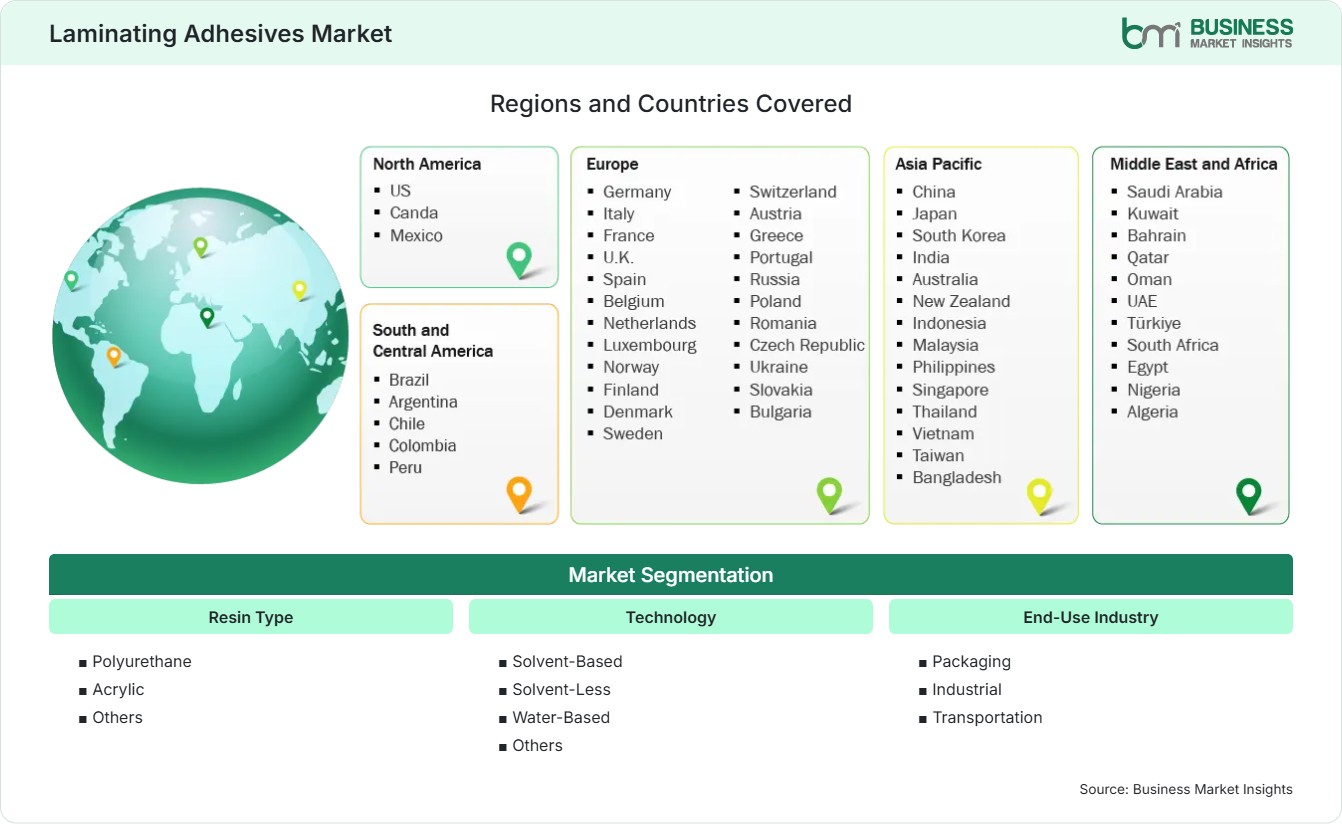
  • Resin Type: Polyurethane, Acrylic, Others
  • Technology: Solvent-Based, Solvent-Less, Water-Based, Others
  • End-Use Industry: Packaging, Industrial, Transportation
US$ 4.15 Bn Market size in 2025
US$ 6.44 Bn Market Size by 2033
5.65% CAGR, 2026 - 2033
2026-2033 Forecast Period

AI Overview

Laminating Adhesives Market Summary

  • North America Region: North America holds 30%–34% share in 2025, growing with a CAGR of 5.20%–5.80% during 2026–2033, supported by flexible packaging demand, advanced manufacturing, sustainable adhesive adoption, regulatory compliance, and pharmaceutical packaging growth. The US market is expanding through packaging modernization and industrial applications, achieving a CAGR of 5.40%–5.90% during 2026–2033.
  • Fastest Growing Region: Asia Pacific holds 32%–36% share in 2025, growing with a CAGR of 6.10%–6.80% during 2026–2033, driven by expanding packaging production, rising consumer goods manufacturing, urbanization, investments in food processing, and increasing adoption of environmentally responsible adhesive technologies across emerging economies.
  • Leading Segment: Polyurethane resin technology holds 45%–49% share in 2025, growing with a CAGR of 5.70%–6.30% during 2026–2033, supported by superior bonding strength, compatibility with diverse substrates, durability requirements, and increasing demand for flexible packaging and industrial applications.
  • High Growth Segment: Solvent-Less technology holds 25%–29% share in 2025, growing with a CAGR of 6.50%–7.20% during 2026–2033, driven by emission reduction priorities, operational efficiency, lower processing costs, sustainability targets, and increasing regulatory preference for low volatile organic compound adhesive solutions.
  • Key Market Opportunity: Growing investments in recyclable packaging structures, bio-based adhesive formulations, and advanced barrier films are creating opportunities for manufacturers to develop sustainable laminating solutions with enhanced performance and broader industrial adoption.
  • Major Market Players: Henkel AG & Co. KGaA, Arkema S.A. (Bostik), H.B. Fuller Company, Dow Inc., Ashland Inc., Sika AG, 3M Company, Coim Group, Toyo-Morton, Ltd., and Jowat SE.
Strategic Insights

Laminating Adhesives Market: Strategic Insights

Laminating Adhesives Market Strategic Framework
FREE PDF
Request your free sample
Request free sample
Stakeholder View

Key Takeaways

  • The value chain is becoming increasingly integrated as adhesive manufacturers collaborate with film producers, packaging converters, and end-use industries to improve compatibility, production efficiency, and sustainable packaging performance.
  • Growth potential is largest in the packaging segment due to the continuing trend of substituting rigid structures with flexible ones in the food, healthcare, and consumer goods markets.
  • Innovation priorities are shifting toward solvent-less systems, recyclable packaging-compatible adhesives, and formulations that maintain bonding performance under demanding temperature, moisture, and chemical exposure conditions.
  • Asia Pacific provides a compelling investment landscape due to expanding packaging manufacturing bases in China, India, Southeast Asia, and increasing domestic consumption of processed and packaged products.
  • Strategic partnerships, technology acquisitions, and capacity expansions among global adhesive manufacturers are strengthening competitive positioning while enabling companies to address sustainability requirements and regional customer needs.
Geographic Outlook

Laminating Adhesives Market Regional Highlights

North America Laminating Adhesives Market

North America accounted for 30%–34% share in 2025 and is projected to expand at a CAGR of 5.20%–5.80% during 2026–2033. The region benefits from mature packaging infrastructure, strong demand from food and healthcare sectors, and increasing adoption of sustainable adhesive technologies. The Laminating Adhesives Market share in North America is supported by advanced manufacturing capabilities, regulatory focus on safer materials, and investments in recyclable packaging solutions. The United States remains the dominant contributor, supported by large-scale flexible packaging production and technology adoption.

  • Flexible packaging manufacturers are increasing investments in advanced bonding solutions to improve barrier properties, durability, and recyclability across food, beverage, and pharmaceutical applications.
  • Sustainability regulations are encouraging adoption of water-based and solvent-less adhesive systems, helping converters reduce emissions while maintaining production efficiency and product quality.
  • Healthcare packaging demand continues expanding as pharmaceutical manufacturers require reliable multilayer structures with improved protection against moisture, contamination, and environmental exposure.
  • Leading adhesive producers are strengthening regional supply chains through product innovation, technical support networks, and localized manufacturing capabilities for packaging customers.

US Laminating Adhesives Market

The United States represented approximately 25%–28% share of the global Laminating Adhesives Market in 2025 and is expected to register a CAGR of 5.40%–5.90% during 2026–2033. Growth is supported by flexible packaging demand, food safety requirements, and increasing preference for recyclable packaging formats. The country maintains strong manufacturing capabilities with significant investments in advanced adhesive technologies. Packaging companies are adopting high-performance solutions to improve operational efficiency and meet evolving sustainability expectations across multiple end-use industries.

  • Food and beverage packaging remains a major demand contributor as producers seek durable laminates that maintain freshness, safety, and extended shelf life.
  • Pharmaceutical packaging applications are increasing due to strict quality standards requiring dependable adhesive performance under regulated production environments.
  • Domestic manufacturers are adopting low-emission adhesive technologies to comply with environmental requirements while improving production efficiency and reducing operational costs.
  • Research activities focused on recyclable packaging structures are encouraging collaboration between adhesive suppliers, converters, and material producers.

Europe Laminating Adhesives Market

Europe accounted for 24%–28% share in 2025 and is anticipated to grow at a CAGR of 4.90%–5.50% between 2026 and 2033. The region benefits from strict sustainability regulations, advanced packaging technologies, and strong demand for environmentally responsible materials. The Laminating Adhesives Market growth in Europe is influenced by circular economy initiatives and increasing adoption of recyclable packaging structures. Germany, France, Italy, and the United Kingdom represent important markets, with Germany maintaining leadership through industrial innovation and packaging expertise.

  • European packaging producers are prioritizing recyclable multilayer structures requiring adhesives compatible with emerging recycling technologies and material separation processes.
  • Germany continues driving adoption through advanced manufacturing capabilities, while Italy benefits from strong food packaging and consumer goods production.
  • Regulatory pressure to reduce volatile organic compound emissions is accelerating demand for solvent-less and water-based adhesive alternatives.
  • Pharmaceutical and healthcare packaging investments are creating opportunities for specialized adhesive formulations with enhanced protection and reliability.
  • Collaboration between adhesive manufacturers and packaging converters is supporting development of sustainable solutions aligned with European environmental objectives.

Asia Pacific Laminating Adhesives Market

Asia Pacific held 32%–36% share in 2025 and is projected to achieve a CAGR of 6.10%–6.80% during 2026–2033. The region represents the largest growth opportunity due to expanding packaging manufacturing, urbanization, and rising consumption of packaged goods. The Laminating Adhesives Market share across Asia Pacific is strengthened by increasing industrial production in China, India, Japan, and Southeast Asian economies. Manufacturers are expanding capacity to serve growing demand from food processing, consumer goods, and pharmaceutical sectors.

  • China remains a major production hub with strong flexible packaging demand and expanding investments in advanced adhesive manufacturing capabilities.
  • India is experiencing rapid adoption due to growth in packaged foods, pharmaceuticals, and consumer product manufacturing requiring efficient laminate technologies.
  • Southeast Asian countries are attracting investments from global packaging companies seeking cost-effective production bases and expanding domestic markets.
  • Sustainability initiatives are encouraging adoption of solvent-less and water-based adhesives across developing packaging industries.
  • Japan and South Korea continue supporting innovation through advanced materials research and high-quality manufacturing standards.

Rest of World Laminating Adhesives Market

Rest of World accounted for 8%–12% share in 2025 and is expected to expand at a CAGR of 4.70%–5.40% during 2026–2033. South and Central America are witnessing increasing demand from food packaging and consumer goods industries, while Middle East and Africa markets benefit from industrial diversification and expanding manufacturing activities. The Laminating Adhesives Market growth in these regions is supported by rising packaged food consumption, infrastructure investments, and improving production capabilities across developing economies.

  • Brazil and Mexico are emerging as important markets due to expanding food processing industries and increasing demand for flexible packaging formats.
  • Middle Eastern countries are investing in manufacturing diversification programs that support packaging production and industrial adhesive consumption.
  • African markets are gradually adopting modern packaging technologies as food distribution networks and consumer markets continue developing.
  • Regional suppliers are strengthening partnerships with international adhesive companies to improve product availability and technical capabilities.
  • Demand for sustainable packaging solutions is increasing as manufacturers respond to environmental awareness and evolving customer preferences.
Global Market Geography
FREE PDF
Request your free sample
Request free sample
Segment Analysis

Laminating Adhesives Market Segmentation

Resin Type

Resin Type represents a critical segmentation category, with polyurethane maintaining the leading position due to its superior bonding performance, flexibility, and compatibility with multiple substrates. The segment accounted for 45%–49% share in 2025 and is projected to expand at a CAGR of 5.70%–6.30% during 2026–2033. Rising demand for durable flexible packaging, industrial laminates, and high-performance bonding systems supports resin innovation. The Laminating Adhesives Market scope continues expanding as manufacturers develop advanced resin chemistries for recyclable and lightweight packaging structures.

  • Polyurethane: Polyurethane adhesives provide strong bonding strength, chemical resistance, and flexibility, making them suitable for food packaging, pharmaceutical laminates, and industrial applications requiring reliable multilayer structures.
  • Acrylic: Acrylic adhesives offer excellent transparency, weather resistance, and durability, supporting applications in specialty packaging, labels, and industrial laminates where long-term performance is essential.
  • Others: Other resin formulations serve niche applications requiring specific performance characteristics, including enhanced temperature resistance, specialized bonding properties, and compatibility with unique substrate combinations.

Technology

Technology segmentation highlights the transition toward sustainable adhesive application methods, with solvent-less solutions gaining momentum because of lower emissions and operational advantages. The segment accounted for 25%–29% share in 2025 and is expected to grow at a CAGR of 6.50%–7.20% during 2026–2033. The market trends indicate increasing adoption of advanced technologies that reduce environmental impact while maintaining high production efficiency. Manufacturers are investing in innovative systems to meet sustainability targets and evolving regulatory requirements.

  • Solvent-Based: Solvent-based adhesives remain widely used due to established processing capabilities, strong bonding performance, and suitability for demanding packaging applications requiring high durability.
  • Solvent-Less: Solvent-less adhesives are gaining adoption because they reduce emissions, improve workplace safety, and support sustainable packaging production through efficient application processes.
  • Water-Based: Water-based adhesives provide environmentally preferable solutions with lower volatile organic compound emissions, supporting packaging applications requiring regulatory compliance and safer manufacturing environments.
  • Others: Other technologies address specialized applications through customized formulations designed for unique production requirements, substrate combinations, and performance expectations across industries.

End-Use Industry

End-Use Industry segmentation reflects strong demand from packaging applications due to rising consumption of flexible formats across food, beverages, pharmaceuticals, and consumer products. Packaging accounted for 55%–59% share in 2025 and is projected to grow at a CAGR of 5.90%–6.40% during 2026–2033. The Laminating Adhesives Market trends demonstrate increasing adoption of lightweight packaging solutions, recyclable structures, and advanced barrier materials. Industrial and transportation sectors continue supporting demand through specialized bonding requirements.

  • Packaging: Packaging applications dominate demand due to increasing flexible packaging adoption, food safety requirements, and the need for durable multilayer structures with improved barrier protection.
  • Industrial: Industrial applications utilize laminating adhesives for durable assemblies, protective materials, and specialty products requiring resistance against environmental conditions and mechanical stress.
  • Transportation: Transportation applications require advanced adhesive solutions for lightweight components, interior materials, and composite structures supporting vehicle efficiency and manufacturing improvements.
Market Forces

Laminating Adhesives Market Dynamics

Key Market Drivers

Growing Flexible Packaging Industry Demand

Flexible packaging expansion remains a primary demand driver as food, beverage, pharmaceutical, and consumer goods companies increasingly replace rigid formats with lightweight multilayer structures. The global flexible packaging demand keeps growing owing to the need for convenience and reduction in material use. These factors are aiding the Laminating Adhesives Market growth as there is an increase in demand for adhesion technologies that can work well with films, foils, and barriers. The market trends show the focus on more recyclable designs, performance on the shelves, and efficient manufacturing processes.

Increasing Food Packaging Safety Requirements

Regulations concerning the safety of food packaging have compelled manufacturers to use adhesives that retain structural strength and ensure no risk of contamination through the entire lifecycle of the products. The regulatory authorities have been increasing the regulations regarding food packaging material, thus promoting the development of food packaging adhesives. With the rise in demand for high-quality bonding solutions due to the need for packaging systems having good barrier properties, durability, and thermal stability, the use of food packaging adhesives is gaining traction.

Rising Industrial Manufacturing Activities Worldwide

Industrial manufacturing growth across automotive, electronics, construction, and consumer goods sectors is creating additional demand for specialized laminating adhesive solutions. Higher production levels necessitate bonding materials that provide strength, flexibility, and resistance in difficult operational environments. Industrial companies have started utilizing modern bonding technology to increase durability of their products and simplify assembly process. The emphasis is now on designing customized formulations for particular substrates and performance needs, providing adhesive manufacturers with prospects to enhance their industrial product range besides packaging applications.

Key Market Opportunities

Expansion into Pharmaceutical Packaging Applications

Pharmaceutical packaging represents an important opportunity as healthcare manufacturers increase demand for secure, high-barrier, and contamination-resistant packaging structures. The growth in the production of pharmaceuticals, use of biologics, and regulations are driving investment in advanced packaging. The adhesive manufacturers are coming up with formulations that work well with medical films and barrier materials. The Laminating Adhesives Market Forecast predicts growth through collaborations between the adhesive manufacturers, pharmaceutical packaging firms, and material suppliers. The future growth will be driven by the need for packaging technologies that can provide protection to the sensitive products.

Growing Demand from Consumer Goods Industry

The consumer goods industry is creating opportunities through expanding demand for attractive, durable, and lightweight packaging formats. Personal care, household products, and premium consumer brands are adopting flexible packaging structures to improve convenience and reduce material consumption. The lamination adhesives help in bringing together several layers with improved aesthetics, protection, and functionality. With the growing need for increased brand differentiation, there is more emphasis placed on the development of packaging technology. The adhesive makers are concentrating on products that offer printable and sustainable films as well as perform well during transportation and storage.

Increasing Investments in Green Packaging Solutions

Sustainability initiatives are creating opportunities for adhesive manufacturers to develop environmentally responsible solutions compatible with recyclable and compostable packaging structures. Packaging companies around the world are adopting approaches to circular economy that demand adhesives that facilitate material recycling and low environmental footprint. Increasing demand for waterborne and solvent-free products that minimize the carbon footprint of manufacturing is anticipated. Packaging manufacturers have begun focusing on developing bio-based and high-performance adhesives that fulfill the goals of sustainability and environmental compliance. Partnerships within the packaging industry can help in accelerating the development of next-generation adhesive technology.

Market Restraints and Challenges

Stringent Environmental Emission Regulations

Factor: Increasing environmental regulations targeting volatile organic compound emissions are creating compliance challenges for manufacturers using conventional solvent-based adhesive systems. Impact: Companies face higher investment requirements for reformulation, production upgrades, and technology transitions toward low-emission alternatives. Adhesive manufacturers must balance performance requirements with sustainability objectives while maintaining competitive pricing.

Volatile Prices of Raw Material Inputs

Factor: Fluctuating prices of polyurethane chemicals, acrylic components, and other petrochemical-based raw materials create uncertainty for adhesive producers. Impact: Rising input costs can reduce profit margins, increase product pricing pressure, and complicate long-term supply planning for manufacturers and packaging converters. However, maintaining consistent quality while controlling production expenses remains a continuing challenge, particularly for manufacturers serving highly competitive packaging markets with demanding performance requirements.

Company Analysis

Competitive Landscape

The Laminating Adhesives Market analysis highlights a competitive environment shaped by global chemical manufacturers, specialty adhesive suppliers, and technology-focused companies. Leading participants are investing in sustainable formulations, production capacity expansion, and application-specific solutions to strengthen their market position.

Company Name

Overview

Products and Services relevant to this market

Henkel AG & Co. KGaA

Global chemical and adhesive technology leader serving packaging, consumer goods, and industrial sectors with advanced bonding solutions.

Provides polyurethane, solvent-less, water-based, and reactive laminating adhesives for flexible packaging and industrial applications.

Arkema S.A. (Bostik)

Specialty materials company offering adhesive technologies for packaging, construction, and industrial markets worldwide.

Supplies advanced laminating adhesive solutions including polyurethane systems and sustainable bonding technologies.

H.B. Fuller Company

Global adhesives manufacturer focused on high-performance solutions across packaging, hygiene, transportation, and industrial applications.

Offers flexible packaging adhesives, solvent-free systems, and customized bonding solutions for converters.

Dow Inc.

Materials science company developing polymer technologies and adhesive solutions for multiple packaging applications.

Provides laminating adhesive technologies including polyurethane-based solutions for flexible packaging structures.

Ashland Inc.

Specialty chemicals provider delivering performance materials and adhesive technologies for diverse industrial applications.

Manufactures adhesive components and solutions supporting packaging, coating, and specialty laminate requirements.

Sika AG

Global specialty chemical company supplying adhesives, sealants, and construction-related bonding technologies.

Provides industrial adhesive solutions and specialized bonding materials for transportation and manufacturing applications.

3M Company

Diversified technology company offering adhesive products across industrial, electronics, transportation, and consumer sectors.

Supplies specialty adhesive technologies supporting industrial laminating, bonding, and composite applications.

Coim Group

Italian chemical manufacturer specializing in polyurethane systems, polymers, and specialty chemical products.

Produces polyurethane raw materials and adhesive technologies for flexible packaging applications.

Toyo-Morton, Ltd.

Japanese adhesive manufacturer specializing in packaging laminating technologies and high-performance bonding materials.

Provides solvent-based, solvent-less, and water-based laminating adhesives for packaging converters.

Jowat SE

German adhesive producer serving packaging, woodworking, automotive, and industrial manufacturing markets.

Offers reactive, water-based, and specialty adhesive solutions for industrial laminating applications.

Trust & Transparency

Research Methodology

The market analysis combines proprietary research with secondary data from government agencies, company disclosures, regulatory filings, industry databases and expert interviews. Market estimates are validated through data triangulation, cross-market benchmarking and analyst review.

View Full Research Methodology

Questions Answered

Frequently Asked Questions

How are manufacturers addressing raw material volatility challenges?

Manufacturers are improving supply chain resilience through supplier diversification, inventory optimization, alternative raw materials research, and development of formulations that reduce dependence on fluctuating petrochemical inputs.

What role does the Laminating Adhesives Market Report provide for industry decision-makers?

The report helps stakeholders evaluate technology shifts, competitive positioning, regional opportunities, segmentation trends, and investment priorities influencing future adhesive industry strategies.

Which industries are creating new demand opportunities for advanced laminating adhesives?

Food packaging, pharmaceuticals, consumer goods, transportation, and industrial manufacturing are creating new opportunities. These sectors require durable multilayer structures that provide protection, improved functionality, and enhanced product presentation.

How are recyclable packaging trends affecting adhesive formulation strategies?

Recyclable packaging initiatives are encouraging adhesive manufacturers to develop formulations compatible with mono-material films and circular economy processes.

What factors are influencing adoption of solvent-less laminating adhesive technologies?

Solvent-less technologies are gaining adoption because they reduce volatile organic compound emissions, lower energy consumption, and support sustainability objectives.

Access the Full Laminating Adhesives Market Report

Get segment-level forecasts, regional estimates, competitive benchmarking, company profiles and downloadable Excel datasets.

Access the full Laminating Adhesives Market Report
350 pages PDF & Excel | 2026-08-25
Similar Research

Related Market Reports