Market Summary
Executive Summary and Global Market Analysis
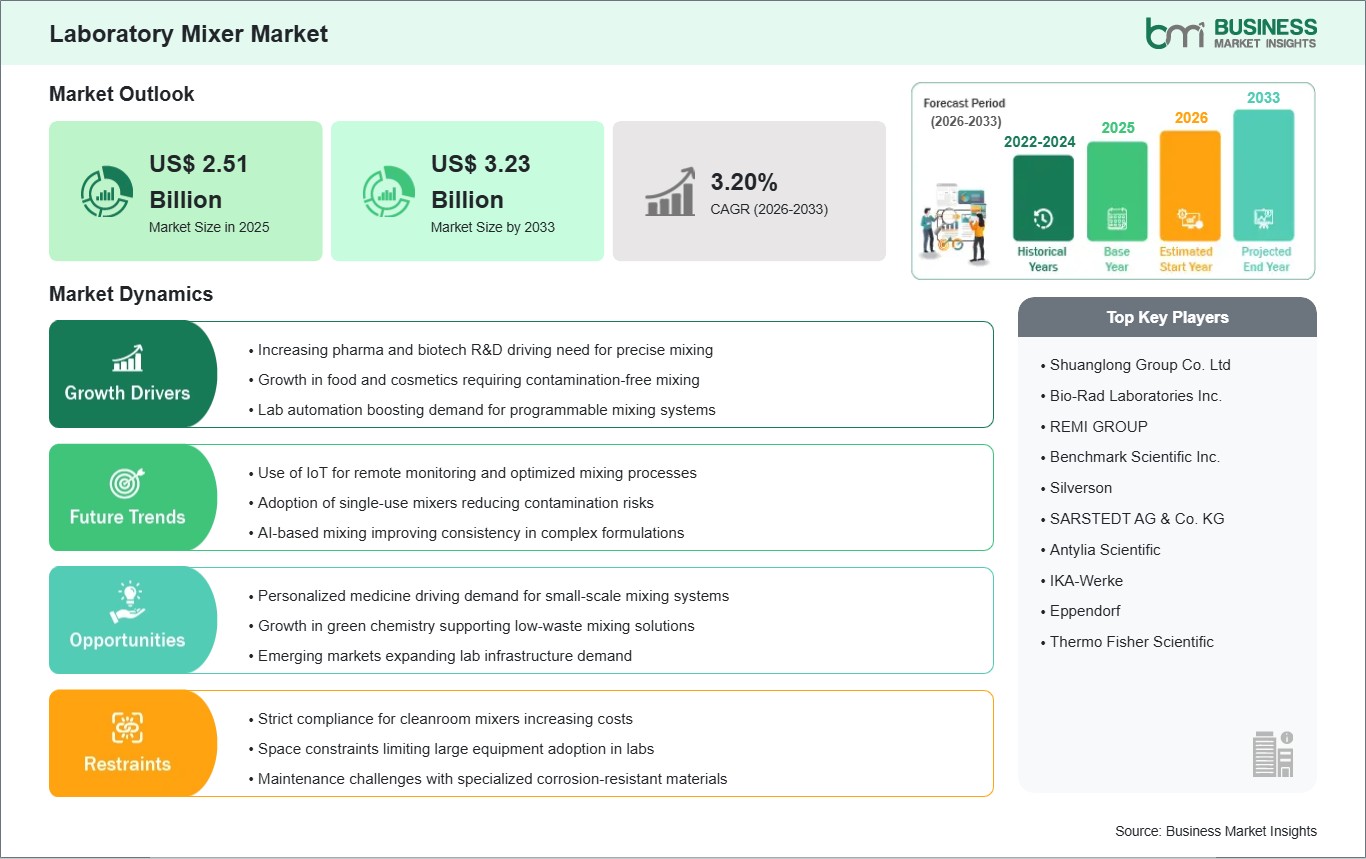
Laboratory mixers are specialized instruments used to combine, emulsify, or homogenize substances into a uniform state. They provide significant value by ensuring reproducibility and sample consistency in pharmaceutical research, clinical diagnostics, and chemical engineering. Market growth is driven by increased pharmaceutical R&D spending, the rapid adoption of automated laboratory workflows, and rising demand for high-throughput drug screening. Additionally, the adoption of digitally connected and IoT-enabled mixers, which support remote monitoring and data logging, is enhancing laboratory productivity and compliance with quality standards.
However, several challenges may limit market growth. High initial costs for advanced systems can be prohibitive for smaller research facilities and university labs. The durability of traditional mixers results in slower replacement cycles, delaying the adoption of new technologies. Complex maintenance and calibration requirements for high-precision homogenizers often require specialized support, increasing long-term operational costs.
Despite these challenges, the market offers significant opportunities due to the growing focus on personalized medicine and biologics, as well as the adoption of single-use and contamination-free mixing technologies. The development of compact designs for modular labs and mixers with integrated AI-driven viscosity sensors is also expected to support long-term market growth.
Segment Analysis
Laboratory Mixer Market Segmentation
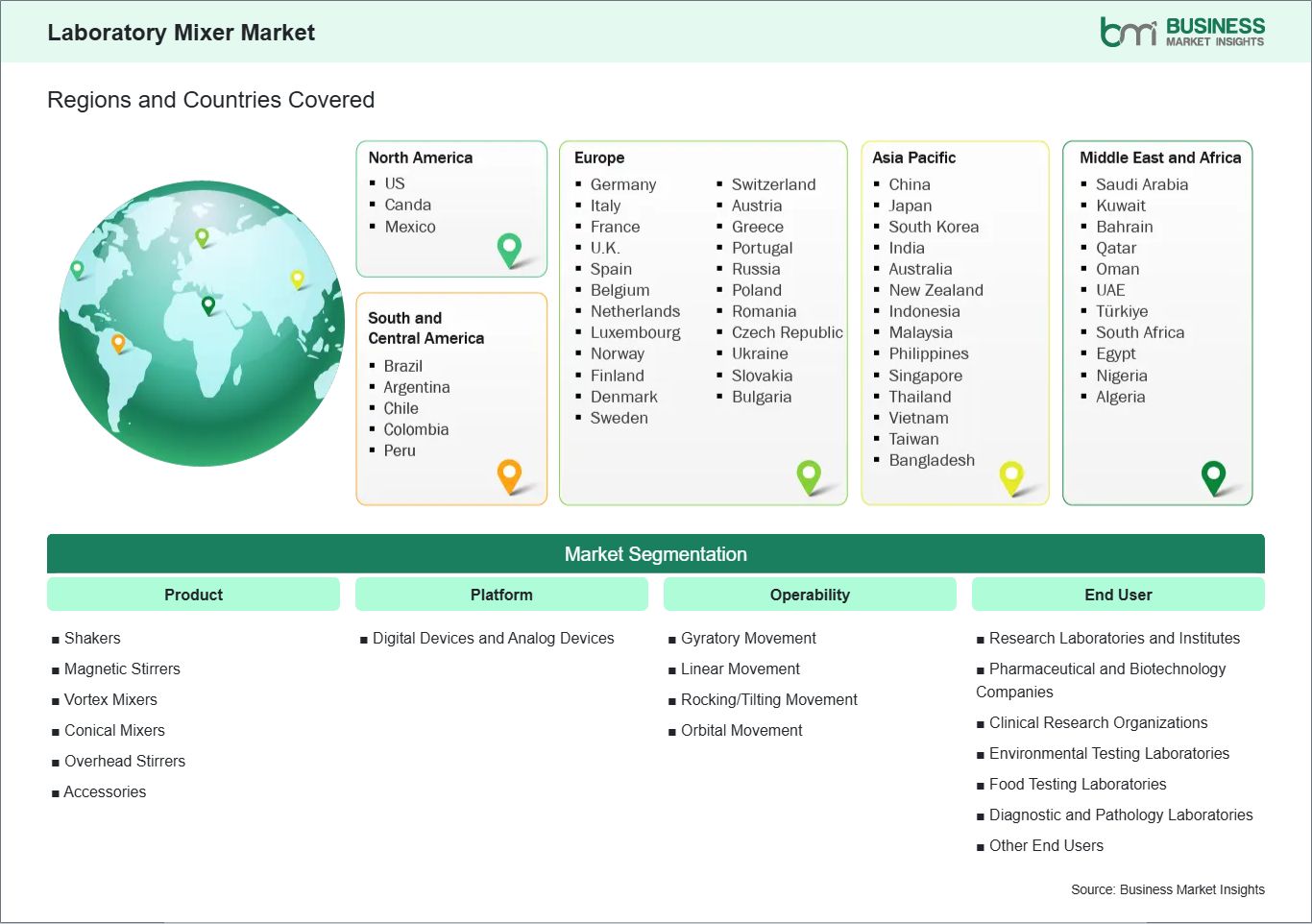
Key segments that contributed to the derivation of the Laboratory Mixer market analysis are product, platform, operability, and end user.
- By Product, the market is segmented into Shakers, Magnetic Stirrers, Vortex Mixers, Conical Mixers, Overhead Stirrers, and Accessories.
- By Platform, the market is divided into Digital Devices and Analog Devices.
- By Operability, the market is categorized into Gyratory Movement, Linear Movement, Rocking/Tilting Movement, and Orbital Movement.
- By End User, the market is segmented into Research Laboratories and Institutes, Pharmaceutical and Biotechnology Companies, Clinical Research Organizations, Environmental Testing Laboratories, Food Testing Laboratories, Diagnostic and Pathology Laboratories, and Other End Users.
Market Forces
Laboratory Mixer Market Drivers and Opportunities
Advancing R&D Expenditure and the Surge in Multi-Functional Automation
A key driver of the Laboratory Mixer Market is the global increase in Research and Development (R&D) spending, particularly within the life sciences sector. The demand for advanced mixing solutions remains strong to support complex drug discovery and vaccine development. Additionally, the rise of laboratory automation and digitization has led to the adoption of mixers equipped with programmable controls, data logging, and Laboratory Information Management System (LIMS) integration. These features reduce human error and help laboratories meet increasingly stringent regulatory standards for data integrity. In the biotechnology sector, the growing prevalence of life-threatening diseases further accelerates demand, as high-throughput screening and parallel processing require mixers capable of handling hundreds of samples simultaneously with consistent performance.
Furthermore, the shift toward high-precision mixing for personalized medicine has increased demand for advanced magnetic stirrers and vortex mixers that can process delicate biological molecules without degradation. Collectively, surging R&D budgets, workflow automation, and the precision requirements of modern genomics are driving rapid growth in laboratory mixing technologies.
Single-Use Bioprocessing and AI-Native Predictive Mixing
The convergence of laboratory mixers with Single-Use Technology (SUT) represents a significant high-value opportunity. As biopharmaceutical companies increasingly adopt disposable manufacturing to eliminate cleaning validation and reduce cross-contamination risks, manufacturers are presented with a substantial growth frontier in developing high-performance, single-use mixing bags and disposable impeller systems that can scale from laboratory to commercial production. Additionally, the development of AI-native and IoT-enabled smart mixers offers another major growth area. These systems leverage real-time sensor data to autonomously adjust mixing speeds in response to changes in fluid viscosity or protein formation, thereby functioning as a cognitive assistant within laboratory environments.
The expansion of lab-on-a-chip and microfluidic systems creates a lucrative opportunity for the development of specialized, miniaturized mixing components suitable for integration into portable diagnostic platforms. In addition to hardware innovation, the emergence of sustainability-driven circular economy models is generating significant market potential. As laboratories face increasing pressure to achieve Scope 3 emissions targets, demand is rising for energy-efficient mixers with extended lifecycles or those available through refurbished, as-a-service procurement models. Manufacturers investing in interchangeable multi-shaft designs and pioneering quantum sensing for molecular-level viscosity tracking are well-positioned to lead the most innovative and high-margin segments of the global laboratory mixer market.
Size and Share Analysis
Laboratory Mixer Market Size and Share Analysis
The Laboratory Mixer market demonstrates steady growth, with size and share analysis revealing evolving trends and competitive positioning among key players. The report further examines subsegments categorized within product, platform, operability, and end user, offering insights into their contribution to overall market performance.
Based on product, the Shakers and Magnetic Stirrers subsegment holds a significant market share, serving as the industry benchmark for versatile sample preparation. Shakers, particularly Orbital and Incubated varieties, are indispensable for the Biotechnology sector, where they provide the gentle, consistent agitation necessary for cell culture and protein expression. A notable trend is the surge in the Magnetic Stirrers and Vortex Mixers subsegments, which are registering higher interest in Diagnostic and Pathology Laboratories. These devices are becoming essential for high-volume liquid-liquid extractions and reagent mixing, where their lack of external moving parts reduces maintenance downtime and ensures a sterile, easy-to-clean environment.
Report Coverage
Laboratory Mixer Market Report Coverage and Deliverables
The "Laboratory Mixer Market Size and Forecast (2022–2033)" report provides a detailed analysis of the market covering below areas:
- Laboratory Mixer market size and forecast at global, regional, and country levels for all the key market segments covered under the scope
- Laboratory Mixer market trends, as well as market dynamics such as drivers, restraints, and key opportunities
- Laboratory Mixer market analysis covering key market trends, global and regional framework, major players, regulations, and recent market developments
- Industry landscape and competition analysis covering market concentration, heat map analysis, prominent players, and recent developments for the Laboratory Mixer market
- Detailed company profiles, including SWOT analysis
Geographic Insights
Laboratory Mixer Market Geographic Insights
The geographical scope of the Laboratory Mixer market report is divided into five regions: North America, Asia Pacific, Europe, Middle East & Africa, and South & Central America.
The Asia-Pacific Laboratory Mixer Market includes China, Japan, South Korea, India, Australia, and the Rest of Asia Pacific. China leads the region, moving from basic lab equipment to high-precision, IoT-enabled digital mixers to support its expanding drug development sector. In India, demand is rising due to the Biotech Pride guidelines and rapid growth in vaccine manufacturing. Japan and South Korea are prioritizing advanced micro-mixers and specialized magnetic stirrers for electronic and semiconductor materials research. Growth is driven by the shift to automated, programmable mixing platforms with data-logging for audit trails. Increased use of magnetic stirrers and shakers with digital speed control, along with greater integration of laboratory mixers into Laboratory Information Management Systems (LIMS), positions Asia-Pacific as a key center for innovation and future industry expansion.
Industry Activity
Recent Developments
The Laboratory Mixer market is evaluated by gathering qualitative and quantitative data post primary and secondary research, which includes important corporate publications, association data, and databases. A few of the key developments in the Laboratory Mixer market are:
- In April 2025, Lancaster Products launched the K2 High Shear Mixer, a 68-litre precision mixing solution designed for small-batch processing and prototyping. Featuring advanced counter-current mixing, optional sensors, and automation, the K2 enhances efficiency, process control, and batch consistency, strengthening the laboratory mixer landscape.
- In August 2024, ATS Corporation announced the acquisition of Heidolph Group, a leading manufacturer of laboratory equipment, including mixers and automation solutions. This acquisition strengthens ATS`s life sciences portfolio and expands its laboratory solutions, positively impacting the laboratory mixer market.
Trust & Transparency
Research Methodology
The market analysis combines proprietary research with secondary data from government agencies, company disclosures, regulatory filings, industry databases and expert interviews. Market estimates are validated through data triangulation, cross-market benchmarking and analyst
review.
View Full Research Methodology
Key Sources Referred:
World Bank – Global Trade IndicatorsWorld Trade Organization (WTO)(International Monetary Fund )IMFInternational Trade Administration (ITA)Company websiteCompany annual reportsCompany investor presentations