Hygroscopic Building Material Market Outlook (2022-2033)

Historic Data: 2022-2024   |   Base Year: 2025   |   Forecast Period: 2026-2033
Report Content: Market Scope, Market Segmentation, Market Dynamics, and Competitive Analysis

Report Coverage:
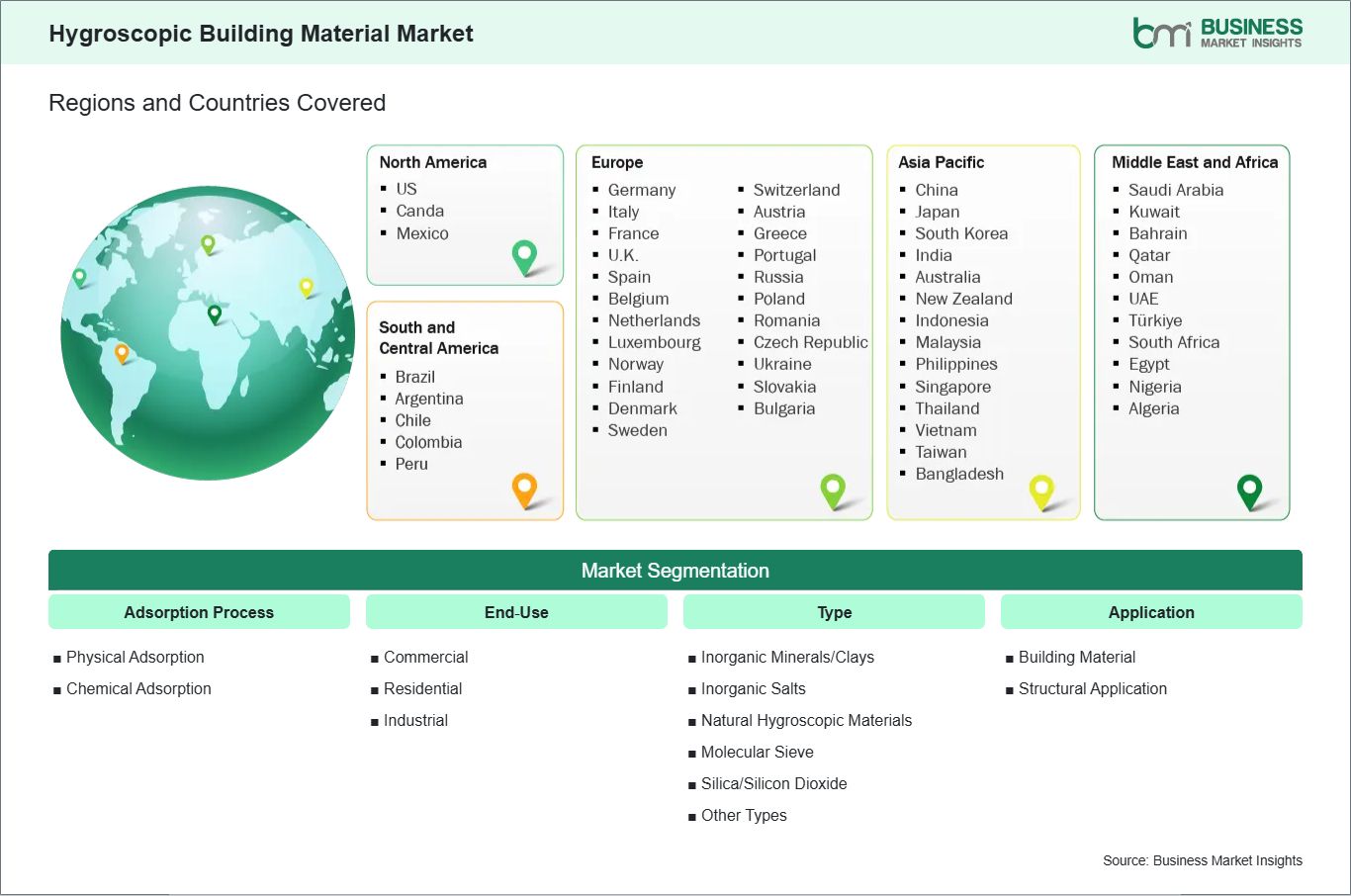
  • Adsorption Process (Physical Adsorption, Chemical Adsorption)
  • End-Use (Commercial, Residential, Industrial)
  • Type (Inorganic Minerals/Clays, Inorganic Salts, Natural Hygroscopic Materials, Molecular Sieve, Silica/Silicon Dioxide, Other Types)
  • Application (Building Material, Structural Application)

No. of Pages: 411
Report Code: BMIPUB00033981
Category: Chemicals and Materials
Hygroscopic Building Material Market

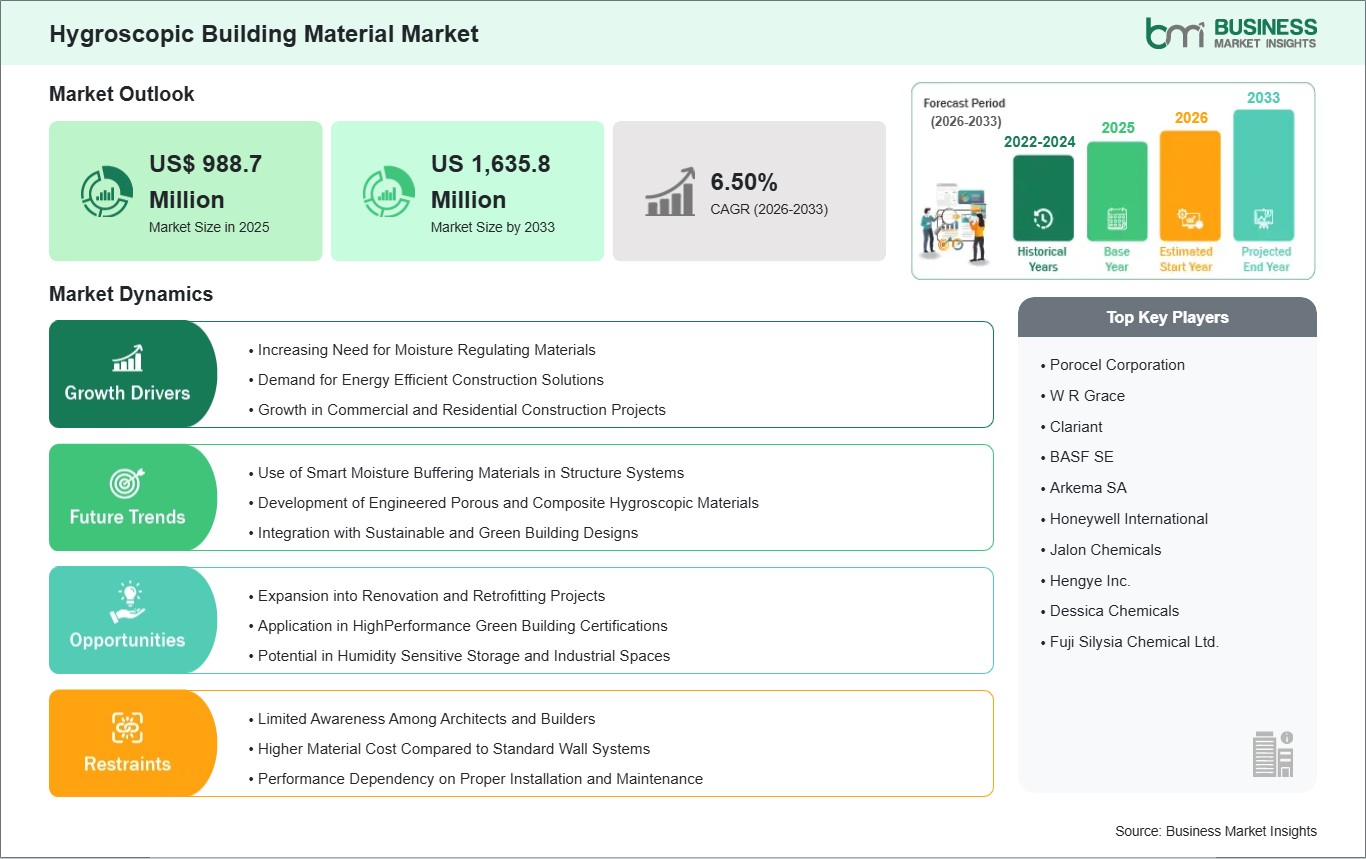
The Hygroscopic Building Material Market size is expected to reach US$ 1,635.8 Million by 2033 from US$ 988.7 Million in 2025. The market is estimated to record a CAGR of 6.50% from 2026 to 2033.

Executive Summary and Global Market Analysis:

The global hygroscopic building materials market revolves around the development of high-end building materials that can naturally absorb and release moisture, thereby creating a healthier indoor environment and increasing the level of energy efficiency within buildings. Hygroscopic materials, including wood-based materials, mineral plasters, clay-based materials, and special wall coatings, play a crucial role in regulating the level of humidity within a building, thereby reducing the need for artificial ventilation within the building. The hygroscopic materials play a crucial role in building structures, including residential and commercial buildings, by reducing the risks of mold formation while at the same time ensuring a healthy and sustainable building practice.

The market is driven by rising awareness of healthy indoor environments and sustainability initiatives that prioritize energy-efficient construction methods. In this context, builders, architects, and individuals are opting for hygroscopic materials to build buildings that respond to environmental changes and minimize dependence on HVAC systems. Moreover, the development and advancement of green building codes and ratings have further emphasized the requirement for building materials to actively contribute to indoor air quality and comfort. However, certain limitations, such as cost, lack of awareness among various segments of the construction industry, and the requirement for specialized construction practices, may impede the development and utilization of these materials. Nevertheless, ongoing research and development in material science and construction techniques are further increasing the scope for hygroscopic building materials to meet the needs of modern construction and environmental requirements.

Hygroscopic Building Material Market - Strategic Insights:

global-market-strategic-framework
Get more information on this report

Hygroscopic Building Material Market Segmentation Analysis:

Key segments that contributed to the derivation of the hygroscopic building material market analysis are adsorption process, end‑use, type, and application.

  • By adsorption process, the hygroscopic building material market is segmented into Physical Adsorption and Chemical Adsorption. The Physical Adsorption subsegment dominated the market in 2025.
  • Based on end‑use, the hygroscopic building material market is classified into Commercial, Residential, and Industrial. The Commercial subsegment dominated the market in 2025.
  • In terms of type, the hygroscopic building material market is categorized into Inorganic Minerals/Clays, Inorganic Salts, Natural Hygroscopic Materials, Molecular Sieve, Silica/Silicon Dioxide, and Other Types. The Inorganic Minerals/Clays subsegment dominated the market in 2025.
  • On the basis of application, the hygroscopic building material market is divided into Building Material and Structural Application. The Building Material subsegment dominated the market in 2025.

Hygroscopic Building Material Market Drivers and Opportunities:

Increasing Need for Moisture Regulating Materials

The global hygroscopic building materials market is witnessing increased demand as the world becomes more aware of the importance of moisture control in the era of advanced building design, which seeks to create a healthier interior while at the same time reducing energy consumption. The use of hygroscopic materials, which can control the moisture level in the surrounding air, helps to create a healthy interior by controlling the level of moisture, thereby preventing the formation of condensation, mold, and structural damage. The use of hygroscopic materials improves the quality of interior air, which in turn improves the health and productivity of occupants of residential, commercial, and institutional buildings across the globe.

In addition to this, sustainable construction is also being promoted through improved indoor air quality. Another advantage is related to sustainable construction, wherein hygroscopic materials help to enhance energy efficiency. By effectively managing humidity levels, buildings can be designed to have reduced requirements for heating, ventilation, and air conditioning systems. Consequently, this helps to reduce energy costs and requirements. Gypsum boards, clay plasters, and wood composite materials are being used to line walls, ceilings, and floors to effectively manage humidity levels. Across the world, sustainable construction is being promoted through various energy-efficient and green building ratings for buildings.

Moreover, the usage of hygroscopic materials depends on climate conditions and changes in building regulations. In some regions, the humidity level is very high. In addition, seasonal changes in temperature and humidity can be quite significant. In such cases, it is essential to control moisture to ensure the longevity of the building. Hygroscopic materials can be used for this purpose. In recent times, the construction industry has gained much importance globally. It is now focused on providing more comfort and sustainability to buildings. In this scenario, hygroscopic materials have become essential for building construction.

Expansion into Renovation and Retrofitting Projects

Hygroscopic building materials are also gaining traction in renovation and retrofitting projects, as older structures are upgraded to meet modern standards for comfort, energy efficiency, and indoor air quality. Retrofitting often involves the improvement of thermal insulation and moisture control systems, and hygroscopic materials offer an effective, minimally invasive solution. They can be incorporated into wall panels, plaster coatings, and ceiling linings without requiring extensive structural modifications, enabling buildings to maintain stable indoor humidity and prevent damage from condensation or dampness during the renovation process.

The use of hygroscopic materials in retrofitting extends beyond moisture control to address overall building performance. These materials contribute to improved thermal comfort and energy efficiency, complementing modern insulation technologies and ventilation systems. For heritage or older buildings, which may have limitations on mechanical upgrades or façade modifications, hygroscopic solutions offer a passive approach to humidity regulation that preserves the structure while enhancing livability. Globally, this has encouraged architects, contractors, and building owners to incorporate hygroscopic materials into refurbishment strategies for both residential and commercial buildings.

Moreover, the growing emphasis on sustainability and lifecycle performance in construction has amplified the role of hygroscopic materials in renovation projects. By improving durability and indoor air quality, these materials reduce maintenance needs and extend the lifespan of building components, providing long-term economic and environmental benefits. As urban areas continue to modernize aging infrastructure, hygroscopic building materials are becoming integral to global retrofitting practices, enabling buildings to meet contemporary standards for health, comfort, and energy efficiency without extensive reconstruction.

Hygroscopic Building Material Market Size and Share Analysis:

The hygroscopic building material market is experiencing steady growth, with market size and share analysis reflecting evolving treatment preferences and competitive dynamics among key players. The report evaluates important subsegments categorized within adsorption process, end‑use, type, and application, highlighting their respective contributions to overall market performance.

By adsorption process, the Physical Adsorption subsegment dominated the Hygroscopic Building Material market in 2025. Physical adsorption materials offer efficient moisture regulation, durability, and cost-effectiveness, driving their widespread adoption in construction applications.

Based on end-use, the Commercial subsegment dominated the Hygroscopic Building Material market in 2025. Commercial buildings demand effective humidity control and indoor air quality solutions, reinforcing strong market adoption of hygroscopic materials.

In terms of type, the Inorganic Minerals/Clays subsegment dominated the Hygroscopic Building Material market in 2025. Inorganic minerals and clays provide excellent moisture absorption, thermal stability, and environmental compatibility, supporting their preference in building applications.

On the basis of application, the Building Material subsegment dominated the Hygroscopic Building Material market in 2025. Building material applications require reliable moisture management and structural performance, driving the widespread use of these materials in construction projects.

Hygroscopic Building Material Market Report Highlights:

Report Attribute Details
Market size in 2025 US$ 988.7 Million
Market Size by 2033 US 1,635.8 Million
Global CAGR (2026 - 2033)6.50%
Historical Data 2022-2024
Forecast period 2026-2033
Segments Covered By Adsorption Process
  • Physical Adsorption
  • Chemical Adsorption
By End-Use
  • Commercial
  • Residential
  • Industrial
By Type
  • Inorganic Minerals/Clays
  • Inorganic Salts
  • Natural Hygroscopic Materials
  • Molecular Sieve
  • Silica/Silicon Dioxide
  • Other Types
By Application
  • Building Material
  • Structural Application
Regions and Countries Covered
North America US, Canada, Mexico
Europe Belgium, Austria, Finland, Denmark, Greece, Poland, Romania, Russia, Ukraine, Czech Republic, Slovakia, Bulgaria, Italy, Luxembourg, Germany, Switzerland, France, Netherlands, Norway, Portugal, Spain, Sweden, United Kingdom
Asia-Pacific Australia, China, India, Japan, South Korea, Indonesia, Malaysia, Philippines, Singapore, Thailand, Vietnam, Bangladesh, New Zealand, Taiwan
South and Central America Brazil, Argentina, Peru, Chile, Colombia
Middle East and Africa Bahrain, Kuwait, Oman, Qatar, Saudi Arabia, United Arab Emirates, Turkiye, South Africa, Egypt, Algeria, Nigeria
Market leaders and key company profiles
  • Porocel Corporation
  • W R Grace
  • Clariant
  • BASF SE
  • Arkema SA
  • Honeywell International
  • Jalon Chemicals
  • Hengye Inc.
  • Dessica Chemicals
  • Fuji Silysia Chemical Ltd.
Get more information on this report

Hygroscopic Building Material Market Report Coverage and Deliverables:

The "Hygroscopic Building Material Market Size and Forecast (2022 - 2033)" report provides a detailed analysis of the market covering below areas:

  • Hygroscopic Building Material market size and forecast at global, regional, and country levels for all the key market segments covered under the scope
  • Hygroscopic Building Material market trends, as well as drivers, restraints, and opportunities
  • Hygroscopic Building Material market analysis covering key trends, regional framework, major players, regulations, and recent developments
  • Industry landscape and competition analysis covering market concentration, heat map analysis, prominent players, and recent developments for the Hygroscopic Building Material market
  • Detailed company profiles, including SWOT analysis

Hygroscopic Building Material Market Geographic Insights:

The geographical scope of the Hygroscopic Building Material market report is divided into five regions: North America, Asia Pacific, Europe, Middle East & Africa, and South & Central America. The Hygroscopic Building Material market in North America is expected to grow during the forecast period.

North America dominates the market for hygroscopic building materials due to its highly developed construction sector and strict building codes, along with increasing interest in sustainable and energy-efficient buildings. Residential and commercial buildings in North America feature hygroscopic building materials in walls, ceilings, and insulation systems to maintain a constant indoor air quality and minimize energy losses. Architects and builders are using hygroscopic building materials in highly efficient buildings, green offices, and sustainable residential buildings, where buildings respond to natural climates and manage moisture levels.

The use of hygroscopic building materials is prominent in retrofit buildings, where maintaining indoor environmental conditions without extensive mechanical upgrades is a priority. The dominance of North America is further emphasized by its research and development capabilities, which allow for the formulation of sophisticated materials that can integrate the properties of hygroscopicity, structural integrity, and aesthetic appeal. Companies are working hard to develop materials that can be more readily installed, are more durable, and can be integrated into existing construction practices. Sustainability is also a key driver in the formulation of materials that can reduce energy consumption, minimize VOC emissions, and utilize renewable and/or recyclable materials.

Despite the drawbacks of the higher cost and more demanding application conditions, North America’s focus on energy conservation, health-conscious architecture, and innovative construction techniques will ensure that it will continue to lead in the global market for hygroscopic building materials.

global-market-geography
Get more information on this report

Hygroscopic Building Material Market Research Report Guidance:

  • The report includes qualitative and quantitative data in the Hygroscopic Building Material market across adsorption process, end‑use, type, application, and geography.
  • The report starts with the key takeaways (chapter 2), highlighting the key trends and outlook of the Hygroscopic Building Material market.
  • Chapter 3 focuses on the research methodology of the study.
  • Chapter 4 includes ecosystem analysis.
  • Chapter 5 highlights the major industry dynamics in the Hygroscopic Building Material market, including factors that are driving the market, prevailing deterrents, potential opportunities, as well as future trends. Impact analysis of these drivers and restraints is also covered in this section.
  • Chapter 6 discusses the Hygroscopic Building Material market scenario, in terms of historical market revenues, and forecast till the year 2033.
  • Chapters 7 to 11 cover the Hygroscopic Building Material market segments by adsorption process, end‑use, type, application, and geography across North America, Europe, Asia Pacific, Middle East and Africa, and South and Central America. They cover the market volume, revenue forecast, and factors driving the market.
  • Chapter 12 describes the competitive analysis with the heat map analysis for the key players operating in the market.
  • Chapter 13 describes the industry landscape analysis. It provides detailed descriptions of business activities such as market initiatives, new developments, mergers, and joint ventures globally, along with a competitive landscape.
  • Chapter 14 provides detailed profiles of the major companies operating in the Hygroscopic Building Material market. Companies have been profiled on the basis of their key facts, business descriptions, products, financial overview, SWOT analysis, and key developments.
  • Chapter 15, i.e., the appendix, is inclusive of a brief overview of the company, list of abbreviations, and disclaimer.

Hygroscopic Building Material Market News and Key Development:

The hygroscopic building material market is evaluated by gathering qualitative and quantitative data post primary and secondary research, which includes important corporate publications, association data, and databases. A few of the key developments in the hygroscopic building material market are:

  • In May 2024, Saint‑Gobain announced that it entered into a strategic partnership with TimberHP to offer high‑performance wood fiber insulation products across North America, with CertainTeed (a Saint‑Gobain subsidiary) as the exclusive distributor in Canada, expanding sustainable insulation offerings that regulate moisture and improve indoor comfort.
  • In February 2024, Saint‑Gobain announced that it completed the acquisition of the business assets of International Cellulose Corporation (ICC), a manufacturer of plant‑based spray insulation and sustainable finishing products, strengthening its portfolio of moisture‑regulating and energy‑efficient building materials for commercial construction applications.

Key Sources Referred:

  • World Bank
  • World Health Organization (WHO)
  • S. Occupational Safety and Health Administration (OSHA)
  • European Commission - Construction & Built Environment
  • International Trade Centre (ITC)
  • Engineering News-Record (ENR)
  • Building Design + Construction (BD+C)
  • Company Websites
  • Company Annual Reports
  • Company Investor Presentations
The List of Companies - Hygroscopic Building Material Market
  • Porocel Corporation
  • W R Grace
  • Clariant
  • BASF SE
  • Arkema SA
  • Honeywell International
  • Jalon Chemicals
  • Hengye Inc.
  • Dessica Chemicals
  • Fuji Silysia Chemical Ltd.
Frequently Asked Questions
How big is the Hygroscopic Building Material Market?

The Hygroscopic Building Material Market is valued at US$ 988.7 Million in 2025, it is projected to reach US 1,635.8 Million by 2033.

What is the CAGR for Hygroscopic Building Material Market by (2026 - 2033)?

As per our report Hygroscopic Building Material Market, the market size is valued at US$ 988.7 Million in 2025, projecting it to reach US 1,635.8 Million by 2033. This translates to a CAGR of approximately 6.50% during the forecast period.

What segments are covered in this report?

The Hygroscopic Building Material Market report typically cover these key segments-

  • Adsorption Process (Physical Adsorption, Chemical Adsorption)
  • End-Use (Commercial, Residential, Industrial)
  • Type (Inorganic Minerals/Clays, Inorganic Salts, Natural Hygroscopic Materials, Molecular Sieve, Silica/Silicon Dioxide, Other Types)
  • Application (Building Material, Structural Application)

What is the historic period, base year, and forecast period taken for Hygroscopic Building Material Market?

The historic period, base year, and forecast period can vary slightly depending on the specific market research report. However, for the Hygroscopic Building Material Market report:

  • Historic Period : 2022-2024
  • Base Year : 2025
  • Forecast Period : 2026-2033
  • Who are the major players in Hygroscopic Building Material Market?

    The Hygroscopic Building Material Market is populated by several key players, each contributing to its growth and innovation. Some of the major players include:

  • Porocel Corporation
  • W R Grace
  • Clariant
  • BASF SE
  • Arkema SA
  • Honeywell International
  • Jalon Chemicals
  • Hengye Inc.
  • Dessica Chemicals
  • Fuji Silysia Chemical Ltd.
  • Who should buy this report?

    The Hygroscopic Building Material Market report is valuable for diverse stakeholders, including:

    • Investors: Provides insights for investment decisions pertaining to market growth, companies, or industry insights. Helps assess market attractiveness and potential returns.
    • Industry Players: Offers competitive intelligence, market sizing, and trend analysis to inform strategic planning, product development, and sales strategies.
    • Suppliers and Manufacturers: Helps understand market demand for components, materials, and services related to concerned industry.
    • Researchers and Consultants: Provides data and analysis for academic research, consulting projects, and market studies.
    • Financial Institutions: Helps assess risks and opportunities associated with financing or investing in the concerned market.

    Essentially, anyone involved in or considering involvement in the Hygroscopic Building Material Market value chain can benefit from the information contained in a comprehensive market report.

    Available Report Formats

    pdf-format excel-format pptx-format
    Buy Now
    Sales Assistance
    +1 646 791 7070 (US & UK)
    Customization Form

    Please tell us your area of interest
    (Market Segments/ Regions and Countries/ Companies)